
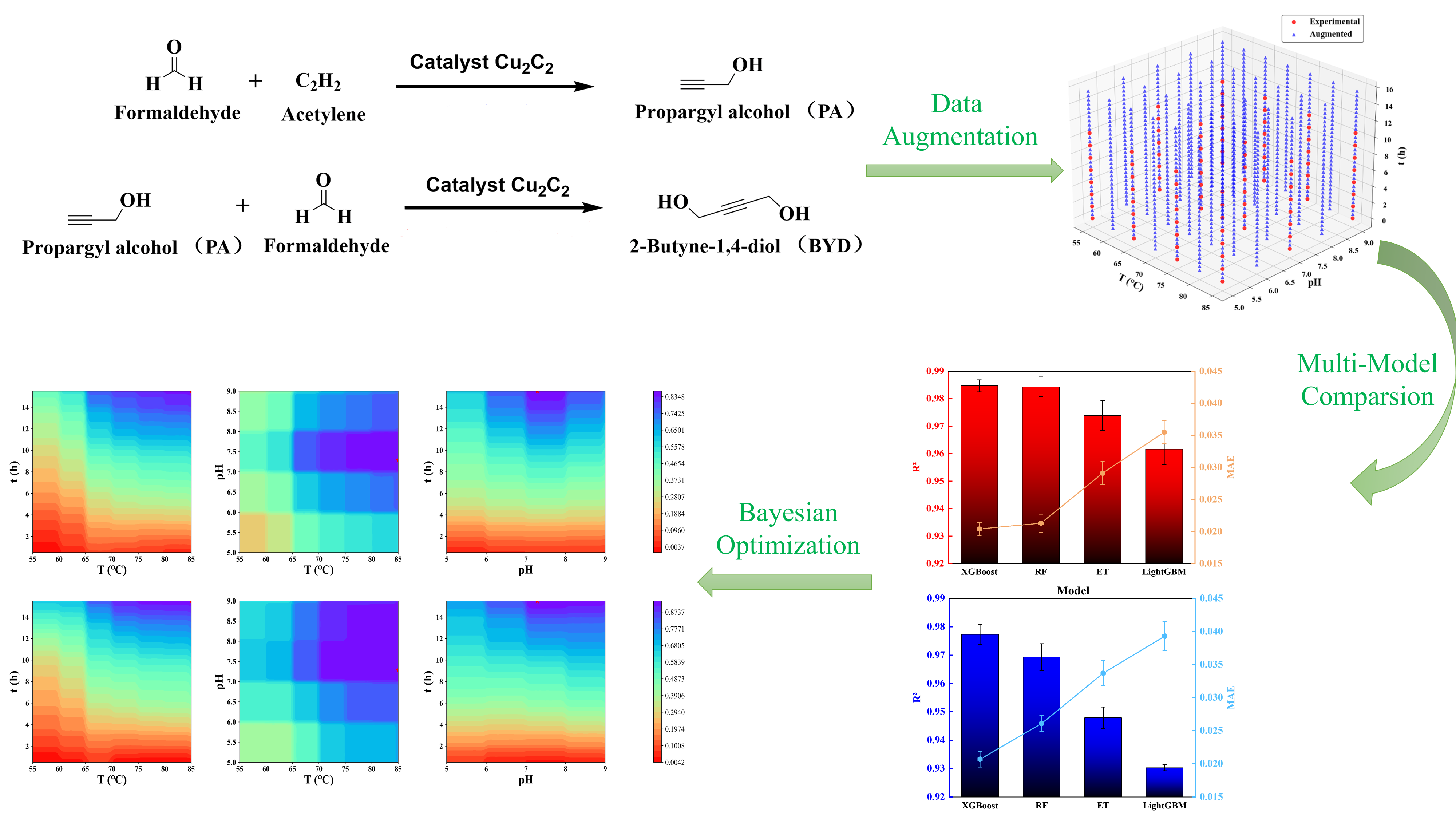
1,4-Butynediol (BYD), an essential intermediate for fine chemicals and polymer production, is primarily synthesized via formaldehyde-acetylene reaction. Kinetic experiments were conducted in a quasi-industrial slurry bed reactor under the conditions of 55–85 °C, 0–10.5 h, and pH 5–9 to obtain the time-resolved yield of 1,4-butynediol and the conversion of formaldehyde. The experimental results revealed that pH was a critical influencing factor on reaction performance, while it can not be directly coupled into mechanistic kinetic models. Therefore, four machine learning models, i.e., random forest (RF), extremely randomized trees (Extra Trees, ET), light gradient boosting machine (LightGBM) and extreme gradient boosting (XGBoost) were employed to establish data-driven models that can directly capture the pH influence. The 84 experimental data points were augmented to 1023 samples by interpolation and extrapolation method, then the dataset was split into training, validation, and testing subsets in a 6:2:2 ratio. The training results demonstrated that the XGBoost model exhibited the best generalization ability and stability, achieving the highest average coefficient of determination (R2) for formaldehyde conversion (0.9847 ± 0.0022) and 1,4-butynediol yield (0.9773 ± 0.0035), and the mean absolute error for both targets was less than 0.027. Finally, the XGBoost model was coupled with Bayesian optimization to search the optimal process parameters.
- Open Access
- Article
Data-Driven Modeling and Bayesian Optimization for the Formaldehyde-Acetylene Reaction in a Slurry Bed Reactor
- Xiao-Qi Liu 1,
- Zuo-Qian Jihou 1,
- Hui-Long Wei 1,*,
- Zheng-Hong Luo 1,2,*
Author Information
Received: 29 Aug 2025 | Revised: 13 Nov 2025 | Accepted: 01 Dec 2025 | Published: 05 Dec 2025
Abstract
Graphical Abstract
Keywords
1,4-butynediol | machine learning | small-sample data | kinetic modeling | multi-objective optimization
References
- 1.
Trotuş, I.; Zimmermann, T.; Schüth, F. Catalytic Reactions of Acetylene: A Feedstock for the Chemical Industry Revisited. Chem. Rev. 2014, 114, 1761–1782.
- 2.
Chen, X.; Zhang, M.; Yang, K.; et al. Raney Ni–Si Catalysts for Selective Hydrogenation of Highly Concentrated 2-Butyne-1,4-diol to 2-Butene-1,4-diol. Catal. Lett. 2014, 144, 1118–1126.
- 3.
Zawadzki, B.; Abid, R.; Fernandez-Ropero, A.J.; et al. Effect of Iron Oxidation State on the Catalytic Performance of Fe/C in Liquid Phase Flow Hydrogenation of 2-Butyne-1,4-diol. Fuel 2025, 380, 133170.
- 4.
D'Amboise, M.; Mathieu, D.; Piron, D.L. A Chemical Study of 2-Butyne-1,4-diol. Talanta 1988, 35, 763–768.
- 5.
Hosseini, M.G.; Arshadi, M.R. Study of 2-Butyne-1,4-diol as Acid Corrosion Inhibitor for Mild Steel with Electrochemical, Infrared and AFM Techniques. Int. J. Electrochem. Sci. 2009, 4, 1339–1350.
- 6.
Yang, W.; Peng, W.; Li, H.; et al. Catalytic Ethynylation of Formaldehyde for Selective Propargyl Alcohol Production Using the Copper Metal Organic Framework HKUST-1. New J. Chem. 2024, 48, 9082–9089.
- 7.
Tanielyan, S.K.; More, S.R.; Augustine, R.L.; et al. Continuous Liquid-Phase Hydrogenation of 1,4-Butynediol to High-Purity 1,4-Butanediol over Particulate Raney Nickel Catalyst in a Fixed Bed Reactor. Org. Process Res. Dev. 2017, 21, 327–335.
- 8.
Yang, G.; Yang, L.; Chen, J. Effective Performance of the Cu/Zn/SiO2 Catalyst Applied in the Ethynylation of Formaldehyde for 1,4-Butynediol Synthesis. Ind. Eng. Chem. Res. 2023, 62, 21067–21077.
- 9.
Wang, C.; Hai, X.; Bai, J.; et al. Elucidating the Atomic Stacking Structure of Nickel Phyllosilicate Catalysts and Their Consequences on Efficient Hydrogenation of 1,4-Butynediol to 1,4-Butanediol. Chem. Eng. J. 2024, 488, 150723.
- 10.
Wang, Z.; Ban, L.; Meng, P.; et al. Ethynylation of Formaldehyde over CuO/SiO2 Catalysts Modified by Mg Species: Effects of the Existential States of Mg Species. Nanomaterials 2019, 9, 1137.
- 11.
Franz, A.W.; Kircher, M. Options for CO2-Neutral Production of Bulk Chemicals. J. Bus. Chem. 2021, 18, 63–78.
- 12.
Yang, G.; Yu, Y.; Tahir, M.U.; et al. Promotion Effect of Bi Species in Cu/Bi/MCM-41 Catalysts for 1,4-Butynediol Synthesis by Ethynylation of Formaldehyde, Reaction Kinetics. React. Kinet. Mech. Catal. 2019, 127, 425–436.
- 13.
Wang, D.; Li, Y.; Yang, Y.; et al. Process Reconfiguration for the Production of 1, 4-Butanediol Integrating Coal with Off-Grid Renewable Electricity. Int. J. Hydrogen Energy 2025, 102, 1295–1305.
- 14.
Yang, G.; Gao, F.; Yang, L. The Importance of Copper-Phyllosilicate Formed in CuO/SiO2 Catalysts in the Ethynylation of Formaldehyde for 1,4-Butynediol Synthesis. React. Chem. Eng. 2023, 8, 881–890.
- 15.
Zhao, F.; Ikushima, Y.; Arai, M. Hydrogenation of 2-Butyne-1,4-diol in Supercritical Carbon Dioxide Promoted by Stainless Steel Reactor Wall. Catal. Today 2004, 93, 439–443.
- 16.
Yeston, J.; Coontz, R. Chemistry Writ Large. Science 2009, 325, 691.
- 17.
Li, L.; Wei, X.; Lv, S.; et al. Specific Catalytic Hydrogenation of 2-Butyne-1,4-diol to Butane-1,4-diol. Fuel 2025, 396, 134673.
- 18.
Rode, C.V.; Tayade, P.R.; Nadgeri, J.M.; et al. Continuous Hydrogenation of 2-Butyne-1,4-diol to 2-Butene- and Butane-1,4-diols. Org. Process Res. Dev. 2006, 10, 278–284.
- 19.
Wei, H.L.; Liu, X.Q.; Jihou, Z.Q.; et al. Synthesis of But-2-yne-1, 4-diol in a Slurry Bed Reactor: Mechanisms, Kinetics and Process Optimization. Chem. Eng. Sci. 2025, 320, 122665.
- 20.
Prats, H.; Illas, F.; Sayós, R. General Concepts, Assumptions, Drawbacks, and Misuses in Kinetic Monte Carlo and Microkinetic Modeling Simulations Applied to Computational Heterogeneous Catalysis. Int. J. Quantum Chem. 2017, 118, e25518.
- 21.
Zhou, X.; Zhang, J.; Zhang, M. Active Site Reconstruction of a Metal Hydroxide/Metal Molybdate Heterogeneous Interface Enhances Electrochemical Water Oxidation. Inorg. Chem. Front. 2025, 19, 5819–5829.
- 22.
Carbonaro, N.J.; Thorpe, I.F. Using Structural Kinetic Modeling to Identify Key Determinants of Stability in Reaction Networks. J. Phys. Chem. A 2017, 121, 4982–4992.
- 23.
Wei, H.L.; Ma, X.M.; Qin, J.Z.; et al. Image-Based Method for In-Situ Monitoring of Reaction Kinetics. Chem. Eng. Sci. 2025, 320, 122720.
- 24.
Jin, J.; Ni, L.; Qiu, W.; et al. Kinetic Evaluation for the Reaction of Hydroxylamine with Acetamide Using Online Infrared Spectra and pH Profile Analysis, Reaction Kinetics. React. Kinet. Mech. Catal. 2023, 136, 1819–1837.
- 25.
Milani, G.; Milani, F. Parabola-Hyperbola pH Kinetic Model for NR Sulphur Vulcanization. Polym. Test. 2017, 58, 104–115.
- 26.
Blurock, E.S. Characterizing Complex Reaction Mechanisms Using Machine Learning Clustering Techniques. Int. J. Chem. Kinet. 2004, 36, 107–118.
- 27.
Kayala, M.A.; Baldi, P. ReactionPredictor: Prediction of Complex Chemical Reactions at the Mechanistic Level Using Machine Learning. J. Chem. Inf. Model. 2012, 52, 2526–2540.
- 28.
Dias, L.S.; Ierapetritou, M.G. Integration of Planning, Scheduling and Control Problems Using Data-Driven Feasibility Analysis and Surrogate Models. Comput. Chem. Eng. 2019, 134, 106174.
- 29.
Regis, R.G. Multi-Objective Constrained Black-Box Optimization Using Radial Basis Function Surrogates. J. Comput. Sci.-Neth. 2016, 16, 140–155.
- 30.
Marino, D.L.; Manic, M. Physics Enhanced Data-Driven Models with Variational Gaussian Processes. Ieee Open J. Ind. Elec. 2021, 2, 252–265.
- 31.
Xia, Y.; Dai, L.; Xie, W.; et al. Network-Based Data-Driven Filtering with Bounded Noises and Packet Dropouts. Ieee T. Ind. Electron. 2016, 64, 4257–4265.
- 32.
Ye, H.; Du, Z.; Lu, H.; et al. Using Machine Learning Methods to Predict VOC Emissions in Chemical Production with Hourly Process Parameters. J. Clean. Prod. 2022, 369, 133406.
- 33.
Mohammadi, M.; Hadavimoghaddam, F.; Atashrouz, S.; et al. Modeling Hydrogen Solubility in Alcohols Using Machine Learning Models and Equations of State. J. Mol. Liq. 2022, 346, 117807.
- 34.
Qi, G.; Liu, B. Production Feature Analysis of Global Onshore Carbonate Oil Reservoirs Based on XGBoost Classier. Processes 2024, 12, 1137.
- 35.
Maharjan, R.; Kim, K.H.; Lee, K.; et al. Machine Learning-Driven Optimization of mRNA-Lipid Nanoparticle Vaccine Quality with XGBoost/Bayesian Method and Ensemble Model Approaches. J. Pharm. Anal. 2024, 14, 100996.
- 36.
Xiang, Y.; Pan, B.; Luo, L. A New Model Updating Strategy with Physics-Based and Data-Driven Models. Struct. Multidiscip. Optim. 2021, 64, 163–176.
- 37.
Jiang, J.; Zhang, C.; Ke, L.; et al. A Review of Machine Learning Methods for Imbalanced Data Challenges in Chemistry. Chem. Sci. 2025, 16, 7637–7658.
- 38.
Krizhevsky, A.; Sutskever, I.; Hinton, G.E. ImageNet Classification with Deep Convolutional Neural Networks. Commun. ACM 2017, 60, 84–90.
- 39.
Zhang, X.; Chen, B.; Wang, J.; et al. Review of Molybdenum Disulfide Research in Slurry Bed Heavy Oil Hydrogenation. ACS Omega 2023, 8, 18400–18407.
- 40.
Gu, P.; Zhang, Y.; Du, H. Experimental Study on Back-Flushing Characteristics of an In-Vessel Filtration System in Fischer–Tropsch Slurry Reactors. Ind. Eng. Chem. Res. 2023, 62, 17937–17946.
- 41.
Heracleous, E.; Papadopoulou, F.; Lappas, A.A. Continuous Slurry Hydrotreating of Sewage Sludge-Derived Hydrothermal Liquefaction Biocrude on Pilot-Scale: Comparison with Fixed-Bed Reactor Operation. Fuel Process. Technol. 2024, 253, 108006.
- 42.
Cubuk, E.D.; Zoph, B.; Shlens, J.; et al. Randaugment: Practical Automated Data Augmentation with a Reduced Search Space, 3rd ed.; Computer Science Press: Beijing, China, 2019; pp. 702–703.
- 43.
Liu, F.; Chen, H.; Yang, J.; et al. Application of Physics-Informed Machine Learning Methods in Buckling Design of Axially Compressed Cylindrical Shells. Thin Wall Struct. 2024, 200, 11963.
- 44.
Zhang, X.; Gong, J.; Xuan, F. A Physics-Informed Neural Network for Creep-Fatigue Life Prediction of Components at Elevated Temperatures. Eng. Fract. Mech. 2021, 258, 108131.
- 45.
Karpatne, A.; Atluri, G.; Faghmous, J.H.; et al. Theory-Guided Data Science: A New Paradigm for Scientific Discovery from Data. IEEE Trans. Knowl. Data Eng. 2017, 29, 2318–2331.
- 46.
Wang, H.; Li, B.; Xuan, F. A Dimensionally Augmented and Physics-Informed Machine Learning for Quality Prediction of Additively Manufactured High-Entropy Alloy. J. Mater. Process. Tech. 2022, 307, 117637.
- 47.
Yu, A.; Pan, Y.; Wan, F.; et al. Rapid Accomplishment of Cost-Effective and Macro-Defect-Free LPBF-Processed Ti Parts Based on Deep Data Augmentation. J. Manuf. Process. 2024, 120, 1023–1034.
- 48.
Isobe, H.; Xiao, X.; Fukunaga, T.M.; et al. Revealing Kinetic Features of a Macrocyclization Reaction Using Machine-Learning-Augmented Data. Angew. Chem. Int. Ed. 2025, 137, e202501365.
- 49.
Hribar, U.; Stevanoska, S.; Camacho-Villalón, C.L.; et al. Optimizing Foamed Glass Production with Machine Learning. Mater.Des 2025, 257, 114459.
- 50.
Zhang, F.; Tamura, R.; Zeng, F.; et al. Bayesian Optimization for Controlled Chemical Vapor Deposition Growth of WS2. Acs Appl. Mater. Inter. 2024, 16, 59109–59115.
- 51.
Wang, X.; Zheng, X.; Huang, Z.; et al. Prediction and Optimization of Key Factors for Catalytic O3 Degradation of Antibiotics Based on Catboost Model Coupled Bayesian Optimisation Algorithm. J. Water Process Eng. 2025, 72, 107481.


This work is licensed under a Creative Commons Attribution 4.0 International License.

 Suite 4002 Level 4, 447 Collins Street, Melbourne, Victoria 3000, Australia
 General Inquiries: info@sciltp.com