
Artificial intelligence (AI), especially large language models (LLMs), are triggering an intelligent transformation in the field of computational fluid dynamics (CFD). LLMs can assist and even partially replace humans in executing complex fluid simulation tasks. Due to such opportunities, we systematically review recent progress and limitations of applying LLMs to the CFD. Specifically, three key applications of LLMs in CFD are surveyed, explored, and analyzed, including: (1) Predictive modeling for prediction of fluid behavior (such as real-time generation of flow field distributions) and automatic discovery of turbulence models (such as improvement of the k-ε model based on direct numerical simulation data, achieving implicit encoding of physical laws); (2) Optimization applications, including CFD model optimization (i.e., optimization of numerical model parameters and their sub-models, such as turbulence model parameters), hyperparameter optimization of machine learning models (such as learning rate, optimizer, number of neurons, and hidden layers involved in neural networks training), geometric structure optimization (such as topological optimization of fluid process equipment structures), and process operating parameters (such as inlet velocity, operating pressure and temperature); (3) Automated execution scheduling for full-process end-to-end automation for efficient CFD simulations, including automatic geometry generation, boundary condition configuration, meshing, and solver invocation. Meanwhile, we summarize and analyze key weaknesses, such as insufficient physical credibility and engineering applicability limitations. Finally, we suggest future directions to possibly address these challenges, including reducing the difficulty of obtaining domain data, continuously updating domain models, and improving model interpretability. The complementary relationship between human intelligence and AI (HI-AI) will promote CFD to better serve academic and engineering applications.
- Open Access
- Review
Large Language Models for Automating Computational Fluid Dynamics (CFD): From Predictive Modeling and Optimization to Execution Scheduling
- Pei-Zhong Ma 1,
- Guodong Gai 2,
- Jian-Kun Li 3,*,
- Zheng-Hong Luo 4,*,
- Li-Tao Zhu 1,*
Author Information
Received: 03 Feb 2026 | Revised: 25 Feb 2026 | Accepted: 05 Mar 2026 | Published: 18 Mar 2026
Abstract
Graphical Abstract
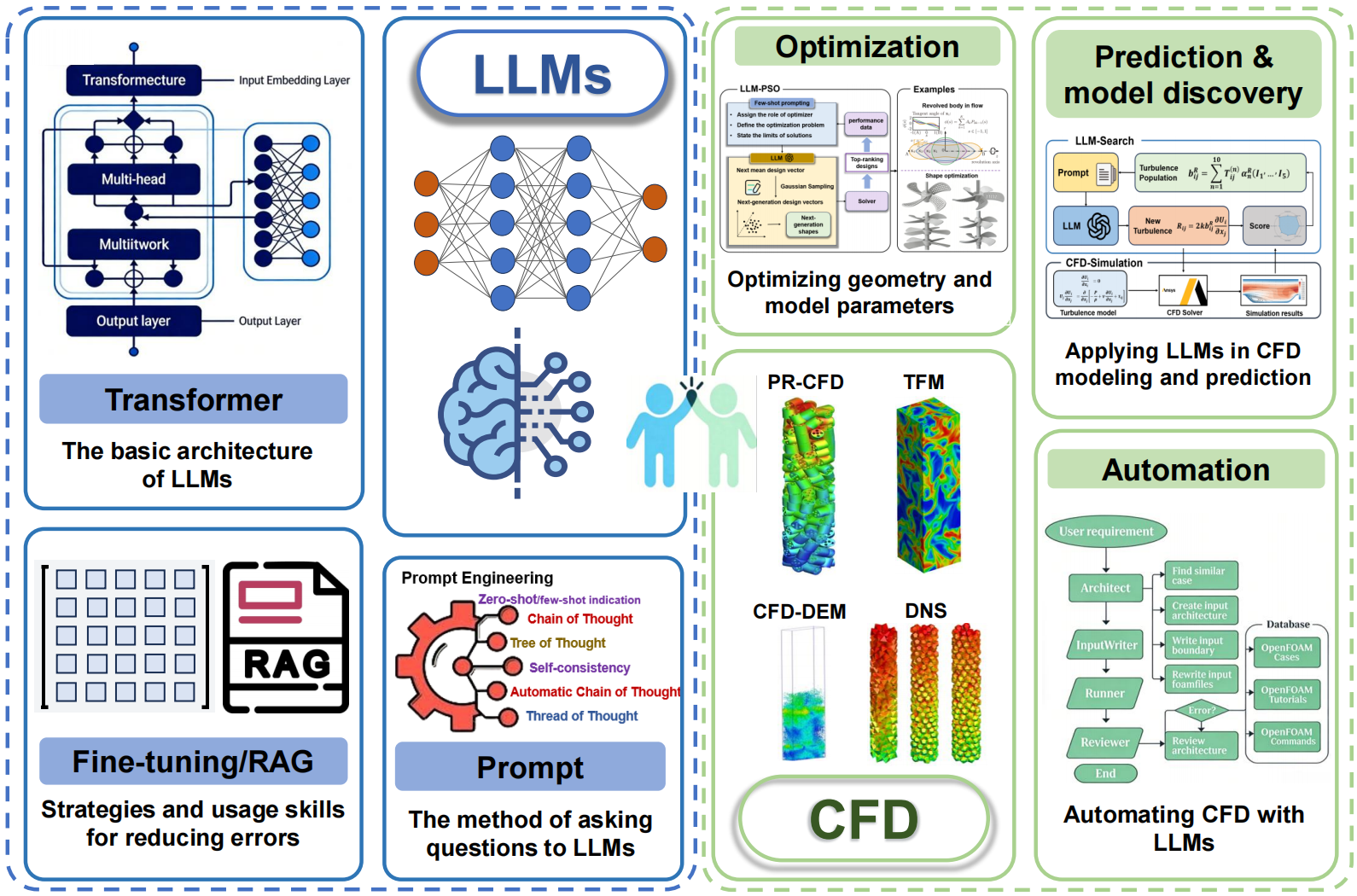
Keywords
computational fluid dynamics (CFD) | large language models (LLMs) | predictive modeling | parameter optimization | automated execution scheduling | intelligent agent
References
- 1.
Poinsot, T.; Candel, S.; Trouvé, A. Applications of Direct Numerical Simulation to Premixed Turbulent Combustion. Prog. Energy Combust. Sci. 1995, 21, 531–576. https://doi.org/10.1016/0360-1285(95)00011-9.
- 2.
Xiong, Q.; Li, B.; Zhou, G.; et al. Large-Scale DNS of Gas–Solid Flows on Mole-8.5. Chem. Eng. Sci. 2012, 71, 422–430. https://doi.org/10.1016/j.ces.2011.10.059.
- 3.
Fox, R.O. Large-Eddy-Simulation Tools for Multiphase Flows. Annu. Rev. Fluid Mech. 2012, 44, 47–76.
- 4.
Chen, Z.; Deng, J. Data-Driven RANS Closures for Improving Mean Field Calculation of Separated Flows. Front. Phys. 2024, 12. https://doi.org/10.3389/fphy.2024.1347657.
- 5.
Moin, P.; Mahesh, K. Direct Numerical Simulation: A Tool in Turbulence Research. Annu. Rev. Fluid Mech. 1998, 30, 539–578.
- 6.
Menicali, L.; Grace, A.; Richter, D.H.; et al. A Physics-Informed Spatiotemporal Deep Learning Framework for Turbulent Systems. arXiv 2025. https://doi.org/10.48550/arXiv.2505.10919.
- 7.
Li, H.; Su, X.; Yuan, X. Entropy Analysis of the Flat Tip Leakage Flow with Delayed Detached Eddy Simulation. Entropy 2018, 21, 21. https://doi.org/10.3390/e21010021.
- 8.
Lin, D.; Xin, Y.; Su, X. Local Entropy Generation in Compressible Flow through a High Pressure Turbine with Delayed Detached Eddy Simulation. Entropy 2017, 19, 29. https://doi.org/10.3390/e19010029.
- 9.
MacDougall, C.Y.; Piomelli, U.; Ambrogi, F. Evaluation of Turbulence Models in Unsteady Separation. Fluids 2023, 8, 273. https://doi.org/10.3390/fluids8100273.
- 10.
Lima, L.E.M. Application of the One-Dimensional Drift-Flux Model for Numerical Simulation of Gas–Liquid Isothermal Flows in Vertical Pipes: A Mechanistic Approach Based on the Flow Pattern. SN Appl. Sci. 2020, 2, 658. https://doi.org/10.1007/s42452-020-2440-x.
- 11.
Van Wachem, B.G.M.; Almstedt, A.E. Methods for Multiphase Computational Fluid Dynamics. Chem. Eng. J. 2003, 96, 81–98. https://doi.org/10.1016/j.cej.2003.08.025.
- 12.
Cai, J.; Zhao, J.; Zhong, J.; et al. Microfluidic Experiments and Numerical Simulation Methods of Pore-Scale Multiphase Flow. Capillarity 2024, 12, 1–5. https://doi.org/10.46690/capi.2024.07.01.
- 13.
Chen, X.; Wang, J. A Comparison of Two-Fluid Model, Dense Discrete Particle Model and CFD-DEM Method for Modeling Impinging Gas–Solid Flows. Powder Technol. 2014, 254, 94–102. https://doi.org/10.1016/j.powtec.2013.12.056.
- 14.
Wachs, A. A DEM-DLM/FD Method for Direct Numerical Simulation of Particulate Flows: Sedimentation of Polygonal Isometric Particles in a Newtonian Fluid with Collisions. Comput. Fluids 2009, 38, 1608–1628. https://doi.org/10.1016/j.compfluid.2009.01.005.
- 15.
Zhong, W.; Yu, A.; Liu, X.; et al. DEM/CFD-DEM Modelling of Non-Spherical Particulate Systems: Theoretical Developments and Applications. Powder Technol. 2016, 302, 108–152. https://doi.org/10.1016/j.powtec.2016.07.010.
- 16.
Wang, S.; Shen, Y. CFD-DEM Modelling of Raceway Dynamics and Coke Combustion in an Ironmaking Blast Furnace. Fuel 2021, 302, 121167. https://doi.org/10.1016/j.fuel.2021.121167.
- 17.
Zhu, L.-T.; Chen, X.-Z.; Ouyang, B.; et al. Review of Machine Learning for Hydrodynamics, Transport, and Reactions in Multiphase Flows and Reactors. Ind. Eng. Chem. Res. 2022, 61, 9901–9949. https://doi.org/10.1021/acs.iecr.2c01036.
- 18.
Zhu, L.; Ouyang, B.; Lei, H.; et al. Conventional and Data-Driven Modeling of Filtered Drag, Heat Transfer, and Reaction Rate in Gas–Particle Flows. AIChE J. 2021, 67, e17299. https://doi.org/10.1002/aic.17299.
- 19.
Mufti, B.; Perron, C.; Mavris, D.N. Nonlinear Reduced-Order Modeling of Compressible Flow Fields Using Deep Learning and Manifold Learning. Phys. Fluids 2025, 37, 036130. https://doi.org/10.1063/5.0253365.
- 20.
Wang, D.; Guo, H.; Sun, Y.; et al. Prediction of Oil–Water Two-Phase Flow Patterns Based on Bayesian Optimisation of the XGBoost Algorithm. Processes 2024, 12, 1660. https://doi.org/10.3390/pr12081660.
- 21.
Cui, Y.; Li, C.; Zhang, W.; et al. A Deep Learning-Based Image Processing Method for Bubble Detection, Segmentation, and Shape Reconstruction in High Gas Holdup Sub-Millimeter Bubbly Flows. Chem. Eng. J. 2022, 449, 137859. https://doi.org/10.1016/j.cej.2022.137859.
- 22.
Zhang, D.; Ouyang, B.; Luo, Z.-H. Identification of Gas-Solid Flow Regimes Using Convolutional Neural Network Techniques. Powder Technol. 2024, 442, 119848. https://doi.org/10.1016/j.powtec.2024.119848.
- 23.
Gómez-Camperos, J.A.; Diaz, C.M.R.; Hernandez-Cely, M.M.; et al. Dense-Gas/Liquid Two-Phase Flow Pattern Recognition Using Convolutional Neural Networks and Transfer Learning. Int. J. Multiph. Flow 2026, 194, 105479. https://doi.org/10.1016/j.ijmultiphaseflow.2025.105479.
- 24.
Jiang, S.; Wu, K.; Francia, V.; et al. Machine Learning Assisted Experimental Characterization of Bubble Dynamics in Gas-Solid Fluidized Beds. Ind. Eng. Chem. Res. 2024, 63, 8819–8832. https://doi.org/10.1021/acs.iecr.4c00631.
- 25.
Wang, Z.; Wang, Y.; Chen, P.; et al. A Study of Online Monitoring for Two‐phase Flow Patterns in a Microchannel Based on Deep Learning. AIChE J. 2025, 71, e18785. https://doi.org/10.1002/aic.18785.
- 26.
Wang, Y.; Li, Z.; Yuan, Z.; et al. Prediction of Turbulent Channel Flow Using Fourier Neural Operator-Based Machine-Learning Strategy. Phys. Rev. Fluids 2024, 9, 084604. https://doi.org/10.1103/PhysRevFluids.9.084604.
- 27.
Lai, Y.; Peng, C.; Hu, W.; et al. Adaptive Optimization Random Forest for Pressure Prediction in Industrial Gas-Solid Fluidized Beds. Powder Technol. 2025, 453, 120607. https://doi.org/10.1016/j.powtec.2025.120607.
- 28.
Xiao, H.; Oloruntoba, A.; Ke, X.; et al. Improving the Precision of Solids Velocity Measurement in Gas-Solid Fluidized Beds with a Hybrid Machine Learning Model. Chem. Eng. Sci. 2024, 285, 119579. https://doi.org/10.1016/j.ces.2023.119579.
- 29.
Li, D.; Zhao, B.; Lu, S.; et al. A Data-Driven Method for Fast Predicting the Long-Term Hydrodynamics of Gas–Solid Flows: Optimized Dynamic Mode Decomposition with Control. Phys. Fluids 2024, 36, 103332. https://doi.org/10.1063/5.0232554.
- 30.
Ranade, V.V.; Marchini, S.; Kipping, R.; et al. Estimation of Gas Hold-up in Bubble Columns Using Wall Pressure Fluctuations and Machine Learning. Chem. Eng. J. 2024, 500, 157078. https://doi.org/10.1016/j.cej.2024.157078.
- 31.
Li, D.; Zhao, B.; Lu, S.; et al. Physics-Informed Dynamic Mode Decomposition for Short-Term and Long-Term Prediction of Gas-Solid Flows. Chem. Eng. Sci. 2024, 289, 119849. https://doi.org/10.1016/j.ces.2024.119849.
- 32.
Karniadakis, G.E.; Kevrekidis, I.G.; Lu, L.; et al. Physics-Informed Machine Learning. Nat. Rev. Phys. 2021, 3, 422–440. https://doi.org/10.1038/s42254-021-00314-5.
- 33.
Patel, Y.; Mons, V.; Marquet, O.; et al. Turbulence Model Augmented Physics Informed Neural Networks for Mean Flow Reconstruction. arXiv 2024. https://doi.org/10.48550/arXiv.2306.01065.
- 34.
Bin, Y.; Huang, G.; Kunz, R.; et al. Constrained Re-Calibration of Reynolds-Averaged Navier-Stokes Models. arXiv 2023. https://doi.org/10.48550/arXiv.2310.09368.
- 35.
Hu, T.; Qin, L.; Zhou, L.; et al. Analysis and Optimization of Methanol Production and Temperature Gradient in CO2 Hydrogenation Fixed Bed Reactors Using CFD and Bayesian Optimization. Chem. Eng. Sci. 2026, 321, 123030. https://doi.org/10.1016/j.ces.2025.123030.
- 36.
Haake, J.; Oggian, T.; Utzig, J.; et al. Investigation of the Pressure Drop Increase in a Square Free-Vortex Cyclonic Separator Operating at Low Particle Concentration. Powder Technol. 2020, 374, 95–105. https://doi.org/10.1016/j.powtec.2020.07.008.
- 37.
Xiang, S.; Wen, Q.; Wei, M.; et al. Optimization of the Double-Slot Blown Airfoil with Jet at the Leading and Trailing Edges of the Flap. AIP Adv. 2024, 14, 025341. https://doi.org/10.1063/5.0196505.
- 38.
Zhang, R.; Huang, L.; Wang, K.; et al. Novel Optimized Layout for Flettner Rotors Based on Reuse of Wake Energy. J. Clean. Prod. 2024, 443, 140922. https://doi.org/10.1016/j.jclepro.2024.140922.
- 39.
Kang, Z.; Feng, L.; Wang, J. Optimization of a Gas–Liquid Dual-Impeller Stirred Tank Based on Deep Learning with a Small Data Set from CFD Simulation. Ind. Eng. Chem. Res. 2024, 63, 843–855. https://doi.org/10.1021/acs.iecr.3c03561.
- 40.
Touvron, H.; Martin, L.; Stone, K.; et al. Llama 2: Open Foundation and Fine-Tuned Chat Models. arXiv 2023. https://doi.org/10.48550/arXiv.2307.09288.
- 41.
Sriram, A.; Miller, B.K.; Chen, R.T.Q.; et al. FlowLLM: Flow Matching for Material Generation with Large Language Models as Base Distributions. arXiv 2024. https://doi.org/10.48550/arXiv.2410.23405.
- 42.
Zhang, C.; Zhang, J.; Lu, J.; et al. Large Language Models Meet Energy Systems: Opportunities, Challenges, and Future Perspectives. Appl. Energy 2026, 403, 127076. https://doi.org/10.1016/j.apenergy.2025.127076.
- 43.
Lin, L.; Zhou, X.; Yang, K.; et al. DeepSeek-LLM with Adaptive RAG for Pharmaceutical Dissolution Prediction. Pharm. Res. 2025, 42, 1821–1835. https://doi.org/10.1007/s11095-025-03932-1.
- 44.
Lin, L.; Zhou, X.; Ding, Y.; et al. Generative Model Enhanced X-Ray Computed Tomography Imaging for Pharmaceutical Powder Microstructure Reconstruction and Evaluation. AAPS PharmSciTech 2025, 27, 37. https://doi.org/10.1208/s12249-025-03292-4.
- 45.
Du, M.; Chen, Y.; Wang, Z.; et al. Large Language Models for Automatic Equation Discovery of Nonlinear Dynamics. Phys. Fluids 2024, 36, 097121. https://doi.org/10.1063/5.0224297.
- 46.
Liu, N.; Jafarzadeh, S.; Lattimer, B.Y.; et al. Harnessing Large Language Models for Data-Scarce Learning of Polymer Properties. Nat. Comput. Sci. 2025, 5, 245–254. https://doi.org/10.1038/s43588-025-00768-y.
- 47.
Guo, J.; Park, C.; Qian, D.; et al. Large Language Model-Empowered next-Generation Computer-Aided Engineering. arXiv 2025. https://doi.org/10.48550/arXiv.2509.11447.
- 48.
Wang, W.; Xu, R.; Feng, J.; et al. A Status Quo Investigation of Large-Language Models for Cost-Effective Computational Fluid Dynamics Automation with OpenFOAMGPT. Theor. Appl. Mech. Lett. 2025, 15, 100623. https://doi.org/10.1016/j.taml.2025.100623.
- 49.
Lin, L.; Liu, Y.; Liu, T.; et al. An SENet-Enhanced Transformer Approach for Multi-Condition Fast Forecasting of Two-Phase Bubble Flows. Chem. Eng. J. 2025, 524, 169259. https://doi.org/10.1016/j.cej.2025.169259.
- 50.
Lorsung, C.; Farimani, A.B. Explain Like I’m Five: Using LLMs to Improve PDE Surrogate Models with Text. arXiv 2025. https://doi.org/10.48550/arXiv.2410.01137.
- 51.
Bao, J.; Boullé, N.; Liu, T.J.B.; et al. Text-Trained LLMs Can Zero-Shot Extrapolate PDE Dynamics. arXiv 2025. https://doi.org/10.48550/arXiv.2509.06322.
- 52.
Zhang, Y.; Zheng, K.; Liu, F.; et al. AutoTurb: Using Large Language Models for Automatic Algebraic Model Discovery of Turbulence Closure. arXiv 2024. https://doi.org/10.48550/arXiv.2410.10657.
- 53.
Zhang, X.; Xu, Z.; Zhu, G.; et al. Using Large Language Models for Parametric Shape Optimization. arXiv 2024. https://doi.org/10.48550/arXiv.2412.08072.
- 54.
Pandey, S.; Xu, R.; Wang, W.; et al. OpenFOAMGPT: A Retrieval-Augmented Large Language Model (LLM) Agent for OpenFOAM-Based Computational Fluid Dynamics. Phys. Fluids 2025, 37, 035120. https://doi.org/10.1063/5.0257555.
- 55.
Chen, Y.; Zhu, X.; Zhou, H.; et al. Metaopenfoam: An LLM-Based Multi-Agent Framework for CFD. arXiv 2024. https://doi.org/10.48550/arXiv.2407.21320.
- 56.
Vaswani, A.; Shazeer, N.; Parmar, N.; et al. Attention Is All You Need. arXiv 2023. https://doi.org/10.48550/arXiv.1706.03762.
- 57.
Park, N.H.; Manica, M.; Born, J.; et al. Artificial Intelligence Driven Design of Catalysts and Materials for Ring Opening Polymerization Using a Domain-Specific Language. Nat. Commun. 2023, 14, 3686. https://doi.org/10.1038/s41467-023-39396-3.
- 58.
Wei, J.; Wang, X.; Schuurmans, D.; et al. Chain-of-Thought Prompting Elicits Reasoning in Large Language Models. arXiv 2023. https://doi.org/10.48550/arXiv.2201.11903.
- 59.
Wang, X.; Wei, J.; Schuurmans, D.; et al. Self-Consistency Improves Chain of Thought Reasoning in Language Models. arXiv 2023. https://doi.org/10.48550/arXiv.2203.11171.
- 60.
Yao, S.; Yu, D.; Zhao, J.; et al. Tree of Thoughts: Deliberate Problem Solving with Large Language Models. arXiv 2023. https://doi.org/10.48550/arXiv.2305.10601.
- 61.
Sahoo, P.; Singh, A.K.; Saha, S.; et al. A Systematic Survey of Prompt Engineering in Large Language Models: Techniques and Applications. arXiv 2025. https://doi.org/10.48550/arXiv.2402.07927.
- 62.
Asad, F.; Shah, W. AI Ethics and Safety: Guiding Principles for Fine-Tuning Machine Learning Models. 2024. Available online: https://www.researchgate.net/publication/387517530_AI_Ethics_and_Safety_Guiding_Principles_for_Fine-Tuning_Machine_Learning_Models (accessed on 20 February 2026).
- 63.
Pake, T.U.; Pachareney, U. Fine-Tuning Strategies for Transformers. In Proceedings of the 2025 4th International Conference on Sentiment Analysis and Deep Learning (ICSADL), Bhimdatta, Nepal, 18–20 February 2025; pp. 670–675. https://doi.org/10.1109/ICSADL65848.2025.10933255.
- 64.
Hu, E.J.; Shen, Y.; Wallis, P.; et al. LoRA: Low-Rank Adaptation of Large Language Models. arXiv 2021. https://doi.org/10.48550/arXiv.2106.09685.
- 65.
Gao, Y.; Xiong, Y.; Gao, X.; et al. Retrieval-Augmented Generation for Large Language Models: A Survey. arXiv 2024. https://doi.org/10.48550/arXiv.2312.10997.
- 66.
Shahade, A.K.; Deshmukh, P.V. Enhancing Natural Language Processing: A Comprehensive Review of Retrieval Augmented Generation. In Proceedings of the 2024 4th International Conference on Sustainable Expert Systems (ICSES), Lekhnath, Nepal, 15–17 October 2024; pp. 609–611. https://doi.org/10.1109/ICSES63445.2024.10763224.
- 67.
Dhuliawala, S.; Komeili, M.; Xu, J.; et al. Chain-of-Verification Reduces Hallucination in Large Language Models. In Findings of the Association for Computational Linguistics ACL 2024; Association for Computational Linguistics: Bangkok, Thailand, 2024; pp. 3563–3578. https://doi.org/10.18653/v1/2024.findings-acl.212.
- 68.
Yu, W.; Zhang, H.; Pan, X.; et al. Chain-of-Note: Enhancing Robustness in Retrieval-Augmented Language Models. arXiv 2024. https://doi.org/10.48550/arXiv.2311.09210.
- 69.
Li, X.; Zhao, R.; Chia, Y.K.; et al. Chain-of-Knowledge: Grounding Large Language Models via Dynamic Knowledge Adapting over Heterogeneous Sources. arXiv 2024. https://doi.org/10.48550/arXiv.2305.13269.
- 70.
Yao, S.; Zhao, J.; Yu, D.; et al. ReAct: Synergizing Reasoning and Acting in Language Models. In Proceedings of the The Eleventh International Conference on Learning Representations ICLR 2023, Kigali, Rwanda, 1–5 May 2023.
- 71.
Hosseini Boosari, S.S. Predicting the Dynamic Parameters of Multiphase Flow in CFD (Dam-Break Simulation) Using Artificial Intelligence-(Cascading Deployment). Fluids 2019, 4, 44. https://doi.org/10.3390/fluids4010044.
- 72.
Vatsal, S.; Dubey, H. A Survey of Prompt Engineering Methods in Large Language Models for Different NLP Tasks. arXiv 2024. https://doi.org/10.48550/arXiv.2407.12994.
- 73.
Sivarajkumar, S.; Kelley, M.; Samolyk-Mazzanti, A.; et al. An Empirical Evaluation of Prompting Strategies for Large Language Models in Zero-Shot Clinical Natural Language Processing. JMIR Med. Inform. 2024, 12, e55318.
- 74.
Saleem, S.; Asim, M.N.; Zulfiqar, S.; et al. The Evolution of Natural Language Processing: How Prompt Optimization and Language Models Are Shaping the Future. arXiv 2025. https://doi.org/10.48550/arXiv.2506.17700.
- 75.
Zhu, M.; Bazaga, A.; Liò, P. FLUID-LLM: Learning Computational Fluid Dynamics with Spatiotemporal-Aware Large Language Models. arXiv 2024. https://doi.org/10.48550/arXiv.2406.04501.
- 76.
Dinh, N.-D.; Nguyen, N.; Tong, R. Autonomous Droplet Microfluidic Design Framework with Large Language Models. Res. Sq. 2025, 10, 45801–45814. https://doi.org/10.21203/rs.3.rs-6282521/v1.
- 77.
Okafor, C.E.; Iweriolor, S.; Ani, O.I.; et al. Advances in Machine Learning-Aided Design of Reinforced Polymer Composite and Hybrid Material Systems. Hybrid Adv. 2023, 2, 100026. https://doi.org/10.1016/j.hybadv.2023.100026.
- 78.
Zhang, Z.; Li, A.; Wang, L.; et al. Big Data-Assisted Urban Governance: A Comprehensive System for Business Documents Classification of the Government Hotline. Eng. Appl. Artif. Intell. 2024, 132, 107997. https://doi.org/10.1016/j.engappai.2024.107997.
- 79.
Elgeldawi, E.; Sayed, A.; Galal, A.R.; et al. Hyperparameter Tuning for Machine Learning Algorithms Used for Arabic Sentiment Analysis. Informatics 2021, 8, 79. https://doi.org/10.3390/informatics8040079.
- 80.
Petruzzellis, F.; Testolin, A.; Sperduti, A. Benchmarking GPT-4 on Algorithmic Problems: A Systematic Evaluation of Prompting Strategies. arXiv 2024. https://doi.org/10.48550/arXiv.2402.17396.
- 81.
Pryzant, R.; Iter, D.; Li, J.; et al. Automatic Prompt Optimization with ‘Gradient Descent’ and Beam Search. arXiv 2023. https://doi.org/10.48550/arXiv.2305.03495.
- 82.
Li, M.; Wang, W.; Feng, F.; et al. Robust Prompt Optimization for Large Language Models Against Distribution Shifts. In Proceedings of the 2023 Conference on Empirical Methods in Natural Language Processing, Singapore, 6–10 December 2023; pp. 1539–1554. https://doi.org/10.18653/v1/2023.emnlp-main.95.
- 83.
Jaitly, S.; Shah, T.; Shugani, A.; et al. Towards Better Serialization of Tabular Data for Few-Shot Classification with Large Language Models. arXiv 2023. https://doi.org/10.48550/arXiv.2312.12464.
- 84.
Cui, W.; Li, Z.; Sun, H.; et al. A Survey of Automatic Prompt Optimization with Instruction-Focused Heuristic-Based Search Algorithm. arXiv 2025. https://doi.org/10.48550/arXiv.2502.18746.
- 85.
Besta, M.; Blach, N.; Kubicek, A.; et al. Graph of Thoughts: Solving Elaborate Problems with Large Language Models. Proc. AAAI Conf. Artif. Intell. 2024, 38, 17682–17690. https://doi.org/10.1609/aaai.v38i16.29720.
- 86.
Yu, P.; Xu, J.; Weston, J.; et al. Distilling System 2 into System 1. arXiv 2024. https://doi.org/10.48550/arXiv.2407.06023.
- 87.
Zhou, Y.; Geng, X.; Shen, T.; et al. Thread of Thought Unraveling Chaotic Contexts. arXiv 2023. https://doi.org/10.48550/arXiv.2311.08734.
- 88.
Besta, M.; Memedi, F.; Zhang, Z.; et al. Demystifying Chains, Trees, and Graphs of Thoughts. IEEE Trans. Pattern Anal. Mach. Intell. 2025, 47, 10967–10989. https://doi.org/10.1109/TPAMI.2025.3598188.
- 89.
Jiang, Y.; Byrne, E.; Chen, X.; et al. A Dynamic PCA and Transformers Coupled Reduced-Order Model for Transient Solid-Liquid Flows in Stirred Tanks. Chem. Eng. Process. Process Intensif. 2026, 219, 110605. https://doi.org/10.1016/j.cep.2025.110605.
- 90.
Yaqub, M.W.; Chen, X. Vision Transformers for Three‐phase Flow Classifications with Data Augmentation through Generative Adversarial Networks. AIChE J. 2025, 71, e70002. https://doi.org/10.1002/aic.70002.
- 91.
Zhang, W.-W.; Noack, B.R. Artificial Intelligence in Fluid Mechanics. Acta Mech. Sin. 2021, 37, 1715–1717. https://doi.org/10.1007/s10409-021-01154-3.
- 92.
Zou, Z.; Xu, P.; Chen, Y.; et al. Application of Artificial Intelligence in Turbomachinery Aerodynamics: Progresses and Challenges. Artif. Intell. Rev. 2024, 57, 222. https://doi.org/10.1007/s10462-024-10867-3.
- 93.
Suh, Y.; Chandramowlishwaran, A.; Won, Y. Recent Progress of Artificial Intelligence for Liquid-Vapor Phase Change Heat Transfer. npj Comput. Mater. 2024, 10, 65. https://doi.org/10.1038/s41524-024-01223-8.
- 94.
Wang, W.; Chu, X. Optimized Flow Control Based on Automatic Differentiation in Compressible Turbulent Channel Flows. J. Fluid Mech. 2025, 1011, A1. https://doi.org/10.1017/jfm.2025.304.
- 95.
Taira, K.; Rigas, G.; Fukami, K. Machine Learning in Fluid Dynamics: A Critical Assessment. Phys. Rev. Fluids 2025, 10, 090701. https://doi.org/10.1103/8t52-mtb9.
- 96.
Adjailia, F.; Takac, M. Exploring the Application of Machine Learning in Computational Fluid Dynamics. In Proceedings of the 2023 IEEE World Conference on Applied Intelligence and Computing (AIC), Sonbhadra, India, 29–30 July 2023; pp. 51–57. https://doi.org/10.1109/AIC57670.2023.10263832.
- 97.
Wang, G.; Cheng, S. Can Foundation Language Models Predict Fluid Dynamics? Eng. Appl. Artif. Intell. 2025, 158, 111427. https://doi.org/10.1016/j.engappai.2025.111427.
- 98.
Dong, Z.; Lu, Z.; Yang, Y. Fine-Tuning a Large Language Model for Automating Computational Fluid Dynamics Simulations. Theor. Appl. Mech. Lett. 2025, 15, 100594. https://doi.org/10.1016/j.taml.2025.100594.
- 99.
Yang, S.D.; Ali, Z.A.; Wong, B.M. FLUID-GPT (Fast Learning to Understand and Investigate Dynamics with a Generative Pre-Trained Transformer): Efficient Predictions of Particle Trajectories and Erosion. Ind. Eng. Chem. Res. 2023, 62, 15278–15289. https://doi.org/10.1021/acs.iecr.3c01639.
- 100.
Sahibzada, S.; Malik, F.S.; Nasir, S.; et al. AI-Augmented Turbulence and Aerodynamic Modelling: Accelerating High-Fidelity CFD Simulations with Physics-Informed Neural Networks. Int. J. Innov. Res. Comput. Sci. Technol. 2025, 13, 91–97. https://doi.org/10.55524/ijircst.2025.13.1.14.
- 101.
Liu, S.; Gao, C.; Li, Y. Large Language Model Agent for Hyper-Parameter Optimization. arXiv 2025. https://doi.org/10.48550/arXiv.2402.01881.
- 102.
Dandamudi, S.R.P.; Sajja, J.; Khanna, A. Leveraging Artificial Intelligence for Data Networking and Cybersecurity in the United States. Int. J. Innov. Res. Comput. Sci. Technol. 2025, 13, 34–41. https://doi.org/10.55524/ijircst.2025.13.1.5.
- 103.
Mehta, M.; Palade, V.; Chatterjee, I. (Eds.) Explainable AI: Foundations, Methodologies and Applications; Springer International Publishing: Berlin/Heidelberg, Germany, 2023. https://doi.org/10.1007/978-3-031-12807-3.
- 104.
Uddin, M.; Irshad, M.S.; Kandhro, I.A.; et al. Generative AI Revolution in Cybersecurity: A Comprehensive Review of Threat Intelligence and Operations. Artif. Intell. Rev. 2025, 58, 236. https://doi.org/10.1007/s10462-025-11219-5.
- 105.
Zainab, H.; Khan, A.R.A.; Khan, M.I.; et al. Ethical Considerations and Data Privacy Challenges in AI-Powered Healthcare Solutions for Cancer and Cardiovascular Diseases. Glob. Trends Sci. Technol. 2025, 1, 63–74. https://doi.org/10.70445/gtst.1.1.2025.63-74.
- 106.
Agarwal, I.; Killamsetty, K.; Popa, L.; et al. DELIFT: Data Efficient Language Model Instruction Fine Tuning. arXiv 2025. https://doi.org/10.48550/arXiv.2411.04425.
- 107.
Ekradi, K.; Madadi, A. Performance Improvement of a Transonic Centrifugal Compressor Impeller with Splitter Blade by Three-Dimensional Optimization. Energy 2020, 201, 117582. https://doi.org/10.1016/j.energy.2020.117582.
- 108.
Hamici, H.; Kanan, A.; Al-hammuri, K. Optimized FIR Filter Using Genetic Algorithms: A Case Study of ECG Signals Filter Optimization. BioMedInformatics 2023, 3, 1197–1215. https://doi.org/10.3390/biomedinformatics3040071.
- 109.
Ghatasheh, N.; Altaharwa, I.; Aldebei, K. Modified Genetic Algorithm for Feature Selection and Hyper Parameter Optimization: Case of XGBoost in Spam Prediction. IEEE Access 2022, 10, 84365–84383. https://doi.org/10.1109/ACCESS.2022.3196909.
- 110.
Takabatake, T.; Yamamoto, M.; Hino, H. Algorithm for Searching Optimal Set Values of Absorption Chiller System Using Bayesian Optimization. Sci. Technol. Built Environ. 2022, 28, 188–199. https://doi.org/10.1080/23744731.2021.2005376.
- 111.
Wang, X.; Jin, Y.; Schmitt, S.; et al. Recent Advances in Bayesian Optimization. ACM Comput. Surv. 2023, 55, 1–36. https://doi.org/10.1145/3582078.
- 112.
Herrera Casanova, R.; Conde, A. Enhancement of LSTM Models Based on Data Pre-Processing and Optimization of Bayesian Hyperparameters for Day-Ahead Photovoltaic Generation Prediction. Comput. Electr. Eng. 2024, 116, 109162. https://doi.org/10.1016/j.compeleceng.2024.109162.
- 113.
Wang, L.; Zhang, L.; He, G. Evaluations of Large Language Models in Computational Fluid Dynamics: Leveraging, Learning and Creating Knowledge. Theor. Appl. Mech. Lett. 2025, 15, 100597. https://doi.org/10.1016/j.taml.2025.100597.
- 114.
Xu, Z.; Wang, L.; Wang, C.; et al. CFDAgent: A Language-Guided, Zero-Shot Multi-Agent System for Complex Flow Simulation. Phys. Fluids 2025, 37, 117124. https://doi.org/10.1063/5.0294696.
- 115.
Kan, K.; Zhou, J.; Feng, J.; et al. Intelligent Optimization of Axial-Flow Pump Using Physics-Considering Machine Learning. J. Comput. Des. Eng. 2024, 11, 325–342. https://doi.org/10.1093/jcde/qwae013.
- 116.
Li, Y.; Xu, J.; Li, F.; et al. Multi-Objective Optimization of Aerodynamic Performance and Internal Flow in Centrifugal Compressor Based on Neural Networks and Genetic Algorithms. AIP Adv. 2025, 15, 085105. https://doi.org/10.1063/5.0280922.
- 117.
Milanese, M.; Colangelo, G.; Laforgia, D.; et al. Multi-Parameter Optimization of Double-Loop Fluidized Bed Solar Reactor for Thermochemical Fuel Production. Energy 2017, 134, 919–932. https://doi.org/10.1016/j.energy.2017.06.088.
- 118.
Liu, F.; Lin, X.; Wang, Z.; et al. Large Language Model for Multi-Objective Evolutionary Optimization. arXiv 2024. https://doi.org/10.48550/arXiv.2310.12541.
- 119.
Wang, W.; Peng, J.; Hu, M.; et al. LLM Agent for Hyper-Parameter Optimization. arXiv 2025. https://doi.org/10.48550/arXiv.2506.15167.
- 120.
Zhang, M.R.; Desai, N.; Bae, J.; et al. Using Large Language Models for Hyperparameter Optimization. arXiv 2024. https://doi.org/10.48550/arXiv.2312.04528.
- 121.
Mahammadli, K.; Ertekin, S. Sequential Large Language Model-Based Hyper-Parameter Optimization. arXiv 2025. https://doi.org/10.48550/arXiv.2410.20302.
- 122.
Kochnev, R.; Goodarzi, A.T.; Bentyn, Z.A.; et al. Optuna vs Code Llama: Are LLMs a New Paradigm for Hyperparameter Tuning? arXiv 2025. https://doi.org/10.48550/arXiv.2504.06006.
- 123.
Chen, Y. Active Learning over DNN: Automated Engineering Design Optimization for Fluid Dynamics Based on Self-Simulated Dataset. arXiv 2020. https://doi.org/10.48550/arXiv.2001.08075.
- 124.
Amaral, C.A.; Oliveira, V.L.; Salazar, J.P.L.C.; et al. Quantum Machine Learning and Quantum-Inspired Methods Applied to Computational Fluid Dynamics: A Short Review. arXiv 2025. https://doi.org/10.48550/arXiv.2510.14099.
- 125.
Feng, J.; Xu, R.; Chu, X. OpenFOAMGPT 2.0: End-to-End, Trustworthy Automation for Computational Fluid Dynamics. arXiv 2025. https://doi.org/10.48550/arXiv.2504.19338.
- 126.
Hong, S.; Zhuge, M.; Chen, J.; et al. MetaGPT: Meta Programming for A Multi-Agent Collaborative Framework. arXiv 2024. https://doi.org/10.48550/arXiv.2308.00352.
- 127.
Chen, Y.; Zhu, X.; Zhou, H.; et al. MetaOpenFOAM 2.0: Large Language Model Driven Chain of Thought for Automating CFD Simulation and Post-Processing. arXiv 2025. https://doi.org/10.48550/arXiv.2502.00498.
- 128.
Zhou, D.; Schärli, N.; Hou, L.; et al. Least-to-Most Prompting Enables Complex Reasoning in Large Language Models. arXiv 2023. https://doi.org/10.48550/arXiv.2205.10625.
- 129.
Paul, D.; West, R.; Bosselut, A.; et al. Making Reasoning Matter: Measuring and Improving Faithfulness of Chain-of-Thought Reasoning. arXiv 2024. https://doi.org/10.48550/arXiv.2402.13950.
- 130.
Diao, S.; Wang, P.; Lin, Y.; et al. Active Prompting with Chain-of-Thought for Large Language Models. arXiv 2024. https://doi.org/10.48550/arXiv.2302.12246.
- 131.
Chen, Y.; Zhang, L.; Zhu, X.; et al. OptMetaOpenFOAM: Large Language Model Driven Chain of Thought for Sensitivity Analysis and Parameter Optimization Based on CFD. arXiv 2025. https://doi.org/10.48550/arXiv.2503.01273.
- 132.
Fan, E.; Hu, K.; Wu, Z.; et al. ChatCFD: An LLM-Driven Agent for End-to-End CFD Automation with Domain-Specific Structured Reasoning. arXiv 2025. https://doi.org/10.48550/arXiv.2506.02019.
- 133.
Yang, Z.; Bin, Y.; Shi, Y.; et al. Large Language Model Driven Development of Turbulence Models. arXiv 2025. https://doi.org/10.48550/arXiv.2505.01681.


This work is licensed under a Creative Commons Attribution 4.0 International License.

 Suite 4002 Level 4, 447 Collins Street, Melbourne, Victoria 3000, Australia
 General Inquiries: info@sciltp.com