
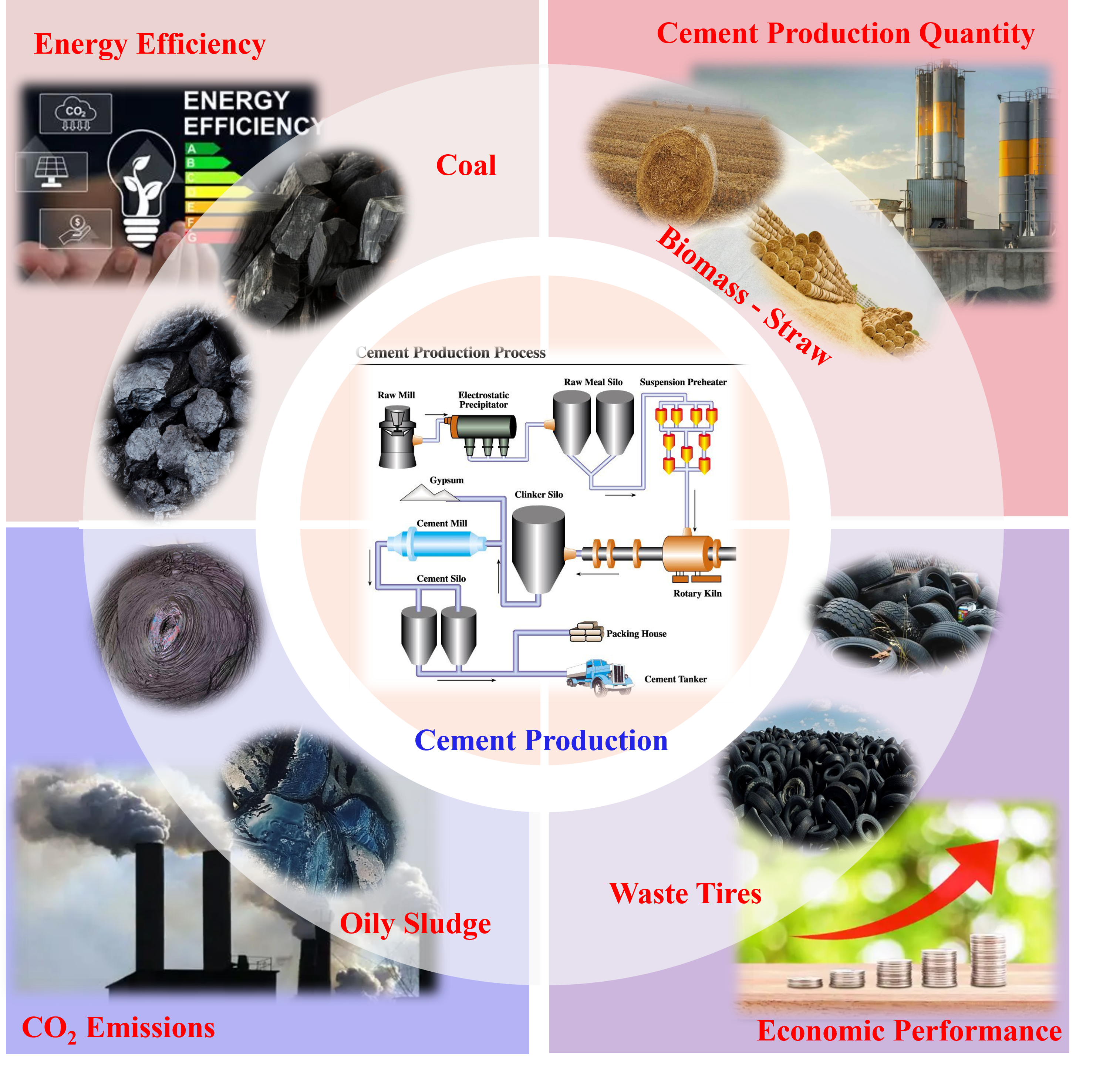
The conventional cement production is characterized by energy-intensive and relies heavily on fossil fuel, resulting in substantial CO2 emissions. Substituting fossil fuels with alternative energy sources is therefore essential for improving process efficiency and reducing the carbon footprint of cement manufacturing. In this study, six representative alternative fuels—including oily sludge, biomass, waste tires were assessed at thermal substitution rates (TSR) of 10%, 20%, 30%, and 40%. A total of 25 combustion scenarios were modeled were to evaluate their effects on clinker production, CO2 emissions, energy efficiency, and techno-economic performance. The simulation results show that alternative fuels can not only effectively reduce coal consumption but also improve energy efficiency. Under the same condition of heat value, in the 10% waste tire A substitution scenario, coal consumption is reduced to 17,325 kg/h, and in the 40% waste tire B substitution scenario, coal consumption is reduced to 11,550 kg/h. The oily sludge-based alternative fuels exhibit the most significant enhancement in cement clinker yield, followed by biomass and waste tire B. Waste tire A is similar to the cement clinker output of conventional cement production. In terms of CO2 emissions, in the 40% oily sludge B substitution scenario, compared with the conventional cement production process, CO2 emissions are reduced by 118,300 tons, relative to the conventional cement production process, representing a 13.17% reduction. In terms of economic performance, a high proportion of oily sludge substitution can reduce the conventional cement production cost by 392.89 CNY/t to 358.45 CNY/t, reduced by 8.77%. Alternative fuels play a crucial role in significantly enhancing energy efficiency and promoting decarbonization. Notably, oily sludge demonstrates optimal techno-economic performance, providing critical parameters for industrial-scale solid waste co-processing.
- Open Access
- Article
Hybrid Fuels Enhance Sustainability and Economics of Cement Manufacturing
- Jinqiang Liang 1,
- Qi Zhang 1,
- Jiahui Li 1,
- Yukun Mei 1,
- Duiping Liu 2,
- Jibin Zhou 2,
- Zhishuang Pan 3,
- Danzhu Liu 2,
- Majid Khan 4,
- He Huang 5, *,
- Mao Ye 2, *
Author Information
Received: 08 Feb 2026 | Revised: 07 Mar 2026 | Accepted: 09 Mar 2026 | Published: 12 Mar 2026
Abstract
Graphical Abstract
Keywords
fuels substitution | cement production | oil sludge | biomass | waste tires | aspen simulation
References
- 1.
Odor, G.E.; Dirisu, C.D.; Omekawum, N.C.; et al. Implementing Carbon Capture Technologies and Strategies in the Cement Industry: A Complete Review. World J. Adv. Eng. Technol. Sci. 2025, 16, 152–170.
- 2.
Ige, O.E.; Kabeya, M. Comprehensive Evaluation of Waste-Derived Fuels as Sustainable Alternatives in Cement Production. Sci. Eng. Technol. 2025, 5, 149–170.
- 3.
Naqi, A.; Jang, J.G. Recent Progress in Green Cement Technology Utilizing Low-Carbon Emission Fuels and Raw Materials: A Review. Sustainability 2019, 11, 537.
- 4.
Rivera Sasso, O.; Ramirez Espinoza, E.; Carreño Gallardo, C.; et al. Laboratory Quantification of Gaseous Emission from Alternative Fuel Combustion: Implications for Cement Industry Decarbonization. Materials 2025, 18, 4859.
- 5.
Wei, J.; Cen, K. Empirical Assessing Cement CO2 Emissions Based on China’s Economic and Social Development During 2001–2030. Sci. Total Environ. 2019, 653, 200–211.
- 6.
Yin, Z.; Lei, Y.; Lu, X.; et al. The 2024 Report of the Synergetic Roadmap on Carbon Neutrality and Clean Air for China: Pollution and Carbon Reduction Promote Green Economic Development. Environ. Sci. Ecotechnol. 2025, 28, 100636.
- 7.
Williams, F.; Yang, A.; Nhuchhen, D.R. Decarbonisation Pathways of the Cement Production Process via Hydrogen and Oxy-Combustion. Energy Convers. Manag. 2024, 300, 117931.
- 8.
Rahman, A.; Rasul, M.G.; Khan, M.M.K.; Sharma, S. Recent Development on the Uses of Alternative Fuels in Cement Manufacturing Process. Fuel 2015, 145, 84–99.
- 9.
Cheng, S.; Jin, B.; Wang, L.; et al. Design and Operation of a Demonstration Plant for Fluidized Bed Low-Temperature Gasification of Alternative Fuels Applied to Cement Production. Chem. Eng. J. 2024, 502, 158117.
- 10.
Elkhaldi, I.; Rozière, E.; Loukili, A. To What Extent Does Decreasing the Proportion of Clinker in Cement Production Effectively Decrease Its Carbon Footprint? Mater. Today Proc. 2023, 8. https://doi.org/10.1016/j.matpr.2023.07.349.
- 11.
Xing, Y.; Zhang, X.; Li, D.; et al. Carbon Emission Reduction Responsibility Allocation in China’s Power Generation Sector Under the “Dual Carbon” Target—Based on a Two-Stage Shared Responsibility Approach. J. Clean. Prod. 2025, 489, 144699.
- 12.
Mancini, V.; Verdone, N.; Trinca, A.; et al. Economic, Environmental and Exergy Analysis of the Decarbonisation of Cement Production Cycle. Energy Convers. Manag. 2022, 260, 115577.
- 13.
Turakulov, Z.; Kamolov, A.; Norkobilov, A.; et al. Techno-Economic and Environmental Analysis of Decarbonization Pathways for Cement Plants in Uzbekistan. Chem. Eng. Res. Des. 2024, 210, 625–637.
- 14.
Li, S.; Chen, H.; Gao, Y.; et al. A Novel Waste-to-Energy System Based on Sludge Hydrothermal Treatment and Medical Waste Plasma Gasification and Integrated with the Waste Heat Recovery of a Cement Plant. Energy 2024, 305, 132358.
- 15.
He, F.; Ma, J.; Hu, Q.; et al. Enhancing Energy Efficiency and Decarbonization of Cement Production Through Integrated Calcium-Looping and Methane Dry Reforming (CaL-DRM) for In-Situ CO2 Conversion to Syngas. Carbon Capture Sci. Technol. 2025, 14, 100359.
- 16.
Niu, Q.; Ma, K.; Wang, W.; et al. Multifactor Analysis of Heat Extraction Performance of Coaxial Heat Exchanger Applied to Hot Dry Rock Resources Exploration: A Case Study in Matouying Uplift, Tangshan, China. Energy 2023, 282, 128277.
- 17.
Driver, J.G.; Hills, T.; Hodgson, P.; et al. Simulation of Direct Separation Technology for Carbon Capture and Storage in the Cement Industry. Chem. Eng. J. 2022, 449, 137721.
- 18.
Ma, W.; Lv, Y.; Li, S.; et al. Study on Thermal Behavior and Gas Pollutant Emission Control During the Co-Combustion of Waste Tire-Modified Oily Sludge and Coal. Fuel 2025, 391, 134758.
- 19.
Ji, J.; Zhang, Z.; Jiang, L.; et al. Investigation on Engineering Performance and Modification Mechanism of Cement-Stabilized Oily Sludge Pyrolysis Residue as Sustainable Road Subbase Materials. Constr. Build. Mater. 2025, 489, 142322.
- 20.
Ibrahim, M.; Rahman, M.K.; Najamuddin, S.K.; et al. A Review on Utilization of Industrial By-Products in the Production of Controlled Low Strength Materials and Factors Influencing the Properties. Constr. Build. Mater. 2022, 325, 126704.
- 21.
Huang, G.; Zhao, J.; Dzemua, G.L.; et al. Utilisation of Local Raw Materials and Mine Waste to Manufacture Cement in the Northwest Territories, Canada. Adv. Cem. Res. 2024, 36, 496–507.
- 22.
Peys, A.; Isteri, V.; Yliniemi, J.; et al. Sustainable Iron-Rich Cements: Raw Material Sources and Binder Types. Cem. Concr. Res. 2022, 157, 106834.
- 23.
Li, C.; Yang, X.; Jia, D.; et al. Investigation of Mechanical Properties and Hydration of Low-Carbon Magnesium and Calcium-Rich Waste Powder Geopolymer Paste. J. CO2 Util. 2024, 90, 102984.
- 24.
Abdulqader, M.A.; Mohammed, M.M.; Saeed, L.I.; et al. Co-Pyrolysis of Oily Sludge and Algal Biomass. J. Environ. Manag. 2025, 394, 127617.
- 25.
Zheng, Z.; Wang, Z.; Wu, S.; et al. Effect of Catalysts on the Conversion of Sulfur, Nitrogen, and Oxygen during Catalytic/Additives Pyrolysis of Oil Sludge. J. Environ. Chem. Eng. 2025, 13, 118657.
- 26.
Kazmi, B.; Taqvi, S.A.A.; Ahmed, U.; et al. Thermodynamic, Exergy and Exergo-Environmental Analysis of Waste Feedstock for the H2 Production: A Simulation Study. Energy Convers. Manage. X 2025, 28, 101211.
- 27.
Her, S.; Park, J.; Li, P.; Bae, S. Feasibility Study on Utilization of Pulverized Eggshell Waste as an Alternative to Limestone in Raw Materials for Portland Cement Clinker Production. Constr. Build. Mater. 2022, 324, 126605.
- 28.
Renó, M.L.G.; Torres, F.M.; da Silva, R.J.; et al. Exergy Analyses in Cement Production Applying Waste Fuel and Mineralizer. Energy Convers. Manag. 2013, 75, 98–104.
- 29.
Çamdali, Ü.; Erişen, A.; Çelen, F. Energy and Exergy Analyses in a Rotary Burner with Pre-Calcinations in Cement Production. Energy Convers. Manag. 2004, 45, 3017–3031.
- 30.
Kaddatz, K.T.; Rasul, M.G.; Rahman, A. Alternative Fuels for Use in Cement Kilns: Process Impact Modelling. Procedia Eng. 2013, 56, 413–420.
- 31.
Shahabuddin, M.; Krishna, B.B.; Bhaskar, T.; et al. Advances in the Thermo-Chemical Production of Hydrogen from Biomass and Residual Wastes: Summary of Recent Techno-Economic Analyses. Bioresour. Technol. 2020, 299, 122557.
- 32.
Zhong, Z.; Ye, W.; Li, B.; et al. Phosphate-Iron Modified Enteromorpha Prolifera Hydrochar Enhances Dry Anaerobic Digestion of Food Waste: Synergistic Mechanisms of Electron Transfer Network, Microbial Consortia Remodeling, and Metagenomic Insights. Environ. Res. 2025, 289, 123385.
- 33.
Cao, X.; Yue, T.; Meng, W.; et al. Nontargeted Screening Unveils Structural Diversity and Environmental Pervasiveness of p-Phenylenediamine Antioxidant-Derived Quinones: Evidence from End-of-Life Tires and Road Dust Contamination. Environ. Sci. Technol. 2025, 59, 20630–20641.
- 34.
Caspani, S.; Manenti, F. Hydrogen Recovery from End-of-Life Tire Pyrolysis Gas via H2S Splitting. Int. J. Hydrog. Energy 2025, 144, 1292–1298.
- 35.
Bi, T.; Chen, Y.; Lin, L.; et al. Closed-Loop Recycling of Polyethylene to Ethylene and Propylene via a Kinetic Decoupling—Recoupling Strategy. Nat. Chem. Eng. 2025, 2, 650–661.
- 36.
Archer de Carvalho, T.; Gaspar, F.; Marques, A.C.; Mateus, A. Evaluation of the Potential of Metakaolin, Electric Arc Furnace Slag, and Biomass Fly Ash for Geopolymer Cement Compositions. Materials 2023, 16, 2741.
- 37.
Eisinas, A.; Kaminskas, R.; Barauskas, I. Synthesis and Characterization of Calcium Silicate Hydrate from Biomass Fly Ash. J. Therm. Anal. Calorim. 2024, 150, 965–975.
- 38.
Reinmöller, M.; Kong, L.; Laabs, M.; et al. Methods for the Determination of Composition, Mineral Phases, and Process-Relevant Behavior of Ashes and Its Modeling: A Case Study for an Alkali-Rich Ash. J. Energy Inst. 2022, 100, 137–147.
- 39.
Huber, F.; Blasenbauer, D.; Aschenbrenner, P.; et al. Complete Determination of the Material Composition of Municipal Solid Waste Incineration Bottom Ash. Waste Manag. 2020, 102, 677–685.
- 40.
Chen, L.; Liao, Y.; Ma, X.; et al. Effect of Co-Combusted Sludge in Waste Incinerator on Heavy Metals Chemical Speciation and Environmental Risk of Horizontal Flue Ash. Waste Manag. 2020, 102, 645–654.
- 41.
Gao, N.; Li, J.; Quan, C.; et al. Product Property and Environmental Risk Assessment of Heavy Metals During Pyrolysis of Oily Sludge with Fly Ash Additive. Fuel 2020, 266, 117090.
- 42.
Van de Velden, M.; Dewil, R.; Baeyens, J.; et al. The Distribution of Heavy Metals During Fluidized Bed Combustion of Sludge (FBSC). J. Hazard. Mater. 2008, 151, 96–102.
- 43.
Wen, H.; Zhao, M.; Gao, J.; et al. Stabilization of Heavy Metals in Sewage Sludge by Co-Hydrothermal Carbonization with Biomass Bottom Ash. J. Mater. Cycles Waste Manag. 2024, 26, 1609–1621.
- 44.
Özkan, S.; Acaralı, N. Efficiency Enhancement and Cost Reduction in Cement Clinker Production: A Comprehensive Energy and Exergy Analysis of a Rotary Kiln in Turkey. Therm. Sci. Eng. Prog. 2024, 53, 102744.
- 45.
Cormos, C-C. Decarbonization Options for Cement Production Process: A Techno-Economic and Environmental Evaluation. Fuel 2022, 320, 123907.
- 46.
Deng, Y.; Cao, H.; He, Z.; et al. Techno-Economic Assessment of Zero-Carbon Cement Clinker Production Process Based on Limestone Hydrogenation. Energy Convers. Manag. 2025, 341, 120022.
- 47.
Liu, Y.; Zheng, Y.; Wang, Y.; et al. Life Cycle Assessment of Beneficial Use of Calcium Carbide Sludge in Cement Clinker Production: A Case Study in China. J. Clean. Prod. 2023, 418, 138003.
- 48.
Gao, T.; Shen, L.; Shen, M.; et al. Analysis of Material Flow and Consumption in Cement Production Process. J. Clean. Prod. 2016, 112, 553–565.
- 49.
Ali, M.; Saidur, R.; Hossain, M. A Review on Emission Analysis in Cement Industries. Renew. Sustain. Energy Rev. 2011, 15, 2252–2261.
- 50.
Zabaniotou, A.; Theofilou, C. Green Energy at Cement Kiln in Cyprus—Use of Sewage Sludge as a Conventional Fuel Substitute. Renew. Sustain. Energy Rev. 2006, 12, 531–541.
- 51.
Margarida, M.M.; Teresa, N.; Morais, D.C. Modern Kiln Burner Technology in the Current Energy Climate: Pushing the Limits of Alternative Fuel Substitution. Fire 2023, 6, 74.
- 52.
Wang, Z.; Zhou, Y.; Hua, S. Investigation of the Effects and Mechanisms of Biomass-Derived Alternative Fuels on Cement Clinker Formation and Hydration Processes. Appl. Sci. 2025, 15, 6294.
- 53.
Hemidat, S.; Saidan, M.; Al-Zu’bi, S. Potential Utilization of RDF as an Alternative Fuel to be Used in Cement Industry in Jordan. Sustainability 2019, 11, 5819.
- 54.
Liang, J.; Liu, D.; Xu, S.; et al. Innovative Coal-to-Olefin Process Integrated with Sustainable Renewable Electricity and Green Hydrogen. Ind. Eng. Chem. Res. 2025, 64, 7115–7125.
- 55.
Liang, J.; Liu, D.; Xu, S.; et al. Assessing the Technical Routes for Chemical Cycling of Waste Plastics to Light Olefins. ACS Sustain. Chem. Eng. 2024, 12, 970–985.
- 56.
Liang, J.; Liu, D.; Xu, S.; et al. Modeling and Analysis of Air Combustion and Steam Cracking Regeneration in MTO Processes. Chin. J. Chem. Eng. 2024, 66, 94–103.

This work is licensed under a Creative Commons Attribution 4.0 International License.

 Suite 4002 Level 4, 447 Collins Street, Melbourne, Victoria 3000, Australia
 General Inquiries: info@sciltp.com