
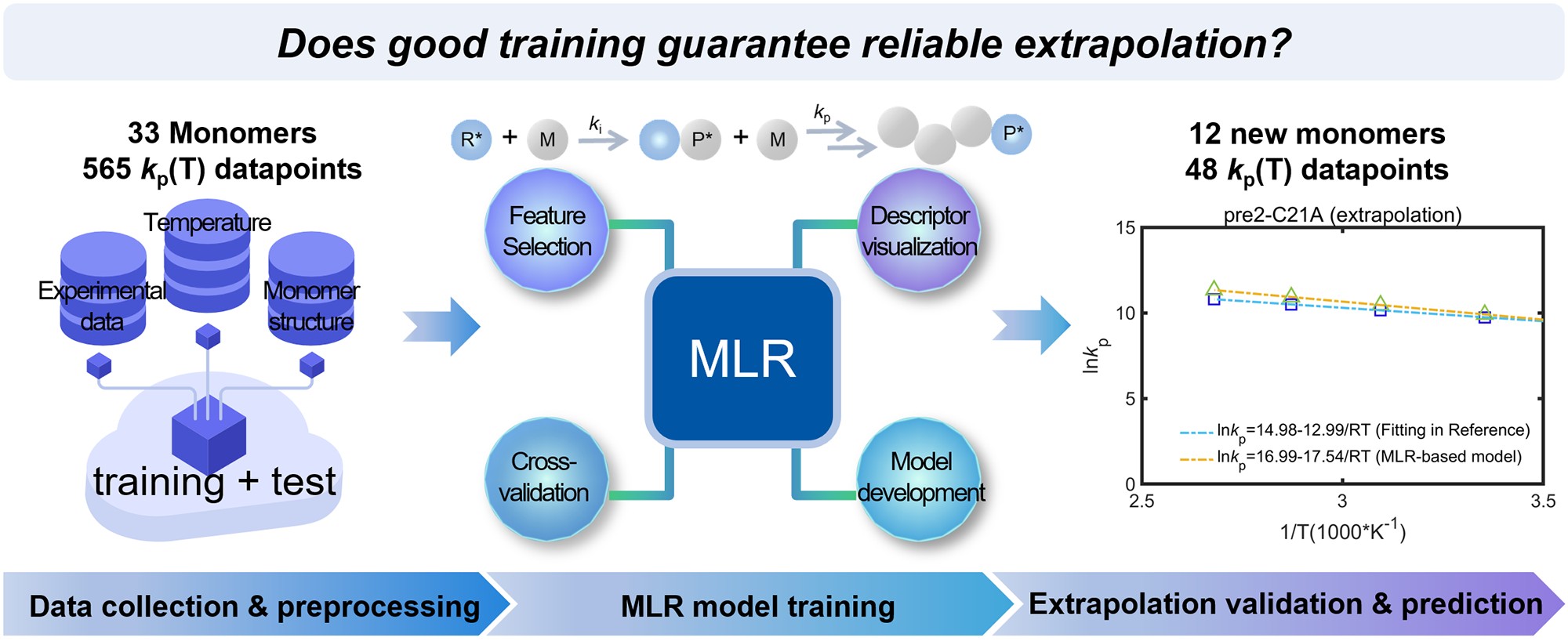
This work assesses the extrapolation performance of the kp (T, NI)-QSPR model for free-radical polymerization. Although QSPR models often achieve high interpolation accuracy, their reliability for predicting beyond the training domain, a situation common in monomer reactivity exploration, remains a critical challenge. To address this, prediction set is classified into interpolation and extrapolation categories using descriptor visualization. Extrapolation validation (EV) is employed to evaluate model reliability, defining an extrapolation degree (ED) to quantify how far test samples lie outside the training domain. Results demonstrate that the model achieves excellent interpolation accuracy but shows limited reliability when descriptors fall beyond the training set range. Descriptors suitable for forward or backward extrapolation are identified, with backward extrapolation yielding relatively better predictions for certain monomers. Uneven descriptor distributions are revealed as the primary cause of high ED and reduced extrapolation performance. This work provides a practical framework for assessing the applicability domain of the kp (T, NI)-QSPR model. More importantly, the established EV approach provides a transferable framework for applicability domain assessment and offers critical guidance for improving extrapolation robustness, thereby laying a foundation for extending such predictive methods to other temperature-dependent kinetic parameters in free-radical polymerization.
- Open Access
- Article
Extrapolative Prediction of Propagation Rate Coefficient in Free-Radical Polymerization Based on kp (T, NI)-QSPR Model
Author Information
Received: 29 May 2026 | Revised: 15 Sep 2026 | Accepted: 16 Sep 2026 | Published: 22 Sep 2026
Abstract
Graphical Abstract
Keywords
QSPR model | propagation rate coefficient | extrapolation performance | Arrhenius parameter | free-radical polymerization
References
- 1.
Jordan, M.I.; Mitchell, T.M. Machine learning: Trends, perspectives, and prospects. Science 2015, 349, 255–260.
- 2.
Gil, Y.; Greaves, M.; Hendler, J.; et al. Amplify scientific discovery with artificial intelligence. Science 2014, 346, 171–172.
- 3.
Shi, Y.; Yan, F.; Jin, J.; et al. Advances in calculation of kinetic parameters in free-radical polymerization by data-driven methods. Curr. Opin. Chem. Eng. 2025, 48, 101141.
- 4.
Li, J.; Zhao, T.; Yang, Q.; et al. A review of quantitative structure-activity relationship: The development and current status of data sets, molecular descriptors and mathematical models. Chemom. Intell. Lab. Syst. 2025, 256, 105278.
- 5.
Le, T.; Epa, V.C.; Burden, F.R.; et al. Quantitative structure–property relationship modeling of diverse materials properties. Chem. Rev. 2012, 112, 2889–2919.
- 6.
Shi, Y.; Wang, J.; Wang, Q.; et al. Supervised machine learning algorithms for predicting rate constants of ozone reaction with micropollutants. Ind. Eng. Chem. Res. 2022, 61, 8359–8367.
- 7.
Pan, I.; Mason, L.R.; Matar, O.K. Data-centric Engineering: Integrating simulation, machine learning and statistics. Challenges and opportunities. Chem. Eng. Sci. 2022, 249, 117271.
- 8.
Chen, L.; Liu, G.; Zhang, Z.; et al. Machine learning and molecular design algorithm assisted discovery of gas separation membranes exceeding the CO2/CH4 and CO2/N2 upper bounds. Chem. Eng. Sci. 2024, 291, 119952.
- 9.
Zhang, J.; Wang, Q.; Shen, W. Hyper-parameter optimization of multiple machine learning algorithms for molecular property prediction using hyperopt library. Chin. J. Chem. Eng. 2022, 52, 115–125.
- 10.
Chen, Y.; Ma, S.; Lei, Y.; et al. Ionic liquid binary mixtures: Machine learning-assisted modeling, solvent tailoring, process design, and optimization. AIChE J. 2024, 70, e18392.
- 11.
Chen, G.; Song, Z.; Qi, Z.; et al. A scalable and integrated machine learning framework for molecular properties prediction. AIChE J. 2023, 69, e18185.
- 12.
Ma, Y.; Gao, Z.; Shi, P.; et al. Machine learning-based solubility prediction and methodology evaluation of active pharmaceutical ingredients in industrial crystallization. Front. Chem. Sci. Eng. 2022, 16, 523–535.
- 13.
Fiosina, J.; Sievers, P.; Drache, M.; et al. Polymer reaction engineering meets explainable machine learning. Comput. Chem. Eng. 2023, 177, 108356.
- 14.
Raven, D.B.; Chikkula, Y.; Patel, K.M.; et al. Machine learning & conventional approaches to process control & optimization: Industrial applications & perspectives. Comput. Chem. Eng. 2024, 189, 108789.
- 15.
Kunz, M.R.; Yonge, A.; Fang, Z.; et al. Data driven reaction mechanism estimation via transient kinetics and machine learning. Chem. Eng. J. 2021, 420, 129610.
- 16.
Rogers, D.; Hahn, M. Extended-Connectivity Fingerprints. J. Chem. Inf. Model. 2010, 50, 742–754.
- 17.
Kwon, H.; Ali, Z.A.; Wong, B.M. Harnessing Semi-Supervised Machine Learning to Automatically Predict Bioactivities of Per- and Polyfluoroalkyl Substances (PFASs). Environ. Sci. Technol. Lett. 2023, 10, 1017–1022.
- 18.
Buback, M. Free-radical propagation rate coefficients. Can. J. Chem. Eng. 2023, 101, 5087–5098.
- 19.
Wang, T.T.; Zhou, Y.N.; Luo, Z.H.; et al. Beauty of Explicit Dispersity (Đ) Equations in Controlled Polymerizations. ACS Macro Lett. 2023, 12, 1423–1436.
- 20.
Wang, T.T.; Wu, Y.Y.; Luo, Z.H.; et al. “Living” Polymer Dispersity Quantification for Nitroxide-Mediated Polymerization Systems by Mimicking a Monodispersed Polymer Blending Strategy. Macromolecules 2020, 53, 10813–10822.
- 21.
Kockler, K.B.; Haehnel, A.P.; Junkers, T.; et al. Determining free-radical propagation rate coefficients with high-frequency lasers: Current status and future perspectives. Macromol. Rapid Commun. 2016, 37, 123–134.
- 22.
Beuermann, S.; Harrisson, S.; Hutchinson, R.A.; et al. Update and Critical Reanalysis of IUPAC Benchmark Propagation Rate Coefficient Data. Polym. Chem. 2022, 13, 1891–1900.
- 23.
Van Herck, J.; Harrisson, S.; Hutchinson, R.A.; et al. A Machine-Readable Online Database for Rate Coefficients in Radical Polymerization. Polym. Chem. 2021, 12, 3688–3692.
- 24.
Marien, Y.W.; Edeleva, M.; Van Steenberge, P.H.M.; et al. Chapter Three—Exploiting the pulsed laser polymerization-size exclusion chromatography technique to retrieve kinetic parameters in radical polymerization: State-of-the-art and future challenges. In Advances in Chemical Engineering; Academic Press: Cambridge, MA, USA, 2020; pp. 59–95.
- 25.
D’Hooge, D.R.; Van Steenberge, P.H.M.; Reyniers, M.F.; et al. The strength of multi-scale modeling to unveil the complexity of radical polymerization. Prog. Polym. Sci. 2016, 58, 59–89.
- 26.
Zhou, Y.N.; Li, J.J.; Wang, T.T.; et al. Precision polymer synthesis by controlled radical polymerization: Fusing the progress from polymer chemistry and reaction engineering. Prog. Polym. Sci. 2022, 130, 101555.
- 27.
Li, Y.; Wang, Q.; Lim, K.H.; et al. Characterization technique for kinetic coefficients of free radical polymerization. CIESC J. 2023, 74, 559–570.
- 28.
Beuermann, S.; Buback, M. Rate coefficients of free-radical polymerization deduced from pulsed laser experiments. Prog. Polym. Sci. 2002, 27, 191–254.
- 29.
Buback, M.; Gilbert, R.G.; Hutchinson, R.A.; et al. Critically Evaluated Rate Coefficients for Free-Radical Polymerization, 1. Propagation Rate Coefficient for Styrene. Macromol. Chem. Phys. 1995, 196, 3267–3280.
- 30.
Beuermann, S.; Buback, M.; Davis, T.P.; et al. Critically Evaluated Rate Coefficients for Free-Radical Polymerization, 2. Propagation Rate Coefficients for Methyl Methacrylate. Macromol. Chem. Phys. 1997, 198, 1545–1560.
- 31.
Olaj, O.F.; Bitai, I.; Hinkelmann, F. The Laser-Flash-Initiated Polymerization as a Tool of Evaluating (Individual) Kinetic Constants of Free-Radical Polymerization, 2. The Direct Determination of the Rate of Constant of Chain Propagation. Makromol. Chem. 1987, 188, 1689–1702.
- 32.
Vir, A.B.; Marien, Y.W.; Van Steenberge, P.H.M.; et al. From n-butyl acrylate Arrhenius parameters for backbiting and tertiary propagation to β-scission via stepwise pulsed laser polymerization. Polym. Chem. 2019, 10, 4116–4125.
- 33.
Moscatelli, D.; Dossi, M.; Cavallotti, C.; et al. Ab Initio Calculation of the Propagation Kinetics in Free Radical Polymerization: Chain Length and Penultimate Effects. Macromol. Symp. 2007, 259, 337–347.
- 34.
Edeleva, M.; Van Steenberge, P.H.M.; Sabbe, M.K.; et al. Connecting Gas-Phase Computational Chemistry to Condensed Phase Kinetic Modeling: The State-of-the-Art. Polymers 2021, 13, 3027.
- 35.
Trigilio, A.D.; Marien, Y.W.; Van Steenberge, P.H.M.; et al. Gillespie-Driven kinetic Monte Carlo Algorithms to Model Events for Bulk or Solution (Bio)Chemical Systems Containing Elemental and Distributed Species. Ind. Eng. Chem. Res. 2020, 59, 18357–18386.
- 36.
Arraez, F.J.; Xu, X.; Van Steenberge, P.H.M.; et al. Macropropagation Rate Coefficients and Branching Levels in Cationic Ring-Opening Polymerization of 2-Ethyl-2-oxazoline through Prediction of Size Exclusion Chromatography Data. Macromolecules 2019, 52, 4067–4078.
- 37.
Wu, Y.Y.; Figueira, F.L.; Van Steenberge, P.H.M.; et al. Bridging principal component analysis and method of moments based parameter estimation for grafting of polybutadiene with styrene. Chem. Eng. J. 2021, 425, 130463.
- 38.
Yu, X.; Wang, X. A support vector machine model for the prediction of monomer reactivity ratios. Polym. Sci. Ser. B 2011, 53, 528.
- 39.
Xu, J.; Wang, L.; Zhang, H.; et al. Quantitative structure-property relationships studies on free-radical polymerization chain-transfer constants for styrene. J. Appl. Polym. Sci. 2012, 123, 356–364.
- 40.
Van De Reydt, E.; Marom, N.; Saunderson, J.; et al. A Predictive machine-learning model for propagation rate coefficients in radical polymerization. Polym. Chem. 2023, 14, 1622–1629.
- 41.
Shi, Y.; Han, J.P.; Yan, F.; et al. In Silico Prediction of the Temperature-Dependent Decomposition Rate Coefficients of Symmetrical Azo Compounds. Ind. Eng. Chem. Res. 2023, 62, 17461–17472.
- 42.
Ishola, N.B.; McKenna, T.F.L. Machine learning techniques for the prediction of polymerization kinetics and polymer properties. Can. J. Chem. Eng. 2024, 102, 2228–2243.
- 43.
Datta, S.; Dev, V.A.; Eden, M.R. Hybrid genetic algorithm-decision tree approach for rate constant prediction using structures of reactants and solvent for Diels-Alder reaction. Comput. Chem. Eng. 2017, 106, 690–698.
- 44.
Datta, S.; Dev, V.A.; Eden, M.R. Developing non-linear rate constant QSPR using decision trees and multi-gene genetic programming. Comput. Chem. Eng. 2019, 127, 150–157.
- 45.
Zhou, Y.; Ren, Y.; Cui, M.; et al. Sonoelectrochemical system mechanisms, design, and machine learning for predicting degradation kinetic constants of pharmaceutical pollutants. Chem. Eng. J. 2023, 478, 147266.
- 46.
Chakkingal, A.; Janssens, P.; Poissonnier, J.; et al. Multi-output machine learning models for kinetic data evaluation: A Fischer–Tropsch synthesis case study. Chem. Eng. J. 2022, 446, 137186.
- 47.
Ouyang, B.; Zhang, D.; Chen, Z.; et al. Enhancing quantitative structure-property relationship models by integrating complete molecular structure with deep learning. Eng. Chem. Eng. 2026, 20, 16.
- 48.
Nguyen, T.; Bavarian, M. Machine learning approach to polymer reaction engineering: Determining monomers reactivity ratios. Polymer 2023, 275, 125866.
- 49.
Farajzadehahary, K.; Telleria-Allika, X.; Asua, J.M.; et al. An artificial neural network to predict reactivity ratios in radical copolymerization. Polym. Chem. 2023, 14, 2779–2787.
- 50.
Shi, Y.; Yu, M.; Liu, J.; et al. Quantitative structure–property relationship model for predicting the propagation rate coefficient in free-radical polymerization. Macromolecules 2022, 55, 9397–9410.
- 51.
Muckley, E.S.; Saal, J.E.; Meredig, B.; et al. Interpretable models for extrapolation in scientific machine learning. Digit. Discov. 2023, 2, 1425–1435.
- 52.
Wang, Y.; King, R.D. Extrapolation is not the same as interpolation. Mach. Learn. 2024, 113, 8205–8232.
- 53.
Ambrosio Garcia, F.; Naets, F. Beyond Limits: Enhancing the Extrapolation Performance of Regression Models by Leaving the Boundary Out. Mach. Learn. 2025, 114, 285.
- 54.
McCartney, M.; Haeringer, M.; Polifke, W. Comparison of Machine Learning Algorithms in the Interpolation and Extrapolation of Flame Describing Functions. J. Eng. Gas Turbines Power 2020, 142, 061009.
- 55.
Feng, X.; Xiong, J.; Wang, Q.; et al. Boiling point enhanced vapor pressure prediction by Antoine-based quantitative structure–property relationship. Chem. Eng. Sci. 2025, 306, 121269.
- 56.
Yu, M.; Zhou, Y.N.; Wang, Q.; et al. Extrapolation validation (EV): A universal validation method for mitigating machine learning extrapolation risk. Digit. Discov. 2024, 3, 1058–1067.
- 57.
Hastie, T.; Tibshirani, R.; Friedman, J. Linear Methods for Regression. In The Elements of Statistical Learning: Data Mining, Inference, and Prediction; Springer: New York, NY, USA, 2009; pp. 43–99.
- 58.
Alexopoulos, E.C. Introduction to multivariate regression analysis. Hippokratia 2010, 14, 23–28.
- 59.
Roy, K.; Kar, S.; Das, R.N. Chapter 7—Validation of QSAR Models. In Understanding the Basics of QSAR for Applications in Pharmaceutical Sciences and Risk Assessment; Academic Press: Boston, MA, USA, 2015; pp. 231–289.
- 60.
Gramatica, P.; Sangion, A. A historical excursus on the statistical validation parameters for QSAR models: A clarification concerning metrics and terminology. J. Chem. Inf. Model. 2016, 56, 1127–1131.


This work is licensed under a Creative Commons Attribution 4.0 International License.
