
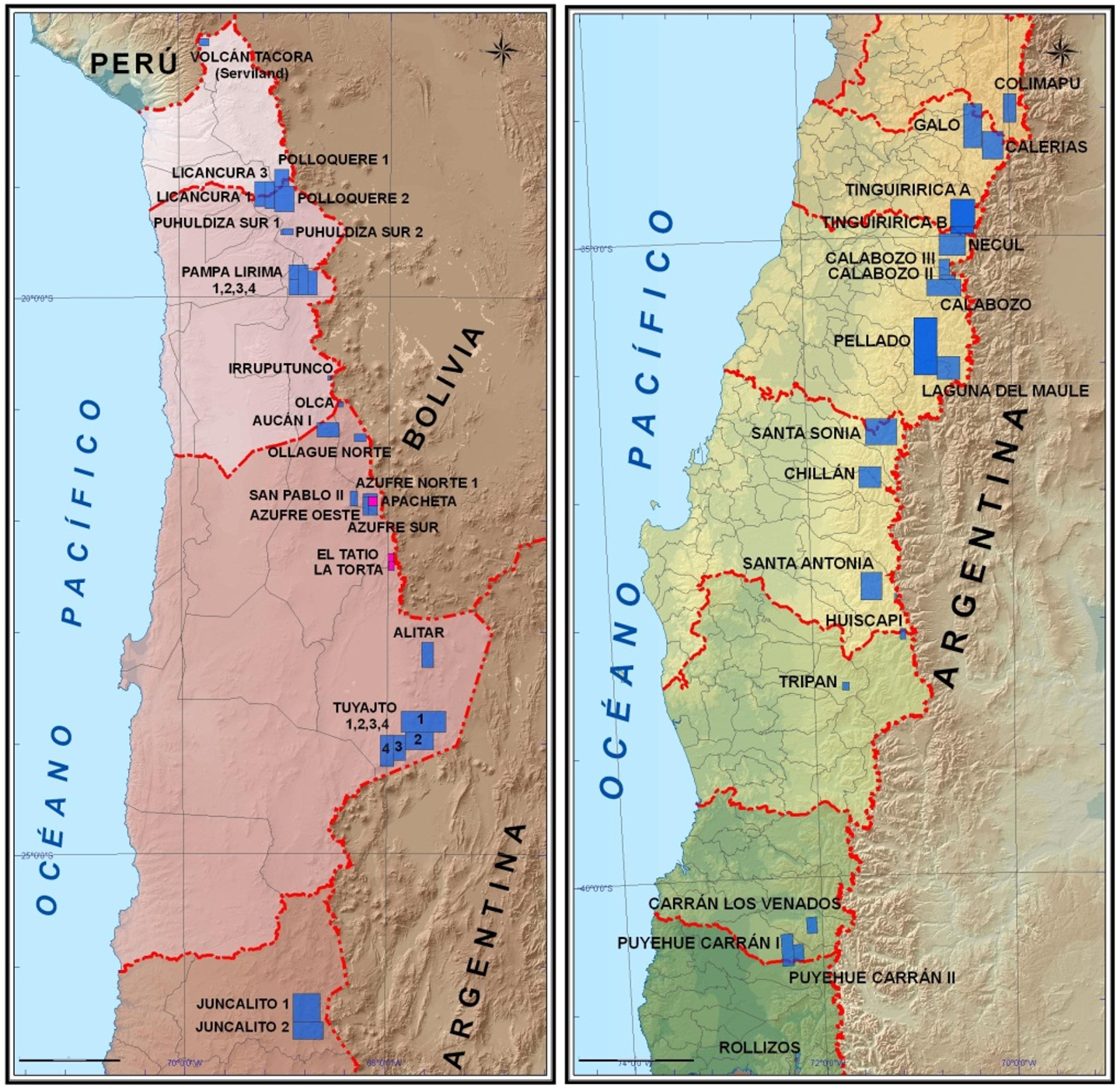
Chile represents one of the largest undeveloped geothermal areas of the world. Chile forms part of the Pacific Ring of Fire, a belt of volcanoes and earthquake epicentres. This belt contains numerous explored and virgin territories for geothermal energy production. The geothermal potential of Chile exceeds 12,000 MWe. The electricity demand in Chile has grown by 125% between 2000 and 2023. The per capita electricity consumption reached 4237 kWh in 2023. The low-carbon electricity generation continues to grow, reaching 3174 kWh per capita in 2024. The Chilean Government has stressed the importance of renewable energy supplies (mostly solar and geothermal, while also looking at further developing hydro energy). Contrary to other countries in the world, as e.g., New Zealand and Iceland, where geothermal energy is widely exploited, South America in general, and Chile in particular, remain in a preliminary development phase despite the abundant resources and the growing electricity demand. The aim of this paper is to illustrate the development of the geothermal energy in Chile, while showing the economical results of a test case of a Geothermal Power Plant of 50 MWe developed in the North of Chile.
- Open Access
- Article
Geothermal Energy in South America: A Case Study for Northern Chile
- Denisse Abudinén 1, 2,
- Miao Yang 3,
- Jin Zhang 3,
- Jan Baeyens 2, 3,
- Qian Kang 4, *,
- Yimin Deng 5, *
Author Information
Received: 04 May 2025 | Revised: 27 Jun 2025 | Accepted: 01 Jul 2025 | Published: 02 Jul 2025
Abstract
Graphical Abstract
Keywords
geothermal energy | Chile | geothermal power plant | economical assessment
References
- 1.Masum, M.; Akbar, M.A. The Pacific ring of fire is working as a home country of geothermal resources in the world. IOP Conf. Ser. Earth Environ. Sci. 2019, 249, 012020.
- 2.Rojas, P.M. Central and South America: significant but constrained potential for geothermal power generation. In Geothermal Power Generation; Elsevier: Amsterdam, The Netherlands, 2016; pp. 667–715.
- 3.de Souza Noel Simas Barbosa, L.; Bogdanov, D.; Vainikka, P.; et al. Hydro, wind and solar power as a base for a 100% renewable energy supply for South and Central America. PLoS ONE 2017, 12, e0173820.
- 4.Vidal, J.; Patrier, P.; Beaufort, D.; et al. Clay Minerals in the Deep Reservoir of the Cerro Pabellón Geothermal System (Northern Chile). Minerals 2022, 12, 1244.
- 5.The Thinkgeoenergy. Available online: http://thinkgeoenergy.com/thinkgeoenergys-top-10-geothermal-countries-2022-power-generation-capacity-mw/ (accessed on 20 January 2025)
- 6.Munoz-Carmona, F.; Hickson, C.; Bona, P.; et al. Factors for Geothermal Energy Development in Peru. In Proceedings of the Geothermal Resources Council Annual General meeting, Las Vegas, NV, USA, 29 September–2 October 2013.
- 7.Munoz-Saez, C.; Manga, M.; Hurwitz, S. Hydrothermal discharge from the El Tatio basin, Atacama, Chile. J. Volcanol. Geotherm. Res. 2018, 361, 25–35.
- 8.Penagos, F.G.; Eduardo, L.; Albeiro, L.; et al. Geothermal potential of the llanos and putumayo foreland basins of colombia and the fluid flow history of the formation waters. In Proceedings of the First EAGE Workshop on Geothermal Energy in Latin America, Online, 19–20 August 2021; pp. 1–4.
- 9.Paz, M.P.J.; Pérez–Zarate, D.; Prol-Ledesma, R.M.; et al. Geochemical exploration in Mesillas geothermal area, Mexico. Appl. Geochem. 2022, 143, 105376.
- 10.Jara-Alvear, J.; De Wilde, T.; Asimbaya, D.; et al. Geothermal resource exploration in South America using an innovative GIS-based approach: A case study in Ecuador. J. S. Am. Earth Sci. 2023, 122, 24. https://doi.org/10.1016/j.jsames.2022.104156.
- 11.Perton, M.; Hernández, L.T.M.; Figueroa-Soto, A.; et al. The magmatic plumbing system of the Acoculco volcanic complex (Mexico) revealed by ambient noise tomography. J. Volcanol. Geotherm. Res. 2022, 432, 13. https://doi.org/10.1016/j.jvolgeores.2022.107704.
- 12.Gawell, K.; Reed, M.; Wright, P.M. Preliminary Report: Geothermal Energy, the Potential for Clean Power from the Earth; Geothermal Energy Association: Washington, DC, USA, 1999.
- 13.Adebayo, T.S.; Akadiri, S.S.; Haouas, I.; et al. Criticality of geothermal and coal energy consumption toward carbon neutrality: evidence from newly industrialized countries. Environ. Sci. Pollut. Res. 2022, 29, 74841–74850.
- 14.Lahsen, A.; Muñoz, N.; Parada, M.A. Geothermal development in Chile. In Proceedings of the World Geothermal Congress, Bali, Indonesia, 25–30 April 2010; p. 7.
- 15.Vargas-Payera, S. Heat in the news: Geothermal energy in Chilean newspaper coverage. Renew. Energy 2024, 237, 10. https://doi.org/10.1016/j.renene.2024.121509.
- 16.Marco, T.; Barbara, N.; Orlando, V.; et al. Soil CO2 flux and temperature from a new geothermal area in the Cordon de Inacaliri Volcanic Complex (northern Chile). Geothermics 2021, 89, 15. https://doi.org/10.1016/j.geothermics.2020.101961.
- 17.Beate, B.; Salgado, R. Geothermal country update for Ecuador, 2005–2010. In Proceedings of the World Geothermal Congress, Bali, Indonesia, 25–30 April 2010; p. 16.
- 18.Aliaga, R.C. Geothermal potential in Bolivia. In Proceedings of the 6th New Zealand Geothermal Workshop, New Zealand, 7–9 November 1984; pp. 225–226.
- 19.Terceros, Z.D. State of the geothermal resources in Bolivia. In Proceedings of World Geothermal Congress, Kyushu-Tohoku, Japan, 28 May–10 June 2000; pp. 153–160.
- 20.Haraldsson, I.G. Geothermal activity in South America: Bolivia, Chile, Colombia, Ecuador, and Peru. In Proceedings of the Short Course on Conceptual Modeling of Geothermal Systems, Santa Tecla, El Salvador, 19 February–2 March 2013.
- 21.ThinkGeoEnergy. 2024: Peru’s Ministry of Energy and Mines (MEM) Estimates the Country’s Exploitable Geothermal Energy Potential at 3000 MW Capacity. Available online: http://thinkgeoenergy.com/small-yet-growing-contribution-of-geothermal-to-electricity-in-chile/ (accessed on 20 January 2025)
- 22.Geotérmica del Norte S.A. Estudio de Impacto Ambiental “Central Geotérmica Cerro Pabellón”. Available online: http://seia.sea.gob.cl/documentos/documento.php?idDocumento=5569787 (accessed on 20 January 2025)
- 23.Procesi, M. Geothermal Potential Evaluation for Northern Chile and Suggestions for New Energy Plans. Energies 2014, 7, 5444–5459. https://doi.org/10.3390/en7085444.
- 24.Almarza, D. Geothermal development in Chile. Presented at “Short Course VI on Utilization of Low- and Medium-Enthalpy Geothermal Resources and Financial Aspects of Utilization”, Organized by UNU-GTP and LaGeo, Santa Tecla, El Salvador, 23–29 March 2014. Available online: http://www.os.is/gogn/unu-gtp-sc/UNU-GTP-SC-18-06.pdf. (accessed on 20 January 2025)
- 25.Allen, M.; Avato, P.A.; Gehringer, M.; et al. Success of Geothermal Wells: A global Study; World Bank Group: Washington, DC, USA, 2013.
- 26.Bhogal, P.S. Geothermal Reservoir Engineering in Perspective; UNU-GTP: Reykjavik, Iceland, 1985.
How to Cite
Abudinén, D.; Yang, M.; Zhang, J.; Baeyens, J.; Kang, Q.; Deng, Y. Geothermal Energy in South America: A Case Study for Northern Chile. Science for Energy and Environment 2025, 2 (3), 7. https://doi.org/10.53941/see.2025.100007.
RIS
BibTex
Copyright & License

Copyright (c) 2025 by the authors.
This work is licensed under a Creative Commons Attribution 4.0 International License.
Article Metrics
347
Article Views
0
Citations
Contents
References

 Suite 4002 Level 4, 447 Collins Street, Melbourne, Victoria 3000, Australia
 General Inquiries: info@sciltp.com