
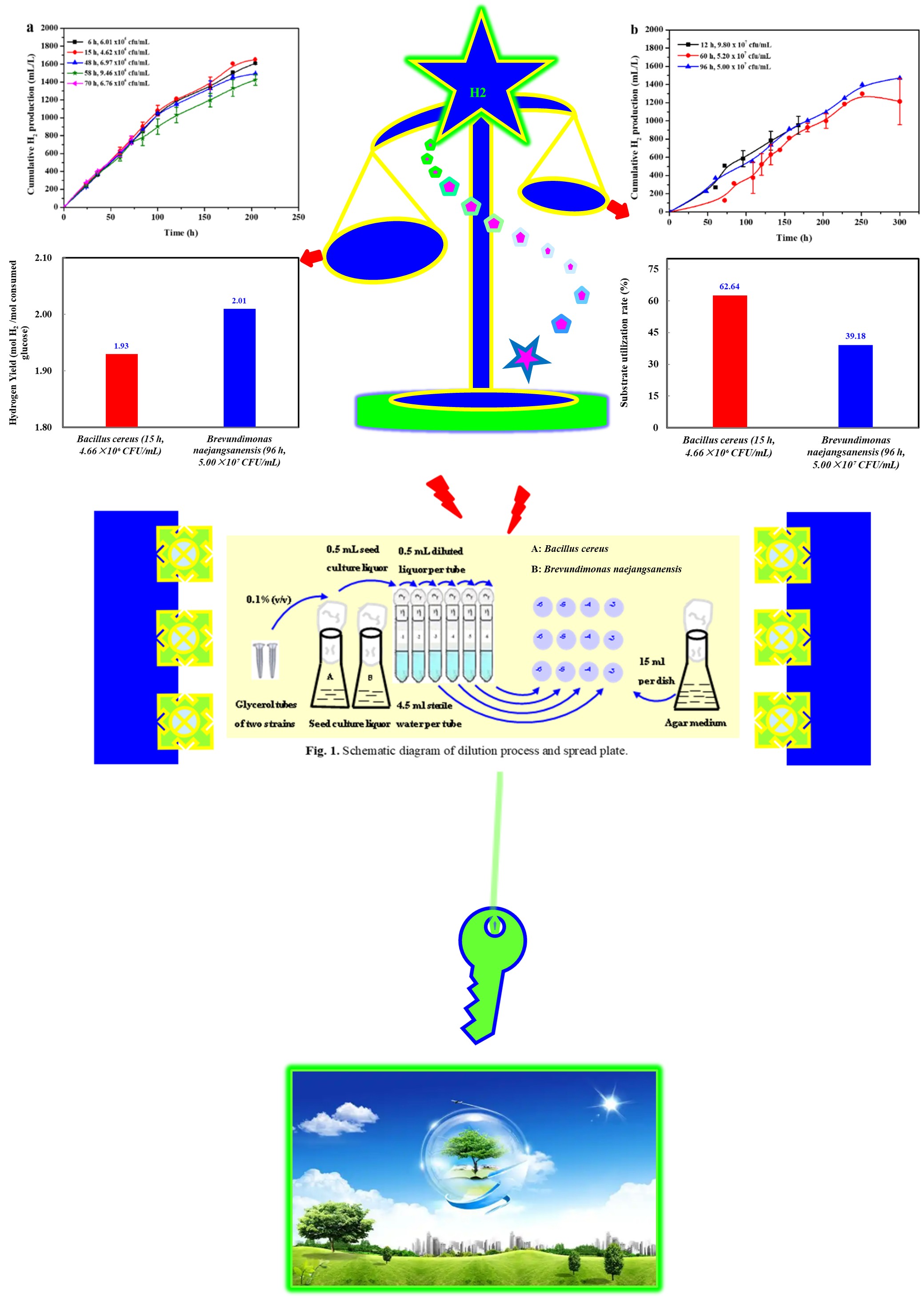
In order to improve the H2-production of Bacillus cereus (B. cereus) and Brevundimonas naejangsanensis (B. naejangsanensis) by dark fermentation and provide the preferred inoculation conditions for better understanding the process of a co-culture fermentative hydrogen production by both strains, initial inoculation conditions for the single fermentation of both strains were optimized. Results showed that the preferred initial inoculation conditions are 15 h (4.62 × 10⁶ CFU/mL) and 96 h (5.00 × 10⁷ CFU/mL). At the end of fermentation, the highest H2 yield is 1.93 mol H2/mol glucose consumed and 1.98 mol H2/mol glucose consumed, respectively. The corresponding substrate consumption rates are 62.64% and 53.25%. Results also showed that inoculated seed liquid in the early stage of the deceleration growth phase has the capacity of both the effective utilization of starch and production of hydrogen for B. cereus, and that in the late stage of the deceleration growth phase has the similar effect for B. naejangsanensis. The time required to decompose starch to soluble sugar of B. cereus is faster 24 h than that of B. naejangsanensis. When metabolic pathway shifted to produce lactic and propionic acid, hydrogen production decreased, elevated acetic and butyric acid concentrations correlated with higher hydrogen production. Butyric acid-type fermentation is dominating during the fermentation process of both strains. B. cereus demonstrated superior performance for starch-based hydrogen production.
- Open Access
- Article
Optimizing Inoculation Conditions for a Two-Strain Fermentation of H2 Production
- Hanxiao Ma 1, *,
- Qian Kang 2
Author Information
Received: 27 May 2025 | Revised: 06 Jul 2025 | Accepted: 09 Jul 2025 | Published: 11 Jul 2025
Abstract
Graphical Abstract
Keywords
biohydrogen production | Bacillus cereus | Brevundimonas naejangsanensis | initial inoculation conditions
References
- 1.Dzulkarnain, E.L.N.; Audu, J.O.; Wan Dagang, W.R.Z.; et al. Microbiomes of biohydrogen production from dark fermentation of industrial wastes: Current trends, advanced tools and future outlook. Bioresour. Bioprocess. 2022, 9, 16. https://doi.org/10.1186/s40643-022-00504-8.
- 2.Baeyens, J.; Zhang, H.L.; Nie, J.P.; et al. Reviewing the potential of bio-hydrogen production by fermentation. Renew. Sust. Energ. Rev. 2020, 131, 110023. https://doi.org/10.1016/j.rser.2020.110023.
- 3.Dahiya, S.; Chatterjee, S.; Sarkar, O.; et al. Renewable hydrogen production by dark-fermentation: Current status, challenges and perspectives. Bioresour. Technol. 2021, 321, 124354. https://doi.org/10.1016/j.biortech. 2020.124354.
- 4.Rahman, S.N.A.; Masdar, M.S.; Rosli, M.I.; et al. Overview biohydrogen technologies and application in fuel cell technology. Renew. Sustain. Energy Rev. 2016, 66, 137–162.
- 5.Bao, M.D.; Su, H.J.; Tan, T.W. Biohydrogen production by dark fermentation of starch using mixed bacterial cultures of Bacillus sp. and Brevumdimonas sp. Energy Fuels 2012, 26, 5872–5878. https://doi.org/10.1021/ef300666m.
- 6.Lee, H.S.; Krajmalinik-Brown, R.; Zhang, H.; et al. An electron-flow model can predict complex redox reactions in mixed-culture fermentative BioH2: Microbial ecology evidence. Biotechnol. Bioeng. 2009, 104, 687–697. https://doi.org/10.1002/bit.22442.
- 7.Li, Y.F.; Ren, N.Q.; Chen, Y.; et al. Ecological mechanism of fermentative hydrogen production by bacteria. Int. J. Hydrogen Energy 2007, 32, 755–760. https://doi.org/10.1016/j.ijhydene.2006.08.004.
- 8.Hawkes, F.R.; Hussy, I.; Kyazze, G.; et al. Continuous dark fermentative hydrogen production by mesophilic microflora: Principles and progress. Int. J. Hydrogen Energy 2007, 32, 172–184. https://doi.org/10.1016/j.ijhydene.2006.08.014.
- 9.Levin, D.B.; Islam, R.; Cicek, N.; et al. Hydrogen production by Clostridium thermocellum 27405 from cellulosic biomass substrates. Int. J. Hydrogen Energy 2006, 31, 1496–1503. https://doi.org/10.1016/j.ijhydene.2006.06.015.
- 10.Yokoi, H.; Tokushige, T.; Hirose, J.; et al. Hydrogen production by immobilized cells of aciduric Enterobacter aerogenes strain HO-39. J. Ferment. Bioeng. 1997, 83, 481–484. https://doi.org/10.1016/S0922-338X(97)83006-1.
- 11.Du, J.; Zhou, J.; Xue, J.; et al. Metabolomic profiling elucidates community dynamics of the Ketogulonicigenium vulgare-Bacillus megaterium consortium. Metabolomics 2012, 8, 960–973. https://doi.org/10.1007/s11306-011-0392-2.
- 12.Wang, X.Y.; Jin, B. Process optimization of biological hydrogen production from molasses by a newly isolated Clostridium butyricum W5. J. Biosci. Bioeng. 2009, 107, 138–144. https://doi.org/10.1016/j.jbiosc.2008.10.012.
- 13.Azman, N.F.; Abdeshahian, P.; Kadier, A.; et al. Utilization of palm kernel cake as a renewable feedstock for fermentative hydrogen production. Renew. Energy 2016, 93, 700–708. https://doi.org/10.1016/j.renene.2016. 03.046.
- 14.Li, Q.; Liu, C.Z. Co-culture of Clostridium thermocellum and Clostridium thermosaccharolyticum for enhancing hydrogen production via thermophilic fermentation of cornstalk waste. Int. J. Hydrogen Energy 2012, 37, 10648–10654. https://doi.org/10.1016/j.ijhydene.2012.04.115.
- 15.Ma, H.X.; Su, H.J. Effect of temperature on the fermentation of starch by two high efficient H2 producers. Renew. Energy 2019, 138, 964–970. https://doi.org/10.1016/j.renene.2019.01.126.
- 16.Ma, H.X.; Liu, Y.; Li, Z.P. The synergistic hydrogen production of bicellular fermentation systems and fluid dynamics simulation in reactor under stirring. Bioresour. Technol. Rep. 2023, 22, 101473. https://doi.org/10.1016/j.biteb.2023.101473.
- 17.Bao, M.D.; Su, H.J.; Tan, T.W. Dark fermentative bio-hydrogen production: Effects of substrate pre-treatment and addition of metal ions or L-cysteine. Fuel 2013, 112, 38–44. https://doi.org/10.1016/j.fuel.2013.04.063.
- 18.Wang, S.J.; Ma, Z.H.; Zhang, T.; et al. Optimization and modeling of biohydrogen production by mixed bacterial cultures from raw cassava starch. Front. Chem. Sci. Eng. 2017, 11, 100–106. https://doi.org/10.1007/s11705-017-1617-3.
- 19.Miller, G.L. Use of dinitrosalicylic acid reagent for determination of reducing sugars. Anal. Chem. 1959, 31, 426–428. https://doi.org/10.1021/ac60147a030.
- 20.Abdeshahian, P.; Al-Shorgani, N.K.N.; Salih, N.K.M.; et al. The production of biohydrogen by a novel strain Clostridium sp. YM1 in dark fermentation process. Int. J. Hydrogen Energy 2014, 39, 12524–12531. https://doi.org/10.1016/j.ijhydene.2014.05.081.
- 21.Wang, S.J.; Tang, H.Z.; Peng, F.; et al. Metabolite-based mutualism enhances hydrogen production in a two-species microbial consortium. Commun. Biol. 2019, 2, 82. https://doi.org/10.1038/s42003-019-0331-8.
- 22.Liu, I.C.; Whang, L.M.; Ren, W.J.; et al. The effect of pH on the production of biohydrogen by clostridia: Thermodynamic and metabolic considerations. Int. J. Hydrogen Energy 2011, 36, 439–449. https://doi.org/10.1016/j.ijhydene.2010.10.045.
- 23.Dada, O.; Yusoff, W.M.W.; Kalil, M.S. Biohydrogen production from ricebran using Clostridium saccharoperbutylacetonicum N1-4. Int. J. Hydrogen Energy 2013, 38, 15063–15073. https://doi.org/10.1016/j.ijhydene.2013.07.048.
- 24.Li, W.M.; Cheng, C.; Ren, N.Q.; et al. Different feedback effects of aqueous end products on hydrogen production of Clostridium tyrobutyricum. Int. J. Hydrogen Energy 2022, 47, 35156–35170. https://doi.org/10.1016/j.ijhydene.2022.08.120.
- 25.Vassilev, I.; Gießelmann, G.; Schwechheimer, S.K.; et al. Anodic electro-fermentation: Anaerobic production of L-Lysine by recombinant Corynebacterium glutamicum. Biotechnol. Bioeng. 2018, 115, 1499–1508. https://doi.org/10.1002/bit.26562.
- 26.Rasdi, Z.; Mumtaz, T.; Rahman, N.A.A.; et al. Kinetic analysis of biohydrogen production from anaerobically treated POME in bioreactor under optimized condition. Int. J. Hydrogen Energy 2012, 37, 17724–17730. https://doi.org/10.1016/j.ijhydene.2012.08.095.
- 27.Khanal, S.K.; Chen, W.H.; Li, L.; et al. Biological hydrogen production: Effects of pH and intermediate products. Int. J. Hydrogen Energy 2004, 29, 1123–1131. https://doi.org/10.1016/j.ijhydene.2003.11.002.
- 28.Chin, H.L.; Chen, Z.S.; Chou, C.P. Fedbatch operation using Clostridium acetobutylicum suspension culture as biocatalyst for enhancing hydrogen production. Biotechnol. Prog. 2003, 19, 383–388. https://doi.org/10.1021/bp0200604.
- 29.Ergal, İ.; Fuchs, W.; Hasibar, B.; et al. The physiology and biotechnology of dark fermentative biohydrogen production. Biotechnol. Adv. 2018, 36, 2165–2186. https://doi.org/10.1016/j.biotechadv.2018.10.005.
- 30.Verhaart, M.R.A.; Bielen, A.A.M.; Van der Oost, J.; et al. Hydrogen production by hyperthermophilic and extremely thermophilic bacteria and archaea: Mechanisms for reductant disposal. Environ. Technol. 2010, 31, 993–1003. https://doi.org/10.1080/09593331003710244.
- 31.Chittibabu, G.; Nath, K.; Das, D. Feasibility studies on the fermentative hydrogen production by recombinant Escherichia coli BL-21. Process Biochem. 2006, 41, 682–688. https://doi.org/10.1016/j.procbio.2005.08.020.
- 32.Willquist, K.; van Niel, E.W.J. Lactate formation in Caldicellulosiruptor saccharolyticus is regulated by the energy carriers pyrophosphate and ATP. Metab. Eng. 2010, 12, 282–290. https://doi.org/10.1016/j.ymben.2010.01.001.
- 33.Antonopoulou, G.; Gavala, H.N.; Skiadas, I.V.; et al. Influence of pH on fermentative hydrogen production from sweet sorghum extract. Int. J. Hydrogen Energy 2010, 35, 1921–1928. https://doi.org/10.1016/j.ijhydene.2009.12.175.
- 34.Hallenbeck, P.C. Fermentative hydrogen production: Principles, progress, and prognosis. Int. J. Hydrogen Energy 2009, 34, 7379–7389. https://doi.org/10.1016/j.ijhydene.2008.12.080.
- 35.Ciranna, A.; Ferrari, R.; Santala, V.; et al. Inhibitory effects of substrate and soluble end products on biohydrogen production of the alkalithermophile Caloramator celer: Kinetic, metabolic and transcription analyses. Int. J. Hydrogen Energy 2014, 39, 6391–6401. https://doi.org/10.1016/j.ijhydene.2014.02.047.
- 36.Nicolaou, S.A.; Gaida, S.M.; Papoutsakis, E.T. A comparative view of metabolite and substrate stress and tolerance in microbial bioprocessing: From biofuels and chemicals, to biocatalysis and bioremediation. Metab. Eng. 2010, 12, 307–331. https://doi.org/10.1016/j.ymben. 2010.03.004.
- 37.Li, W.M.; He, L.; Cheng, C.; et al. Effects of biochar on ethanol-type and butyrate-type fermentative hydrogen productions. Bioresour. Technol. 2020, 306, 123088. https://doi.org/10.1016/j.biortech.2020.123088.
- 38.Li, S.; Kang, Q.; Baeyens, J.; et al. Hydrogen production: State of technology. IOP Conf. Ser. Earth Environ. Sci. 2020, 544, 012011. https://doi.org/10.1088/1755-1315/544/1/012011.
- 39.Zhao, M.X.; Ruan, W.Q. Improving hydrogen generation from kitchen wastes by microbial acetate tolerance response. Energ. Convers. Manag. 2014, 77, 419–423. https://doi.org/10.1016/j.enconman.2013.10.007.
- 40.Cotter, P.D.; Hill, C. Surviving the acid test: Responses of gram-positive bacteria to low pH. Microbiol. Mol. Biol. Rev. 2003, 67, 429–453. https://doi.org/10.1128/MMBR.67.3.429-453.2003.
- 41.Junghare, M.; Subudhi, S.; Lal, B. Improvement of hydrogen production under decreased partial pressure by newly isolated alkaline tolerant anaerobe, Clostridium butyricum TM-9A: Optimization of process parameters. Int. J. Hydrogen Energy 2012, 37, 3160–3168. https://doi.org/10.1016/j.ijhydene.2011.11.043.
- 42.Keskin, T.; Abubackar, H.N.; Yazgin, O.; et al. Effect of percolation frequency on biohydrogen production from fruit and vegetable wastes by dry fermentation. Int. J. Hydrogen Energy 2019, 44, 18767–18775. https://doi.org/10.1016/j.ijhydene.2018.12.099.
- 43.Vardar-Schara, G.; Maeda, T.; Wood, T.K. Metabolically engineered bacteria for producing hydrogen via fermentation. Microb. Biotechnol. 2008, 1, 107–125. https://doi.org/10.1111/j.1751-7915.2007.00009.x.
- 44.Wang, S.J.; Zhang, T.; Su, H.J. Enhanced hydrogen production from corn starch wastewater as nitrogen source by mixed cultures. Renew. Energy 2016, 96, 1135–1141. https://doi.org/10.1016/j.renene.2015.11.072.
- 45.Elsharnouby, O.; Hafez, H.; Nakhla, G.; et al. A critical literature review on biohydrogen production by pure cultures. Int. J. Hydrogen Energy 2013, 38, 4945–4966. https://doi.org/10.1016/j.ijhydene.2013.02.032.

How to Cite
Ma, H.; Kang, Q. Optimizing Inoculation Conditions for a Two-Strain Fermentation of H2 Production. Science for Energy and Environment 2025, 2 (3), 8. https://doi.org/10.53941/see.2025.100008.
RIS
BibTex
Copyright & License

Copyright (c) 2025 by the authors.
This work is licensed under a Creative Commons Attribution 4.0 International License.
Article Metrics
129
Article Views
0
Citations
Contents
References

 Suite 4002 Level 4, 447 Collins Street, Melbourne, Victoria 3000, Australia
 General Inquiries: info@sciltp.com