
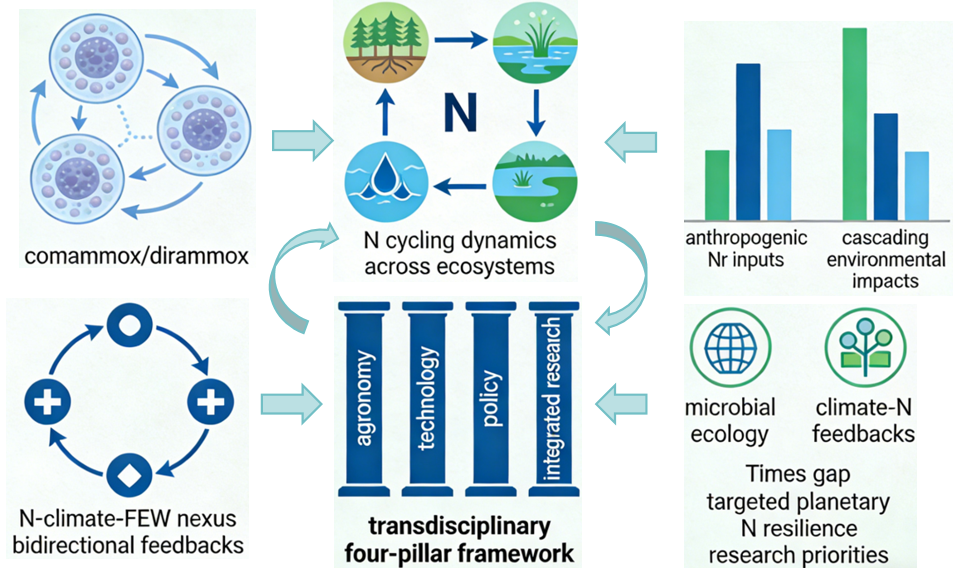
Nitrogen (N) is an essential constituent of all living organisms and a primary nutrient limiting life on Earth, mediating critical biogeochemical processes across the atmosphere, hydrosphere, biosphere, and pedosphere. The natural nitrogen cycle is a finely tuned network of microbial, physical, and chemical transformations that regulate the availability of reactive nitrogen (Nr) while maintaining environmental equilibrium. However, anthropogenic activities—particularly industrial nitrogen fixation via the Haber–Bosch process, intensive agriculture, and fossil fuel combustion—have drastically perturbed this cycle, leading to a tripling of global Nr inputs since the pre-industrial era. This perturbation has triggered cascading environmental crises, including eutrophication of aquatic ecosystems, atmospheric pollution, greenhouse gas emissions, and biodiversity loss, while simultaneously threatening food security and human health. Achieving a sustainable nitrogen cycle is therefore central to addressing global sustainability challenges, including the United Nations Sustainable Development Goals (SDGs). In this Review, we synthesize the latest advances in our understanding of the natural nitrogen cycle and its anthropogenic perturbations, highlight the complex interactions between nitrogen cycling and climate change, food-energy-water (FEW) nexus, and ecosystem resilience, and outline actionable pathways to restore and sustain nitrogen balance at local, regional, and global scales. We emphasize the need for integrated, transdisciplinary approaches that combine microbial ecology, biogeochemistry, agronomy, policy, and technology to mitigate Nr losses, enhance nitrogen use efficiency (NUE), and reconcile food production with environmental protection. Finally, we identify key knowledge gaps and future research priorities that will be critical for advancing toward a sustainable nitrogen cycle and safeguarding planetary health.
- Open Access
- Review
Sustainable Nitrogen Cycle: Mechanisms, Anthropogenic Perturbations, and Pathways to Global Resilience
- Fanghua Li 1,2,3
Author Information
Received: 23 Feb 2026 | Revised: 16 Apr 2026 | Accepted: 20 Apr 2026 | Published: 23 Apr 2026
Abstract
Graphical Abstract
Keywords
sustainable nitrogen cycle | reactive nitrogen | nitrogen use efficiency | food-energy-water nexus | climate-nitrogen feedbacks
References
- 1.
Canfield, D.E.; Glazer, A.N.; Falkowski, P.G. The Evolution and Future of Earth’s Nitrogen Cycle. Science 2010, 330, 192–196. https://doi.org/10.1126/science.1186120.
- 2.
Galloway, J.N.; Aber, J.D.; Erisman, J.W.; et al. The Nitrogen Cascade. BioScience 2003, 53, 341–356. https://doi.org/10.1641/0006-3568(2003)053[0341:Tnc]2.0.Co;2.
- 3.
Smith, C.; Hill, A.K.; Torrente-Murciano, L. Current and future role of Haber–Bosch ammonia in a carbon-free energy landscape. Energy Environ. Sci. 2020, 13, 331–344. https://doi.org/10.1039/C9EE02873K.
- 4.
Zhang, X.; Winiwarter, W.; van Grinsven, H.J.M.; et al. Integrated assessment of the costs and benefits of reactive nitrogen emission and mitigation: A methodological review and framework proposal. Earth Crit. Zone 2025, 2, 100047. https://doi.org/10.1016/j.ecz.2025.100047.
- 5.
Fowler, D.; Coyle, M.; Skiba, U.; et al. The global nitrogen cycle in the twenty-first century. Philos. Trans. R. Soc. B Biol. Sci. 2013, 368, 20130164. https://doi.org/10.1098/rstb.2013.0164.
- 6.
Steffen, W.; Richardson, K.; Rockström, J.; et al. Planetary boundaries: Guiding human development on a changing planet. Science 2015, 347, 1259855, doi:doi:10.1126/science.1259855.
- 7.
Ma, X.; Wang, X.; Liu, J.; et al. Electrochemical N2 Conversion: Reduction and Oxidation Pathways under Mild Conditions. Sci. Energy Environ. 2026, 3, 1. https://doi.org/10.53941/see.2026.100001.
- 8.
Zhang, L.; Liu, Y.; Li, L.; et al. Aryl sulfur ligand-modulated silver catalysts with tailored binding affinity for selective nitrate-to-ammonia conversion. Nat. Commun. 2026, 17, 2553. https://doi.org/10.1038/s41467-026-69385-1.
- 9.
Ward, B.B.; Jensen, M.M. The microbial nitrogen cycle. Front. Microbiol. 2014, 5, 553. https://doi.org/10.3389/fmicb.2014.00553.
- 10.
Palatinszky, M.; Herbold, C.W.; Sedlacek, C.J.; et al. Growth of complete ammonia oxidizers on guanidine. Nature 2024, 633, 646–653. https://doi.org/10.1038/s41586-024-07832-z.
- 11.
Li, D.; Fang, F.; Liu, G. Efficient Nitrification and Low-Level N(2)O Emission in a Weakly Acidic Bioreactor at Low Dissolved-Oxygen Levels Are Due to Comammox. Appl. Environ. Microbiol. 2021, 87. https://doi.org/10.1128/AEM.00154-21.
- 12.
Seitzinger, S.; Harrison, J.A.; Böhlke, J.K.; et al. Denitrification across landscapes and waterscapes: A synthesis. Ecol. Appl. 2006, 16, 2064–2090. https://doi.org/10.1890/1051-0761(2006)016[2064:dalawa]2.0.co;2.
- 13.
Strous, M.; Fuerst, J.A.; Kramer, E.H.M.; et al. Missing lithotroph identified as new planctomycete. Nature 1999, 400, 446–449. https://doi.org/10.1038/22749.
- 14.
Xu, X.; Yang, Y.; Zhou, Y.; et al. Global patterns and drivers of coupling between anammox and denitrification processes across inland aquatic ecosystems. Commun. Earth Environ. 2025, 6, 23. https://doi.org/10.1038/s43247-024-01980-w.
- 15.
Zhang, L.; Liu, Y.; Li, L.; et al. High-efficiency ammonia electrosynthesis from nitrate on ruthenium-induced trivalent cobalt sites. Energy Environ. Sci. 2025, 18, 5622–5631. https://doi.org/10.1039/D5EE01585E.
- 16.
Akinnawo, S.O. Eutrophication: Causes, consequences, physical, chemical and biological techniques for mitigation strategies. Environ. Chall. 2023, 12, 100733. https://doi.org/10.1016/j.envc.2023.100733.
- 17.
Melillo, J.M. Disruption of the global nitrogen cycle: A grand challenge for the twenty-first century. Ambio 2021, 50, 759–763. https://doi.org/10.1007/s13280-020-01429-2.
- 18.
Erfani, N.; Baharudin, L.; Watson, M. Recent advances and intensifications in Haber-Bosch ammonia synthesis process. Chem. Eng. Process. Process Intensif. 2024, 204, 109962. https://doi.org/10.1016/j.cep.2024.109962.
- 19.
Jin, X.; Behrens, P.; Erisman, J.W.; et al. Ammonia emissions from agricultural products at high resolution across Europe. Sci. Data 2025, 12, 1493. https://doi.org/10.1038/s41597-025-05110-9.
- 20.
Rizwan, M.; Tanveer, H.; Ali, M.H.; et al. Role of reactive nitrogen species in changing climate and future concerns of environmental sustainability. Environ. Sci. Pollut. Res. Int. 2024, 31, 51147–51163. https://doi.org/10.1007/s11356-024-34647-2.
- 21.
Maúre, E.d.R.; Terauchi, G.; Ishizaka, J.; et al. Globally consistent assessment of coastal eutrophication. Nat. Commun. 2021, 12, 6142. https://doi.org/10.1038/s41467-021-26391-9.
- 22.
Richardson, K.; Steffen, W.; Lucht, W.; et al. Earth beyond six of nine planetary boundaries. Sci. Adv. 2023, 9, eadh2458. https://doi.org/10.1126/sciadv.adh2458.
- 23.
Wang, Y.; Liu, D.; Xiao, W.; et al. Coastal eutrophication in China: Trend, sources, and ecological effects. Harmful Algae 2021, 107, 102058. https://doi.org/10.1016/j.hal.2021.102058.
- 24.
Giovannoni, S.J. SAR11 Bacteria: The Most Abundant Plankton in the Oceans. Annu. Rev. Mar. Sci. 2017, 9, 231–255. https://doi.org/10.1146/annurev-marine-010814-015934.
- 25.
Malone, T.C.; Newton, A. The Globalization of Cultural Eutrophication in the Coastal Ocean: Causes and Consequences. Front. Mar. Sci. 2020, 7. https://doi.org/10.3389/fmars.2020.00670.
- 26.
Khoshakhlagh, A.H.; Mohammadzadeh, M.; Gruszecka-Kosowska, A.; et al. Burden of cardiovascular disease attributed to air pollution: A systematic review. Glob. Health 2024, 20, 37. https://doi.org/10.1186/s12992-024-01040-0.
- 27.
Climate Change 2022—Mitigation of Climate Change: Working Group III Contribution to the Sixth Assessment Report of the Intergovernmental Panel on Climate Change; Cambridge University Press: Cambridge, UK, 2023.
- 28.
Ruan, Y.; Bao, Q.; Wang, L.; et al. Cardiovascular diseases burden attributable to ambient PM2.5 pollution from 1990 to 2019: A systematic analysis for the global burden of disease study 2019. Environ. Res. 2024, 241, 117678. https://doi.org/10.1016/j.envres.2023.117678.
- 29.
Bodirsky, B.L.; Popp, A.; Lotze-Campen, H.; et al. Reactive nitrogen requirements to feed the world in 2050 and potential to mitigate nitrogen pollution. Nat. Commun. 2014, 5, 3858. https://doi.org/10.1038/ncomms4858.
- 30.
Hu, Z.; Fan, Y.; Yang, J.; et al. Nitrogen deposition reduces biodiversity but strengthens plant–microbe interactions. Geoderma 2025, 460, 117449. https://doi.org/10.1016/j.geoderma.2025.117449.
- 31.
Liu, X.; Zhang, Y.; Han, W.; et al. Enhanced nitrogen deposition over China. Nature 2013, 494, 459–462. https://doi.org/10.1038/nature11917.
- 32.
Gui, X.; Wang, W.; Qin, D.; et al. Revisiting the microbial nitrogen-cycling network: Bibliometric analysis and recent advances. Environ. Earth Sci. 2025, 84, 484. https://doi.org/10.1007/s12665-025-12481-0.
- 33.
Leauthaud, C.; Leenhardt, D. Towards multiservice irrigation for an agroecological future. npj Sustain. Agric. 2025, 3, 55. https://doi.org/10.1038/s44264-025-00094-w.
- 34.
Zhang, W.; Cao, G.; Li, X.; et al. Closing yield gaps in China by empowering smallholder farmers. Nature 2016, 537, 671–674. https://doi.org/10.1038/nature19368.
- 35.
Ibn, R.A.; Ghosh, U.K.; Hossain, M.S.; et al. Enhancing nitrogen use efficiency in cereal crops: From agronomy to genomic perspectives. Cereal Res. Commun. 2025, 53, 1–16. https://doi.org/10.1007/s42976-024-00515-5.
- 36.
Weber, M.A. Blood pressure variability and cardiovascular prognosis: Implications for clinical practice. Eur. Heart J. 2017, 38, 2823–2826. https://doi.org/10.1093/eurheartj/ehx322.
- 37.
Cardenas, I.C. Mitigation of climate change. Risk and uncertainty research gaps in the specification of mitigation actions. Environ. Sci. Policy 2024, 162, 103912. https://doi.org/10.1016/j.envsci.2024.103912.
- 38.
Romanello, M.; Di Napoli, C.; Drummond, P.; et al. The 2022 report of the Lancet Countdown on health and climate change: Health at the mercy of fossil fuels. Lancet 2022, 400, 1619–1654. https://doi.org/10.1016/S0140-6736(22)01540-9.
- 39.
Moreno-García, P.; Montaño-Centellas, F.; Liu, Y.; et al. Long-term nitrogen deposition reduces the diversity of nitrogen-fixing plants. Sci. Adv. 2024, 10, eadp7953, doi:doi:10.1126/sciadv.adp7953.
- 40.
Rockström, J.; Williams, J.; Daily, G.; et al. Sustainable intensification of agriculture for human prosperity and global sustainability. Ambio 2017, 46, 4–17. https://doi.org/10.1007/s13280-016-0793-6.
- 41.
Mueller, N.D.; Gerber, J.S.; Johnston, M.; et al. Correction: Corrigendum: Closing yield gaps through nutrient and water management. Nature 2013, 494, 390. https://doi.org/10.1038/nature11907.
- 42.
Mouratiadou, I.; Latka, C.; van der Hilst, F.; et al. Quantifying sustainable intensification of agriculture: The contribution of metrics and modelling. Ecol. Indic. 2021, 129, 107870. https://doi.org/10.1016/j.ecolind.2021.107870.
- 43.
Zhang, X.; Sun, Y.; Gao, Y.; et al. Halving global ammonia emissions with cost-effective measures. Nat. Sustain. 2026, 9, 247–259. https://doi.org/10.1038/s41893-025-01723-5.
- 44.
Sapkota, T.B.; Bijay, S.; Takele, R. Chapter Five—Improving nitrogen use efficiency and reducing nitrogen surplus through best fertilizer nitrogen management in cereal production: The case of India and China. Adv. Agron. 2023, 178, 233–294.
- 45.
Gong, K.; Rong, L.; Zhang, Y.; et al. Efficient agronomic practices narrow yield gaps and alleviate climate change impacts on winter wheat production in China. Commun. Earth Environ. 2025, 6, 290. https://doi.org/10.1038/s43247-025-02280-7.
- 46.
Ren, W.; Li, X.; Liu, T.; et al. Impact of controlled-release fertilizer on nitrogen use efficiency, greenhouse gas emissions, and environmental sustainability in sunflower cropping systems. Eur. J. Agron. 2026, 174, 127963. https://doi.org/10.1016/j.eja.2025.127963.
- 47.
Liu, L.; Ding, N.; Meng, L.; et al. Nitrification inhibitor enhances nitrogen use efficiency and crop yield more than biochar in calcareous soils. Nitrogen Cycl. 2026, 2, e001. https://doi.org/10.48130/nc-0025-0013.
- 48.
Tilman, D.; Cassman, K.G.; Matson, P.A.; et al. Agricultural sustainability and intensive production practices. Nature 2002, 418, 671–677. https://doi.org/10.1038/nature01014.
- 49.
Zhang, Z.; Liu, Y.; Zhao, W.; et al. Distinct genes and microbial communities involved in nitrogen cycling between monsoon- and westerlies-dominated Tibetan glaciers. Nat. Commun. 2025, 16, 5926. https://doi.org/10.1038/s41467-025-61002-x.
- 50.
Green Ammonia Synthesis. Nat. Synth. 2023, 2, 581–582. https://doi.org/10.1038/s44160-023-00362-y.
- 51.
Zhang, L.; Zhou, Q.; Liang, J.; et al. Enhancing Electrocatalytic NO Reduction to NH3 by the CoS Nanosheet with Sulfur Vacancies. Inorg. Chem. 2022, 61, 8096–8102. https://doi.org/10.1021/acs.inorgchem.2c01112.
- 52.
Zhang, L.; Liang, J.; Wang, Y.; et al. High-Performance Electrochemical NO Reduction into NH(3) by MoS(2) Nanosheet. Angew. Chem. Int. Ed. Engl. 2021, 60, 25263–25268. https://doi.org/10.1002/anie.202110879.
- 53.
Joyce, S. The dead zones: Oxygen-starved coastal waters. Environ. Health Perspect. 2000, 108, A120–A125. https://doi.org/10.1289/ehp.108-a120.
- 54.
Ma, R.; Jia, H.; Li, G.; et al. The Application and Challenges of Environment, Social and Governance in the Global Carbon Neutrality Vision. Sci. Energy Environ. 2025, 2, 5. https://doi.org/10.53941/see.2025.100005.
- 55.
Jia, L.; Li, F. Carbon Dioxide and Nitrate Electrocatalytic C-N Coupling for Sustainable Production of Urea. Sci. Energy Environ. 2024, 1, 2. https://doi.org/10.53941/see.2024.100002.


This work is licensed under a Creative Commons Attribution 4.0 International License.

 Suite 4002 Level 4, 447 Collins Street, Melbourne, Victoria 3000, Australia
 General Inquiries: info@sciltp.com