
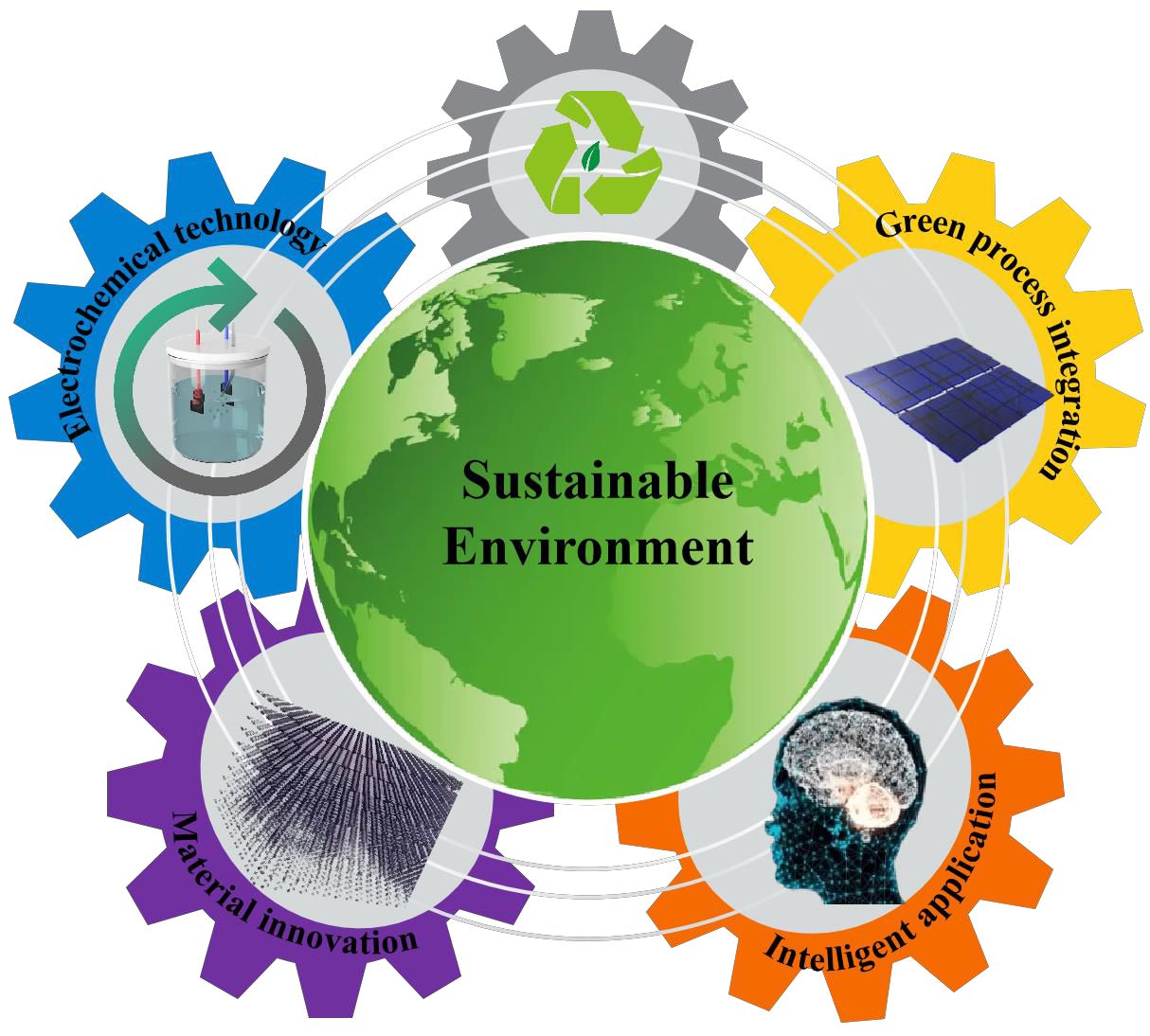
With the escalating severity of global environmental pollution, electrochemical technology has emerged as a pivotal tool in environmental governance due to its high efficiency, eco-friendliness, and precise controllability. Electrochemical technology demonstrates significant potential in wastewater treatment, carbon dioxide management, resource recovery, and environmental monitoring by leveraging unique reaction mechanisms, including advanced oxidation/reduction, selective separation, and carbon capture. However, its widespread adoption is hindered by limitations in material performance, high operational costs, and system complexity. To advance the sustainable development of electrochemical technologies, future efforts should focus on nanomaterial innovation, integration with green processes, and the application of intelligent systems for optimization and control.
- Open Access
- Perspective
Electrochemical Technologies in Energy and Environment: Prospects, Developments, and Educational Perspectives
- Yujia Wang 1,
- Ziqing Zheng 1,
- Lei Huang 1,*,
- Jia Yan 1,
- Meng Li 1,
- Zhenxin Chen 1,
- Hongguo Zhang 1,2,*
Author Information
Received: 28 Apr 2026 | Revised: 18 May 2026 | Accepted: 20 May 2026 | Published: 25 May 2026
Abstract
Graphical Abstract
Keywords
electrochemical catalysis | electrochemical separation | carbon capture and conversion | intelligent applications
References
- 1.
Song, J.; Cai, K.; Huang, R. Electrochemical activation of molecular oxygen: Mechanistic insights, catalytic strategies, and innovative applications in sustainable oxidation. Water Res. 2026, 288, 124695. https://doi.org/10.1016/j.watres.2025.124695.
- 2.
Ahmadi, M.; Adeleye, O.; Vonalt, G.; et al. Identifying Sweet Spots for Redox Reactions in Electrochemical Advanced Oxidation and Reduction Processes for Pollutant Degradation and Resource Recovery. Environ. Sci. Technol. 2025, 59, 17952–17977. https://doi.org/10.1021/acs.est.5c04748.
- 3.
Fitch, A.; Balderas-Hernandez, P.; Ibanez, J.G. Electrochemical technologies combined with physical, biological, and chemical processes for the treatment of pollutants and wastes: A review. J. Environ. Chem. Eng. 2022, 10, 107810. https://doi.org/10.1016/j.jece.2022.107810.
- 4.
Zeng, W.; Yao, B.; Zhou, Y.; et al. Combination of electrochemical advanced oxidation and biotreatment for wastewater treatment and soil remediation. J. Environ. Sci. 2025, 150, 36–53. https://doi.org/10.1016/j.jes.2024.02.036.
- 5.
Manikandan, S.; Deena, S.R.; Subbaiya, R.; et al. Waves of change: Electrochemical innovations for environmental management and resource recovery from water—A review. J. Environ. Manag. 2024, 366, 121879. https://doi.org/10.1016/j.jenvman.2024.121879.
- 6.
Zuo, K.; Garcia-Segura, S.; Cerrón-Calle, G.A.; et al. Electrified water treatment: Fundamentals and roles of electrode materials. Nat. Rev. Mater. 2023, 8, 472–490. https://doi.org/10.1038/s41578-023-00564-y.
- 7.
Yadav, G.; Koundle, P.; Sharma, H.; et al. Electrochemically reactive nanobubbles (ERNBs): An innovative solution for advanced oxidation processes (AOPs) in pollutant degradation and CO2 utilization. Water Res. 2025, 284, 123947. https://doi.org/10.1016/j.watres.2025.123947.
- 8.
Lim, H.J.; Kim, D.J.; Rigby, K.; et al. Peroxymonosulfate-Based Electrochemical Advanced Oxidation: Complication by Oxygen Reduction Reaction. Environ. Sci. Technol. 2023, 57, 19054–19063. https://doi.org/10.1021/acs.est.3c06156.
- 9.
Cui, X.; Peng, C.; Duan, W.; et al. Scalable flow-through device for electrochemical water treatment without secondary pollution. Nat. Sustain. 2026. https://doi.org/10.1038/s41893-026-01799-7.
- 10.
Li, G.; Liu, Y.; Jiao, C.; et al. Direct recovery of high-purity uranium from fluoride-containing nuclear wastewater via extraction materials with ensemble Lewis sites and a tandem electrochemical device. Water Res. 2025, 279, 123467. https://doi.org/10.1016/j.watres.2025.123467.
- 11.
Wu, H.; Xu, L.; Zhang, Y.; et al. Selective chromium and copper recovery from wastewater using flow-electrode capacitance deionization: In-situ reduction mechanism regulating metal charging characteristics. Sep. Purif. Technol. 2024, 328, 124970. https://doi.org/10.1016/j.seppur.2023.124970.
- 12.
Li, Y.; Wei, X.; Liu, H.; et al. Flotation-assisted electrodeposition process to recover copper from waste printed circuit boards. Chem. Eng. J. 2024, 497, 154747. https://doi.org/10.1016/j.cej.2024.154747.
- 13.
Zhu, P.; Wu, Z.-Y.; Elgazzar, A.; et al. Continuous carbon capture in an electrochemical solid-electrolyte reactor. Nature 2023, 618, 959–966. https://doi.org/10.1038/s41586-023-06060-1.
- 14.
Liu, T.; Wang, Y.; Wu, Y.; et al. Continuous decoupled redox electrochemical CO2 capture. Nat. Commun. 2024, 15, 10920. https://doi.org/10.1038/s41467-024-55334-3.
- 15.
Xi, D.; Yang, Z.; Emanuel, M.S.; et al. Electrochemical acid–base generators for decoupled carbon management. Energy Environ. Sci. 2025, 18, 3839–3851. https://doi.org/10.1039/D4EE05109B.
- 16.
Xu, Z.; Mapstone, G.; Coady, Z.; et al. Enhancing electrochemical carbon dioxide capture with supercapacitors. Nat. Commun. 2024, 15, 7851. https://doi.org/10.1038/s41467-024-52219-3.
- 17.
Liu, Z.; Ze, H.; Peng, B.; et al. Electrified reversible surface mineralization of CO2 for direct air capture. Nat. Energy 2026, 11, 603–612. https://doi.org/10.1038/s41560-026-01989-9.
- 18.
Zhang, P.; Zou, D.; Dong, C.; et al. Mechanism investigation of arsenic remediation in contaminated soil by Fe anode using the electrochemical method. J. Environ. Chem. Eng. 2024, 12, 113183. https://doi.org/10.1016/j.jece.2024.113183.
- 19.
Xu, J.; Liu, C.; Hsu, P.-C.; et al. Remediation of heavy metal contaminated soil by asymmetrical alternating current electrochemistry. Nat. Commun. 2019, 10, 2440. https://doi.org/10.1038/s41467-019-10472-x.
- 20.
Xiao, P.; Wang, Y.; Yang, Q.; et al. Innovative Bipolar Co-Planar Janus Membranes for High-Efficiency Electrocatalytic Filtration and Sustainable Water Reuse. Environ. Sci. Technol. 2026, 60, 8180–8192. https://doi.org/10.1021/acs.est.5c13834.
- 21.
Xie, S.; Wang, Z.; Zhang, N.; et al. Sequential oxidation and crystallization based on split-flow electrochemical oxidation with rapid filtration for sustainable phosphate recovery from phosphonate. Water Res. 2026, 298, 125782. https://doi.org/10.1016/j.watres.2026.125782.
- 22.
Yu, X.; Rabiee, H.; Dutta, A.; et al. Upcycling CO2 and PET Waste: Ampere-Level Formate Electrosynthesis in an Integrated Electrolyzer. J. Am. Chem. Soc. 2025, 147, 41481–41491. https://doi.org/10.1021/jacs.5c11708.
- 23.
Luo, H.; Zhang, X.; Wang, Z.; et al. Self-lithiation electrode with improved lithium-ion transport kinetics enables fast-charging SiOx-based anode for lithium-ion batteries. Chem. Eng. J. 2023, 469, 143677. https://doi.org/10.1016/j.cej.2023.143677.
- 24.
Ingram, M.; Campbell, E.; Molotnikov, A.; et al. Recent advances in multifunctional polymer/2D nanocomposite development for fused filament fabrication and direct ink writing of electrically and thermally conductive components. Adv. Nanocompos. 2024, 1, 157–170. https://doi.org/10.1016/j.adna.2024.03.003.
- 25.
Wang, Y.; Cao, L. Machine Learning–Driven Mapping of the Surface Structure and Activity Landscape in Cu–Zn Catalysts for CO2 Electroreduction. ACS Catal. 2025, 15, 16591–16599. https://doi.org/10.1021/acscatal.5c03337.
- 26.
Ding, R.; Chen, J.; Chen, Y.; et al. Unlocking the potential: Machine learning applications in electrocatalyst design for electrochemical hydrogen energy transformation. Chem. Soc. Rev. 2024, 53, 11390–11461. https://doi.org/10.1039/D4CS00844H.
- 27.
Rabbi, M.F. AI-accelerated discovery of defect-engineered heteroatom-doped carbon electrocatalysts for electrochemical CO₂ reduction to C₂⁺ products. J. CO2 Util. 2026, 107, 103432. https://doi.org/10.1016/j.jcou.2026.103432.
- 28.
Tian, Y.; Yu, K.; Zhu, X.; et al. Data-driven optimization of a polarity-reversing electrooxidation-electrocoagulation system for simultaneous nitrogen and phosphorus removal. Desalination 2026, 619, 119557. https://doi.org/10.1016/j.desal.2025.119557.
- 29.
Chakravarthy, V.J.; Thontadari, C.; Basavaraj, G.N.; et al. Neural network-assisted carbon nanotube electrochemical sensors for automated environmental risk assessment. Microchem. J. 2025, 218, 115413. https://doi.org/10.1016/j.microc.2025.115413.
- 30.
Pan, Y.; Guo, J.; Huang, Y.; et al. Multi-agent artificial intelligence designs novel catalysts for ultrafast water purification. Nat. Water 2026. https://doi.org/10.1038/s44221-026-00634-9.


This work is licensed under a Creative Commons Attribution 4.0 International License.

 Suite 4002 Level 4, 447 Collins Street, Melbourne, Victoria 3000, Australia
 General Inquiries: info@sciltp.com