
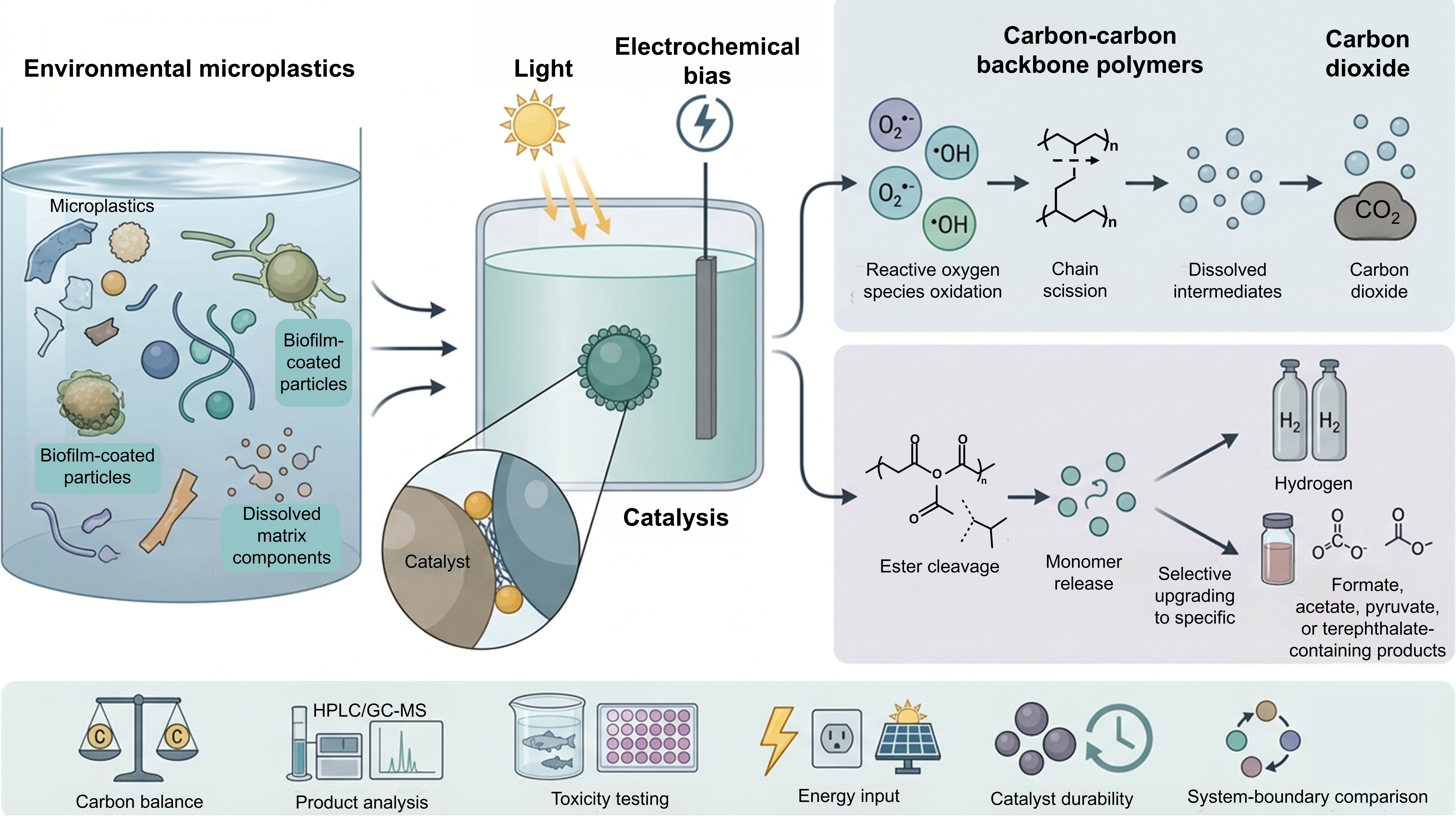
Microplastic control often removes particles from water without destroying polymer carbon and transfers this carbon to sludge or other residual streams. Catalytic treatment can deconstruct the polymer, yet surface oxidation, particle loss, chain scission, and mineralization are frequently reported as equivalent outcomes. This Review defines an evidence hierarchy that distinguishes interfacial ageing, backbone scission, product-resolved deconstruction, and terminal carbon conversion. Degradation denotes measurable chemical change of the polymer. Destruction denotes irreversible elimination of the polymeric particulate phase. Mineralization denotes conversion to CO2 or inorganic carbon. Valorization denotes formation of chemically defined, recoverable products. Microplastics with carbon-carbon backbones are limited by hydrophobicity and inert C-C bonds, whereas hydrolysable polyesters permit depolymerization and subsequent conversion. Representative studies are evaluated by the analytical evidence supporting each claim. Required measurements include carbon balance closure, identification of dissolved and volatile products, detection of secondary nanofragments, and separate toxicity assessment of residual solids and aqueous products. Selective valorization is environmentally credible mainly for concentrated, polymer-defined streams that permit product recovery. Dilute or mixed environmental microplastics require verified polymer deconstruction, reduced toxicity, and a traceable terminal carbon fate.
- Open Access
- Review
Catalytic Degradation of Microplastics: From Apparent Removal to True Destruction and Carbon Valorization
Author Information
Received: 03 May 2026 | Revised: 22 Jul 2026 | Accepted: 16 Aug 2026 | Published: 18 Aug 2026
Abstract
Graphical Abstract
Keywords
microplastics | catalytic deconstruction | carbon balance | evidence hierarchy | treatment realism
References
- 1.
Thompson, R.C.; Courtene-Jones, W.; Boucher, J.; et al. Twenty Years of Microplastic Pollution Research and What We Have Learned. Science 2024, 386, eadl2746. https://doi.org/10.1126/science.adl2746.
- 2.
MacLeod, M.; Arp, H.P.H.; Tekman, M.B.; et al. The Global Threat from Plastic Pollution. Science 2021, 373, 61–65. https://doi.org/10.1126/science.abg5433.
- 3.
Murphy, F.; Ewins, C.; Carbonnier, F.; et al. Wastewater Treatment Works (WwTW) as a Source of Microplastics in the Aquatic Environment. Environ. Sci. Technol. 2016, 50, 5800–5808. https://doi.org/10.1021/acs.est.5b05416.
- 4.
Iyare, P.U.; Ouki, S.K.; Bond, T. Microplastics Removal in Wastewater Treatment Plants: A Critical Review. Environ. Sci. Water Res. Technol. 2020, 6, 2664–2675. https://doi.org/10.1039/D0EW00397B.
- 5.
Zandieh, M.; Griffiths, E.; Waldie, A.; et al. Catalytic and Biocatalytic Degradation of Microplastics. Exploration 2024, 4, 20230018. https://doi.org/10.1002/EXP.20230018.
- 6.
Nabi, I.; Bacha, A.-U.-R.; Li, K.; et al. Complete Photocatalytic Mineralization of Microplastic on TiO2 Nanoparticle Film. iScience 2020, 23, 101326. https://doi.org/10.1016/j.isci.2020.101326.
- 7.
Lin, J.; Hu, K.; Wang, Y.; et al. Tandem Microplastic Degradation and Hydrogen Production by Hierarchical Carbon Nitride-Supported Single-Atom Iron Catalysts. Nat. Commun. 2024, 15, 8769. https://doi.org/10.1038/s41467-024-53055-1.
- 8.
Pfohl, P.; Wagner, M.; Meyer, L.; et al. Environmental Degradation of Microplastics: How to Measure Fragmentation Rates to Secondary Micro- and Nanoplastic Fragments and Dissociation into Dissolved Organics. Environ. Sci. Technol. 2022, 56, 11323–11334. https://doi.org/10.1021/acs.est.2c01228.
- 9.
Gewert, B.; Plassmann, M.M.; MacLeod, M. Pathways for Degradation of Plastic Polymers Floating in the Marine Environment. Environ. Sci. Process. Impacts 2015, 17, 1513–1521. https://doi.org/10.1039/C5EM00207A.
- 10.
Shi, Y.; Liu, P.; Wu, X.; et al. Insight into Chain Scission and Release Profiles from Photodegradation of Polycarbonate Microplastics. Water Res. 2021, 195, 116980. https://doi.org/10.1016/j.watres.2021.116980.
- 11.
Shi, Y.; Zheng, L.; Huang, H.; et al. Formation of Nano- and Microplastics and Dissolved Chemicals during Photodegradation of Polyester Base Fabrics with Polyurethane Coating. Environ. Sci. Technol. 2023, 57, 1894–1906. https://doi.org/10.1021/acs.est.2c05063.
- 12.
Bertier, G.; Martel, A.; George, M.; et al. Where Polymer Carbon Goes under Solar Exposure: A Carbon-Balance Method for Assessing Plastic Fate. PLoS ONE 2025, 20, e0333021. https://doi.org/10.1371/journal.pone.0333021.
- 13.
Ortiz, D.; Muñoz, M.; Nieto-Sandoval, J.; et al. Insights into the Degradation of Microplastics by Fenton Oxidation: From Surface Modification to Mineralization. Chemosphere 2022, 309, 136809. https://doi.org/10.1016/j.chemosphere.2022.136809.
- 14.
Bridson, J.H.; Abbel, R.; Smith, D.A.; et al. Release of Additives and Non-Intentionally Added Substances from Microplastics under Environmentally Relevant Conditions. Environ. Adv. 2023, 12, 100359. https://doi.org/10.1016/j.envadv.2023.100359.
- 15.
Caudillo-Flores, U.; Munoz-Batista, M.J.; Fernandez-Garcia, M.; et al. Recent Progress in the Quantitative Assessment and Interpretation of Photoactivity. Catal. Rev. Sci. Eng. 2024, 66, 531–585. https://doi.org/10.1080/01614940.2022.2075535.
- 16.
Ran, H.; Zhang, S.; Ni, W.; et al. Precise Activation of C–C Bonds for Recycling and Upcycling of Plastics. Chem. Sci. 2024, 15, 795–831. https://doi.org/10.1039/D3SC05701A.
- 17.
Chan, W.X.; Kong, X.Y.; Choo, S.R.; et al. Photocatalytic Upcycling of Plastics Containing Aliphatic C–C Bonds into Versatile Chemicals. Chem Catal. 2024, 4, 101044. https://doi.org/10.1016/j.checat.2024.101044.
- 18.
Miao, Y.; Zhao, Y.; Gao, J.; et al. Direct Photoreforming of Real-World Polylactic Acid Plastics into Highly Selective Value-Added Pyruvic Acid under Visible Light. J. Am. Chem. Soc. 2024, 146, 4842–4850. https://doi.org/10.1021/jacs.3c13000.
- 19.
Jiang, R.; Lu, G.; Yan, Z.; et al. Microplastic Degradation by Hydroxy-Rich Bismuth Oxychloride. J. Hazard. Mater. 2021, 405, 124247. https://doi.org/10.1016/j.jhazmat.2020.124247.
- 20.
Qi, X.; Zhou, Q.; Wang, C.; et al. Crystalline Supramolecular Naphthalimide Photocatalyst for Visible-Light Microplastic Mineralization via Enhanced Interfacial Interactions. Adv. Funct. Mater. 2026, 36, e27581. https://doi.org/10.1002/adfm.202527581.
- 21.
Guo, Y.; Zhu, B.; Tang, C.Y.; et al. Photogenerated Outer Electric Field Induced Electrophoresis of Organic Nanocrystals for Effective Solid-Solid Photocatalysis. Nat. Commun. 2024, 15, 428. https://doi.org/10.1038/s41467-024-44700-w.
- 22.
He, J.; Han, L.; Ma, W.; et al. Efficient Photodegradation of Polystyrene Microplastics Integrated with Hydrogen Evolution: Uncovering Degradation Pathways. iScience 2023, 26, 106833. https://doi.org/10.1016/j.isci.2023.106833.
- 23.
Danquigny, R.; Grassl, B.; Jiménez-Lamana, J.; et al. 13C-Labeled Nanoplastic Model Materials: Synthesis and Evaluation of Their Use in Ecotoxicology through Bioaccumulation Studies in Aquatic Crustaceans. J. Hazard. Mater. 2025, 495, 138810. https://doi.org/10.1016/j.jhazmat.2025.138810.
- 24.
Bajo, K.; Kolvenbach, B.; Corvini, P.F.-X.; et al. Mineralization of 13C-Labeled Polyethylene by Marine Bacillus velezensis MT9. Int. Biodeterior. Biodegrad. 2026, 209, 106294. https://doi.org/10.1016/j.ibiod.2026.106294.
- 25.
Lee, Y.K.; Romera-Castillo, C.; Hong, S.; et al. Characteristics of Microplastic Polymer-Derived Dissolved Organic Matter and Its Potential as a Disinfection Byproduct Precursor. Water Res. 2020, 175, 115678. https://doi.org/10.1016/j.watres.2020.115678.
- 26.
Ateia, M.; Kanan, A.; Karanfil, T. Microplastics Release Precursors of Chlorinated and Brominated Disinfection Byproducts in Water. Chemosphere 2020, 251, 126452. https://doi.org/10.1016/j.chemosphere.2020.126452.
- 27.
Piazza, V.; Uheida, A.; Gambardella, C.; et al. Ecosafety Screening of Photo-Fenton Process for the Degradation of Microplastics in Water. Front. Mar. Sci. 2022, 8, 791431. https://doi.org/10.3389/fmars.2021.791431.
- 28.
Capolupo, M.; Sorensen, L.; Jayasena, K.D.R.; et al. Chemical Composition and Ecotoxicity of Plastic and Car Tire Rubber Leachates to Aquatic Organisms. Water Res. 2020, 169, 115270. https://doi.org/10.1016/j.watres.2019.115270.
- 29.
Xu, Y.; Huang, D.; Liu, P.; et al. The Characteristics of Dissolved Organic Matter Release from UV-Aged Microplastics and Its Cytotoxicity on Human Colonic Adenocarcinoma Cells. Sci. Total Environ. 2022, 826, 154177. https://doi.org/10.1016/j.scitotenv.2022.154177.
- 30.
Zhu, X.; Bu, C.; Zhang, Q.; et al. Dose-Dependent Proteomic Profiling Uncovers Toxicity Transformation of Nanoplastics Induced by Simulated Fenton Oxidation in Urban Wastewater Treatment. Ecotoxicol. Environ. Saf. 2025, 306, 119299. https://doi.org/10.1016/j.ecoenv.2025.119299.
- 31.
Brito, D.A.S.; Silva, T.F.; Cavalheri, P.S.; et al. Aging and Transformation of Polyethylene Microplastics in UASB Effluents Treated with O3 and O3/H2O2: Physicochemical Changes and Toxicity Assessment. ACS EST Water 2025, 5, 6830–6841. https://doi.org/10.1021/acsestwater.5c00773.
- 32.
Wang, M.; Wang, M.; Ma, D. Key Terms in Plastic Waste Transformation Reactions. J. Phys. Chem. C 2024, 128, 16302–16307. https://doi.org/10.1021/acs.jpcc.4c05685.
- 33.
Haghshenas, Y.; Wong, W.P.; Gunawan, D.; et al. Predicting the Rates of Photocatalytic Hydrogen Evolution over Cocatalyst-Deposited TiO2 Using Machine Learning with Active Photon Flux as a Unifying Feature. EES Catal. 2024, 2, 612–623. https://doi.org/10.1039/D3EY00246B.
- 34.
Keen, O.; Bolton, J.; Litter, M.; et al. Standard Reporting of Electrical Energy per Order (EEO) for UV/H2O2 Reactors (IUPAC Technical Report). Pure Appl. Chem. 2018, 90, 1487–1499. https://doi.org/10.1515/pac-2017-0603.
- 35.
Buriak, J.M.; Kamat, P.V.; Schanze, K.S. Best Practices for Reporting on Heterogeneous Photocatalysis. ACS Appl. Mater. Interfaces 2014, 6, 11815–11816. https://doi.org/10.1021/am504389z.
- 36.
Quintavalla, A.; Carboni, D.; Lombardo, M. Green Metrics and Sustainability in Photocatalysis. ChemCatChem 2024, 16, e202301225. https://doi.org/10.1002/cctc.202301225.
- 37.
Vital-Grappin, A.D.; Ariza-Tarazona, M.C.; Luna-Hernandez, V.M.; et al. The Role of the Reactive Species Involved in the Photocatalytic Degradation of HDPE Microplastics Using C,N-TiO2 Powders. Polymers 2021, 13, 999. https://doi.org/10.3390/polym13070999.
- 38.
Aragon, D.; Barquin, C.; Bringas, E.; et al. Unravelling the Photocatalytic Degradation of Polyethylene Microplastics with TiO2 under UV Light: Evidence from Kinetic Studies. Chem. Eng. J. 2025, 522, 166672. https://doi.org/10.1016/j.cej.2025.166672.
- 39.
Garcia, J.; di Luca, C.; Abarkan, A.; et al. Kinetic and Mechanistic Insights into the Photo-Fenton Oxidation of Polystyrene Nanoplastics in Water. J. Water Process Eng. 2025, 78, 108838. https://doi.org/10.1016/j.jwpe.2025.108838.
- 40.
Praus, P.; Rehackova, L.; Filip-Edelmanova, M.; et al. Photoreforming of PET and PLA Microplastics for Sustainable Hydrogen Production Using TiO2 and g-C3N4 Photocatalysts. J. Environ. Chem. Eng. 2025, 13, 116998. https://doi.org/10.1016/j.jece.2025.116998.
- 41.
Jiang, S.; Wang, M.; Huang, Y.; et al. Selective Degradation of Polyethylene Terephthalate Plastic Waste Using Iron Salt Photocatalysts. ChemSusChem 2025, 18, e202401920. https://doi.org/10.1002/cssc.202401920.
- 42.
Du, M.; Xing, M.; Yuan, W.; et al. Upgrading Polyethylene Terephthalate Plastic into Commodity Chemicals Paired with Hydrogen Evolution over a Partially Oxidized CuIn5S₈ Nanosheet Photocatalyst. Green Chem. 2023, 25, 9818–9825. https://doi.org/10.1039/D3GC03156J.
- 43.
Hu, M.; Feng, C.; Alharbi, J.; et al. Isolated Ni Atoms Enable Alkali-Free Photoreforming of Waste Polylactic Acid Plastic. Nat. Commun. 2026, 17, 347. https://doi.org/10.1038/s41467-025-67050-7.
- 44.
Liu, Y.; Yeung, C.W.S.; Reisner, E. Photoelectrochemical Comproportionation of Pre-Treated PET Plastics and CO2 to Formate. Energy Environ. Sci. 2025, 18, 7023–7033. https://doi.org/10.1039/D5EE00689A.
- 45.
Lan, B.; Chen, Y.; Xiao, N.; et al. Efficient and Selective Upcycling of Waste Polylactic Acid into Acetate Using Nickel Selenide. J. Energy Chem. 2024, 97, 575–584. https://doi.org/10.1016/j.jechem.2024.05.057.
- 46.
Schmidt, P.M.; Tantawi, O.; Santizo, K.; et al. Abiotic Hydrolysis of Microplastics: Influence of Polymer Chain Scission on Particle Fragmentation and Dissolved Organic Carbon Release. Environ. Sci. Technol. 2026, 60, 13109–13122. https://doi.org/10.1021/acs.est.5c17195.
- 47.
Trhlíková, O.; Vlčková, V.; Abbrent, S.; et al. Microbial and Abiotic Degradation of Fully Aliphatic Polyurethane Foam Suitable for Biotechnologies. Polym. Degrad. Stab. 2021, 194, 109764. https://doi.org/10.1016/j.polymdegradstab.2021.109764.
- 48.
Han, H.; Yan, P.; Li, Q.; et al. Photothermal Upcycling of Waste Polyvinyl Chloride Plastics. Environ. Sci. Technol. 2024, 58, 21861–21870. https://doi.org/10.1021/acs.est.4c07350.
- 49.
Luo, H.; Li, Y.; Zhao, Y.; et al. Effects of Accelerated Aging on Characteristics, Leaching, and Toxicity of Commercial Lead Chromate Pigmented Microplastics. Environ. Pollut. 2020, 257, 113475. https://doi.org/10.1016/j.envpol.2019.113475.
- 50.
Tian, Z.; Zhao, H.; Peter, K.T.; et al. A Ubiquitous Tire Rubber-Derived Chemical Induces Acute Mortality in Coho Salmon. Science 2021, 371, 185–189. https://doi.org/10.1126/science.abd6951.
- 51.
Uekert, T.; Kuehnel, M.F.; Wakerley, D.W.; et al. Plastic Waste as a Feedstock for Solar-Driven H2 Generation. Energy Environ. Sci. 2018, 11, 2853–2857. https://doi.org/10.1039/C8EE01408F.
- 52.
Uekert, T.; Kasap, H.; Reisner, E. Photoreforming of Nonrecyclable Plastic Waste over a Carbon Nitride/Nickel Phosphide Catalyst. J. Am. Chem. Soc. 2019, 141, 15201–15210. https://doi.org/10.1021/jacs.9b06872.
- 53.
Bhattacharjee, S.; Guo, C.; Lam, E.; et al. Chemoenzymatic Photoreforming: A Sustainable Approach for Solar Fuel Generation from Plastic Feedstocks. J. Am. Chem. Soc. 2023, 145, 20355–20364. https://doi.org/10.1021/jacs.3c05486.
- 54.
Ma, F.; Wang, S.; Gong, X.; et al. Highly Efficient Electrocatalytic Hydrogen Evolution Coupled with Upcycling of Microplastics in Seawater Enabled via Ni3N/W5N4 Janus Nanostructures. Appl. Catal. B Environ. Energy 2022, 307, 121198. https://doi.org/10.1016/j.apcatb.2022.121198.
- 55.
Liang, X.; Gao, T.; Cui, Y.; et al. Photoreforming of Poly(Ethylene Terephthalate) Plastic into Valuable Chemicals and Hydrogen over BiVO4/MoOx: Synergistic Promotion of Oxidation and Reduction Processes. Appl. Catal. B Environ. Energy 2024, 357, 124326. https://doi.org/10.1016/j.apcatb.2024.124326.
- 56.
Jiang, M.; Li, J.; Wan, X.; et al. Floatable Organic-Inorganic Hybrid-TiO2 Generates Superoxide Radicals for Plastic Photoreforming in Neutral Solution. Nat. Commun. 2025, 16, 4136. https://doi.org/10.1038/s41467-025-59467-x.
- 57.
Poerio, T.; Lavorato, C.; Severino, A.; et al. Combined Membrane Separation and Photocatalysis Process for the Recovery and Decomposition of Micro/Nanoplastics from Polyester Fabrics. J. Environ. Chem. Eng. 2024, 12, 113310. https://doi.org/10.1016/j.jece.2024.113310.
- 58.
Severino, A.; Russo, B.; Lavorato, C.; et al. Integrated Nanofiltration and Photocatalytic Processes for the Removal of Polystyrene Nanoplastics Waste in Water. Sep. Purif. Technol. 2025, 360, 131232. https://doi.org/10.1016/j.seppur.2024.131232.
- 59.
Su, X.; Liu, M.; Dai, H.; et al. Novel Insight into the Aging Process of Microplastics: An In-Situ Study in Coastal Wetlands. Water Res. 2024, 248, 120871. https://doi.org/10.1016/j.watres.2023.120871.
- 60.
Ren, X.; Han, Y.; Zhao, H.; et al. Elucidating the Characteristic of Leachates Released from Microplastics under Different Aging Conditions: Perspectives of Dissolved Organic Carbon Fingerprints and Nano-Plastics. Water Res. 2023, 233, 119786. https://doi.org/10.1016/j.watres.2023.119786.
- 61.
Chen, C.; Du, R.; Tang, J.; et al. Characterization of Microplastic-Derived Dissolved Organic Matter in Freshwater: Effects of Light Irradiation and Polymer Types. Environ. Int. 2024, 185, 108536. https://doi.org/10.1016/j.envint.2024.108536.
- 62.
Wang, Q.; Gu, W.; Chen, H.; et al. Molecular Properties of Dissolved Organic Matter Leached from Microplastics during Photoaging Process. J. Hazard. Mater. 2024, 480, 136154. https://doi.org/10.1016/j.jhazmat.2024.136154.
- 63.
Llorente-Garcia, B.E.; Hernandez-Lopez, J.M.; Zaldivar-Cadena, A.A.; et al. First Insights into Photocatalytic Degradation of HDPE and LDPE Microplastics by a Mesoporous N-TiO2 Coating: Effect of Size and Shape of Microplastics. Coatings 2020, 10, 658. https://doi.org/10.3390/coatings10070658.
- 64.
Jiang, S.; Yin, M.; Ren, H.; et al. Novel CuMgAlTi-LDH Photocatalyst for Efficient Degradation of Microplastics under Visible Light Irradiation. Polymers 2023, 15, 2347. https://doi.org/10.3390/polym15102347.
- 65.
Zhu, K.; Sun, Y.; Jiang, W.; et al. Inorganic Anions Influenced the Photoaging Kinetics and Mechanism of Polystyrene Microplastic under the Simulated Sunlight: Role of Reactive Radical Species. Water Res. 2022, 216, 118294. https://doi.org/10.1016/j.watres.2022.118294.
- 66.
Wu, X.; Liu, P.; Gong, Z.; et al. Humic Acid and Fulvic Acid Hinder Long-Term Weathering of Microplastics in Lake Water. Environ. Sci. Technol. 2021, 55, 15810–15820. https://doi.org/10.1021/acs.est.1c04501.
- 67.
Wang, X.; Muhmood, A.; Ren, D.; et al. Exploring the Mechanisms of Humic Acid Mediated Degradation of Polystyrene Microplastics under Ultraviolet Light Conditions. Chemosphere 2023, 327, 138544. https://doi.org/10.1016/j.chemosphere.2023.138544.
- 68.
Wen, Q.; Liu, N.; Qu, R.; et al. High Salinity Promotes the Photoaging of Polystyrene Microplastics with Humic Acid in Seawater. Sci. Total Environ. 2023, 901, 165741. https://doi.org/10.1016/j.scitotenv.2023.165741.
- 69.
Chen, R.; Deng, Y.; Wang, J.; et al. The Effects of Different Types of Surfactants on the Electrochemical Degradation of PET Microplastics. J. Water Process Eng. 2025, 74, 107779. https://doi.org/10.1016/j.jwpe.2025.107779.
- 70.
Lu, J.; Hou, R.; Wang, Y.; et al. Surfactant-Sodium Dodecyl Sulfate Enhanced Degradation of Polystyrene Microplastics with an Energy-Saving Electrochemical Advanced Oxidation Process (EAOP) Strategy. Water Res. 2022, 226, 119277. https://doi.org/10.1016/j.watres.2022.119277.
- 71.
Gao, J.; Ju, Z.; Yang, Q.; et al. Exploring Different Effects of Biofilm Formation and Natural Organic Matter Adsorption on the Properties of Three Typical Microplastics in Freshwater. Sci. Total Environ. 2025, 958, 178156. https://doi.org/10.1016/j.scitotenv.2024.178156.
- 72.
Zhang, H.; Liu, P.; Zhang, J.; et al. Unveiling the Protective Role of Biofilm Formation on the Photoaging of Microplastics. Sci. China Technol. Sci. 2024, 67, 3067–3078. https://doi.org/10.1007/s11431-024-2721-5.
- 73.
Li, M.; Lou, F.; Huang, Y.; et al. Electrical Energy Consumption of Multiscale UV-AOP Reactors for Micropollutant Removal in Drinking Water: Facilitated Prediction by Reaction Rate Constants Measured on a Mini-Fluidic Photoreactor. Environ. Sci. Technol. 2023, 57, 18960–18969. https://doi.org/10.1021/acs.est.3c00888.
- 74.
Uekert, T.; DesVeaux, J.S.; Singh, A.; et al. Life Cycle Assessment of Enzymatic Poly(Ethylene Terephthalate) Recycling. Green Chem. 2022, 24, 6531–6543. https://doi.org/10.1039/D2GC02162E.
- 75.
Yadav, G.; Singh, A.; Dutta, A.; et al. Techno-Economic Analysis and Life Cycle Assessment for Catalytic Fast Pyrolysis of Mixed Plastic Waste. Energy Environ. Sci. 2023, 16, 3638–3653. https://doi.org/10.1039/D3EE00749A.
- 76.
Iturrondobeitia, M.; Alonso, L.; Lizundia, E. Prospective Life Cycle Assessment of Poly(Ethylene Terephthalate) Upcycling via Chemoselective Depolymerization. Resour. Conserv. Recycl. 2023, 198, 107182. https://doi.org/10.1016/j.resconrec.2023.107182.
- 77.
Han, J.; Nain, P.; Peterson, R.-J.L.; et al. Life Cycle Assessment of Chemical Upcycling of Postconsumer Polyethylene Terephthalate to Kevlar Polymer. ACS Sustain. Chem. Eng. 2025, 13, 18924–18937. https://doi.org/10.1021/acssuschemeng.5c04073.
- 78.
Uekert, T.; Singh, A.; DesVeaux, J.S.; et al. Technical, Economic, and Environmental Comparison of Closed-Loop Recycling Technologies for Common Plastics. ACS Sustain. Chem. Eng. 2023, 11, 965–978. https://doi.org/10.1021/acssuschemeng.2c05497.
- 79.
Ducoli, S.; Marchesi, C.; Rigo, M.; et al. Developing Environmentally Relevant Test Materials for Microplastic Research through UV-Induced Photoaging. J. Hazard. Mater. Adv. 2025, 20, 100905. https://doi.org/10.1016/j.hazadv.2025.100905.
- 80.
Altmann, K.; Wimmer, L.; Alcolea-Rodriguez, V.; et al. Quality-by-Design and Current Good Practices for the Production of Test and Reference Materials for Micro- and Nano-Plastic Research. J. Hazard. Mater. 2025, 497, 139595. https://doi.org/10.1016/j.jhazmat.2025.139595.

This work is licensed under a Creative Commons Attribution 4.0 International License.

 Suite 4002 Level 4, 447 Collins Street, Melbourne, Victoria 3000, Australia
 General Inquiries: info@sciltp.com