
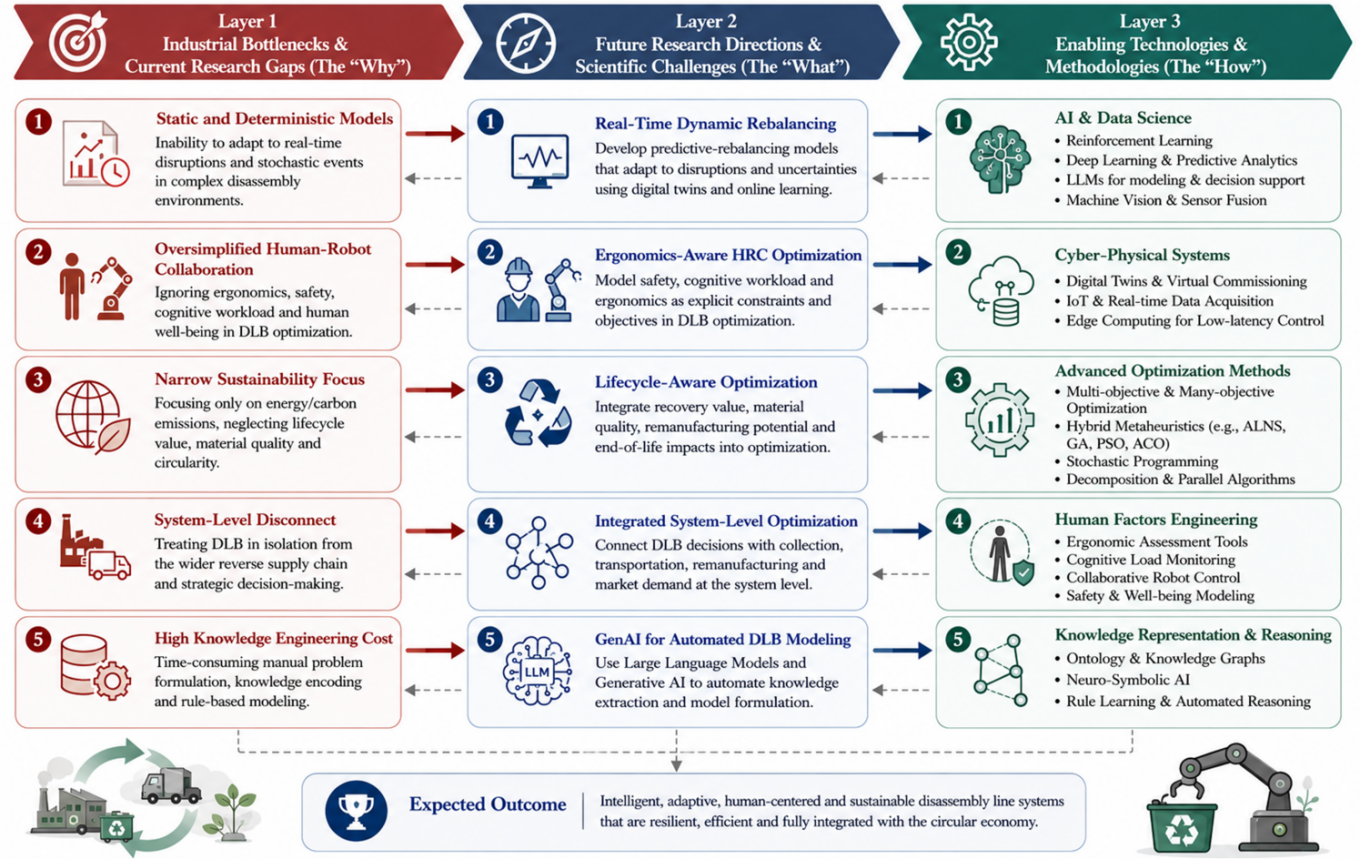
Disassembly line balancing (DLB) has become an important technology for sustainable manufacturing, implementation of circular economy and recovery of end-of-life (EOL) products. With the increase in the complexity of waste electrical and electronic equipment, electric vehicle batteries and human-robot cooperative disassembly systems, DLB research has progressed from conventional deterministic optimization towards intelligent, uncertainty aware and sustainability oriented decision-making. In this paper, we present a detailed and thorough survey of recent advancements in DLB by analysing 135 representative papers published from 2003 to 2025, where about 80% were published after 2020. A Grounded Theory based literature review method was applied to systematically classify the existing research according to the disassembly representation methods, optimization objectives, mathematical models, uncertainty modelling strategies and solution algorithms. Special emphasis was put on the development of intelligent optimization techniques such as exact algorithms, heuristic methods, swarm intelligence, hybrid meta-heuristics, stochastic and fuzzy programming and recent reinforcement learning approaches. Additionally, this review suggests an integrated analytical framework which reveals the connections between optimization objectives, modelling paradigms and algorithmic developments, providing a better understanding of the technological progress of DLB. According to a comprehensive evaluation of the current achievements and the remaining shortcomings, six promising research fields are identified, including digital twin supported adaptive disassembly, intelligent decision-making assisted by large language models, multi-agent collaborative optimisation, human-robot cooperation, carbon aware circular manufacturing and data driven autonomous disassembly systems. This review not only summarises the present status of DLB research but also establishes a systematic guide for the development of next generation intelligent disassembly systems towards Industry 5.0 and sustainable manufacturing.
- Open Access
- Review
- Jiaju Peng 1,
- Guangdong Tian 1,*,
- Duc Truong Pham 2,
- Hao Huang 1,
- Hongbin Chi 1,
- Songang Zhang 1
Author Information
Received: 27 May 2026 | Revised: 29 Jun 2026 | Accepted: 03 Jul 2026 | Published: 15 Jul 2026
Abstract
Graphical Abstract
Keywords
disassembly line balancing | intelligent optimization | sustainable manufacturing | human–robot collaboration | circular economy
References
- 1.
Ma, G.; Peng, F.; Yang, W.; et al. The Valuation of China’s Environmental Degradation from 2004 to 2017. Environ. Sci. Ecotechnology 2020, 1, 100016.
- 2.
Moxnes, E. Overexploitation of Renewable Resources: The Role of Misperceptions. J. Econ. Behav. Organ. 1998, 37, 107–127.
- 3.
Rhodes, C.J. Shortage of Resources for Renewable Energy and Food Production. Sci. Prog. 2011, 94, 323–334.
- 4.
Tian, G.D.; Zhang, X.S.; Fathollahi-Fard, A.M.; et al. Multi-Objective Evolutionary Algorithm with Machine Learning and Local Search for an Energy-Efficient Disassembly Line Balancing Problem in Remanufacturing. J. Manuf. Sci. Eng. Trans. ASME 2023, 145, 051002.
- 5.
Tseng, M.L.; Chiu, A.S.F.; Ashton, W.; et al. Sustainable Management of Natural Resources Toward Sustainable Development Goals. Resour. Conserv. Recycl. 2019, 145, 419–421.
- 6.
Mishra, K.; Siwal, S.S.; Thakur, V.K. E‑Waste Recycling and Utilization: A Review of Current Technologies and Future Perspectives. Curr. Opin. Green Sustain. Chem. 2024, 47, 100900.
- 7.
Lahmar, H.; Dahane, M.; Mouss, K.N.; et al. Multi‑Objective Sustainable Production Planning for a Hybrid Multi‑Stage Manufacturing‑Remanufacturing System with Grade‑Based Classification of Recovered and Remanufactured Products. J. Intell. Manuf. 2025, 36, 1385‑1407.
- 8.
Özceylan, E.; Kalayci, C.B.; Güngör, A.; et al. Disassembly Line Balancing Problem: A Review of the State of the Art and Future Directions. Int. J. Prod. Res. 2019, 57, 4805–4827.
- 9.
Gungor, A.; Gupta, S.M.; Pochampally, K.; et al. Complications in Disassembly Line Balancing. In Environmentally Conscious Manufacturing; SPIE: Bellingham, WA, USA, 2001; pp. 289–298.
- 10.
Wolfswinkel, J.F.; Furtmueller, E.; Wilderom, C.P. Using Grounded Theory as a Method for Rigorously Reviewing Literature. Eur. J. Inf. Syst. 2013, 22, 45–55.
- 11.
Vongbunyong, S.; Chen, W.H. Disassembly Automation. In Disassembly Automation: Automated Systems with Cognitive Abilities; Springer International Publishing: Cham, Switzerland, 2015; pp. 25–54.
- 12.
Tang, Y.; Zhou, M.C.; Zussman, E.; et al. Disassembly Modeling, Planning, and Application. J. Manuf. Syst. 2002, 21, 200–217.
- 13.
Gungor, A.; Gupta, S.M. Disassembly Line in Product Recovery. Int. J. Prod. Res. 2002, 40, 2569–2589.
- 14.
Tian, G.; Liu, Y.; Tian, Q.; et al. Evaluation Model and Algorithm of Product Disassembly Process with Stochastic Feature. Clean Technol. Environ. Policy 2012, 14, 345–356.
- 15.
De Mello, L.H.; Sanderson, A.C. AND/OR Graph Representation of Assembly Plans. IEEE Trans. Robot. Autom. 1990, 6, 188–199.
- 16.
Min, S.-S.; Zhu, X.-J.; Zhu, X. Mechanical Product Disassembly AND/OR Graph Construction. In Proceedings of the 2010 International Conference on Measuring Technology and Mechatronics Automation, Changsha, China, 13–14 March 2010; pp. 627–631.
- 17.
Zussman, E.; Kriwet, A.; Seliger, G. Disassembly-Oriented Assessment Methodology to Support Design for Recycling. CIRP Ann. 1994, 43, 9–14.
- 18.
Zussman, E.; Zhou, M.-C.; Caudill, R. Disassembly Petri Net Approach to Modeling and Planning Disassembly Processes of Electronic Products. In Proceedings of the 1998 IEEE International Symposium on Electronics and the Environment (ISEE-1998), Oak Brook, IL, USA, 6 May 1998; pp. 331–336.
- 19.
Liang, P.; Fu, Y.; Gao, K. Multi product Disassembly Line Balancing Optimization Method for High Disassembly Profit and Low Energy Consumption with Noise Pollution Constraints. Eng. Appl. Artif. Intell. 2024, 130, 107721.
- 20.
Zhou, M.; DiCesare, F. Petri Net Synthesis for Discrete Event Control of Manufacturing Systems; Springer Science & Business Media: Berlin/Heidelberg, Germany, 2012; Volume 204.
- 21.
Moore, K.E.; Gungor, A.; Gupta, S.M. A Petri Net Approach to Disassembly Process Planning. Comput. Ind. Eng. 1998, 35, 165–168.
- 22.
Moore, K.E.; Güngör, A.; Gupta, S.M. Petri Net Approach to Disassembly Process Planning for Products with Complex AND/OR Precedence Relationships. Eur. J. Oper. Res. 2001, 135, 428–449.
- 23.
Yuan, G.; Li, H.; Luo, J.; et al. Integrated Optimization of Disassembly Planning and EOL Decision of Obsolete Agricultural Machinery Products Under the Dual Carbon Target. Trans. Chin. Soc. Agric. Eng. 2023, 39, 17–24.
- 24.
Edis, E.B.; Ilgin, M.A.; Edis, R.S. Disassembly Line Balancing with Sequencing Decisions: A Mixed Integer Linear Programming Model and Extensions. J. Clean. Prod. 2019, 238, 117826.
- 25.
Li, Z.; Kucukkoc, I.; Zhang, Z. Iterated Local Search Method and Mathematical Model for Sequence-Dependent U-Shaped Disassembly Line Balancing Problem. Comput. Ind. Eng. 2019, 137, 106056.
- 26.
Mete, S.; Cil, Z.A.; Celik, E.; et al. Supply-Driven Rebalancing of Disassembly Lines: A Novel Mathematical Model Approach. J. Clean. Prod. 2019, 213, 1157–1164.
- 27.
Cil, Z.A. An Exact Solution Method for Multi-Manned Disassembly Line Design with AND/OR Precedence Relations. Appl. Math. Model. 2021, 99, 785–803.
- 28.
Ozceylan, E.; Paksoy, T. Reverse Supply Chain Optimization with Disassembly Line Balancing. Int. J. Prod. Res. 2013, 51, 5985–6001.
- 29.
Yin, T.; Zhang, Z.; Zhang, Y.; et al. Mixed-Integer Programming Model and Hybrid Driving Algorithm for Multi-Product Partial Disassembly Line Balancing Problem with Multi-Robot Workstations. Robot. Comput. Integr. Manuf. 2022, 73, 102251.
- 30.
Ozceylan, E.; Paksoy, T.; Bektas, T. Modeling and Optimizing the Integrated Problem of Closed-Loop Supply Chain Network Design and Disassembly Line Balancing. Transp. Res. Part E Logist. Transp. Rev. 2014, 61, 142–164.
- 31.
Zhou, Y.; Guo, X.; Li, D. A Dynamic Programming Approach to a Multiobjective Disassembly Line Balancing Problem. Ann. Oper. Res. 2022, 311, 921–944.
- 32.
Ilgin, M.A.; Akcay, H.; Araz, C. Disassembly Line Balancing Using Linear Physical Programming. Int. J. Prod. Res. 2017, 55, 6108–6119.
- 33.
McGovern, S.M.; Gupta, S.M. 2-Opt Heuristic for the Disassembly Line Balancing Problem. In Proceedings of the 3rd International Conference on Environmentally Conscious Manufacturing, Providence, RI, USA, 29–30 October 2003; pp. 71–84.
- 34.
McGovern, S.M.; Gupta, S.M. Greedy Algorithm for Disassembly Line Scheduling. In Proceedings of the IEEE International Conference on Systems, Man and Cybernetics (SMC 03), Washington, DC, USA, 5–8 October 2003; pp. 1737–1744.
- 35.
Mete, S.; Cil, Z.A.; Agpak, K.; et al. A Solution Approach Based on Beam Search Algorithm for Disassembly Line Balancing Problem. J. Manuf. Syst. 2016, 41, 188–200.
- 36.
Kizilay, D. A Novel Constraint Programming and Simulated Annealing for Disassembly Line Balancing Problem with AND/OR Precedence and Sequence Dependent Setup Times. Comput. Oper. Res. 2022, 146, 105915.
- 37.
Wang, K.; Li, X.; Gao, L. Modeling and Optimization of Multiobjective Partial Disassembly Line Balancing Problem Considering Hazard and Profit. J. Clean. Prod. 2019, 211, 115–133.
- 38.
Wang, K.; Li, X.; Gao, L.; et al. Modeling and Balancing for Green Disassembly Line Using Associated Parts Precedence Graph and Multiobjective Genetic Simulated Annealing. Int. J. Precis. Eng. Manuf. Green Technol. 2021, 8, 1597–1613.
- 39.
Wang, K.; Li, X.; Gao, L.; et al. A Genetic Simulated Annealing Algorithm for Parallel Partial Disassembly Line Balancing Problem. Appl. Soft Comput. 2021, 107, 107404.
- 40.
Fang, Y.; Ming, H.; Li, M.; et al. Multiobjective Evolutionary Simulated Annealing Optimization for Mixed-Model Multi-Robotic Disassembly Line Balancing with Interval Processing Time. Int. J. Prod. Res. 2020, 58, 846–862.
- 41.
Liang, J.; Guo, S.; Du, B.; et al. Minimizing Energy Consumption in Multiobjective Two-Sided Disassembly Line Balancing Problem with Complex Execution Constraints Using Dual-Individual Simulated Annealing Algorithm. J. Clean. Prod. 2021, 284, 125418.
- 42.
Ren, Y.; Zhang, C.; Zhao, F.; et al. An Asynchronous Parallel Disassembly Planning Based on Genetic Algorithm. Eur. J. Oper. Res. 2018, 269, 647–660.
- 43.
Liu, Q.; Li, Y.; Fang, Y.; et al. Many-Objective Best-Order-Sort Genetic Algorithm for Mixed-Model Multi-Robotic Disassembly Line Balancing. In Proceedings of the 11th CIRP Conference on Industrial Product-Service Systems, Zhuhai and Hong Kong, China, 29–31 May 2019; pp. 14–21.
- 44.
Wang, Y.J.; Wang, N.D.; Cheng, S.M.; et al. Optimization of Disassembly Line Balancing Using an Improved Multiobjective Genetic Algorithm. Adv. Prod. Eng. Manag. 2021, 16, 240–252.
- 45.
Kucukkoc, I. Balancing of Two-Sided Disassembly Lines: Problem Definition, MILP Model and Genetic Algorithm Approach. Comput. Oper. Res. 2020, 124, 105064.
- 46.
Chen, J.C.; Chen, Y.-Y.; Chen, T.-L.; et al. An Adaptive Genetic Algorithm-Based and AND/OR Graph Approach for the Disassembly Line Balancing Problem. Eng. Optim. 2022, 54, 1583–1599.
- 47.
Jiang, H.; Yi, J.; Chen, S.; et al. A Multiobjective Algorithm for Task Scheduling and Resource Allocation in Cloud-Based Disassembly. J. Manuf. Syst. 2016, 41, 239–255.
- 48.
Wang, K.; Li, X.; Gao, L.; et al. Energy Consumption and Profit-Oriented Disassembly Line Balancing for Waste Electrical and Electronic Equipment. J. Clean. Prod. 2020, 265, 121829.
- 49.
Cheng, C.-Y.; Chen, Y.-Y.; Pourhejazy, P.; et al. Disassembly Line Balancing of Electronic Waste Considering the Degree of Task Correlation. Electronics 2022, 11, 533.
- 50.
Meng, W.; Zhang, X. Optimization of Remanufacturing Disassembly Line Balance Considering Multiple Failures and Material Hazards. Sustainability 2020, 12, 7318.
- 51.
Dalle Mura, M.; Pistolesi, F.; Dini, G.; et al. End-of-Life Product Disassembly with Priority-Based Extraction of Dangerous Parts. J. Intell. Manuf. 2021, 32, 837–854.
- 52.
Yilmaz, O.F.; Yazici, B. Tactical Level Strategies for Multiobjective Disassembly Line Balancing Problem with Multi-Manned Stations: An Optimization Model and Solution Approaches. Ann. Oper. Res. 2022, 319, 1793–1843.
- 53.
Wang, S.; Guo, X.; Liu, J. An Efficient Hybrid Artificial Bee Colony Algorithm for Disassembly Line Balancing Problem with Sequence-Dependent Part Removal Times. Eng. Optim. 2019, 51, 1920–1937.
- 54.
Xu, C.; Wei, H.; Guo, X.; et al. Human-Robot Collaboration Multiobjective Disassembly Line Balancing Subject to Task Failure via Multiobjective Artificial Bee Colony Algorithm. In Proceedings of the 3rd IFAC Workshop on Cyber-Physical and Human Systems (CPHS), Beijing, China, 3–5 December 2020; pp. 1–6.
- 55.
Kalayci, C.B.; Gupta, S.M. A Particle Swarm Optimization Algorithm with Neighborhood-Based Mutation for Sequence-Dependent Disassembly Line Balancing Problem. Int. J. Adv. Manuf. Technol. 2013, 69, 197–209.
- 56.
Zhang, L.; Wu, Y.; Zhao, X.; et al. A Multiobjective Two-Sided Disassembly Line Balancing Optimization Based on Artificial Bee Colony Algorithm: A Case Study of an Automotive Engine. Int. J. Precis. Eng. Manuf. Green Technol. 2022, 9, 1329–1347.
- 57.
Wang, K.P.; Li, X.Y.; Gao, L.; et al. A Discrete Artificial Bee Colony Algorithm for Multiobjective Disassembly Line Balancing of End-of-Life Products. IEEE Trans. Cybern. 2022, 52, 7415–7426.
- 58.
Liu, J.; Wang, S. Balancing Disassembly Line in Product Recovery to Promote the Coordinated Development of Economy and Environment. Sustainability 2017, 9, 309.
- 59.
Cao, J.; Xia, X.; Wang, L.; et al. A Novel Multi-Efficiency Optimization Method for Disassembly Line Balancing Problem. Sustainability 2019, 11, 6969.
- 60.
Wang, K.P.; Gao, L.; Li, X.Y.; et al. Energy-Efficient Robotic Parallel Disassembly Sequence Planning for End-of-Life Products. IEEE Trans. Autom. Sci. Eng. 2022, 19, 1277–1285.
- 61.
Gao, Y.; Wang, Q.; Feng, Y.; et al. An Energy-Saving Optimization Method of Dynamic Scheduling for Disassembly Line. Energies 2018, 11, 1261.
- 62.
Li, Z.; Janardhanan, M.N. Modelling and Solving Profit-Oriented U-Shaped Partial Disassembly Line Balancing Problem. Expert Syst. Appl. 2021, 183, 115431.
- 63.
Kalayci, C.B.; Gupta, S.M. Artificial Bee Colony Algorithm for Solving Sequence-Dependent Disassembly Line Balancing Problem. Expert Syst. Appl. 2013, 40, 7231–7241.
- 64.
Xiao, S.; Wang, Y.; Yu, H.; et al. An Entropy-Based Adaptive Hybrid Particle Swarm Optimization for Disassembly Line Balancing Problems. Entropy 2017, 19, 596.
- 65.
Tseng, Y.-J.; Yu, F.-Y.; Huang, F.-Y. A Green Assembly Sequence Planning Model with a Closed-Loop Assembly and Disassembly Sequence Planning Using a Particle Swarm Optimization Method. Int. J. Adv. Manuf. Technol. 2011, 57, 1183–1197.
- 66.
Li, W.D.; Xia, K.; Gao, L.; et al. Selective Disassembly Planning for Waste Electrical and Electronic Equipment with Case Studies on Liquid Crystal Displays. Robot. Comput. Integr. Manuf. 2013, 29, 248–260.
- 67.
Kalayci, C.B.; Polat, O.; Gupta, S.M. A Hybrid Genetic Algorithm for Sequence-Dependent Disassembly Line Balancing Problem. Ann. Oper. Res. 2016, 242, 321–354.
- 68.
Pistolesi, F.; Lazzerini, B.; Mura, M.D.; et al. EMOGA: A Hybrid Genetic Algorithm with Extremal Optimization Core for Multiobjective Disassembly Line Balancing. IEEE Trans. Ind. Inform. 2018, 14, 1089–1098.
- 69.
Zhu, L.; Zhang, Z.; Wang, Y.; et al. On the End-of-Life State Oriented Multiobjective Disassembly Line Balancing Problem. J. Intell. Manuf. 2020, 31, 1403–1428.
- 70.
Zhu, L.; Zhang, Z.; Guan, C. Multiobjective Partial Parallel Disassembly Line Balancing Problem Using Hybrid Group Neighbourhood Search Algorithm. J. Manuf. Syst. 2020, 56, 252–269.
- 71.
Wu, K.; Guo, X.; Liu, S.; et al. Multiobjective Discrete Brainstorming Optimizer for Multiple-Product Partial U-Shaped Disassembly Line Balancing Problem. In Proceedings of the 33rd Chinese Control and Decision Conference (CCDC), Kunming, China, 22–24 May 2021; pp. 305–310.
- 72.
Zhang, Z.; Zhu, L.; Chen, Y.; et al. A Multi-Objective Hybrid Evolutionary Search Algorithm for Parallel Production Line Balancing Problem Including Disassembly and Assembly Tasks. Int. Trans. Oper. Res. 2023, 30, 3508–3553.
- 73.
Yang, W.L.; Li, Z.X.; Zheng, C.Y.; et al. A Q-Learning-Oriented Multi-Objective Teaching-Learning-Based Optimization Algorithm for Balancing U-Shaped Disassembly Lines. Appl. Soft Comput. 2025, 177, 113273.
- 74.
Huang, Z.W.; Zhang, H.H.; Tian, G.D.; et al. Energy-Efficient Human-Robot Collaborative U-Shaped Disassembly Line Balancing Problem Considering Turn On-Off Strategy: Uncertain Modeling and Solution Method. J. Manuf. Syst. 2025, 80, 38–69.
- 75.
Liu, M.; Liu, X.; Chu, F.; et al. An Exact Method for Disassembly Line Balancing Problem with Limited Distributional Information. Int. J. Prod. Res. 2021, 59, 665–682.
- 76.
Liu, X.; Chu, F.; Zheng, F.; et al. Distributionally Robust and Risk-Averse Optimization for the Stochastic Multi-Product Disassembly Line Balancing Problem with Workforce Assignment. Int. J. Prod. Res. 2022, 60, 1973–1991.
- 77.
Liu, H.; Zhang, L. Optimizing a Disassembly Sequence Planning with Success Rates of Disassembly Operations via a Variable Neighborhood Search Algorithm. IEEE Access 2021, 9, 157540–157549.
- 78.
Altekin, F.T. A Piecewise Linear Model for Stochastic Disassembly Line Balancing. In Proceedings of the 8th IFAC Conference on Manufacturing Modelling, Management and Control (MIM), Troyes, France, 28–30 June 2016; pp. 932–937.
- 79.
Aydemir-Karadag, A.; Turkbey, O. Multiobjective Optimization of Stochastic Disassembly Line Balancing with Station Paralleling. Comput. Ind. Eng. 2013, 65, 413–425.
- 80.
Mete, S.; Serin, F.; Cil, Z.A.; et al. A Comparative Analysis of Meta-Heuristic Methods on Disassembly Line Balancing Problem with Stochastic Time. Ann. Oper. Res. 2023, 321, 371–408.
- 81.
Xia, X.; Liu, W.; Zhang, Z.; et al. Partial Disassembly Line Balancing Problem Analysis Based on Sequence-Dependent Stochastic Mixed-Flow. J. Comput. Inf. Sci. Eng. 2020, 20, 061005.
- 82.
Huang, F.G.; Liu, P.S.; Guo, X.W.; et al. Bat Optimizer for Stochastic Multiple-Objective Disassembly Line Balancing Problem Subject to Disassembly Failure Cost. In Proceedings of the 4th International Conference on Informatics Engineering and Information Science (ICIEIS), Tianjin, China, 19–21 November 2021.
- 83.
Wang, K.; Li, X.; Gao, L. A Multiobjective Discrete Flower Pollination Algorithm for Stochastic Two-Sided Partial Disassembly Line Balancing Problem. Comput. Ind. Eng. 2019, 130, 634–649.
- 84.
Guo, X.; Zhang, Z.; Qi, L.; et al. Stochastic Hybrid Discrete Grey Wolf Optimizer for Multiobjective Disassembly Sequencing and Line Balancing Planning in Disassembling Multiple Products. IEEE Trans. Autom. Sci. Eng. 2022, 19, 1744–1756.
- 85.
Zhang, Z.; Guo, X.; Zhou, M.; et al. Multiobjective Discrete Grey Wolf Optimizer for Solving Stochastic Multiobjective Disassembly Sequencing and Line Balancing Problem. In Proceedings of the IEEE International Conference on Systems, Man, and Cybernetics (SMC), Virtual, 11–14 October 2020; pp. 682–687.
- 86.
Wang, T.; Guo, X.; Liu, S.; et al. A Stochastic Sequence-Dependent Multiobjective Disassembly Line Balancing Model Subject to Task Failure and Resource Constraint via Multiobjective Cuckoo Search. In Proceedings of the IEEE International Conference on Systems, Man, and Cybernetics (SMC), Virtual, 11–14 October 2020; pp. 700–705.
- 87.
Wu, K.; Guo, X.; Zhou, M.; et al. Multiobjective Discrete Brainstorming Optimizer for Stochastic Disassembly Line Balancing Problem Subject to Disassembly Failure. In Proceedings of the IEEE International Conference on Systems, Man, and Cybernetics (SMC), Virtual, 11–14 October 2020; pp. 1224–1229.
- 88.
Xia, X.; Liu, W.; Zhang, Z.; et al. A Balancing Method of Mixed-Model Disassembly Line in Random Working Environment. Sustainability 2019, 11, 2304.
- 89.
He, J.; Chu, F.; Zheng, F.; et al. A Green-Oriented Bi-Objective Disassembly Line Balancing Problem with Stochastic Task Processing Times. Ann. Oper. Res. 2021, 296, 71–93.
- 90.
He, J.; Chu, F.; Zheng, F.; et al. A Multiobjective Distribution-Free Model and Method for Stochastic Disassembly Line Balancing Problem. Int. J. Prod. Res. 2020, 58, 5721–5737.
- 91.
Wang, W.; Guo, X.; Zhou, M.; et al. A Multiobjective Discrete Chemical Reaction Optimization Algorithm for Stochastic Disassembly Line Balancing Problem. In Proceedings of the International Conference on Advanced Mechatronic Systems (ICAMechS), Tokyo, Japan, 9–12 December 2021; pp. 156–161.
- 92.
Liang, J.; Guo, S.; Xu, W. Balancing Stochastic Mixed-Model Two-Sided Disassembly Line Using Multiobjective Genetic Flatworm Algorithm. IEEE Access 2021, 9, 138067–138081.
- 93.
Wang, K.; Li, X.; Gao, L.; et al. Partial Disassembly Line Balancing for Energy Consumption and Profit Under Uncertainty. Robot. Comput. Integr. Manuf. 2019, 59, 235–251.
- 94.
Guo, H.; Zhang, L.; Ren, Y.; et al. Optimizing a Stochastic Disassembly Line Balancing Problem with Task Failure via a Hybrid Variable Neighborhood Descent-Artificial Bee Colony Algorithm. International Journal of Production Research 2023, 61, 2307–2321.
- 95.
Tian, G.D.; Zhang, X.S.; Fathollahi-Fard, A.M.; et al. Hybrid Evolutionary Algorithm for Stochastic Multiobjective Disassembly Line Balancing Problem in Remanufacturing. Environ. Sci. Pollut. Res. 2023. https://doi.org/10.1007/s11356-023-27081-3.
- 96.
Kalaycilar, E.G.; Azizoğlu, M.; Batun, S. Disassembly Line Balancing with Hazardous Task Failures—Model Based Solution Approaches. Comput. Ind. Eng. 2024, 190, 110089.
- 97.
Zhang, Z.Q.; Liang, W.; Ji, D.; et al. Mixed Integer Programming and Multi-Objective Enhanced Differential Evolution Algorithm for Human–Robot Responsive Collaborative Disassembly in Remanufacturing System. Adv. Eng. Inform. 2024, 62, 102895.
- 98.
Paksoy, T.; Gungor, A.; Ozceylan, E.; et al. Mixed Model Disassembly Line Balancing Problem with Fuzzy Goals. Int. J. Prod. Res. 2013, 51, 6082–6096.
- 99.
Zhang, Z.; Wang, K.; Zhu, L.; et al. A Pareto Improved Artificial Fish Swarm Algorithm for Solving a Multiobjective Fuzzy Disassembly Line Balancing Problem. Expert Syst. Appl. 2017, 86, 165–176.
- 100.
Seidi, M.; Saghari, S. The Balancing of Disassembly Line of Automobile Engine Using Genetic Algorithm (GA) in Fuzzy Environment. Ind. Eng. Manag. Syst. 2016, 15, 364–373.
- 101.
Ming, H.; Liu, Q.; Duc Truong, P. Multi-Robotic Disassembly Line Balancing with Uncertain Processing Time. In Proceedings of the 11th CIRP Conference on Industrial Product-Service Systems, Zhuhai and Hong Kong, China, 29–31 May 2019; pp. 71–76.
- 102.
Liang, J.; Guo, S.; Zhang, Y.; et al. Energy-Efficient Optimization of Two-Sided Disassembly Line Balance Considering Parallel Operation and Uncertainty Using Multiobjective Flatworm Algorithm. Sustainability 2021, 13, 3358.
- 103.
Kalayci, C.B.; Hancilar, A.; Gungor, A.; et al. Multiobjective Fuzzy Disassembly Line Balancing Using a Hybrid Discrete Artificial Bee Colony Algorithm. J. Manuf. Syst. 2015, 37, 672–682.
- 104.
Kalayci, C.B.; Gupta, S.M. A Tabu Search Algorithm for Balancing a Sequence-Dependent Disassembly Line. Prod. Plan. Control. 2014, 25, 149–160.
- 105.
Ren, Y.; Yu, D.; Zhang, C.; et al. An Improved Gravitational Search Algorithm for Profit-Oriented Partial Disassembly Line Balancing Problem. Int. J. Prod. Res. 2017, 55, 7302–7316.
- 106.
Zhu, L.; Zhang, Z.; Wang, Y. A Pareto Firefly Algorithm for Multiobjective Disassembly Line Balancing Problems with Hazard Evaluation. Int. J. Prod. Res. 2018, 56, 7354–7374.
- 107.
Liu, J.; Zhou, Z.; Duc Truong, P.; et al. An Improved Multiobjective Discrete Bees Algorithm for Robotic Disassembly Line Balancing Problem in Remanufacturing. Int. J. Adv. Manuf. Technol. 2018, 97, 3937–3962.
- 108.
Cil, Z.A.; Kizilay, D.; Li, Z.; et al. Two-Sided Disassembly Line Balancing Problem with Sequence-Dependent Setup Time: A Constraint Programming Model and Artificial Bee Colony Algorithm. Expert Syst. Appl. 2022, 203, 117529.
- 109.
Cil, Z.A.; Mete, S.; Serin, F. Robotic Disassembly Line Balancing Problem: A Mathematical Model and Ant Colony Optimization Approach. Appl. Math. Model. 2020, 86, 335–348.
- 110.
Liu, J.; Zhou, Z.; Duc Truong, P.; et al. Collaborative Optimization of Robotic Disassembly Sequence Planning and Robotic Disassembly Line Balancing Problem Using Improved Discrete Bees Algorithm in Remanufacturing. Robot. Comput. Integr. Manuf. 2020, 61, 101829.
- 111.
Fang, Y.; Zhang, H.; Liu, Q.; et al. Interval Multiobjective Evolutionary Optimization for Disassembly Line Balancing with Uncertain Task Time. In Proceedings of the 15th ASME International Manufacturing Science and Engineering Conference (MSEC), Virtual, 21–25 June 2020.
- 112.
Wang, K.; Gao, L.; Li, X. A Multiobjective Algorithm for U-Shaped Disassembly Line Balancing with Partial Destructive Mode. Neural Comput. Appl. 2020, 32, 12715–12736.
- 113.
Huang, F.; Guo, L.; Guo, X.; et al. Multiobjective Discrete Bat Optimizer for Partial U-Shaped Disassembly Line Balancing Problem. In Proceedings of the International Conference on Cyber-Physical Social Intelligence (ICCSI), Beijing, China, 18–20 December 2021.
- 114.
Fan, C.; Guo, X.; Wang, J.; et al. Multiobjective Shuffled Frog Leading Algorithm for Human-Robot Collaborative Disassembly Line Balancing Problems. In Proceedings of the 4th International Conference on Informatics Engineering and Information Science (ICIEIS), Tianjin, China, 19–21 November 2021.
- 115.
Zhang, L.; Zhao, X.; Ke, Q.; et al. Disassembly Line Balancing Optimization Method for High Efficiency and Low Carbon Emission. Int. J. Precis. Eng. Manuf. Green Technol. 2021, 8, 233–247.
- 116.
Qiu, L.; Dong, L.; Wang, Z.; et al. Asynchronous Parallel Disassembly Sequence Planning Method of Complex Products Using Discrete Multiobjective Optimization. Proc. Inst. Mech. Eng. Part B J. Eng. Manuf. 2022, 236, 1466–1482.
- 117.
Liang, J.; Guo, S.; Du, B.; et al. Restart Genetic Flatworm Algorithm for Two-Sided Disassembly Line Balancing Problem Considering Negative Impact of Destructive Disassembly. J. Clean. Prod. 2022, 355, 131708.
- 118.
Liang, W.; Zhang, Z.; Zhang, Y.; et al. Improved Social Spider Algorithm for Partial Disassembly Line Balancing Problem Considering the Energy Consumption Involved in Tool Switching. International Journal of Production Research 2023, 61, 2250–2266.
- 119.
Zhang, Y.; Zhang, Z.; Guan, C.; et al. Improved Whale Optimization Algorithm for Two-Sided Disassembly Line Balancing Problems Considering Part Characteristic Indexes. Int. J. Prod. Res. 2022, 60, 2553–2571.
- 120.
Yu, G.; Zhang, X.; Meng, W. Modeling and Solving the Parallel Mixed-Flow Remanufacturing Disassembly Line Balancing Problem for Multi-Variety Products. Sci. Rep. 2022, 12, 15383.
- 121.
Cui, X.S.; Guo, X.W.; Zhou, M.C.; et al. Discrete Whale Optimization Algorithm for Disassembly Line Balancing with Carbon Emission Constraint. IEEE Robot. Autom. Lett. 2023, 8, 3055–3061.
- 122.
Xu, G.D.; Zhang, Z.W.; Li, Z.W.; et al. Multi-Objective Discrete Brainstorming Optimizer to Solve the Stochastic Multiple-Product Robotic Disassembly Line Balancing Problem Subject to Disassembly Failures. Mathematics 2023, 11, 1557.
- 123.
Zhang, Y.; Zhang, Z.Q.; Zeng, Y.Q.; et al. Constraint Programming for Multi-Line Parallel Partial Disassembly Line Balancing Problem with Optional Common Stations. Appl. Math. Model. 2023, 122, 435–455.
- 124.
Zhang, X.S.; Zhou, H.; Fu, C.X.; et al. Application and Planning of an Energy-Oriented Stochastic Disassembly Line Balancing Problem. Environ. Sci. Pollut. Res. 2023. https://doi.org/10.1007/s11356-023-27288-4.
- 125.
Liang, W.; Zhang, Z.Q.; Zeng, Y.Q.; et al. Modeling and Optimization of Parallel Disassembly Line Balancing Problem with Parallel Workstations. IEEE Trans. Ind. Inform. 2023, 19, 10684–10693.
- 126.
Qin, S.J.; Wang, J.X.; Wang, J.C.; et al. Linear Disassembly Line Balancing Problem with Tool Deterioration and Solution by Discrete Migratory Bird Optimizer. Mathematics 2024, 12, 342.
- 127.
Qin, S.J.; Xie, X.K.; Wang, J.C.; et al. An Optimized Advantage Actor-Critic Algorithm for Disassembly Line Balancing Problem Considering Disassembly Tool Degradation. Mathematics 2024, 12, 836.
- 128.
Wu, T.F.; Zhang, Z.Q.; Guo, L.; et al. A Hybrid Evolutionary Algorithm for the Stochastic Human–Robot Collaborative Disassembly Line Balancing Problem Considering Carbon Emission Optimization. Eng. Appl. Artif. Intell. 2024, 135, 108703.
- 129.
Guo, X.W.; Fan, C.Y.; Zhou, M.C.; et al. Human–Robot Collaborative Disassembly Line Balancing Problem with Stochastic Operation Time and a Solution via Multi-Objective Shuffled Frog Leaping Algorithm. IEEE Trans. Autom. Sci. Eng. 2024, 21, 4448–4459.
- 130.
Guo, J.; Li, Y.; Du, B.G.; et al. A Multi-Population Cooperative Coevolution Artificial Bee Colony Algorithm for Partial Multi-Robotic Disassembly Line Balancing Problem Considering Preventive Maintenance Scenarios. Adv. Eng. Inform. 2024, 62, 102750.
- 131.
Wang, K.P.; Li, Y.B.; Guo, J.; et al. Dynamic Balancing of U-Shaped Robotic Disassembly Lines Using an Effective Deep Reinforcement Learning Approach. IEEE Trans. Ind. Inform. 2024, 20, 6855–6865.
- 132.
Wang, J.C.; Xi, G.P.; Guo, X.W.; et al. Reinforcement Learning for Hybrid Disassembly Line Balancing Problems. Neurocomputing 2024, 569, 127145.
- 133.
Hu, P.; Chu, F.; Dolgui, A.; et al. Integrated Multi-Product Reverse Supply Chain Design and Disassembly Line Balancing Under Uncertainty. Omega Int. J. Manag. Sci. 2024, 126, 103062.
- 134.
Fathollahi-Fard, A.M.; Wu, P.; Tian, G.D.; et al. An Efficient Multi-Objective Adaptive Large Neighborhood Search Algorithm for Solving a Disassembly Line Balancing Model Considering Idle Rate, Smoothness, Labor Cost, and Energy Consumption. Expert Syst. Appl. 2024, 250, 123908.
- 135.
Yang, W.L.; Li, Z.X.; Zheng, C.Y.; et al. Multi-Objective Optimization for a Partial Disassembly Line Balancing Problem Considering Profit and Carbon Emission. Mathematics 2024, 12, 1218.
- 136.
Guo, X.W.; Chen, L.; Qi, L.; et al. Multifactory Disassembly Process Optimization Considering Worker Posture. IEEE Trans. Comput. Soc. Syst. 2025, 12, 3049–3061.
- 137.
Qi, L.; Zeng, Q.Q.; Liu, S.X.; et al. Twin Delayed Deep Deterministic Policy Gradient Algorithm for a Heterogeneous Multifactory Remanufacturing Optimization Problem. IEEE Trans. Comput. Soc. Syst. 2025, 12, 2864–2875.
- 138.
Mao, J.; Li, S.G.; Zhao, Z.X.; et al. Optimization of Dismantling Line for Used Electric Vehicle Battery Packs. Symmetry 2025, 17, 916.
- 139.
Zhang, Y.; Zhang, Z.Q.; Chu, F.; et al. A Constraint Programming-Based Lexicographic-Pareto Approach for Balancing Two-Sided Robotic Disassembly Lines with 7-Axis Robots. J. Manuf. Syst. 2025, 83, 235–251.
- 140.
Wang, K.P.; Ma, X.Y.; Li, Y.B.; et al. An Adaptive Genetic Algorithm Based on Q-Learning for Energy-Efficient E-Waste Disassembly Line Balancing and Rebalancing Considering Task Failures. J. Manuf. Syst. 2025, 80, 1–19.
- 141.
Niu, X.Y.; Guo, X.W.; Liu, P.S.; et al. Hybrid Disassembly Line Balancing of Multi-Factory Remanufacturing Process Considering Workers with Government Benefits. Mathematics 2025, 13, 880.
- 142.
Zeng, Y.Q.; Zhang, Z.Q.; Zhang, Y.; et al. Modelling and Optimization of Line Efficiency for Preventive Maintenance of Robot Disassembly Line. J. Manuf. Syst. 2025, 79, 347–363.
- 143.
Zhang, W.; Li, Y.B.; Wang, K.P.; et al. A Green and Efficient Disassembly Line Balancing with Human-Robot Collaboration and Destructive Disassembly. Robot. Comput. Integr. Manuf. 2026, 97, 103081.
- 144.
McGovern, S.M.; Gupta, S.M. Disassembly Line Balancing. In Environment Conscious Manufacturing; CRC Press: Boca Raton, FL, USA, 2007; pp. 235–310.
- 145.
Bentaha, M.L.; Battaïa, O.; Dolgui, A. Disassembly Line Balancing and Sequencing Under Uncertainty. Procedia CIRP 2014, 15, 239–244.
- 146.
Laili, Y.; Li, Y.; Fang, Y.; et al. Model Review and Algorithm Comparison on Multiobjective Disassembly Line Balancing. J. Manuf. Syst. 2020, 56, 484–500.
- 147.
Mei, K.; Fang, Y. Multi-Robotic Disassembly Line Balancing Using Deep Reinforcement Learning. In International Manufacturing Science and Engineering Conference; American Society of Mechanical Engineers: New York, NY, USA, 2021; Volume V002T07A005.

This work is licensed under a Creative Commons Attribution 4.0 International License.
