
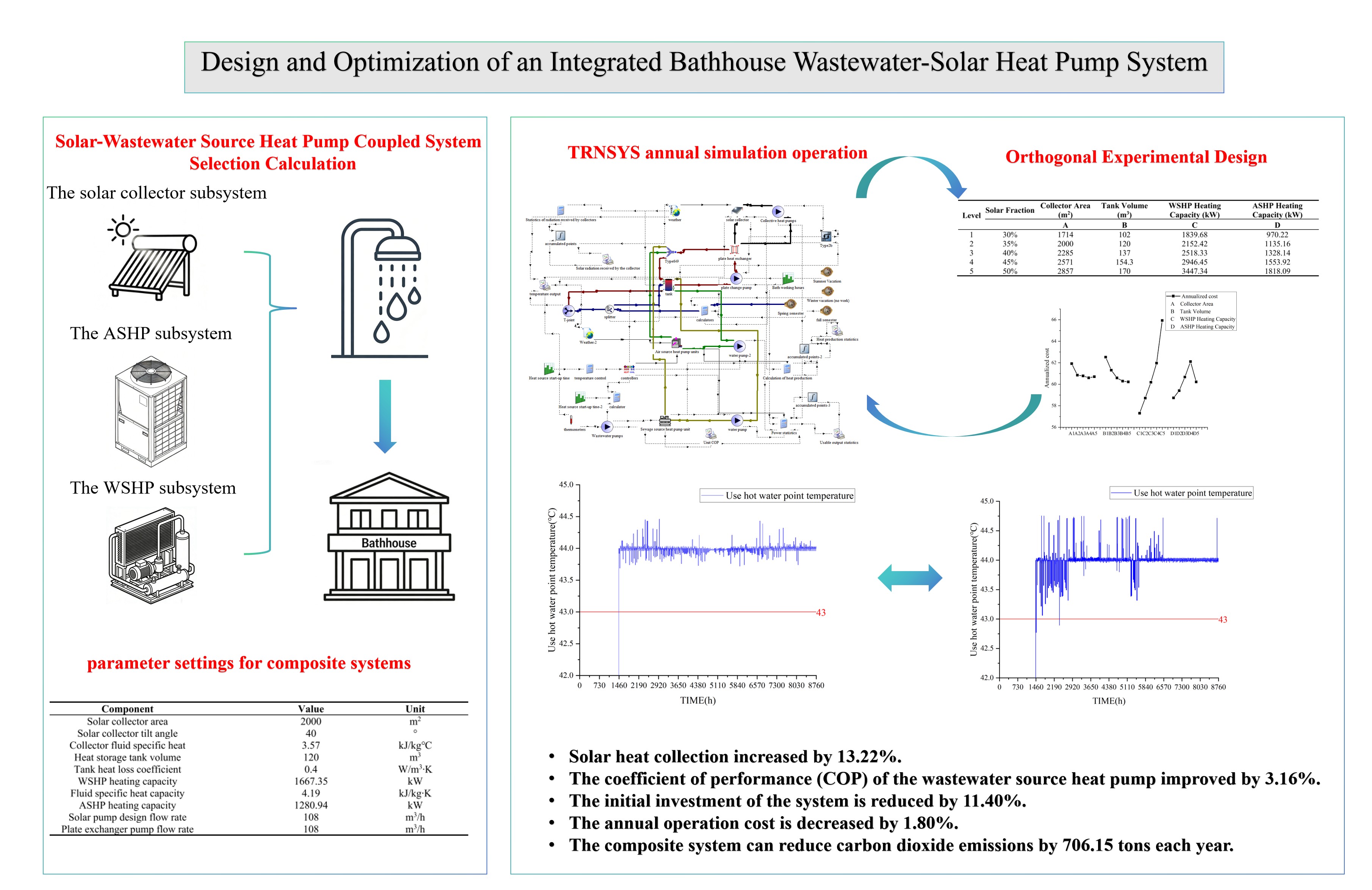
Public bathhouse wastewater exhibits significant waste heat recovery potential due to its high-temperature and high-flow characteristics. However, the temporal mismatch between wastewater availability cycles and bathing demand necessitates supplementary heat sources, with solar energy emerging as a critical renewable solution. Current research gaps persist in understanding multi-factor synergy mechanisms and parameter optimization in solar-wastewater source heat pump (WSHP) coupled systems. This study focuses on a university bathhouse in Changchun, China, designing a solar-WSHP hybrid heating system integrated with an air-source heat pump (ASHP) as auxiliary backup, tailored to academic calendar-driven operational cycles and bathing load characteristics. Utilizing the Transient System Simulation Tool (TRNSYS), a dynamic simulation model was developed to analyze annual performance, while a five-level orthogonal experimental design optimized four key parameters: solar collector area, storage tank volume, WSHP heating capacity, and ASHP heating capacity. Results demonstrate that the optimized system not only meets the hot water load demand, but also improves energy performance, with solar heat collection increased by 13.22% and the coefficient of performance (COP) of the wastewater source heat pump improved by 3.16%. In terms of economy, the initial investment of the system is reduced by 11.40%, and the annual operation cost is decreased by 1.80%. The composite system can reduce carbon dioxide emissions by 706.15 tons each year. This study provides theoretical and technical foundations for multi-objective optimization of waste heat recovery systems in public buildings, particularly addressing the operational demands of educational institutions.
- Open Access
- Article
- Yongji Wang 1,
- Xiaolei Yuan 2,
- Cheong Peng Au-Yong 3,
- Bee Teng Chew 4,
- Mingyuan Qin 5, *
Author Information
Received: 11 May 2025 | Revised: 12 Jun 2025 | Accepted: 08 Jul 2025 | Published: 14 Jul 2025
Abstract
Graphical Abstract
Keywords
solar energy | wastewater source heat pump | orthogonal experiment | multifactorial analysis
References
- 1.
Bruckner, T. Decarbonizing the Global Energy System: An Updated Summary of the IPCC Report on Mitigating Climate Change. Energy Technol. 2016, 4, 19–30.
- 2.
Tsilingiris, P.T. Solar water-heating design—A new simplified dynamic approach. Sol. Energy 1996, 57, 19–28.
- 3.
Leonforte, F.; Miglioli, A.; Del Pero, C.; et al. Design and Performance Monitoring of a Novel Photovoltaic-Thermal Solar-Assisted Heat Pump System for Residential Applications. Appl. Therm. Eng. 2022, 210, 118301.
- 4.
Gueymard, C.A.; Wilcox, S.M. Spatial and Temporal Variability in the Solar Resource: Assessing the Value of Short-Term Measurements at Potential Solar Power Plant Sites. In Proceedings of the Solar 2009 Conference, Buffalo, NY, USA, 11–16 May 2009.
- 5.
Ozcan, H.; Dincer, I. Exergy Analysis and Environmental Impact Assessment of Solar-Driven Heat Pump Drying Systems. In Causes, Impacts and Solutions to Global Warming; Springer: New York, NY, USA, 2013.
- 6.
Sterling, S.J.; Collins, M.R. Feasibility analysis of an indirect heat pump assisted solar domestic hot water system. Appl. Energy 2012, 93, 11–17.
- 7.
Yang, L.W.; Hua, N.; Pu, J.H.; et al. Analysis of operation performance of three indirect expansion solar assisted air source heat pumps for domestic heating. Energy Convers. Manag. 2022, 252, 115061.
- 8.
Anderson, J.V.; Mitchell, J.W.; Beckman, W.A. A design method for parallel solar-heat pump systems. Sol. Energy 1980, 25, 155–163.
- 9.
Liu, Y.; Ma, J.; Zhou, G.; et al. Performance of a solar air composite heat source heat pump system. Renew. Energy 2016, 93, 628−637.
- 10.
Wang, Q.; Zhang, X.; Geng, X.; et al. Experiments on the characteristics of a sewage water source heat pump system for heat recovery from bath waste. Appl. Therm. Eng. 2022, 204, 117956.
- 11.
Mi, P.; Ma, L.; Zhang, J. Integrated optimization study of hot water supply system with multi-heat-source for the public bath based on PVT heat pump and water source heat pump. Appl. Therm. Eng. 2020, 176, 115146.
- 12.
Ministry of Housing and Urban-Rural Development. China Urban Construction Statistical Yearbook 2022; China Planning Press: Beijing, China, 2023.
- 13.
Wang, R.Z.; Wang, L.W.; Cai, J.; et al. Research Status and Trends on Industrial Heat Pump and Network Utilization of Waste Heat. J. Refrig. 2017, 38, 1−10.
- 14.
Baek, N.C.; Shin, U.C.; Yoon, J.H. A study on the design and analysis of a heat pump heating system using wastewater as a heat source. Sol. Energy 2005, 78, 75–85.
- 15.
Ali, K.; Alaeddin, E. Investigation of the Performance of a Heat Pump Using Waste Water as a Heat Source. Energies 2009, 2, 697–713.
- 16.
Qin, N.; Hao, P.Z. The operation characteristics of sewage source heat pump system and the analysis of its thermal economic benefits. Appl. Therm. Eng. 2017, 124, 1083–1089.
- 17.
Liu, Z.; Ma, L.; Zhang, J. Application of a heat pump system using untreated urban sewage as a heat source. Appl. Therm. Eng. 2014, 62, 747–757.
- 18.
Allouhi, A.; Amine, M.B.; Buker, M.S.; et al. Forced-circulation solar water heating system using heat pipe-flat plate collectors: Energy and exergy analysis. Energy 2019, 180, 429–443.
- 19.
Maraj, A.; Londo, A.; Gebremedhin, A.; et al. Energy performance analysis of a forced circulation solar water heating system equipped with a heat pipe evacuated tube collector under the Mediterranean climate conditions. Renew. Energy 2019, 140, 874–883.
- 20.
Lai, Y.; Hao, W.; Yu, H.; et al. Performance and economic evaluation of evacuated tube solar collector with auxiliary electric heater for rural heating. Energy Procedia 2019, 158, 186–191.
- 21.
Xu, W.; Liu, C.; Li, A.; et al. Feasibility and performance study on hybrid air source heat pump system for ultra-low energy building in severe cold region of China. Renew Energy 2020, 146, 2124–2133.
- 22.
GB/T 50364-2018; Technical Standard for Solar Waterheating System of Civil Buildings. China Standard Press: Beijing, China, 2018.
- 23.
Li, J. Discussion on the value of cold water calculation temperature for solar water heating systems. Water Wastewater Eng. 2011, 47, 76–82.
- 24.
Zeng, N.H.; Yuan, Y.P.; Sun, L.L.; et al. Optimization research on air source heat pump assisted solar water heating system based on TRNSYS. Acta Energiae Solaris Sin. 2018, 39, 1245–1254.
- 25.
Chen, M.; Du, Q.; Yu, T.; et al. Heating performance and optimization of ice source heat pump system with supercooled water. Appl. Therm. Eng. 2024, 239, 122082.
- 26.
Si, Q.; Okumiya, M.; Zhang, X. Performance evaluation and optimization of a novel solar-ground source heat pump system. Energy Build. 2014, 70, 237–245.
- 27.
Znaczko, P.; Kaminski, K.; Chamier-Gliszczynski, N. Experimental Analysis of Control Methods in Solar Water Heating System. Energies 2021, 14, 8258.
- 28.
Porras-Prieto, C.J.; Mazarrón, F.R.; de los Mozos, V.; et al. Influence of required tank water temperature on the energy performance and water withdrawal potential of a solar water heating system equipped with a heat pipe evacuated tube collector. Sol. Energy 2014, 110, 365–377.
- 29.
Faddouli, A.; Fadili, S.; Labrim, H.; et al. Comparative study of a normal solar water heater and smart thermal/thermoelectric hybrid systems. Mater. Today Proc. 2020, 30, 1039–1042.
- 30.
Wu, X.; Leung, D.Y.C. Optimization of biodiesel production from camelina oil using orthogonal experiment. Appl. Energy 2011, 88, 3615–3624.
- 31.
Yin, W.L. Optimal Configuration of Electricity-Heat Integrated Energy Storage Supplier and Multi-Microgrid System Scheduling Strategy Considering Demand Response. Energies 2024, 17, 5436.
- 32.
Kalogirou, S.; Papamarcou, C. Simple validation method of a TRNSYS model for a thermosyphon solar water heating system. In Proceedings of the 2000 10th Mediterranean Electrotechnical Conference, Lemesos, Cyprus, 29–31 May 2000; pp. 1102–1106.
- 33.
Hussein, H.M.S. Optimization of a natural circulation two phase closed thermosyphon flat plate solar water heater. Energy Convers. Manag. 2003, 44, 2341–2352.
- 34.
Wang, X.; Xia, L.; Bales, C.; et al. A systematic review of recent air source heat pump (ASHP) systems assisted by solar thermal, photovoltaic and photovoltaic/thermal sources. Renew. Energy 2020, 146, 2472–2487.
- 35.
Terhan, M.; Comakli, K. Energy and exergy analyses of natural gas-fired boilers in a district heating system. Appl. Therm. Eng. 2017, 121, 380–387.
- 36.
GB/T 24896-2010; Thermal Performance Test Code for Industrial Boilers. China Standard Press: Beijing, China, 2010.
- 37.
Technical Guideline for Monitoring and Evaluation of Renewable Energy Building Application Demonstration Projects; China Architecture & Building Press: Beijing, China, 2009.
- 38.
Yu, S.; Wei, Y.M.; Guo, H.; et al. Carbon emission coefficient measurement of the coal-to-power energy chain in China. Appl. Energy 2015, 114, 200–300.


This work is licensed under a Creative Commons Attribution 4.0 International License.

 Suite 4002 Level 4, 447 Collins Street, Melbourne, Victoria 3000, Australia
 General Inquiries: info@sciltp.com