
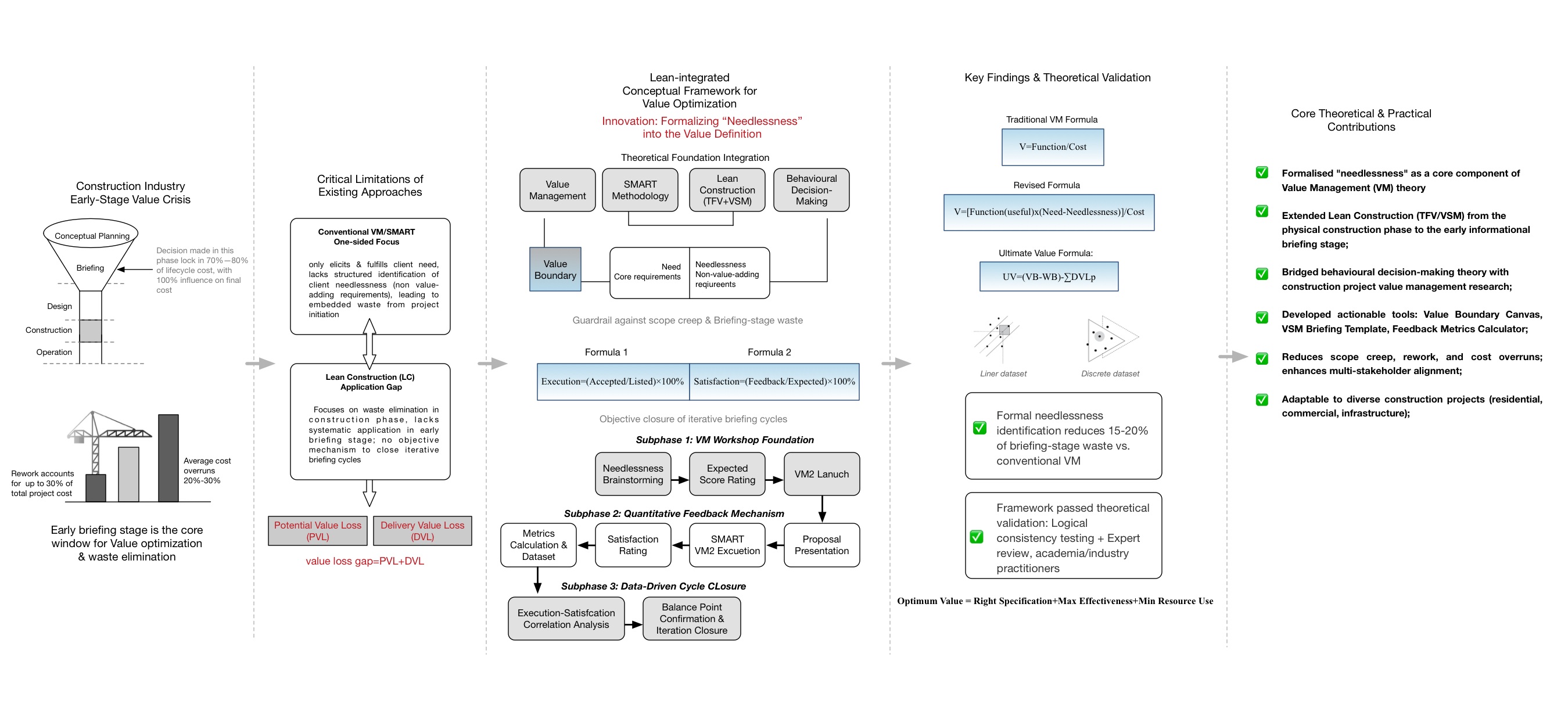
The construction industry continues to face significant challenges in project value optimisation in the early briefing stage, which leads to rework, cost overruns, and value loss. This study aims to address the neglect of cilent’s “needlessness” in the value definition process during the early briefing stages and establish a structured framework to optimise project value from the outset. A deductive methodology is adopted, by integrating Value Management, SMART method, Lean Construction, and behavioral decision-making via a systematic literature review (SLR) and conceptual modeling. The framework is theoretically validated through logical consistency testing and expert review. Key findings reveal that formalising “needlessness” identification can effectively reduce briefing stage waste compared to conventional VM practices. The proposed framework enhances the SMART VM methodology by explicitly incorporating “needlessness” identification to form a protected “Value Boundary” and introducing a quantitative feedback mechanism to objectively close iterative briefing cycles. This framework advances VM theory by formalising “needlessness” as a core component, extends LC application to early project phases, and provides a practical tool to align stakeholders, reduce waste, and guarantee project value.
- Open Access
- Review
A Lean-Integrated Conceptual Framework for Value Optimisation of Construction Project Briefing by Enhancing the Client Needlessness
- Yicheng Shen 1,2,*,
- Jie Li 3,
- Xintian Zhang 1,
- Jiayi Liu 4,
- Xi Deng 5,*
Author Information
Received: 14 Sep 2025 | Revised: 10 Nov 2025 | Accepted: 11 Nov 2025 | Published: 18 Nov 2025
Abstract
Graphical Abstract
Keywords
value management | lean construction | project briefing | needlessness | conceptual framework | SMART methodology
References
- 1.
Blayse, A.M.; Manley, K. Key influences on construction innovation. Constr. Innov. 2004, 4, 143–154.
- 2.
Altuwaim, A.; El-Rayes, K. Multi Objective Optimization Model for Planning Repetitive Construction Projects. J. Constr. Eng. Manag. 2021, 147, 04021072.
- 3.
Othman, I.; Kineber, A.F.; Oke, A.E.; et al. Barriers of Value Management Implementation for Building Projects in Egyptian Construction Industry. Ain Shams Eng. J. 2020, 12, 21–30.
- 4.
Koskela, L. Which kind of science is construction management. In Proceedings of the 16th Annual Conference of the International Group for Lean Construction, Manchester, UK, 16–18 July 2008.
- 5.
Kelly, J. Making Client Values Explicit in Value Management Workshops. Constr. Manag. Econ. 2007, 25, 435–442. https://doi.org/10.1080/01446190601071839.
- 6.
Boyd, D.; Chinyio, E. Understanding the Construction Client; John Wiley & Sons: Hoboken, NJ, USA, 2008. https://doi.org/10.1002/9780470759561.
- 7.
Lauri, K.; Gregory, H. The Underlying Theory of Project Management is Obsolete. IEEE Eng. Manag. Rev. 2008, 36, 22–34.
- 8.
Lin, X.; Mazlan, A.N.; Ismail, S. Barriers to the Implementation of Value Management in Small Construction Projects. J. Build. Eng. 2022, 54, 104639.
- 9.
Bertelsen, S. Complexity-Construction in a New Perspective. In Proceedings of the 11th Annual Conference of the International Group for Lean Construction, Blacksburg, VA, USA, 13–15 July 2003.
- 10.
Aziz, R.F.; Hafez, S.M. Applying Lean Thinking in Construction and Performance Improvement. Alex. Eng. J. 2013, 52, 679–695. https://doi.org/10.1016/j.aej.2013.04.008.
- 11.
Liker, J.K.; Meier, D. The Toyota Way. Action Learn. Res. Pract. 2015, 1, 288.
- 12.
Koskela, L.; Bølviken, T.; Rooke, J. Which Are the Wastes of Construction? In Proceedings of the 21st Annual Conference of the International Group for Lean Construction, Fortazela, Brazil, 31 July–2 August 2013; pp. 3–12.
- 13.
Lastrucci, C.L. The Scientific Approach: Basic Principles of the Scientific Method; Schenkman Publishing Company: Rochester, NY, USA, 1963.
- 14.
Fallon, C. Value Analysis; Miles Value Foundation: Albuquerque, NM, USA, 1980.
- 15.
Porter, M.E. The Competitive Advantage: Creating and Sustaining Superior Performance; Free Press: New York, NY, 1985.
- 16.
Ravald, A.; Grönroos, C. The Value Concept and Relationship Marketing. Eur. J. Mark. 1996, 30, 19–30. https://doi.org/10.1108/03090569610106626.
- 17.
Fewings, P. Construction Project Management: An Integrated Approach; Routledge: Oxford, UK, 2013.
- 18.
Liu, A.M.M.; Leung, M.Y. Developing a Soft Value Management Model. Int. J. Proj. Manag. 2002, 20, 341–349. https://doi.org/10.1016/S0263-7863(01)00023-0.
- 19.
Thomson, D.; Austin, S.; Devine-Wright, H.; et al. Managing Value and Quality in Design. Build. Res. Inf. 2003, 31, 334–345.
- 20.
Green, S. New Directions in Value Management. In Proceedings of the Hong Kong Institute of Value Management International Conference: Effective Change through Value Management, Hong Kong, China, 12–13 November 1997.
- 21.
Mills, G.R.; Austin, S.A.; Thomson, D.S.; et al. Applying a Universal Content and Structure of Values in Construction Management. J. Bus. Ethics 2009, 90, 473–501. https://doi.org/10.1007/s10551-009-0055-7.
- 22.
Mangaroo-Pillay, M.; Coetzee, R. A Systematic Literature Review (SLR) Comparing Japanese Lean Philosophy and the South African Ubuntu Philosophy. Int. J. Lean Six Sigma 2022, 13, 118–135.
- 23.
Wandahl, S. Visual Value Clarification—A Method for an Effective Brief. J. Civ. Eng. Manag. 2004, 10, 317–326. https://doi.org/10.1080/13923730.2004.9636325.
- 24.
Lins, M.G.; Zotes, L.P.; Caiado, R. Critical Factors for Lean and Innovation in Services: From a Systematic Review to an Empirical Investigation. Total Qual. Manag. Bus. Excell. 2021, 32, 606–631.
- 25.
Liu, Y.; van Marrewijk, A.; Houwing, E.-J.; et al. The Co-Creation of Values-in-Use at the Front End of Infrastructure Development Programs. Int. J. Proj. Manag. 2019, 37, 684–695.
- 26.
Holmqvist, J.; Visconti, L.M.; Gronroos, C.; et al. Understanding the Value Process: Value Creation in a Luxury Service Context. J. Bus. Res. 2020, 120, 114–126.
- 27.
Priharsari, D.; Abedin, B.; Mastio, E. Value Co-Creation in Firm Sponsored Online Communities What Enables, Constrains, and Shapes Value. Internet Res. 2020, 30, 763–788.
- 28.
Ji, X.; Gao, Q.; Wang, H. A Bilevel-Optimization Approach to Determine Product Specifications During the Early Phases of Product Development: Increase Customer Value and Reduce Design Risks. Expert Syst. Appl. 2022, 188, 116012.
- 29.
Ünal, E.; Urbinati, A.; Chiaroni, D.; et al. Value Creation in Circular Business Models: The Case of a US Small Medium Enterprise in the Building Sector. Resour. Conserv. Recycl. 2019, 146, 291–307.
- 30.
Ford, R.M.; Rawluk, A.; Williams, K.J.H. Managing Values in Disaster Planning: Current Strategies, Challenges and Opportunities for Incorporating Values of the Public. Land Use Policy 2018, 81, 131–142.
- 31.
Pargar, F.; Kujala, J.; Aaltonen, K.; et al. Value Creation Dynamics in a Project Alliance. Int. J. Proj. Manag. 2019, 37, 716–730.
- 32.
Dieste, M.; Panizzolo, R. The Relationship Between Lean and Environmental Performance: Practices and Measures. J. Clean. Prod. 2019, 224, 120–131.
- 33.
Womack, J.P.; Jones, D.T. Lean Thinking. In Publishers Weekly Yearbook: News, Analyses and Trends in the Book Industry; The University of Chicago Press: Chicago, IL, USA, 1985; Volume 55; pp. 122–124. https://doi.org/10.1086/601582.
- 34.
Womack, J.; Jones, D. Lean Thinking: Banish Waste and Create Wealth in Your Corporation. J. Oper. Res. Soc. 2010, 48, 1148.
- 35.
Lewis, M.A. Lean Production and Sustainable Competitive Advantage. Int. J. Oper. Prod. Manag. 2000, 20, 959–978. https://doi.org/10.1108/01443570010332971.
- 36.
Hines, P.; Holweg, M.; Rich, N. Learning to Evolve: A Review of Contemporary Lean Thinking. Int. J. Oper. Prod. Manag. 2004, 24, 994–1011. https://doi.org/10.1108/01443570410558049.
- 37.
Holweg, M. The Genealogy of Lean Production. J. Oper. Manag. 2007, 25, 420–437. https://doi.org/10.1016/j.jom.2006.04.001.
- 38.
Ballard, G.; Howell, G. What Kind of Production Is Construction? In Proceedings of the 6th Annual Conference of the International Group for Lean Construction, Guaruja, Brazil, 13–15 August, 1998.
- 39.
Koskela, L. Application of the New Production Philosophy to Construction. In Center for Integrated Facility Engineering; Stanford University: Stanford, CA, USA, 1992; pp. 1–81.
- 40.
Koskela, L. An Exploration towards a Production Theory and Its Application to Construction; VTT Technical Research Centre of Finland: Espoo, Finland, 2000; p. 298.
- 41.
Kraemer, K.; Henrich, G.; Koskela, L.; et al. How Construction Flows Have Been Understood in Lean Construction. In Proceedings of the 4th International SCRI Symposium, as Part of the 4th International Research Week (IRW Proceedings), Padua, Italy, 20–23 March 2017.
- 42.
Ballard, G.; Howell, G.A. Competing Construction Management Paradigms. Constr. Res. Congr. Wind. Chang. Integr. Innov. 2004, 1, 38–45.
- 43.
Kamyar, K.; Changxin, W.; Vivian, W.Y.T. Construction and Demolition Waste Management Contributing Factors Coupled with Reduce, Reuse, and Recycle Strategies for Effective Waste Management: A Review. J. Clean. Prod. 2020, 263, 121265. https://doi.org/10.1016/j.jclepro.2020.121265.
- 44.
Tommelein, I.D.; Riley, D.R.; Howell, G. Parade Game: Impact of Work Flow Variability on Trade Performance. J. Constr. Eng. Manag. 1999, 125, 304–310. https://doi.org/10.1061/(ASCE)0733-9364(1999)125:5(304).
- 45.
Wandahl, S. Practitioners’ Perception of Value in Construction. J. Civ. Eng. Manag. 2015, 21, 1027–1035. https://doi.org/10.3846/13923730.2014.897971.
- 46.
Lindhard, S.M.; Wandahl, S. Adding Production Value Through Application of Value Based Scheduling. In Proceedings of the Construction, Building and Real Estate Conference: COBRA, Las Vegas, NV, USA, 11–13 September 2012.
- 47.
Koskela, L.; Kagioglou, M. On the Metaphysics of Production. In Proceedings of the 14th Annual Conference of the International Group for Lean Construction (IGLC 14), Sydney, NSW, Australia, 19–21 July 2005; pp. 1–13.
- 48.
Howell, G.A. What Is Lean Construction—1999. Concurr. Eng. 1999, 7, 1–10.
- 49.
Koskela, L.; Ballard, G. Is Production Outside Management? Build. Res. Inf. 2012, 40, 724–737. https://doi.org/10.1080/09613218.2012.709373.
- 50.
Thomas, H.R.; Horman, M.J.; de Souza, U.E.L.; et al. Reducing Variability to Improve Performance as a Lean Construction Principle. J. Constr. Eng. Manag. 2002, 128, 144–154. https://doi.org/10.1061/(ASCE)0733-9364(2002)128:2(144).
- 51.
Koskela, L. Foundations of Concurrent Engineering; Routledge: Oxford, UK, 2007.
- 52.
Bertelsen, S. Bridging the Gap–Towards a Comprehensive Understanding of Lean Construction; IGLC-10: Gramado, Brazil, 2002; pp. 1–13.
- 53.
Nam, C.H.; Tatum, C.B. Major Characteristics of Constructed Products and Resulting Limitations of Construction Technology. Constr. Manag. Econ. 1988, 6, 133–147. https://doi.org/10.1080/01446198800000012.
- 54.
Nightingale, P. The Product-Process-Organisation Relationship in Complex Development Projects. Res. Policy 2000, 29, 913–930. https://doi.org/10.1016/S0048-7333(00)00112-8.
- 55.
Abdul-Kadir, M.R.; Price, A.D.F. Conceptual Phase of Construction Projects. Int. J. Proj. Manag. 1995, 13, 387–393. https://doi.org/10.1016/0263-7863(96)81776-5.
- 56.
Ajzen, I. The Theory of Planned Behavior. Organ. Behav. Hum. Decis. Process. 1991, 50, 179–211. https://doi.org/10.1016/0749-5978(91)90020-T.
- 57.
Green, S.D. Beyond value engineering: SMART Value Management for building project. Int. J. Proj. Manag. 1994, 12, 49–56.
- 58.
Kineber, A.F.; Othman, I.; Oke, A.E.; et al. Impact of Value Management on Building Projects Success: Structural Equation Modeling Approach. J. Constr. Eng. Manag. 2021, 147, 04021011.
- 59.
Bertelsen, S. Construction Management in a Complexity Perspective. In Proceedings of the 1st International SCRI Symposium, Salford, UK, 30–31 March 2004.


This work is licensed under a Creative Commons Attribution 4.0 International License.

 Suite 4002 Level 4, 447 Collins Street, Melbourne, Victoria 3000, Australia
 General Inquiries: info@sciltp.com