
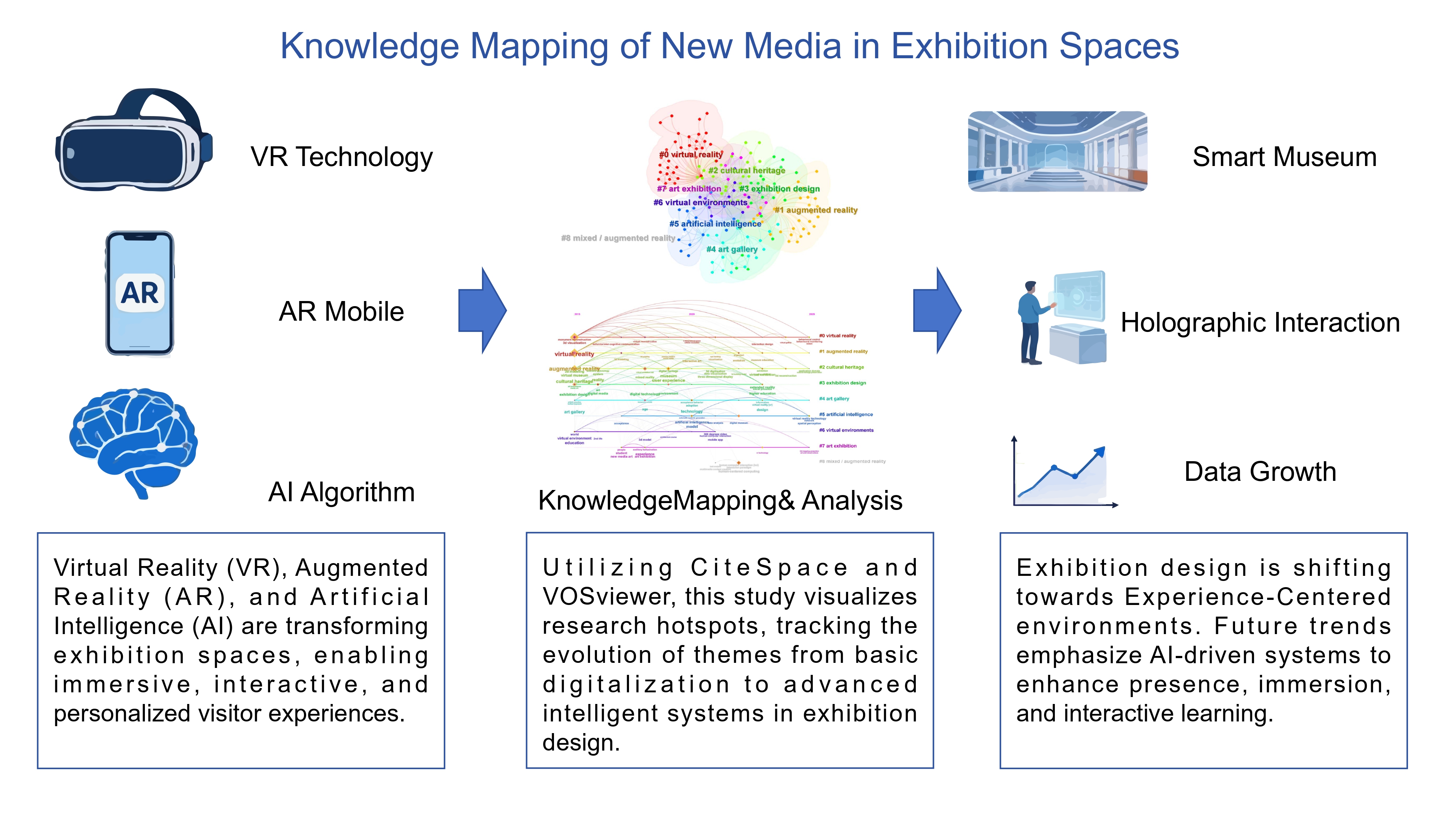
With the rapid development of virtual reality, augmented reality, mixed reality, and artificial intelligence, exhibition space design and communication have undergone significant transformations. This study systematically reviews the research progress using the Web of Science Core Collection as the data source. Publications from 2015 to 2025 were analyzed through bibliometric and visualization tools, including R-biblioshiny, CiteSpace, and VOSviewer. The analysis examined annual publication trends, keyword co-occurrence and bursts, thematic evolution, and national and institutional collaboration networks. Results show a steady growth in studies, with peaks in 2018 and 2023, reflecting strong academic interest in immersive exhibition technologies. “Virtual reality” and “augmented reality” remain central themes, while “cultural heritage”, “exhibition design”, and “user experience” are major application domains. Emerging topics such as “artificial intelligence”, “virtual environments”, and “data visualization” highlight a shift toward intelligence-driven and experience-centered research. China and the United States lead in output and influence internationally, whereas European countries show regional collaboration. Despite these advances, limitations persist regarding intelligent applications, cross-cultural comparisons, longitudinal research, theoretical development, and sustainability concerns. By mapping knowledge structures and research frontiers, this study offers valuable insights for advancing academic inquiry and guiding innovative practices in exhibition spaces.
- Open Access
- Article
Knowledge Mapping and Research Trends of New Media Technology Applications in Exhibition Spaces
- Jiaqi Liu 1,*,
- Zeqin Wu 2,
- Haoyuan Xu 3,
- Yuxuan Wan 4
Author Information
Received: 26 Sep 2025 | Revised: 07 Nov 2025 | Accepted: 17 Nov 2025 | Published: 19 Nov 2025
Abstract
Graphical Abstract
Keywords
museum | exhibition space | interactive art | digital art | Scientometrics | knowledge mapping
References
- 1.
Ye, W.N.; Li, Y.H. Design and Research of Digital Media Art Display Based on Virtual Reality and Augmented Reality. Mob. Inf. Syst. 2022, 2022, 6606885. https://doi.org/10.1155/2022/6606885.
- 2.
Al-Ansi, A.M.; Jaboob, M.; Garad, A.; et al. Analyzing augmented reality (AR) and virtual reality (VR) recent development in education. Soc. Sci. Humanit. Open 2023, 8, 100532.
- 3.
Garro, V.; Sundstedt, V.; Sandahl, C. Impact of Location, Gender and Previous Experience on User Evaluation of Augmented Reality in Cultural Heritage: The Mjällby Crucifix Case Study. Heritage 2022, 5, 1988–2006.
- 4.
Dargan, S.; Bansal, S.; Kumar, M.; et al. Augmented reality: A comprehensive review. Arch. Comput. Methods Eng. 2023, 30, 1057–1080.
- 5.
Liu, X.; Zhang, N. Interactive Display of Images in Digital Exhibition Halls under Artificial Intelligence and Mixed Reality Technology. Comput. Intell. Neurosci. 2022, 2022, 3688797. https://doi.org/10.1155/2022/3688797.
- 6.
Kent, L.; Snider, C.; Gopsill, J.; et al. Mixed reality in design prototyping: A systematic review. Des. Stud. 2021, 77, 101046.
- 7.
Spittle, B.; Frutos-Pascual, M.; Creed, C.; et al. A review of interaction techniques for immersive environments. IEEE Trans. Vis. Comput. Graph. 2022, 29, 3900–3921.
- 8.
Wang, D.; Huang, X. Transforming education through artificial intelligence and immersive technologies: Enhancing learning experiences. Interact. Learn. Environ. 2025, 33, 4546–4565.
- 9.
Ai, L.; Phaholthep, C. Evaluating Museum Environment Composition Containing Digital Media Interaction to Improve Communication Efficiency. Buildings 2025, 15, 1186. https://doi.org/10.3390/buildings15071186.
- 10.
Li, M.Q.; Wang, G.H.; Fu, X.; et al. Interactive Design of Museum Display Space Based on Virtual and Reality Technology. Wirel. Commun. Mob. Comput. 2022, 2022, 8662037. https://doi.org/10.1155/2022/8662037.
- 11.
Zhang, Y. Application of digital media art in exhibit design. In Proceedings of the 2016 4th International Education, Economics, Social Science, Arts, Sports and Management Engineering Conference (IEESASM 2016), Yinchuan, China, 13–14 August 2016; pp. 23–26.
- 12.
Iacono, S.; Scaramuzzino, M.; Martini, L.; et al. Virtual Reality in Cultural Heritage: A Setup for Balzi Rossi Museum. Appl. Sci. 2024, 14, 3562. https://doi.org/10.3390/app14093562.
- 13.
Charitonidou, M. Interactive art as reflective experience: Imagineers and ultra-technologists as interaction designers. Vis. Resour. 2020, 36, 382–396. https://doi.org/10.1080/01973762.2022.2041218.
- 14.
Zhao, J.; Guo, L.; Li, Y. Application of digital twin combined with artificial intelligence and 5G technology in the art design of digital museums. Wirel. Commun. Mob. Comput. 2022, 2022, 8214514.
- 15.
Zhao, Y. Control System and Speech Recognition of Exhibition Hall Digital Media Based on Computer Technology. Mob. Inf. Syst. 2022, 2022, 7427899. https://doi.org/10.1155/2022/7427899.
- 16.
Liu, W.; Kim, H.G. The Analysis of Body Emotion Recognition in New Media Art Exhibition Space-Based Artificial Intelligence. IEEE Access 2025, 13, 66197–66210. https://doi.org/10.1109/ACCESS.2025.3560422.
- 17.
Lampropoulos, G.; Kinshuk. Virtual reality and gamification in education: A systematic review. Educ. Technol. Res. Dev. 2024, 72, 1691–1785.
- 18.
Yu, Z.; Xu, W. A meta‐analysis and systematic review of the effect of virtual reality technology on users' learning outcomes. Comput. Appl. Eng. Educ. 2022, 30, 1470–1484.
- 19.
Denes, A.; Pradit, A. Chiang Mai’s intangible cultural heritage: Urban revitalization and cultural identity in a northern Thai city. J. Urban Cult. Res. 2025, 25, 3–17.
- 20.
Lin, X.; Wang, Y.; Zhan, Z.; et al. Effects of VR technical interaction and acceptance on rural cultural identity: The mediating role of embodied cognition and flow experience. Telemat. Inform. Rep. 2024, 16, 100170.
- 21.
Kar, A.K.; Choudhary, S.K.; Singh, V.K. How can artificial intelligence impact sustainability: A systematic literature review. J. Clean. Prod. 2022, 376, 134120.
- 22.
Adlawan, R. Interdisciplinary Approaches to Aesthetics in the Digital Age. Eur. Rev. Contemp. Arts Humanit. 2025, 1, 16–19.
- 23.
Muenster, S. Digital 3D technologies for humanities research and education: An overview. Appl. Sci. 2022, 12, 2426.
- 24.
Windhager, F.; Mayr, E. Digital humanities and distributed cognition: From a lack of theory to its visual augmentation. J. Cult. Anal. 2024, 7. https://doi.org/10.22148/001c.121866.
- 25.
Hutson, J.; Olsen, T. Virtual reality and art history: A case study of digital humanities and immersive learning environments. J. High. Educ. Theory Pract. 2022, 22, 50–65.
- 26.
Asubiaro, T.; Onaolapo, S.; Mills, D. Regional disparities in Web of Science and Scopus journal coverage. Scientometrics 2024, 129, 1469–1491.
- 27.
Wu, Z.; Sulaiman, R.; Ahmad, Y. Scoping Review and Bibliometric Analyses on Trends and Design of Adult Daycare Centers. INQUIRY J. Health Care Organ. Provis. Financ. 2025, 62. https://doi.org/10.1177/00469580251333308.
- 28.
Shao, Z.; Yuan, S.; Wang, Y.; et al. Evolutions and trends of artificial intelligence (AI): Research, output, influence and competition. Libr. Hi Tech 2022, 40, 704–724.
- 29.
Klarin, A. How to conduct a bibliometric content analysis: Guidelines and contributions of content co‐occurrence or co‐word literature reviews. Int. J. Consum. Stud. 2024, 48, e13031.
- 30.
Winter, M.; Sweeney, L.; Mason, K.; et al. Low-power machine learning for visitor engagement in museums. In Proceedings of the 6th International Conference on Computer-Human Interaction Research and Applications (CHIRA 2022), Valletta, Malta, 27–28 October 2022; pp. 236–243.
- 31.
Jangra, S.; Singh, G.; Mantri, A.; et al. Exploring the impact of virtual reality on museum experiences: Visitor immersion and experience consequences. Virtual Real. 2025, 29, 84. https://doi.org/10.1007/s10055-025-01140-1.
- 32.
Chang, S.; Suh, J. The Impact of VR Exhibition Experiences on Presence, Interaction, Immersion, and Satisfaction: Focusing on the Experience Economy Theory (4Es). Systems 2025, 13, 55.
- 33.
Muñoz, A.; Climent-Ferrer, J.J.; Martí-Testón, A.; et al. Enhancing Cultural Heritage Engagement with Novel Interactive Extended-Reality Multisensory System. Electronics 2025, 14, 2039.
- 34.
Lei, L. The artificial intelligence technology for immersion experience and space design in museum exhibition. Sci. Rep. 2025, 15, 27317. https://doi.org/10.1038/s41598-025-13408-2.
- 35.
Boampong, M.S.; Boakye-Danquah, J.; Boafo, Y.A.; et al. Experiences of inequality in international collaborative research—Perspectives from environmental and sustainability scholars from Ghana, West Africa. Environ. Sci. Policy 2024, 152, 103661. https://doi.org/10.1016/j.envsci.2023.103661.
- 36.
Chankseliani, M. Who funds the production of globally visible research in the Global South? Scientometrics 2023, 128, 783–801. https://doi.org/10.1007/s11192-022-04583-4.
- 37.
Astuti, H.M.; Ayinde, L.A. Uneven progress: Analyzing the factors behind digital technology adoption rates in Sub-Saharan Africa (SSA). Data Policy 2025, 7, e23. https://doi.org/10.1017/dap.2024.89.
- 38.
Pioli, M. Museums of the Future: Digitalisation as a New Form of Communication. Master’s Thesis, Università Ca’ Foscari: Venice, Italy, 2024.


This work is licensed under a Creative Commons Attribution 4.0 International License.

 Suite 4002 Level 4, 447 Collins Street, Melbourne, Victoria 3000, Australia
 General Inquiries: info@sciltp.com