
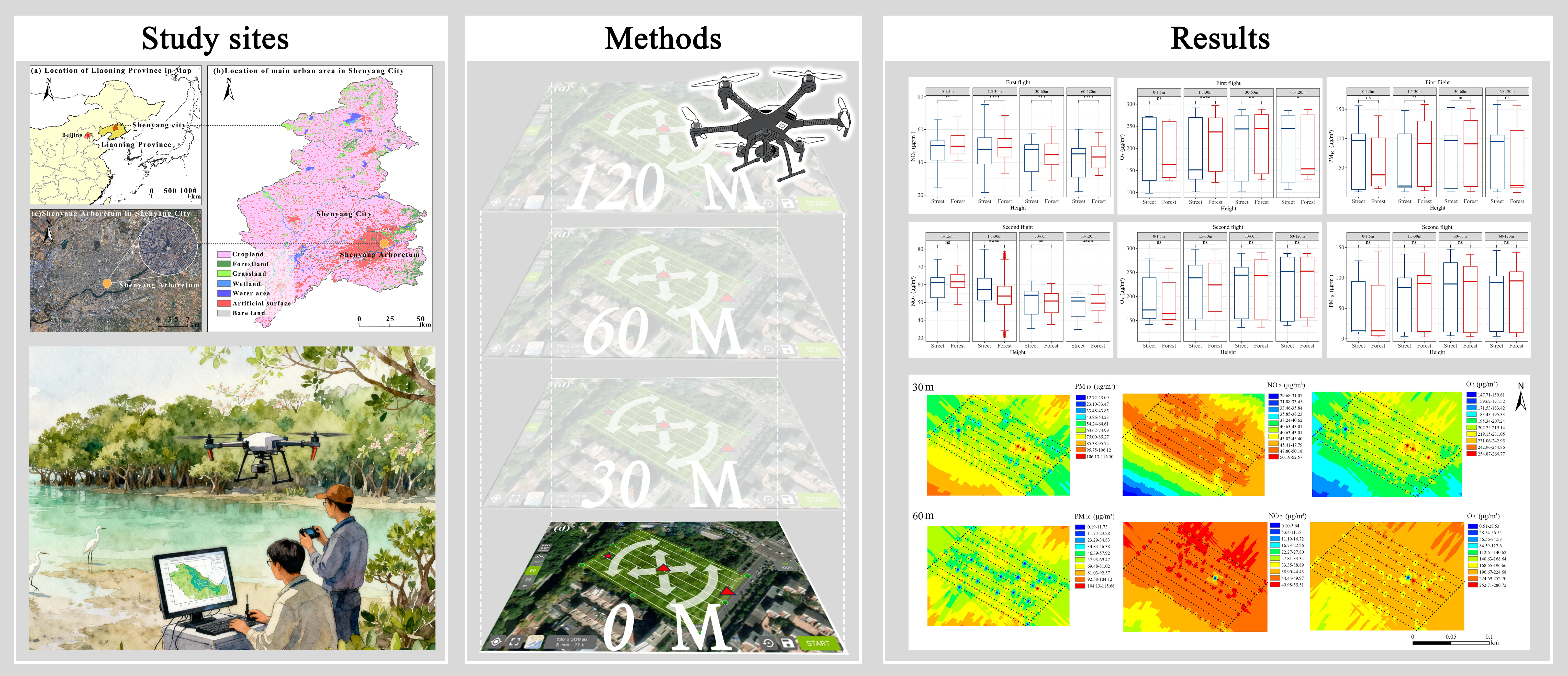
Urban forests play a critical role in air quality regulation in urban areas. This study aimed to utilize unmanned aerial vehicles to monitor the concentrations of NO2, O3 and PM10 at multiple heights during the autumn days in 2022 to evaluate the vertical effects of urban forests on air quality in Shenyang, China. Result showed that NO2 concentrations at 0–1.5 m were 46.99 ± 12.86 µg/m3 in the streets, which was significantly lower than 51.64 ± 7.33 µg/m3 in forests at midday. However, there was no significant difference in O3 and PM10 concentrations at 0–1.5 m between in the forests and in the street. NO2 and O3 concentrations at 1.5–30 m in the forests were significantly lower at that at 1.5–30 m in the street, while PM10 concentrations at 1.5–30 m in the forests were significantly higher at that at 1.5–30 m in the street. The purifying effects of the urban forests on NO2, O3 and PM10 gradually strengthened from midday to afternoon.
- Open Access
- Article
Uncovering the Air Quality Benefits of Urban Forests Using UAV Surveys
- Lihua Huang 1,
- Sohail Ahmad 1,
- Chunping Miao 1,*,
- Fengxian Chen 2,
- Leila Mohaghegh 3,
- Ali Cheshmehzangi 4
Author Information
Received: 06 Oct 2025 | Revised: 16 Dec 2025 | Accepted: 19 Dec 2025 | Published: 23 Dec 2025
Abstract
Graphical Abstract
Keywords
References
- 1.
WHO. Air Pollution and its Impact on Public Health; World Health Organization Report; WHO: Geneva, Switzerland, 2021.
- 2.
Wania, A.; Bruse, M.; Blond, N.; et al. Analysing the influence of different street vegetation on traffic-induced particle dispersion using microscale simulations. J. Environ. Manag. 2012, 94, 91–101.
- 3.
WHO. Ambient (Outdoor) Air Pollution; World Health Organization Report; WHO: Geneva, Switzerland, 2024.
- 4.
Du, Z.; Li, H.; Chen, S.; et al. Advancements in machine learning for spatiotemporal urban on-road traffic-air quality study: A review. Atmos. Environ. 2025, 346, 121054.
- 5.
Hsu, H.-C.; Tarekegn, G.B.; Getnet, M.E.; et al. UAV-Based real-time air quality monitoring and prediction using machine learning approach. IEEE Internet Things J. 2025, 12, 27915–27928.
- 6.
Huang, X. The impact of PM10 and other airborne particulate matter on the cardiopulmonary and respiratory systems of sports personnel under atmospheric exposure. Atmosphere 2023, 14, 1697.
- 7.
Miao, C.; Hu, T.; Liu, Y.; et al. Interpreting the relationship between urban forests and air quality: Horizontal and vertical investigations utilizing unmanned aerial vehicles. Urban Clim. 2025, 61, 102394.
- 8.
Zhang, X.; Huang, T.; Zhang, L.; et al. Trends of deposition fluxes and loadings of sulfur dioxide and nitrogen oxides in the artificial Three Northern Regions Shelter Forest across northern China. Environ. Pollut. 2015, 207, 238–247.
- 9.
Wang, C.; Ren, Z.; Dong, Y.; et al. Efficient cooling of cities at global scale using urban green space to mitigate urban heat island effects in different climatic regions. Urban For. Urban Green. 2022, 74, 127635.
- 10.
Gong, C.; Xian, C.; Wu, T.; et al. Role of urban vegetation in air phytoremediation: Differences between scientific research and environmental management perspectives. NPJ Urban Sustain. 2023, 3, 24.
- 11.
Gong, C.; Xian, C.; Cui, B.; et al. Estimating NOx removal capacity of urban trees using stable isotope method: A case study of Beijing. China. Environ. Pollut. 2021, 290, 118004.
- 12.
Ren, F.; Qiu, Z.; Liu, Z.; et al. Trees help reduce street-side air pollution: A focus on cyclist and pedestrian exposure risk. Build. Environ. 2023, 229, 109923.
- 13.
Ahn, J.W.; Dinh, T.-V.; Park, S.-Y.; et al. Characteristics of biogenic volatile organic compounds emitted from major species of street trees and urban forests. Atmos. Pollut. Res. 2022, 13, 101470.
- 14.
Vranckx, S.; Vos, P.; Maiheu, B.; et al. Impact of trees on pollutant dispersion in street canyons: A numerical study of the annual average effects in Antwerp. Belgium. Sci. Total Environ. 2015, 532, 474–483.
- 15.
Xing, Y.; Brimblecombe, P. Dispersion of traffic derived air pollutants into urban parks. Sci. Total Environ. 2018, 622, 576–583.
- 16.
Miao, C.P.; Cui, A.; Xiong, Z.; et al. Vertical evaluation of air quality improvement by urban forest using unmanned aerial vehicles. Front. Ecol. Evol. 2022, 10, 1045937.
- 17.
Mircea, M.; Borge, R.; Finardi, S.; et al. The role of vegetation on urban atmosphere of three European cities. Part 2: Evaluation of vegetation impact on air pollutant concentrations and depositions. Forests 2023, 14, 1255.
- 18.
Moftakhar Juybari, M.; Heshmatol Vaezin, S.M.; Moeinaddini, M.; et al. Effectiveness of urban parks in reducing ambient PM10 through deposition and dispersion: Towards greener cities. Environ. Dev. Sustain. 2025. https://doi.org/10.1007/s10668-025-06072-z.
- 19.
Fry, J.; Ooms, P.; Maarten Krol, M.; et al. Effect of street trees on local air pollutant concentrations (NO2, BC, UFP, PM2.5) in Rotterdam, the Netherlands. Environ. Sci. Atmos. 2025, 5, 394.
- 20.
Hashad, K.; Yang, B.; Gallagher, J.; et al. Impact of roadside conifers vegetation growth on air pollution mitigation. Landsc. Urban Plan. 2023, 229, 104594.
- 21.
Liu, C.; Huang, J.; Hu, X.; et al. Evaluation of WRF-Chem simulations on vertical profiles of PM2.5 with UAV observations during a haze pollution event. Atmos. Environ. 2021, 252, 118332.
- 22.
Yao, J.; Wu, S.; Cao, Y.; et al. Dry deposition effect of urban green spaces on ambient particulate matter pollution in China. Sci. Total Environ. 2023, 900, 165830.
- 23.
Villa, T.F.; Gonzalez, F.; Miljievic, B.; et al. An overview of small unmanned aerial vehicles for air quality measurements: Present applications and future prospectives. Sensors 2016, 16, 1072.
- 24.
Roostaei, V.; Gharibzadeh, F.; Shamsipour, M.; et al. Vertical distribution of ambient air pollutants (PM2.5, PM10, NOx, and NO2); A systematic review. Heliyon 2024, 10, 39726.
- 25.
Moura, B.B.; Nissim, W.G.; Manzini, J.; et al. The role of urban forests in tackling air and soil pollution in Italian cities. Urban For. Urban Green. 2025, 113, 129066.
- 26.
Bortolazzi, A.; Ros, L.D.; Rodeghiero, M.; et al. The canopy layer, a biogeochemical actor in the forest N-cycle. Sci. Total Environ. 2021, 776, 146024.
- 27.
Guan, J.; Solomon, S.; Madronich, S.; et al. Inferring the photolysis rate of NO2 in the stratosphere based on satellite observations. Atmos. Chem. Phys. 2023, 23, 10413–10422.
- 28.
Vuilleumier, L.; Bamer, J.T.; Harley, R.A.; et al. Evaluation of nitrogen dioxide photolysis rates in an urban area using data from the 1997 Southern California Ozone Study. Atmos. Environ. 2001, 35, 6525–6537.
- 29.
Grundström, M.; Pleijel, H. Limited effect of urban tree vegetation on NO2 and O3 concentrations near a traffic route. Environ. Pollut. 2014, 189, 73–76.
- 30.
Ren, Y.; Qu, Z.; Du, Y.; et al. Air quality and health effects of biogenic volatile organic compounds emissions from urban green spaces and the mitigation strategies. Environ. Pollut. 2017, 230, 849–861.
- 31.
Wang, R.; Xu, S.; Ping, Q.; et al. Differential responses of tree species to elevated ozone and increasing air temperature: Implications for foliar functional traits, carbon sequestration, and their relationship under mixed planting. Forests 2024, 15, 2183.
- 32.
Huang, Y.; Cai, Y.; Jiao, J.; et al. The impact of meteorological factors and canopy structure on PM2.5 dynamics under different urban functional zones in a subtropical city. Forests 2025, 16, 479.
- 33.
Yang, Y.; Xu, Y.; Duan, Y.; et al. How can trees protect us from air pollution and urban heat? Associations and pathways at the neighborhood scale. Landsc. Urban Plan. 2023, 236, 104779.
- 34.
Li, Y.H.; Halik, Ü.; Abudumutailifu, M.; et al. Effects of leaf microstructure characteristics of urban trees on atmospheric particulates retention capacity. Acta Ecol. Sin. 2022, 42, 2228–2236.
- 35.
Lindén, J.; Gustafsson, M.; Uddling, J.; et al. Air pollution removal through deposition on urban vegetation: The importance of vegetation characteristics. Urban For. Urban Green. 2023, 81, 127843.


This work is licensed under a Creative Commons Attribution 4.0 International License.

 Suite 4002 Level 4, 447 Collins Street, Melbourne, Victoria 3000, Australia
 General Inquiries: info@sciltp.com