
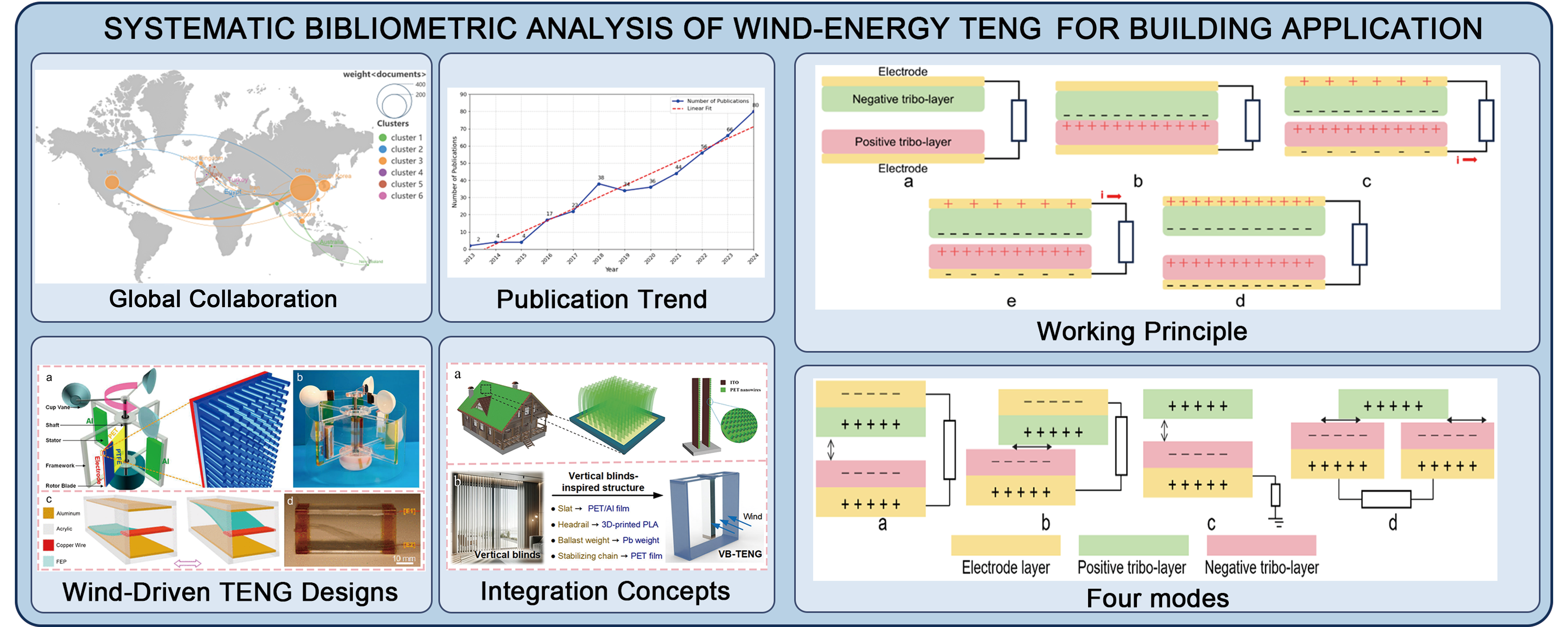
Energy conservation and carbon reduction in the building sector are critical to addressing climate change. This paper presents a building-oriented critical review of wind-driven triboelectric nanogenerators (TENGs), aiming to clarify their research maturity, realistic functional roles, and key limitations in the built environment. Bibliometric analysis reveals a rapid growth of TENG-related studies, with research activity concentrated in East Asia and North America, while work directly connected to architectural applications remains limited. Keyword evolution indicates a shift from fundamental energy-conversion mechanisms toward device optimization and sensing-oriented functions. Based on a structured review, two representative device categories—rotational systems and flutter-based designs—are examined with respect to their operating characteristics and suitability for low-wind building conditions. Reported building-related applications are currently focused on hybrid rooftop harvesting concepts and self-powered sensing components integrated into building systems, particularly for environmental monitoring. However, most demonstrations remain at a laboratory or prototype level, and their architectural integration is constrained by issues including low power output, durability, environmental adaptability, and system-level compatibility. Rather than positioning wind-driven TENGs as near-term power sources for buildings, this review highlights their more realistic short-term potential as supplementary micro-energy units and self-powered sensors, while emphasizing the technical and architectural challenges that must be addressed before broader building adoption can be achieved.
- Open Access
- Review
Wind-Driven Triboelectric Nanogenerators: A Critical Review of Research Trends, Structural Principles, and Prospects for the Built Environment
- Yanan Liu 1,2,*,
- Hongyuan Peng 1,2,
- Yixian Zhang 3,
- Xiaohong Lai 1,2,
- Xianyun Cai 1,2,
- Shen Wei 4,
- Sergio Altomonte 5
Author Information
Received: 24 Nov 2025 | Revised: 05 Feb 2026 | Accepted: 06 Feb 2026 | Published: 25 Feb 2026
Abstract
Graphical Abstract
Keywords
triboelectric nanogenerator (TENG) | wind energy | smart buildings | hybrid systems | self-powered sensors
References
- 1.
Pan, Y.; Zhang, L. Integrating BIM and AI for Smart Construction Management: Current Status and Future Directions. Arch. Comput. Methods Eng. 2023, 30, 1081–1110. https://doi.org/10.1007/s11831-022-09830-8.
- 2.
Elghaish, F.; Hosseini, M.R.; Kocaturk, T.; et al. Digitalised Circular Construction Supply Chain: An Integrated BIM-Blockchain Solution. Autom. Constr. 2023, 148, 104746. https://doi.org/10.1016/j.autcon.2023.104746.
- 3.
Wang, S.; Lin, L.; Wang, Z.L. Nanoscale Triboelectric-Effect-Enabled Energy Conversion for Sustainably Powering Portable Electronics. Nano Lett. 2012, 12, 6339–6346. https://doi.org/10.1021/nl303573d.
- 4.
Yang, Y.; Lin, Z.-H.; Hou, T.; et al. Nanowire-Composite Based Flexible Thermoelectric Nanogenerators and Self-Powered Temperature Sensors. Nano Res. 2012, 5, 888–895. https://doi.org/10.1007/s12274-012-0272-8.
- 5.
Xu, L.; Hasan, M.A.M.; Wu, H.; et al. Electromagnetic–Triboelectric Hybridized Nanogenerators. Energies 2021, 14, 6219. https://doi.org/10.3390/en14196219.
- 6.
Wang, Z.L. Triboelectric Nanogenerators as New Energy Technology for Self-Powered Systems and as Active Mechanical and Chemical Sensors. ACS Nano 2013, 7, 9533–9557. https://doi.org/10.1021/nn404614z.
- 7.
Pang, Y.; He, T.; Liu, S.; et al. Triboelectric Nanogenerator-Enabled Digital Twins in Civil Engineering Infrastructure 4.0: A Comprehensive Review. Adv. Sci. 2024, 11, 2306574. https://doi.org/10.1002/advs.202306574.
- 8.
Zhu, G.; Peng, B.; Chen, J.; et al. Triboelectric Nanogenerators as a New Energy Technology: From Fundamentals, Devices, to Applications. Nano Energy 2015, 14, 126–138. https://doi.org/10.1016/j.nanoen.2014.11.050.
- 9.
Dicka, Z.; Dolnikova, E.; Katunsky, D. Solar Architecture: Significance and Integration of Technologies. In Proceedings of the 16th International Scientific Conference of Civil and Environmental Engineering for the PhD. Students and Young Scientists—Young Scientist 2024 (YS24), High Tatras, Slovakia, 17–19 April 2024; Volume 550. https://doi.org/10.1051/e3sconf/202455001002.
- 10.
Yu, G.; Ji, P.; Gao, X.; et al. Efficient Pedestrian-Level Wind Energy Harvesting Using a Hybridized Technology. Energy Environ. Sci. 2025, 18, 8280–8291. https://doi.org/10.1039/d5ee03460d.
- 11.
Fang, L.; Zheng, Q.; Hou, W.; et al. A Self-Powered Tilt Angle Sensor for Tall Buildings Based on the Coupling of Multiple Triboelectric Nanogenerator Units. Sens. Actuators A 2023, 349, 114015. https://doi.org/10.1016/j.sna.2022.114015.
- 12.
Tasneem, Z.; Al Noman, A.; Das, S.K.; et al. An Analytical Review on the Evaluation of Wind Resource and Wind Turbine for Urban Application: Prospect and Challenges. Dev. Built Environ. 2020, 4, 100033. https://doi.org/10.1016/j.dibe.2020.100033.
- 13.
Ge, J.; Shen, C.; Zhao, K.; et al. Energy Production Features of Rooftop Hybrid Photovoltaic–Wind System and Matching Analysis with Building Energy Use. Energy Convers. Manag. 2022, 258, 115485. https://doi.org/10.1016/j.enconman.2022.115485.
- 14.
Ismail, M.F.; Al-mahasne, M.M.; Borowski, G.; et al. Optimized Low-Speed Wind Energy Harvesters: Enhancing Piezoelectric and Triboelectric Performance for Urban Applications. J. Ecol. Eng. 2025, 26, 325–340. https://doi.org/10.12911/22998993/205241.
- 15.
Waltman, L.; van Eck, N.J. A Smart Local Moving Algorithm for Large-Scale Modularity-Based Community Detection. Eur. Phys. J. B 2013, 86, 471. https://doi.org/10.1140/epjb/e2013-40829-0.
- 16.
Xie, Y.; Wang, S.; Lin, L.; et al. Rotary Triboelectric Nanogenerator Based on a Hybridized Mechanism for Harvesting Wind Energy. ACS Nano 2013, 7, 7119–7125. https://doi.org/10.1021/nn402477h.
- 17.
Yang, Y.; Zhu, G.; Zhang, H.; et al. Triboelectric Nanogenerator for Harvesting Wind Energy and as Self-Powered Wind Vector Sensor System. ACS Nano 2013, 7, 9461–9468. https://doi.org/10.1021/nn4043157.
- 18.
Jang, W.; Ko, H.-J.; Sim, J.; et al. Tree-Inspired Omnidirectional Conical Triboelectric Nanogenerator for Ultra-Low Wind Speeds. Sens. Actuators A 2025, 394, 116906. https://doi.org/10.1016/j.sna.2025.116906.
- 19.
Liu, D.; Luo, J.; Huang, L.; et al. Triboelectric Nanogenerators as a Practical Approach for Wind Energy Harvesting: Mechanisms, Designs, and Applications. Nano Energy 2025, 136, 110767. https://doi.org/10.1016/j.nanoen.2025.110767.
- 20.
Bai, Y.; Zhu, W.; Zhang, M.; et al. Triboelectric Nanogenerator for Harvesting Ultra-High-Speed Wind Energy with High-Frequency Output. J. Mater. Chem. A 2025, 13, 9101–9110. https://doi.org/10.1039/D5TA00649J.
- 21.
Zhang, H.; Yang, Y.; Zhong, X.; et al. Single-Electrode-Based Rotating Triboelectric Nanogenerator for Harvesting Energy from Tires. ACS Nano 2014, 8, 680–689. https://doi.org/10.1021/nn4053292.
- 22.
Wang, Y.; Wang, J.; Xiao, X.; et al. Multi-Functional Wind Barrier Based on Triboelectric Nanogenerator for Power Generation, Self-Powered Wind Speed Sensing and Highly Efficient Windshield. Nano Energy 2020, 73, 104736. https://doi.org/10.1016/j.nanoen.2020.104736.
- 23.
Wu, Y.; Zhong, X.; Wang, X.; et al. Hybrid Energy Cell for Simultaneously Harvesting Wind, Solar, and Chemical Energies. Nano Res. 2014, 7, 1631–1639. https://doi.org/10.1007/s12274-014-0523-y.
- 24.
Dudem, B.; Ko, Y.H.; Leem, J.W.; et al. Hybrid Energy Cell with Hierarchical Nano/Micro-Architectured Polymer Film to Harvest Mechanical, Solar, and Wind Energies Individually/Simultaneously. ACS Appl. Mater. Interfaces 2016, 8, 30165–30175. https://doi.org/10.1021/acsami.6b09785.
- 25.
Wang, S.; Wang, X.; Wang, Z.L.; et al. Efficient Scavenging of Solar and Wind Energies in a Smart City. ACS Nano 2016, 10, 5696–5700. https://doi.org/10.1021/acsnano.6b02575.
- 26.
Cao, R.; Wang, J.; Xing, Y.; et al. A Self-Powered Lantern Based on a Triboelectric–Photovoltaic Hybrid Nanogenerator. Adv. Mater. Technol. 2018, 3, 1700371. https://doi.org/10.1002/admt.201700371.
- 27.
Liu, C.; Zhao, C.; Liu, J.; et al. Design and Study of a Combining Energy Harvesting System Based on Thermoelectric and Flapping Triboelectric Nanogenerator. Int. J. Green Energy 2021, 18, 1302–1308. https://doi.org/10.1080/15435075.2021.1904405.
- 28.
Zhao, J.; Li, X.; Lu, X.; et al. Hybrid Wind-Solar Self-Powered Detector System Using a Triboelectric-Photovoltaic Generator for Smart Agriculture. Energy Technol. 2024, 13, 2401281. https://doi.org/10.1002/ente.202401281.
- 29.
Yang, C.; Liu, G.; Wang, X.; et al. Harvesting Wide Frequency Micromechanical Vibration Energy and Wind Energy with a Multi-Mode Triboelectric Nanogenerator for Traffic Monitoring and Warning. Adv. Mater. Technol. 2023, 8, 2200465. https://doi.org/10.1002/admt.202200465.
- 30.
Quan, Z.; Han, C.B.; Jiang, T.; et al. Robust Thin Films-Based Triboelectric Nanogenerator Arrays for Harvesting Bidirectional Wind Energy. Adv. Energy Mater. 2016, 6, 1501799. https://doi.org/10.1002/aenm.201501799.-
- 31.
Gao, S.; Zeng, X.; Chen, X.; et al. Self-Powered System for Environment and Aeolian Vibration Monitoring in the High-Voltage Transmission System by Multi-Directional Wind-Driven Triboelectric Nanogenerator. Nano Energy 2023, 117, 108911. https://doi.org/10.1016/j.nanoen.2023.108911.
- 32.
Tang, Y.; Fu, H.; Xu, B. Advanced Design of Triboelectric Nanogenerators for Future Eco-Smart Cities. Adv. Compos. Hybrid Mater. 2024, 7, 102. https://doi.org/10.1007/s42114-024-00909-3.
- 33.
Li, Y.; Deng, H.; Wu, H.; et al. Rotary Wind-Driven Triboelectric Nanogenerator for Self-Powered Airflow Temperature Monitoring of Industrial Equipment. Adv. Sci. 2024, 11, 2307382. https://doi.org/10.1002/advs.202307382.
- 34.
Niu, J.; Hu, R.; Li, M.; et al. A Novel Triboelectric–Electromagnetic Hybrid Generator with a Multi-Layered Structure for Wind Energy Harvesting and Wind Vector Monitoring. Micromachines 2025, 16, 795. https://doi.org/10.3390/mi16070795.
- 35.
Feng, Y.; Zhang, L.; Zheng, Y.; et al. Leaves Based Triboelectric Nanogenerator (TENG) and TENG Tree for Wind Energy Harvesting. Nano Energy 2019, 55, 260–268. https://doi.org/10.1016/j.nanoen.2018.10.075.
- 36.
Zhang, L.; Zhang, B.; Chen, J.; et al. Lawn Structured Triboelectric Nanogenerators for Scavenging Sweeping Wind Energy on Rooftops. Adv. Mater. 2016, 28, 1650–1656. https://doi.org/10.1002/adma.201504462.
- 37.
Zhang, F.; Zheng, L.; Li, H.; et al. Multifunctional Triboelectric Nanogenerator for Wind Energy Harvesting and Mist Catching. Chem. Eng. J. 2024, 488, 150875. https://doi.org/10.1016/j.cej.2024.150875.
- 38.
Zhang, J.; Sun, Y.; Yang, J.; et al. Irregular Wind Energy Harvesting by a Turbine Vent Triboelectric Nanogenerator and Its Application in a Self-Powered On-Site Industrial Monitoring System. ACS Appl. Mater. Interfaces 2021, 13, 55136–55144. https://doi.org/10.1021/acsami.1c16680.
- 39.
Choi, J.-A.; Jeong, J.; Kang, M.; et al. Vertical Blinds-Inspired Triboelectric Nanogenerator for Wind Energy Harvesting and Self-Powered Wind Speed Monitoring. ACS Appl. Electron. Mater. 2024, 6, 2534–2543. https://doi.org/10.1021/acsaelm.4c00175.
- 40.
Yeh, M.-H.; Lin, L.; Yang, P.-K.; et al. Motion-Driven Electrochromic Reactions for Self-Powered Smart Window System. ACS Nano 2015, 9, 4757–4765. https://doi.org/10.1021/acsnano.5b00706.
- 41.
Zhao, X.; Zhang, D.; Xu, S.; et al. Self-Powered Wireless Monitoring of Obstacle Position and State in Gas Pipe via Flow-Driven Triboelectric Nanogenerators. Adv. Mater. Technol. 2020, 5, 2000466. https://doi.org/10.1002/admt.202000466.
- 42.
Zhao, C.; Wu, Y.; Dai, X.; et al. Calliopsis Structure-Based Triboelectric Nanogenerator for Harvesting Wind Energy and Self-Powerd Wind Speed/Direction Sensor. Mater. Des. 2022, 221, 111005. https://doi.org/10.1016/j.matdes.2022.111005.
- 43.
He, H.C.; Mu, J.L.; Mu, J.B.; et al. Breeze-Activated Wind Speed Sensor with Ultra-Low Friction Resistance for Self-Powered Gale Disaster Warning. Sci. China Technol. Sci. 2023, 66, 57–70. https://doi.org/10.1007/s11431-022-2247-3.
- 44.
Ali, M.; Khan, S.A.; Ali, A.; et al. Low Profile Wind Savonius Turbine Triboelectric Nanogenerator for Powering Small Electronics. Sens. Actuators A 2023, 363, 114535. https://doi.org/10.1016/j.sna.2023.114535.
- 45.
Liu, Y.; Liu, J.; Che, L. A High Sensitivity Self-Powered Wind Speed Sensor Based on Triboelectric Nanogenerators (TENGs). Sensors 2021, 21, 2951. https://doi.org/10.3390/s21092951.
- 46.
Fan, X.; He, J.; Mu, J.; et al. Triboelectric-Electromagnetic Hybrid Nanogenerator Driven by Wind for Self-Powered Wireless Transmission in Internet of Things and Self-Powered Wind Speed Sensor. Nano Energy 2020, 68, 104319. https://doi.org/10.1016/j.nanoen.2019.104319.
- 47.
Sheebani, M.A.; Isaifan, R.J. Unregulated Dust: The Impact of Excavation on Urban Air Quality and Vulnerable Communities in the Global South. Urban Built Environ. Sustain. 2025, 1, 5. https://doi.org/10.53941/ubs.2025.100005.
- 48.
Osuizugbo, I.C.; Omer, M.M.; Oshodi, O.S.; et al. Emerging Technologies for Mitigating Air Pollution in Buildings: Systematic Review and Meta-Analysis. Built Environ. Proj. Asset Manag. 2025, 15, 951–973. https://doi.org/10.1108/BEPAM-03-2024-0050.
- 49.
Chen, S.; Gao, C.; Tang, W.; et al. Self-Powered Cleaning of Air Pollution by Wind Driven Triboelectric Nanogenerator. Nano Energy 2015, 14, 217–225. https://doi.org/10.1016/j.nanoen.2014.12.013.
- 50.
Gu, G.Q.; Han, C.B.; Lu, C.X.; et al. Triboelectric Nanogenerator Enhanced Nanofiber Air Filters for Efficient Particulate Matter Removal. ACS Nano 2017, 11, 6211–6217. https://doi.org/10.1021/acsnano.7b02321.
- 51.
Han, C.B.; Jiang, T.; Zhang, C.; et al. Removal of Particulate Matter Emissions from a Vehicle Using a Self-Powered Triboelectric Filter. ACS Nano 2015, 9, 12552–12561. https://doi.org/10.1021/acsnano.5b06327.
- 52.
He, C.; Wang, Z.L. Triboelectric Nanogenerator as a New Technology for Effective PM2.5 Removing with Zero Ozone Emission. Prog. Nat. Sci. Mater. Int. 2018, 28, 99–112. https://doi.org/10.1016/j.pnsc.2018.01.017.
- 53.
Liu, D.; Chen, B.; An, J.; et al. Wind-Driven Self-Powered Wireless Environmental Sensors for Internet of Things at Long Distance. Nano Energy 2020, 73, 104819. https://doi.org/10.1016/j.nanoen.2020.104819.
- 54.
Shen, J.; Yang, Z.; Yang, Y.; et al. A Remote Monitoring System for Wind Speed and Direction Based on Non-Contact Triboelectric Nanogenerator. Nano Energy 2025, 133, 110453. https://doi.org/10.1016/j.nanoen.2024.110453.
- 55.
Mudgal, T.; Tiwari, M.; Bharti, D. Cylindrical-Electrode Triboelectric Nanogenerator for Low-Speed Wind Energy Harvesting. Nano Energy 2024, 123, 109388. https://doi.org/10.1016/j.nanoen.2024.109388.
- 56.
Olsen, M.; Zhang, R.; Ortegren, J.; et al. Frequency and Voltage Response of a Wind-Driven Fluttering Triboelectric Nanogenerator. Sci. Rep. 2019, 9, 5543. https://doi.org/10.1038/s41598-019-42128-7.
- 57.
Liu, Z.; Chen, Y.; Wang, Y.; et al. The Development and Validation of the Inhomogeneous Wind Scheme for Urban Street (IWSUS-V1). Geosci. Model Dev. 2023, 16, 4385–4403. https://doi.org/10.5194/gmd-16-4385-2023.
- 58.
Jin, L.; Zhang, J.; Ao, Y.; et al. A High-Durability Triboelectric Nanogenerator for Broad-Spectrum Wind Energy Harvesting. Adv. Mater. Interfaces 2025, 12, e00372. https://doi.org/10.1002/admi.202500372.
- 59.
Fang, L.; Chen, C.; Zhang, H.; et al. Polynary Energy Harvesting and Multi-Parameter Sensing in the Heatwave Environment of Industrial Factory Buildings by an Integrated Triboelectric–Thermoelectric Hybrid Generator. Mater. Horiz. 2024, 11, 1414–1425. https://doi.org/10.1039/D3MH02228E.
- 60.
Wang, J.; Zhang, H.; Xie, Y.; et al. Smart Network Node Based on Hybrid Nanogenerator for Self-Powered Multifunctional Sensing. Nano Energy 2017, 33, 418–426. https://doi.org/10.1016/j.nanoen.2017.01.055.
- 61.
Fang, Y.; Tang, T.; Li, Y.; et al. A High-Performance Triboelectric-Electromagnetic Hybrid Wind Energy Harvester Based on Rotational Tapered Rollers Aiming at Outdoor IoT Applications. iScience 2021, 24, 102300. https://doi.org/10.1016/j.isci.2021.102300.
- 62.
Zhang, X.; Hu, J.; Yang, Q.; et al. Harvesting Multidirectional Breeze Energy and Self-Powered Intelligent Fire Detection Systems Based on Triboelectric Nanogenerator and Fluid-Dynamic Modeling. Adv. Funct. Mater. 2021, 31, 2106527. https://doi.org/10.1002/adfm.202106527.
- 63.
Zhang, L.; Yuan, X.; Jia, W.; et al. A Conceptual Framework for Performance Evaluation and Classification of Multi-Agent Hybrid Game Problems Based on Reinforcement Learning: Impact Factors and Evaluation Metrics. Urban Built Environ. Sustain. 2025, 1, 4. https://doi.org/10.53941/ubs.2025.100004.
- 64.
Si, J.; Yang, J.; Chen, Y.; et al. An Integrated Temperature and Humidity Dual-Parameter Triboelectric Sensor. J. Mater. Chem. C 2024, 12, 11640–11647. https://doi.org/10.1039/D4TC01087F.
- 65.
Zhu, L.; Zhang, Z.; Kong, D.; et al. A Triboelectric Nanogenerator Sensor Based on Phononic Crystal Structures for Smart Buildings and Transportation Systems. Nano Energy 2022, 97, 107165. https://doi.org/10.1016/j.nanoen.2022.107165.
- 66.
Zhong, Y.; Zhao, H.; Guo, Y.; et al. An Easily Assembled Electromagnetic-Triboelectric Hybrid Nanogenerator Driven by Magnetic Coupling for Fluid Energy Harvesting and Self-Powered Flow Monitoring in a Smart Home/City. Adv. Mater. Technol. 2019, 4, 1900741. https://doi.org/10.1002/admt.201900741.


This work is licensed under a Creative Commons Attribution 4.0 International License.

 Suite 4002 Level 4, 447 Collins Street, Melbourne, Victoria 3000, Australia
 General Inquiries: info@sciltp.com