
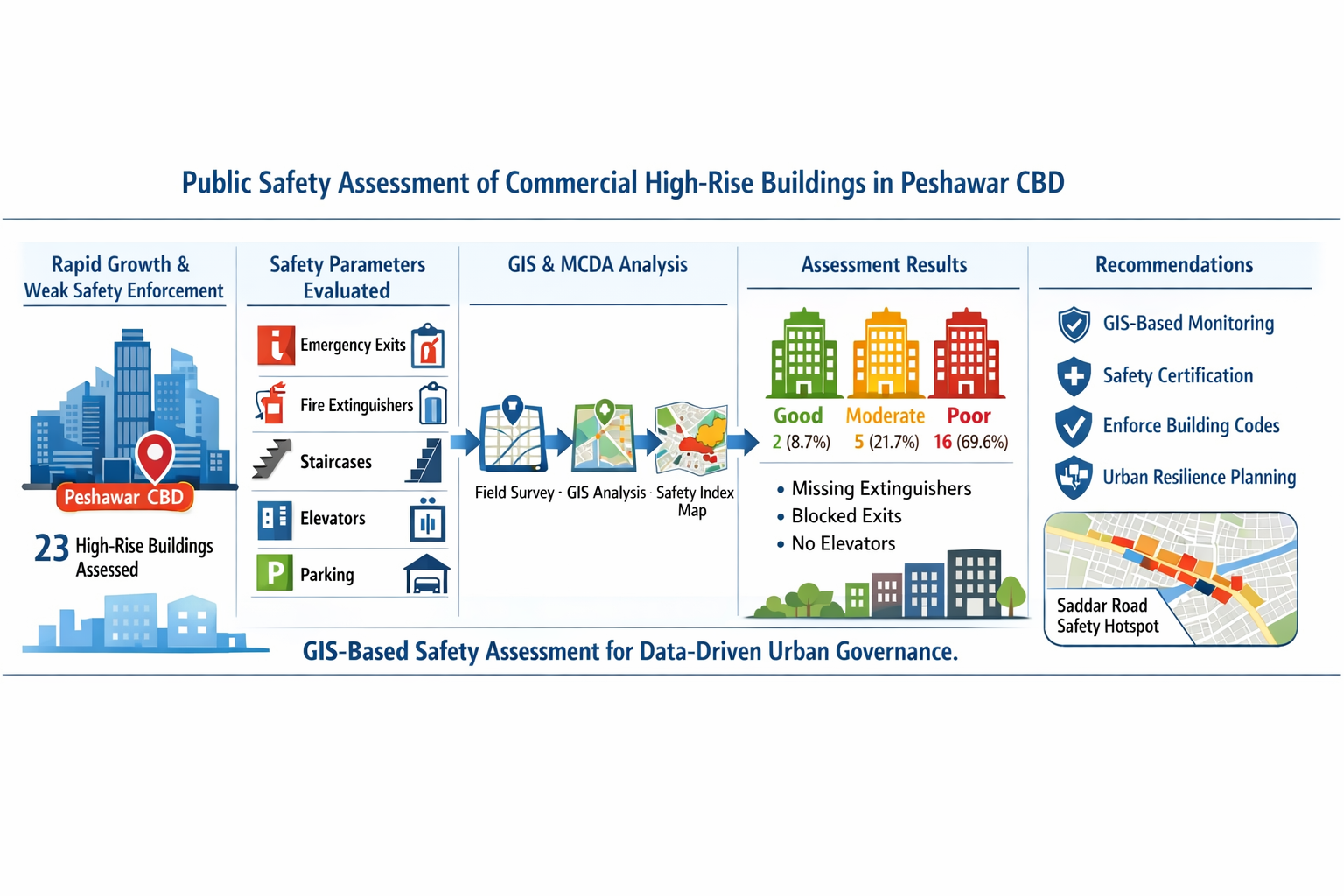
Rapid vertical development in South Asian cities has led to an increase in high-rise buildings, but enforcement of safety regulations has not kept pace with construction. This study evaluates compliance with public safety standards across twenty-three (23) commercial high-rises in Peshawar’s Central Business District (CBD). Using a GIS-based Multi-Criteria Decision Analysis (MCDA), the research assesses seven safety parameters, including Emergency Exit, fire extinguishing systems, staircases, elevators, parking, basements, and building structures, in accordance with the Cantonment Board Peshawar (CBP) by-laws. Data collected through field surveys were spatially analysed and categorised into three safety levels, i.e., good, moderate, and poor. Results reveal that only two buildings (8.7 per cent) achieved a “good” safety rating, five (21.7 per cent) a moderate, and sixteen (69.6 per cent) a poor. Key deficiencies included a lack of Fire Extinguishers, locked or missing Emergency Exit, the absence of elevators, and non-compliance with parking and accessibility standards. Spatial analysis indicated that poorly rated buildings were concentrated along Saddar Road, reflecting older, unregulated commercial areas. These findings underscore the importance of strengthening institutional coordination, adopting GIS-based compliance monitoring, and enforcing mandatory periodic safety certifications for commercial high-rises. Beyond technical measures, the study stresses that public safety should be integrated into broader urban resilience and sustainability initiatives. This developed methodological framework can serve as a High-Rise Safety Index for other cities, fostering data-driven governance and safer vertical development nationwide.
- Open Access
- Article
Assessment of Public Safety Standards in Commercial High-Rise Buildings of the Central Business District of Peshawar, Pakistan
- Muhammad Ibrahim 1,*,
- Waqas Ahmed Mahar 2,3,
- Muhammad Jawad Khan 4,
- Muhammad Jamal Nasir 5,
- Aman Ullah 2
Author Information
Received: 08 Dec 2025 | Revised: 24 Feb 2026 | Accepted: 09 Mar 2026 | Published: 01 Apr 2026
Abstract
Graphical Abstract
Keywords
high-rise buildings | public safety | building codes | GIS | central business district | urban resilience | Peshawar
References
- 1.
Emtehani, M.R.; Nagendra, H.N.; Rafiee, N. Changing Scenario of CBD: A Case Study of Shiraz City in Iran. Int. J. Environ. Sci. 2012, 1, 173–177.
- 2.
Murphy, R.E.; Vance, J.E., Jr. A comparative study of nine central business districts. Econ. Geogr. 1954, 30, 301–336.
- 3.
Beavon, K.S.O. The role of transport in the rise and decline of the Johannesburg CBD, 1886–2001. In Proceedings of the 20th Annual South African Transport Conference, Pretoria, South Africa, 16–20 July 2001.
- 4.
Reddy, K.N. Urban Redevelopment: A Study of High-Rise Buildings; Concept Publishing Company: New Delhi, India, 1996.
- 5.
Hall, J.R. High-Rise Building Fires; The Association: Quincy, MA, USA, 2000.
- 6.
Foroughi, R.; Mostavi, E.; Asadi, S. Determining the optimum geometrical design parameters of windows in commercial buildings: Comparison between humid subtropical and humid continental climate zones in the United States. J. Archit. Eng. 2018, 24, 04018026.
- 7.
Smith, W.S. Mass transport for high-rise high-density living. J. Transp. Eng. 1984, 110, 521–535.
- 8.
Al-Kodmany, K.; Ali, M.M. Skyscrapers and placemaking: Supporting local culture and identity. Archnet-IJAR 2012, 6, 43.
- 9.
UN ESCAP. The State of Asian and Pacific Cities 2015: Urban Transformations Shifting from Quantity to Quality; United Nations: Bangkok, Thailand, 2015.
- 10.
Pakistan Engineering Council. Pakistan Electric and Telecommunication Safety Code (PETSAC-2014). Available online: https://www.pec.org.pk/wp-content/uploads/2021/05/Pakistan-Electric-Telecommunication-Safety-Code-PETSAC-2014.pdf (accessed on 14 November 2025).
- 11.
PEC. Building Code of Pakistan: Seismic Provisions—2007. Pakistan Engineering Council. Available online: http://www.ndma.gov.pk/storage/publications/July2024/c4N0IE4vVWQCa073QB1i.pdf (accessed on 20 November 2025).
- 12.
Pakistan Engineering Council. Building Code of Pakistan: Energy Provisions. 2013. Available online: https://www.pec.org.pk/downloads-documents/building-code-of-pakistan/ (accessed on 28 October 2025).
- 13.
Pakistan Engineering Council. Building Code of Pakistan: Fire Safety Provisions—2016. Available online: https://www.pec.org.pk/wp-content/uploads/2021/05/Building-Code-of-Pakistan-Fire-Safety-Provisions-2016.pdf (accessed on 30 October 2025).
- 14.
National Energy Efficiency and Conservation Authority (NEECA). Energy Conservation Building Code (ECBC-2023); NEECA: Islamabad, Pakistan, 2023.
- 15.
WHO. WHO Mortality Database: Interactive Platform Visualizing Mortality Data. World Health Organization. Available online: https://platform.who.int/mortality/themes/theme-details/topics/indicator-groups/indicator-group-details/MDB/fires (accessed on 11 November 2025).
- 16.
IHME. Global Burden of Disease Collaborative Network. Global Burden of Disease Study 2021. Institute for Health Metrics and Evaluation. Available online: https://ghdx.healthdata.org/gbd-2021 (accessed on 11 November 2025).
- 17.
Fire Protection Association of Pakistan (FPAP). Violation of Building Codes, no Safety Kits: Over 12,000–15,000 Die in Fire Incidents Annually: Experts. Business Recorder, 2025. Available online: https://www.brecorder.com/news/40274722 (accessed on 13 November 2025).
- 18.
Barry, F. 1 Dead as Fire at Karachi Building Brought under Control: Rescue 1122. Dawn, 2024. Available online: https://www.dawn.com/news/1858347 (accessed on 25 October 2025).
- 19.
Nasir, G.; Asghar, W.; Anwar, S. Analyzing the Causes of Fire Accidents and Prevention Strategies in Pakistan: Exploring Mitigation Measures. Sustain. Bus. Soc. Emerg. Econ. 2025, 7, 145–158.
- 20.
Chakor Ventures. Fire Protection Systems in Pakistan. 8 November 2022. Available online: https://chakorventures.com/fire-protection-systems-in-pakistan-have-improved/ (accessed on 26 October 2025).
- 21.
Masood Rafi, M.; Wasiuddin, S.; Hameed Siddiqui, S. Assessment of fire hazard in Pakistan. Disaster Prev. Manag. 2012, 21, 71–84.
- 22.
International Labour Organization (ILO). Pakistani Factory Fire Highlights Lack of Workplace Safety Measures, Says ILO. Available online: https://www.ilo.org/resource/news/pakistani-factory-fire-highlights-lack-workplace-safety-measures-says-ilo (accessed on 1 Novermber 2025).
- 23.
Foroughi, R.; Asadi, S.; Khazaeli, S. On the optimization of energy efficient fenestration for small commercial buildings in the United States. J. Clean. Prod. 2021, 283, 124604.
- 24.
Chen, X. Enhancing Public Facility Planning with Sustainable Development Viewpoints: A Case Study in the City of Tracy, California; Cornell University: Ithaca, NY, USA, 2023.
- 25.
Alianto, B.; Nasruddin; Nugroho, Y.S. Numerical Study on the Effect of Single and Multi-injection Pressurized Fan in Enclosed Stairwell of High-Rise Building. In Sustainable Architecture and Building Environment; Springer: Berlin/Heidelberg, Germany, 2021; pp. 99–105.
- 26.
Zhang, Y.; Yan, D.; Hu, S.; Guo, S. Modelling of energy consumption and carbon emission from the building construction sector in China, a process-based LCA approach. Energy Policy 2019, 134, 110949.
- 27.
Al-Fahad, J.Y. Reform of Building Codes, Regulations, Administration and Enforcement in Kuwait: Within the Legal, Administrative, Technical and Social Framework. Ph.D. Thesis, Loughborough University, Loughborough, UK, 2012.
- 28.
Anees, M.; Yan, W. An Overview about the Challenges of Urban Expansion on Environmental Health in Pakistan. J. Energy Environ. Policy Options 2019, 2, 64–71.
- 29.
Khan, A.F.; Ahmad, I. A critical analysis of building codes of Pakistan; fire safety provision 2016. In 5th World Congress on Disaster Management: Volume I.; Routledge: Abingdon, UK, 2022; pp. 138–144.
- 30.
Pakistan Engineering Council. Building Code of Pakistan 2021 (BCP-2021). Available online: https://www.pec.org.pk/thinktank/building-code-of-pakistan-thinktank/ (accessed on 1 Novermber 2025).
- 31.
Civil Aviation Authority. No Objection Certificate (NOC) for Height Clearance. CAA Notice, 2019. Available online: https://www.zameen.com/news/important-notice-for-developers-from-caa.html (accessed on 2 Novermber 2025).
- 32.
Peshawar Development Authority. Building and Zoning Regulations 2020. 2020. Available online: https://rda.gop.pk/wp-content/uploads/2024/01/RDA_Building&Zoning_Regulations2020.pdf (accessed on 2 Novermber 2025).
- 33.
The Express Tribune. Building By-Laws Raise Height Limit. 2020. Available online: https://tribune.com.pk/story/2256368/building-by-laws-raise-height-limit (accessed on 3 Novermber 2025).
- 34.
Kobes, M.; Post, J.; Helsloot, I.; Vries, B.D. Fire risk of high-rise buildings based on human behavior in fires. In Proceedings of the Conference Proceedings FSHB 2008, Bucharest, Romania, 7–9 May 2008; pp. 7–9.
- 35.
Nakagawa, T. Staircase Design of High-rise Buildings Preparing against Fire. In Proceedings of the TRIZCON2001: The 3rd Annual AI TRIZ Conference, Woodland Hills, CA, USA, 25–27 March 2001; pp. 25–27.
- 36.
Rahman, M.M.; et al. Does building development in Dhaka comply with land use zoning? An analysis using nighttime light and digital building heights. Sustain. Sci. 2021, 16, 1323–1340.
- 37.
Naz, N. Proliferation of the tallest building syndrome: From global to local. Pak. J. Eng. Appl. Sci. 2007, 1, 84–103.
- 38.
Ali, A.; Malik, S.M.; Jan, M.A. Delimitation of the Central Business District Peshawar (Pakistan). Glob. Soc. Sci. Rev. 2018, 3, 193–213.
- 39.
Yeboah, G. First Responders’ Emergency Response Time Analysis: City of Saskatoon Case Study. Master’s Thesis, University of Saskatchewan, Saskatoon, SK, Canada, 2017.
- 40.
Schröter, K.; Schweizer, P.-J.; Gräler, B.; et al. Invited perspectives: Fostering interoperability of data, models, communication and governance for disaster resilience through transdisciplinary knowledge co-production. Nat. Hazards Earth Syst. Sci. Discuss. 2025, 25, 3055–3073.
- 41.
Goswami, S.; Kolte, R.; Kumar, A.; Pipralia, S. Prioritizing fire risk factors in historic urban cores of India: An analytic hierarchy process approach. Int. J. Disaster Resil. Built Environ. 2025, 16, 474–493.
- 42.
Mendizabal, S. Modeling urban fire risk using the AHP-GIS method and sensitivity analysis: A case study in the City of Santa Fe, Argentina. Cybergeo: Eur. J. Geogr. 2025. https://doi.org/10.4000/14khq.
- 43.
Aman, M.; Waheed, A.; Naeem, M.A.; Shah, S.A.A. Implementing the living streets concept by transforming streets in the central business district of Peshawar, Pakistan. Urbani Izziv 2019, 30, 75–86.
- 44.
Cantonment Board Peshawar. Cantonment Board Peshawar (Building) Bye-Laws, 2016; 2016. Available online: http://peshawar.cantonment.gov.pk/en/laws/building-bye-laws (accessed on 5 Novermber 2025).
- 45.
Saaty, T.L. Decision making with the analytic hierarchy process. Int. J. Serv. Sci. 2008, 1, 83–98.
- 46.
Danish; Baloch, M.A. Dynamic linkages between road transport energy consumption, economic growth, and environmental quality: Evidence from Pakistan. Environ. Sci. Pollut. Res. 2018, 25, 7541–7552.


 Suite 4002 Level 4, 447 Collins Street, Melbourne, Victoria 3000, Australia
 General Inquiries: info@sciltp.com