
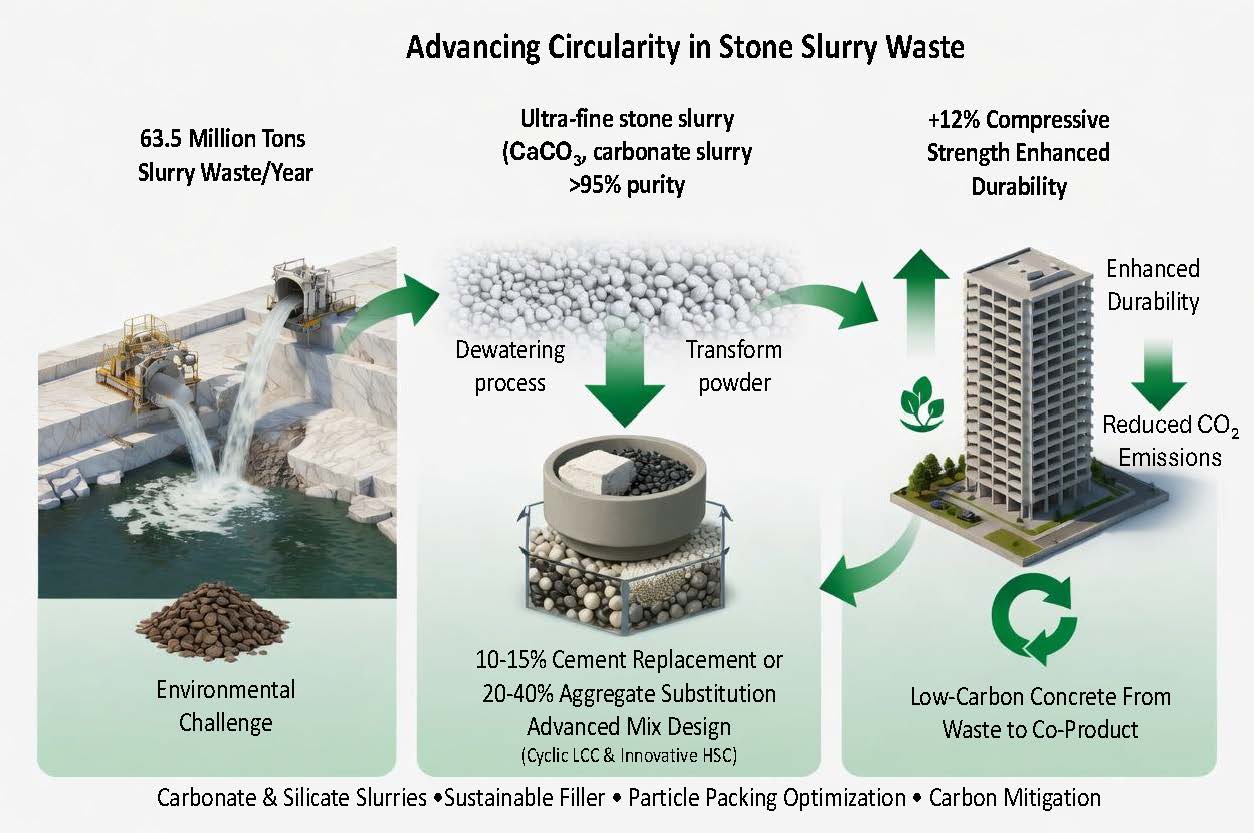
Natural stones have served as essential building elements since ancient eras, maintaining their relevance in contemporary urban development and high-rise structures. Over recent years, the dimension stone industry generates approximately 63.5 million tons of slurry waste annually, representing 20% of processed material and posing significant environmental challenges such as land degradation and water contamination. This review synthesizes global production data, physical-chemical characterizations, and reuse pathways for stone slurry, focusing on its valorization as a sustainable filler in cement-based materials. Key findings include: carbonate slurries (CS) exhibit high purity (>95% CaCO3) and fine particle sizes (d50 ~10–25 μm), enabling 10–15% cement replacement or 20–40% fine aggregate substitution to enhance compressive strength (up to 12% increase) and durability via microstructural densification. Silicate slurries (SS) offer similar benefits but require contaminant management (e.g., heavy metals < 10 ppm). Advanced particle-packing mix designs, such as the cyclic method for low-cement concrete (LCC) and a novel approach for high-strength concrete (HSC), minimize cement content while achieving targets like 31.6 MPa strength, reducing CO2 emissions. In conclusion, reclassifying slurry as a co-product promotes circularity; future efforts should prioritize standardization, contaminant treatments, and lifecycle assessments to integrate high-volume reuse in construction, fostering a low carbon built environment.
- Open Access
- Article
Advancing Circularity in Stone Slurry Waste: Opportunities for Reuse as a Sustainable Filler in Cement-Based Materials
- Zhaofeng Chen 1,
- Changjun Zhong 2,
- Alberto Speroni 1,*,
- Mingyuan Qin 3,4,*
Author Information
Received: 12 Jan 2026 | Revised: 01 Mar 2026 | Accepted: 12 Mar 2026 | Published: 01 Apr 2026
Abstract
Graphical Abstract
Keywords
stone slurry | cementitious supplements | binder substitution | repurposing | carbon mitigation
References
- 1.
Ashmole, I.; Motloung, M. Dimension stone: The latest trends in exploration and production technology. In Proceedings of the International Conference on Surface Mining, Johannesburg, South Africa, 14–17 October 2008; Volume 5, No. 8.
- 2.
Montani, C. XXXIII World Marble and Stones Report 2021; Casa di Edizioni: Carrara, Italy, 2021.
- 3.
Kamble, S.K.; Sachin, K.R.; Bhagat, A. Stone Slurry in Cement Concrete for Sustainable Use in Civil Engineering. IOP Conf. Ser. Earth Environ. Sci. 2023, 1193, 012020.
- 4.
Shakarna, M. Utilization of Stone Cutting Industry Slurry in Cement Production. Univers. J. Civ. Eng. 2024, 12, 26–34.
- 5.
Fawad, M.; Khan, S.A.; Khan, M.A.; et al. Impacts of the Marble Waste Slurry on Ground Water Quality and its Reuse Potential. Fresenius Environ. Bull. 2021, 30, 2955–2963.
- 6.
Gupta, S. Industrial Calcium Byproduct Waste: Sustainable Construction Materials for Building Applications. ACS Sustain. Resour. Manag. 2025, 2, 212–218.
- 7.
Alcobia, D.; Figueiredo, B. Stone slurry waste: Circularity and additive manufacturing. In Structures and Architecture; CRC Press: Boca Raton, FL, USA, 2025.
- 8.
Onyelowe, K.C.; Kamchoom, V.; Ebid, A.M.; et al. Evaluating the impact of waste marble on the compressive strength of traditional concrete using machine learning. Sci. Rep. 2025, 15, 98431.
- 9.
Ma, R.; Zhang, L.; Song, Y.; et al. Recycling stone powder as a partial substitute for cementitious materials into eco-friendly manufactured sand ultra-high performance concretes: Towards cleaner and more cost-effective construction production. J. Build. Eng. 2024, 92, 109765.
- 10.
Abbas, M.M.; Muntean, R. Marble Powder as a Sustainable Cement Replacement: A Review of Mechanical Properties. Sustainability 2025, 17, 736.
- 11.
Li, Y.; Zhang, L.; Wang, H.; et al. Utilization of Granite Sludge in the Production of Low Carbon Cement Clinker. Cem. Concr. Compos. 2024, 148, 105456.
- 12.
Karaca, Z.; Ercikdi, B.; Cihangir, F.; et al. Classification of dimension stone wastes. Environ. Earth Sci. 2012, 66, 1317–1325.
- 13.
Chen, Z.; Liu, Y.; Sun, W.; et al. Environmental Alternatives for Stone Slurry Circularity: From Waste to Resource; Politecnico di Milano Thesis Repository; Politecnico di Milano: Milano, Italy, 2023.
- 14.
U.S. Geological Survey. Mineral Commodity Summaries; USGS: Reston, VA, USA, 2024.
- 15.
Eurostat. Waste Statistics; European Commission: Luxembourg, 2023.
- 16.
Careddu, N.; Locanto, G.; Enna, C.; et al. Reuse of residual sludge from stone processing: Differences and similarities between sludge coming from carbonate and silicate stones. Environ. Earth Sci. 2016, 75, 1–12.
- 17.
Parent, S.-E.; Cabral, A.; Zornberg, J.G. Water Retention Curve and Hydraulic Conductivity Function of Highly Compressible Materials. Can. Geotech. J. 2007, 44, 1200–1212.
- 18.
Vardhan, K.; Singh, S.K.; Kumar, A.; et al. Mechanical properties and microstructural analysis of cement mortar incorporating marble powder as partial replacement of cement. Constr. Build. Mater. 2015, 96, 615–621.
- 19.
Gupta, L.K.; Vyas, A.K. Impact on mechanical properties of cement sand mortar containing waste granite powder. Constr. Build. Mater. 2018, 191, 155–164.
- 20.
U.S. Environmental Protection Agency. Leachate Environmental Assessment Framework; EPA: Washington, DC, USA, 2018.
- 21.
Careddu, N.; Siotto, G. Promoting ecological sustainable planning for natural stone quarrying. Resour. Policy 2011, 36, 304–314.
- 22.
Environmental Protection Agency. European Waste Catalogue and Hazardous Waste List; Environmental Protection Agency: Wexford, Ireland, 2002.
- 23.
Ercikdi, B.; Cihangir, F.; Karaca, Z.; et al. Utilization of granulated marble wastes as a cementitious material in cemented paste backfill. J. Hazard. Mater. 2015, 300, 585–592.
- 24.
Al-Jabari, M. Treating stone cutting waste by flocculation–sedimentation. In Proceedings of the Second International Conference on the Palestinian Environment, Nablus, Palestine, 13–15 October 2009.
- 25.
Kabas, S.; Ekinci, E.; Turan, A.; et al. Combined application of marble waste and beneficial microorganisms toward a cost-effective approach for restoration of heavy metals contaminated sites. J. Soil Sci. Plant Nutr. 2022, 22, 1710–1723.
- 26.
Omar, O.M.; Abdel-Gawwad, H.A.; Al-Zahrani, M.M.; et al. Influence of limestone waste as partial replacement material for sand and marble powder in concrete properties. HBRC J. 2012, 8, 193–203.
- 27.
Singh, M.; Kumar, R.; Kumar, S.; et al. An investigation on effect of partial replacement of cement by waste marble slurry. Constr. Build. Mater. 2017, 148, 770–781.
- 28.
Saboya, F.; Xavier, G.C.; de Brito, J.; et al. The use of the powder marble by-product to enhance the properties of brick ceramic. Constr. Build. Mater. 2007, 21, 1950–1960.
- 29.
Torres, P.; Rincón, J.M.; Moreno, P.; et al. Incorporation of granite cutting sludge in industrial porcelain tile formulations. J. Eur. Ceram. Soc. 2004, 24, 3177–3185.
- 30.
Karaşahin, M.; Terzi, S. Evaluation of marble waste dust in the mixture of asphaltic concrete. Constr. Build. Mater. 2007, 21, 1067–1073.
- 31.
Mehta, D.; Kumar, A.; Singh, D.; et al. Utilization of marble waste powder as a novel adsorbent for removal of fluoride ions from aqueous solution. J. Environ. Chem. Eng. 2016, 4, 2294–2302.
- 32.
Ghazy, S.E.; Abdel Rahman, A.M.; El-Sayed, G.O.; et al. Kinetic Investigation of the Removal of Aluminum from Water Samples by Adsorption onto Powdered Marble Wastes. Desalination Water Treat. 2010, 20, 180–187.
- 33.
Sivrikaya, O.; Kalkan, E.; Akbulut, S.; et al. Recycling waste from natural stone processing plants to stabilise clayey soil. Environ. Earth Sci. 2014, 71, 4397–4407.
- 34.
Kabas, S.; Acar, M.; Turan, A.; et al. Effect of marble waste and pig slurry on the growth of native vegetation and heavy metal mobility in a mine tailing pond. J. Geochem. Explor. 2012, 123, 98–104.
- 35.
Tressmann, J.; Silva, M.A.; de Andrade, R.C.; et al. Use of marble waste as mineral filler in soil-pigmented paints. J. Clean. Prod. 2020, 255, 120280.
- 36.
Awad, A.H.; Abdellatif, M.H. Assessment of mechanical and physical properties of LDPE reinforced with marble dust. Compos. Part B Eng. 2019, 173, 106948.
- 37.
Abenojar, J.; Martínez, M.A.; Rubio, C.; et al. Mechanical properties and fire-resistance of composites with marble particles. J. Mater. Res. Technol. 2021, 12, 1339–1352.
- 38.
Ahmed, K.; Ismail, M.I.; Abdel Bary, A.; et al. Marble sludge filled natural rubber composites: Physico-mechanical and swelling properties. Polym. Plast. Technol. Eng. 2013, 52, 507–513.
- 39.
Kannapu, H.P.R.; Kumar, V.; Reddy, C.S.; et al. Natural marble powder-modified SBA-15 as an efficient catalyst for the selective production of 2-methyl-2-pentenal from n-propanal self-aldol condensation. Mol. Catal. 2021, 504, 111456.
- 40.
Rana, A.; Kalla, R.; Csetenyi, L.J.; et al. Sustainable use of marble slurry in concrete. J. Clean. Prod. 2015, 94, 304–311.
- 41.
Khodabakhshian, A.; de Brito, J.; Ghalehnovi, M.; et al. Durability performance of structural concrete containing silica fume and marble industry waste powder. J. Clean. Prod. 2018, 170, 42–60.
- 42.
Campos, H.F.; de Andrade, R.C.; de Oliveira, L.C.; et al. A new mix design method for sustainable high-strength concrete: Reducing cement and CO2 emissions. J. Clean. Prod. 2020, 266, 121503.
- 43.
Fareghian, M.; Afrazi, M.; Fakhimi, A. Soil reinforcement by waste tire textile fibers: Small-scale experimental tests. J. Mater. Civ. Eng. 2023, 35, 04022402.
- 44.
Rouhanifar, S.; Afrazi, M.; Fakhimi, A.; et al. Strength and deformation behaviour of sand-rubber mixture. Int. J. Geotech. Eng. 2021, 15, 1078–1092.
- 45.
Sahan Arel, H. Recyclability of waste marble in concrete production. J. Clean. Prod. 2016, 131, 179–188.
- 46.
Alyamaç, K.E.; Aydın, A.B. Concrete properties containing fine aggregate marble powder. KSCE J. Civ. Eng. 2015, 19, 2208–2216.
- 47.
Gesoglu, M.; Güneyisi, E.; Özbay, E.; et al. Fresh and hardened characteristics of self-compacting concretes made with combined use of marble powder, limestone filler, and fly ash. Constr. Build. Mater. 2012, 37, 160–170.
- 48.
Elyamany, H.E.; Elmoaty, A.E.M.A.; Abdel-Kareem, M.; et al. Effect of filler types on physical, mechanical, and microstructural properties of self-compacting concrete. J. Mater. Civ. Eng. 2014, 26, 04014080.
- 49.
Danish, P.; Ganesh, G.M. Effect of waste marble powder and metakaolin on the fresh and hardened properties of self-compacting concrete. Adv. Concr. Constr. 2021, 11, 241–252.
- 50.
Celik, T.; Marar, K. Effects of crushed stone dust on some properties of concrete. Cem. Concr. Res. 1996, 26, 1121–1130.
- 51.
Kabeer, K.I.S.A.; Vyas, A.K. Utilization of marble powder as fine aggregate in mortar mixes. Constr. Build. Mater. 2018, 165, 321–332.
- 52.
Vijayalakshmi, M.; Palanisamy, T.; Kaliappan, T.; et al. Strength and durability properties of concrete made with granite industry waste. Constr. Build. Mater. 2013, 46, 1–7.
- 53.
Matschei, T.; Lothenbach, B.; Glasser, F.P. The role of calcium carbonate in cement hydration. Cem. Concr. Res. 2007, 37, 551–558.
- 54.
Lothenbach, B.; Le Saout, G.; Gallucci, E.; et al. Influence of limestone on the hydration of Portland cements. Cem. Concr. Res. 2008, 38, 848–860.
- 55.
Tennich, M.; Khatib, J.; Kenai, S.; et al. Behavior of self-compacting concrete made with marble and tile wastes exposed to external sulfate attack. Constr. Build. Mater. 2017, 135, 335–343.
- 56.
Berra, M.; Carassiti, F.; Mangialardi, T.; et al. Effects of nanosilica addition on workability and compressive strength of Portland cement pastes. Constr. Build. Mater. 2012, 35, 666–675.
- 57.
Oey, T.; Kumar, A.; Bullard, J.W.; et al. The filler effect: The influence of filler content and surface area on cementitious reaction rates. J. Am. Ceram. Soc. 2013, 96, 1978–1990.
- 58.
Alyamaç, K.E.; Ince, R. A preliminary concrete mix design for SCC with marble powders. Constr. Build. Mater. 2009, 23, 1201–1210.
- 59.
Fennis, S.A.A.M. Design of Ecological Concrete by Particle Packing Optimization. Ph.D. Thesis, Delft University of Technology, Delft, The Netherlands, 2011.
- 60.
Fennis, S.A.A.M.; Walraven, J.; de Koster, K. The use of particle packing models to design ecological concrete. Heron 2009, 54, 185–204.
- 61.
de Larrard, F. Concrete Mixture Proportioning: A Scientific Approach; CRC Press: Boca Raton, FL, USA, 1999.
- 62.
Wong, H.H.C.; Kwan, A.K.H. Packing density of cementitious materials: Part 1—Measurement using a wet packing method. Mater. Struct. 2008, 41, 689–701.

This work is licensed under a Creative Commons Attribution 4.0 International License.

 Suite 4002 Level 4, 447 Collins Street, Melbourne, Victoria 3000, Australia
 General Inquiries: info@sciltp.com