
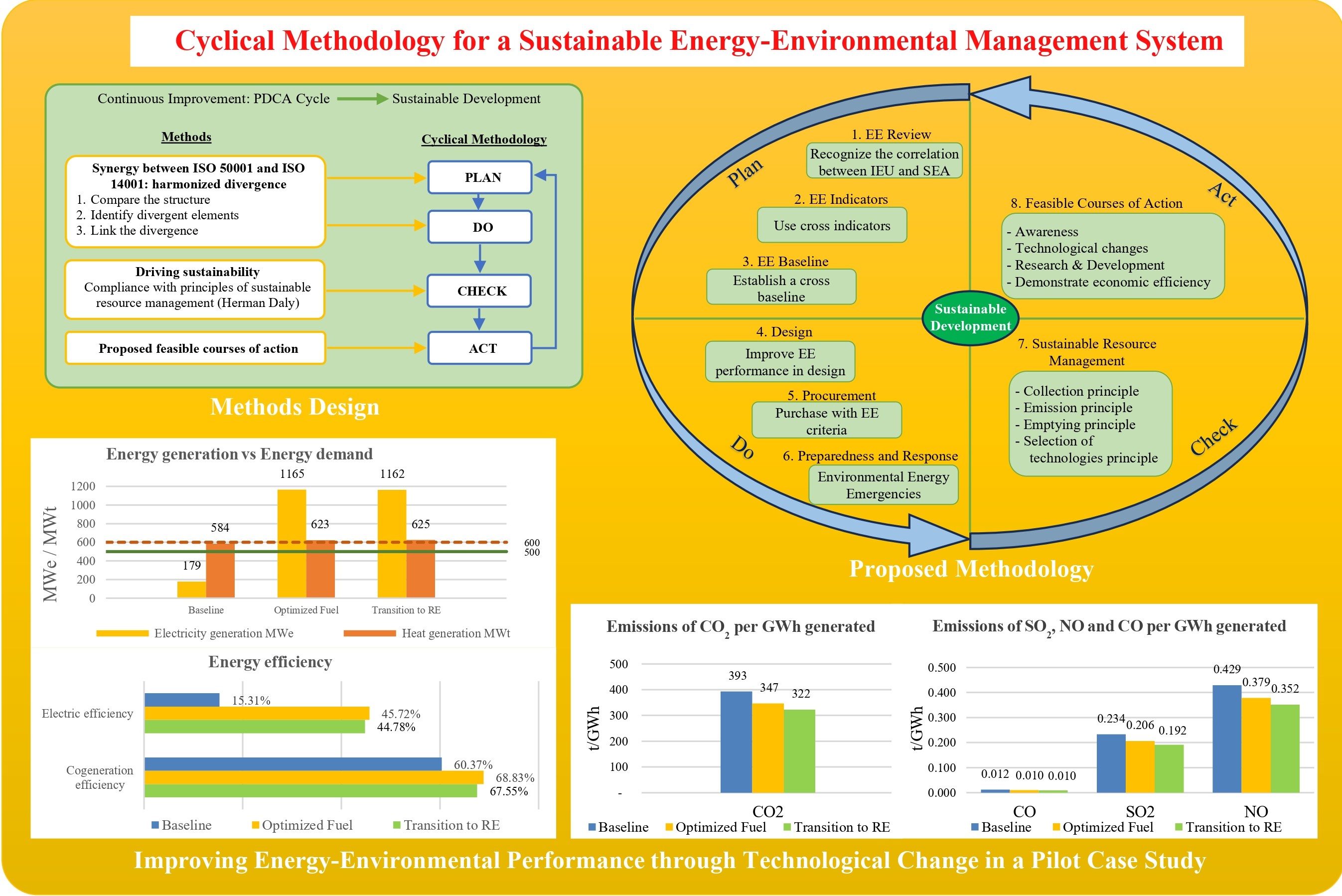
Based on a sustainability approach, the synergy between the current most implemented standards for Energy Management Systems (EnMS) ISO 50001:2018 and Environmental Management Systems (EMS) ISO 14001:2015 is addressed in this work to propose a general cyclical methodology for improving organizational comprehensive performance and promoting the transition to renewable energy. Nowadays, organizations are required to establish robust and integrated management systems, responding to intensive competition and complex market dynamics. The combined implementation of these standards is a recent research field, due to the recent arrival of ISO 50001 in 2011. There are already some studies regarding the benefits, drivers, challenges, and barriers that companies face with this integration. Therefore, this paper unprecedentedly explores a divergence coupling approach to propose a methodology framed in the Plan-Do-Check-Act cycle, for the promotion of good energy-environmental practices, continuous improvement and sustainability. The main divergences of the standards appear in the planning and operation clauses and are mostly related to ISO 50001 requirements not included in ISO 14001. Thus, through extrapolation the divergences are harmonized to shape the “Plan” and “Do” stages of the methodology. The “Check” and “Act” stages consist of compliance with sustainability principles and feasible courses of action. This proposed approach improves the integrated energy and environmental performance, and increases economic benefits and sustainability in any organization, but especially in fossil fuel-based industry, as in the referenced case study at the Tula refinery. Moreover, the findings presented can be used by standardization bodies and policymakers in accelerating energy transition and sustainable development.
- Open Access
- Article
Cyclical Methodology to Optimize an Integrated Energy-Environmental Management System towards Sustainability †
- Fabio Daniel Chaves Almanza
Author Information
Received: 30 Jan 2026 | Revised: 01 Apr 2026 | Accepted: 07 Apr 2026 | Published: 14 Apr 2026
Abstract
Graphical Abstract
Keywords
synergy between ISO 50001 and ISO 14001 | coupling divergence approach | sustainability principles | comprehensive energy and environmental performance | continuous improvement PDCA cycle | feasible courses of action
References
- 1.
Filonchyk, M.; Peterson, M.P.; Zhang, L.; et al. Greenhouse gases emissions and global climate change: Examining the influence of CO2, CH4, and N2O. Sci. Total Environ. 2024, 935, 173359. https://doi.org/10.1016/j.scitotenv.2024.173359.
- 2.
Pata, U.K.; Erdogan, S.; Ozkan, O. Is reducing fossil fuel intensity important for environmental management and ensuring ecological efficiency in China? J. Environ. Manag. 2023, 329, 117080. https://doi.org/10.1016/j.jenvman.2022.117080.
- 3.
Hou, H.; Lu, W.; Liu, B.; et al. Exploring the role of fossil fuels and renewable energy in determining environmental sustainability: Evidence from OECD countries. Sustainability 2023, 15, 2048. https://doi.org/10.3390/su15032048.
- 4.
Lee, H.; Calvin, K.; Dasgupta, D.; et al. IPCC, 2023: Climate change 2023: Synthesis report, summary for policymakers. In Contribution of Working Groups I, II and III to the Sixth Assessment Report of the Intergovernmental Panel on Climate Change; Lee, H., Romero, J., Eds.; IPCC: Geneva, Switzerland, 2023.
- 5.
Kause, A.; Bruine de Bruin, W.; Persson, J.; et al. Confidence levels and likelihood terms in IPCC reports: A survey of experts from different scientific disciplines. Clim. Chang. 2022, 173, 2.
- 6.
Kikstra, J.S.; Nicholls, Z.R.; Smith, C.J.; et al. The IPCC sixth assessment report WGIII climate assessment of mitigation pathways: From emissions to global temperatures. Geosci. Model Dev. 2022, 15, 9075–9109.
- 7.
Brundtland, G.H. Report of the World Commission on Environment and Development: Our Common Future; United Nations: Oslo, Norway, 1987.
- 8.
Armindo, J.; Fonseca, A.; Abreu, I.; et al. Perceived importance of sustainability dimensions in the Portuguese metal industry. Int. J. Sustain. Dev. World Ecol. 2019, 26, 154–165. https://doi.org/10.1080/13504509.2018.1508524.
- 9.
Gómez, C. Sustainable Development Goals (SDGs): A critical review. Papeles De Relac. Ecosociales Y Cambio Glob. 2018, 140, 107–118.
- 10.
Riestra, L. Las dimensiones del desarrollo sostenible como paradigma para la construcción de las políticas públicas en Venezuela. Tekhné 2018, 21, 24–33.
- 11.
Chaves Almanza, F.D.; Leon de los Santos, G. Towards sustainable cogeneration in an oil refinery: A synergy between ISO 50001 and ISO 14001 management systems. Int. J. Renew. Energy Dev. 2025, 14, 1262–1272. https://doi.org/10.61435/ijred.2025.61162.
- 12.
Barua, A.; Karim, F.; Islam, M.M.; et al. Optimizing energy consumption patterns in southern california: An ai-driven approach to sustainable resource management. J. Ecohumanism 2025, 4, 2920–2935.
- 13.
Gómez, I. Desarrollo Sostenible: Sustainable Development, 1st ed.; Editorial Elearning, S.L.: Malaga, Spain, 2020.
- 14.
Florkowski, W.J.; Banks, N.; Shewfelt, R.L.; et al. (Eds.) Postharvest Handling: A Systems Approach, 4th ed.; Academic Press: San Diego, CA, USA, 2021.
- 15.
Bertalanffy, L.V. General Systems Theory: Foundations, Development, Applications; George Braziller: New York, NY, USA, 1968.
- 16.
ISO. ISO 50001:2018, Energy Management Systems—Requirements with Guidance for Use; ISO/IEC: Geneva, Switzerland, 2018.
- 17.
Fuchs, H.; Aghajanzadeh, A.; Therkelsen, P. Identification of drivers, benefits, and challenges of ISO 50001 through case study content analysis. Energy Policy 2020, 142, 111443. https://doi.org/10.1016/j.enpol.2020.111443.
- 18.
Jovanović, B.; Filipović, J. ISO 50001 standard-based energy management maturity model-proposal and validation in industry. J. Clean. Prod. 2016, 112, 2744–2755. https://doi.org/10.1016/j.jclepro.2015.10.023.
- 19.
Gopalakrishnan, B.; Ramamoorthy, K.; Crowe, E.; et al. A structured approach for facilitating the implementation of ISO 50001 standard in the manufacturing sector. Sustain. Energy Technol. Assess. 2014, 7, 154–165. https://doi.org/10.1016/j.seta.2014.04.006.
- 20.
ISO. ISO 14001:2015, Environmental Management Systems—Requirements with Guidance for Use; ISO/IEC: Geneva, Switzerland, 2015.
- 21.
Bugdol, M.; Goranczewski, B.; Kądzielawski, G. Systemic support and environmental awareness in a normalized environmental management system consistent with ISO 14001. Manag. Environ. Qual. Int. J. 2021, 32, 949–969. https://doi.org/10.1108/MEQ-11-2020-0256.
- 22.
Székely, F.; Knirsch, M. Responsible leadership and corporate social responsibility: Metrics for sustainable performance. Eur. Manag. J. 2005, 23, 628–647. https://doi.org/10.1016/j.emj.2005.10.009.
- 23.
Bracke, R.; Albrecht, J. Competing environmental management standards: How ISO 14001 outnumbered EMAS in Germany, the UK, France, and Sweden. Environ. Plan. C: Gov. Policy 2007, 25, 611–627. https://doi.org/10.1068/c0602j.
- 24.
Montiel, I.; Husted, B.W.; Christmann, P. Using private management standard certification to reduce information asymmetries in corrupt environments. Strateg. Manag. J. 2012, 33, 1103–1113. https://doi.org/10.1002/smj.1957.
- 25.
Domingues, J.P.T.; Sampaio, P.; Arezes, P.M. Analysis of integrated management systems from various perspectives. Total Qual. Manag. Bus. Excell. 2015, 26, 1311–1334. https://doi.org/10.1080/14783363.2014.931064.
- 26.
Hernandez-Vivanco, A.; Domingues, P.; Sampaio, P.; et al. Do multiple certifications leverage firm performance? A dynamic approach. Int. J. Prod. Econ. 2019, 218, 386–399. https://doi.org/10.1016/j.ijpe.2019.07.016.
- 27.
Singh, M.; Brueckner, M.; Kumar, P. Environmental management system ISO 14001: Effective waste minimization in small and medium enterprises in India. J. Clean. Prod. 2015, 102, 285–301. https://doi.org/10.1016/j.jclepro.2015.04.028.
- 28.
Grandic, D. The impact of environmental management systems (EMSs) and ISO 14001 standards on corporate performance: A systematic literature review. Eurasian J. Bus. Manag. 2017, 5, 21–34. https://ideas.repec.org/a/ejn/ejbmjr/v5y2017i1p21-34.html.
- 29.
Schilizzi, S.; Lesourd, J.B. Accounting systems and environmental decision making: What costs, what benefits? In Proceedings of the 2001 AARES Conferences, Adelaide, Australia, 23–25 January 2001.
- 30.
Melnyk, S.A.; Sroufe, R.P.; Calantone, R. Assessing the impact of environmental management systems on corporate and environmental performance. J. Oper. Manag. 2003, 21, 329–351. https://doi.org/10.1016/S0272-6963(02)00109-2.
- 31.
Tarí, J.J.; Molina-Azorín, J.F.; Heras, I. Benefits of the ISO 9001 and ISO 14001 standards: A literature review. J. Ind. Eng. Manag. 2012, 5, 297–322. https://doi.org/10.3926/jiem.488.
- 32.
Rampasso, I.S.; Melo Filho, G.P.; Anholon, R.; et al. Challenges presented in the implementation of sustainable energy management via ISO 50001:2011. Sustainability 2019, 11, 6321. https://doi.org/10.3390/su11226321.
- 33.
Nunhes, T.V.; Ferreira Motta, L.C.; de Oliveira, O.J. Evolution of integrated management systems research on the Journal of Cleaner Production: Identification of contributions and gaps in the literature. J. Clean. Prod. 2016, 139, 1234–1244. https://doi.org/10.1016/j.jclepro.2016.08.159.
- 34.
Wilson, J.P.; Campbell, L. Developing a knowledge management policy for ISO 9001:2015. J. Knowl. Manag. 2016, 20, 829–844. https://doi.org/10.1108/JKM-11-2015-0472.
- 35.
Wilson, J.P.; Campbell, L. ISO 9001:2015: The evolution and convergence of quality management and knowledge management for competitive advantage. Total Qual. Manag. Bus. Excell. 2018, 29, 1555–1570. https://doi.org/10.1080/14783363.2018.1445965.
- 36.
ISO/IEC. Directives, Part 1 Procedures for the Technical Work, Consolidated ISO Supplement, Procedures Specific to ISO; ISO/IEC: Geneva, Switzerland, 2024.
- 37.
Brem, A.; Cusack, D.Ó.; Adrita, M.M.; et al. How do companies certified to ISO 50001 and ISO 14001 perform in LEED and BREEAM assessments? Energy Effic. 2020, 13, 751–766. https://doi.org/10.1016/j.cie.2017.10.016.
- 38.
Comoglio, C.; Botta, S. The use of indicators and the role of environmental management systems for environmental performances improvement: A survey on ISO 14001 certified companies in the automotive sector. J. Clean. Prod. 2012, 20, 92–102. https://doi.org/10.1016/j.jclepro.2011.08.022.
- 39.
Cardenas, Y.; Acevedo, C.H.; Valencia, G.E. A systematic procedure to combine the integral management systems in a services sector company. Chem. Eng. Trans. 2018, 67, 373–378. http://repositorio.ufps.edu.co/handle/ufps/1796.
- 40.
Uriarte-Romero, R.; Gil-Samaniego, M.; Valenzuela-Mondaca, E.; et al. Methodology for the successful integration of an Energy Management System to an Operational Environmental System. Sustainability 2017, 9, 1304. https://doi.org/10.3390/su9081304.
- 41.
Chrysikopoulos, S.; Chountalas, P. Integrating energy and environmental management systems to enable facilities to qualify for carbon funds. Energy Environ. 2018, 29, 938–956. https://doi.org/10.1177/0958305X18762586.
- 42.
Jeong, S.; Lee, J. Environment and energy? The impact of environmental management systems on energy efficiency. Manuf. Serv. Oper. Manag. 2022, 24, 1311–1328. https://doi.org/10.1287/msom.2021.1057.
- 43.
Chaves, F.; Leon, G. Barriers found in the integrated implementation of energy and environmental management systems through ISO 50001 and ISO 14001. In 3rd International Conference on Water Energy Food and Sustainability; Springer: Cham, Switzerland, 2024; pp. 157–167.
- 44.
Laskurain, L.; Saizarbitoria, I.H.; Casadesús, M. Fostering renewable energy sources by standards for environmental and energy management. Renew. Sustain. Energy Rev. 2015, 50, 1148–1156. https://doi.org/10.1016/j.rser.2015.05.050.
- 45.
Figge, F.; Thorpe, A.; Gutberlet, M. Definitions of the circular economy-circularity matters. Ecol. Econ. 2023, 208, 107823.
- 46.
Kirchherr, J.; Yang, N.H.N.; Schulze-Spüntrup, F.; et al. Conceptualizing the circular economy (revisited): An analysis of 221 definitions. Resour. Conserv. Recycl. 2023, 194, 107001. https://doi.org/10.1016/j.resconrec.2023.107001.
- 47.
Sosa, E.R.; Vega, E.; Wellens, A.; et al. Reduction of atmospheric emissions due to switching from fuel oil to natural gas at a power plant in a critical area in Central Mexico. J. Air Waste Manag. Assoc. 2020, 70, 1043–1059. https://doi.org/10.1080/10962247.2020.1808113.
- 48.
Waide, M.P.; Gerundino, M.D. International standards to develop and promote energy efficiency and renewable energy sources. Prepared for the G8 plan of action. Int. Energy Agency 2007, 28, 2011.
- 49.
Tienan, W.; Pengcheng, L. How much is too much? Saving energy the smart way. ISO Focus+ 2011, 5, 20–21.
- 50.
UNIDO. Standards for energy efficiency, water, climate change, and their management background. In Proceedings of the 42nd Meeting of ISO DEVCO, Dubai, United Arab Emirates, 12–13 October 2008.
- 51.
Boiral, O.; Heras-Saizarbitoria, I. Management system standards, metaperspective. In Encyclopedia of Quality and the Service Economy; Dahlgaard-Park, S.M., Ed.; SAGE Publications: Thousand Oaks, CA, USA, 2014.

This work is licensed under a Creative Commons Attribution 4.0 International License.

 Suite 4002 Level 4, 447 Collins Street, Melbourne, Victoria 3000, Australia
 General Inquiries: info@sciltp.com