
2604003751
  • Open Access
  • Article

Toward Personalized Thermal Comfort: A Spatiotemporal Dynamic Heating Strategy for the Catalytic Combustion Local Heater

  • Hongyue Fang 1,†,   
  • Junlong Jiang 1,†,   
  • Mingyuan Qin 1,2,*,   
  • Xiaofei Han 3,   
  • Yindong Yuan 2,   
  • Sijia Sun 4

Received: 20 Feb 2026 | Revised: 05 Apr 2026 | Accepted: 24 Apr 2026 | Published: 06 May 2026

Abstract

Localized heating can improve thermal comfort in cold environments while reducing energy use relative to whole-space heating; however, robust control remains challenging under rapidly varying outdoor conditions. This study develops an adaptive thermal-comfort prediction model for infrared localized heating to enable personalized spatiotemporal control. A total of 3243 observations were collected from 64 participants using a catalytic-combustion radiant heater, combining subjective thermal votes with multi-site skin-temperature measurements across a range of operating conditions. The results demonstrate that localized heating effectively alleviates cold discomfort, increasing mean skin temperature (MST) by approximately 0.4–1.0 °C. Continuous heating is recommended when the ambient temperature ranges from 0 to 11 °C, as it achieves a thermal satisfaction rate of approximately 65%. Above 11 °C, intermittent operation maintained MST within 30–33 °C and achieved higher satisfaction (around 72%), while reducing the risk of local overheating and improving energy efficiency. To reduce dependence on detailed heat-transfer modeling, five machine learning classifiers were trained and compared; the Random Forest model performed best. After hyperparameter optimization, the model achieved an accuracy of 0.84, F1 scores of 0.83–0.85 across three classes, and AUC values above 0.93, indicating strong discrimination and generalization. These findings provide a foundation for efficient and personalized intelligent control of localized heating in cold outdoor settings.
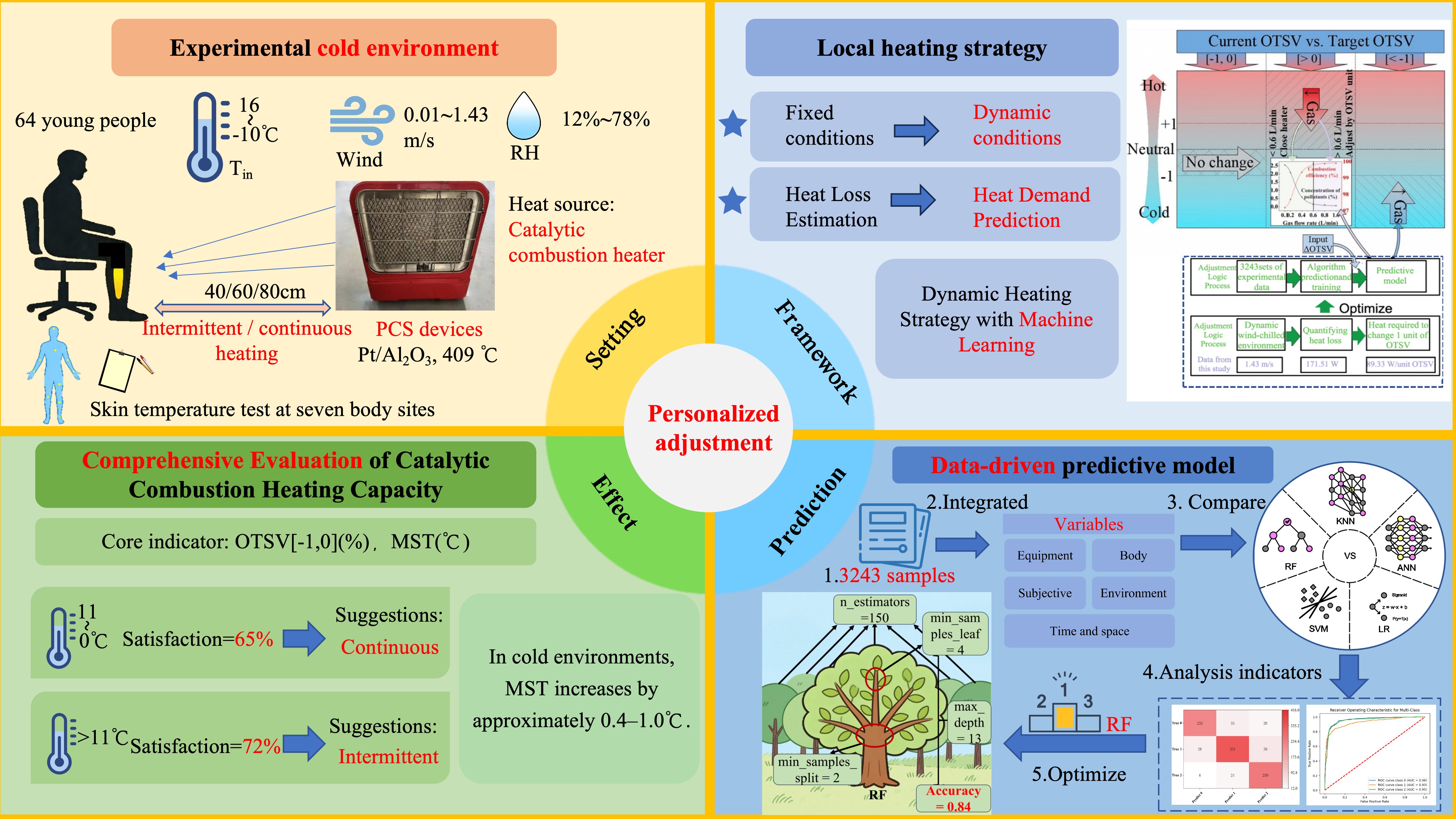

 

Graphical Abstract

References 

  • 1.

    Zhan, H.X.; Lin, G. Roof‑Integrated Phase Change Materials for Urban Heat Island Mitigation: Advances and Strategies. Int. J. Environ. Sci. Technol. 2026, 23, 301. https://doi.org/10.1007/s13762-026-07108-1.

  • 2.

    Mohtasham, D. Several Fans Treated for Hypothermia at the Fourth‑Coldest Game in NFL History. Available online: https://www.npr.org/2024/01/17/1225209300/chiefs-dolphins-hypothermia-cold (accessed on 11 December 2025).

  • 3.

    Kamata, H.; Seto, S.; Suppasri, A.; et al. A Study on Hypothermia and Associated Countermeasures in Tsunami Disasters: A Case Study of Miyagi Prefecture during the 2011 Great East Japan Earthquake. Int. J. Disaster Risk Reduct. 2022, 81, 103253. https://doi.org/10.1016/j.ijdrr.2022.103253.

  • 4.

    Qin, M.Y.; Chew, B.T.; Yau, Y.H.; et al. A Novel Evaluation Indicator and Optimal Heating Strategy for Using an Intermittent-Operation Catalytic Combustion Heater in Open Cold Environments. Build. Environ. 2024, 252, 111271. https://doi.org/10.1016/j.buildenv.2024.111271.

  • 5.

    Hu, J.H.; Li, Z.W.; Zhu, J.L.; et al. Effect of Compound Exposure to Snowstorm and Cold Spell on Acute Myocardial Infarction Mortality. Environ. Res. 2025, 272, 121191. https://doi.org/10.1016/j.envres.2025.121191.

  • 6.

    Wu, J.S.; Hu, Z.Q.; Han, Z.X.; et al. Human Physiological Responses of Exposure to Extremely Cold Environments. J. Therm. Biol. 2021, 98, 102933. https://doi.org/10.1016/j.jtherbio.2021.102933.

  • 7.

    Wu, J.S.; Sun, B.Y.; Hu, Z.Q.; et al. Physiological Responses and Thermal Sensation during Extremely Cold Exposure (−20 °C). Build. Environ. 2021, 206, 108338. https://doi.org/10.1016/j.buildenv.2021.108338.

  • 8.

    Kim, K.; Stephens, K.K.; McGlone, M.S.; et al. Strengthening Individual Preparedness for Extreme Cold Weather through Enhanced Messaging, Risk Perception, and Trust. Sustain. Cities Soc. 2025, 121, 106164. https://doi.org/10.1016/j.scs.2025.106164.

  • 9.

    Huang, X.Z.; Yao, R.M.; Xu, T.T.; et al. The Impact of Heatwaves on Human Perceived Thermal Comfort and Thermal Resilience Potential in Urban Public Open Spaces. Build. Environ. 2023, 242, 110586. https://doi.org/10.1016/j.buildenv.2023.110586.

  • 10.

    Liu, C.; Tang, Y.Z.; Sun, L.M.; et al. Effects of Local Heating of Body on Human Thermal Sensation and Thermal Comfort. J. Build. Eng. 2022, 53, 104543. https://doi.org/10.1016/j.jobe.2022.104543.

  • 11.

    Wang, J.H.; Ju, X.Y.; Wang, M.; et al. Alternating Intermittent Heating: An Energy‑Efficient Wearable Heating Strategy for Enhanced Comfort in Extremely Cold Environments. Energy 2025, 339, 139010. https://doi.org/10.1016/j.energy.2025.139010.

  • 12.

    Kaczmarczyk, J.; Melikov, A.; Sliva, D. Effect of Warm Air Supplied Facially on Occupants’ Comfort. Build. Environ. 2010, 45, 848–855. https://doi.org/10.1016/j.buildenv.2009.09.005.

  • 13.

    Du, C.Q.; Liu, H.; Li, C.J.; et al. Demand and Efficiency Evaluations of Local Convective Heating to Human Feet and Low Body Parts in Cold Environments. Build. Environ. 2020, 171, 106662. https://doi.org/10.1016/j.buildenv.2020.106662.

  • 14.

    Wang, H.Y.; Wang, J.; Li, W.Y.; et al. Experimental Study on a Radiant Leg Warmer to Improve Thermal Comfort of Office Workers in Winter. Build. Environ. 2022, 207, 108461. https://doi.org/10.1016/j.buildenv.2021.108461.

  • 15.

    Wang, T.Y.; Wang, H.C.; Luo, Z.W. Effects of Local Heating of Phase Change Floor (PCF) on Thermal Comfort and Energy Efficiency. J. Build. Eng. 2025, 103, 112157. https://doi.org/10.1016/j.jobe.2025.112157.

  • 16.

    Asai, M.; Fukasawa, R.; Matsui, T. Heat Transfer Controlling the Temperature of Human Forehead at Rest and during Walking. Int. J. Heat Mass Transfer 2026, 256, 128025. https://doi.org/10.1016/j.ijheatmasstransfer.2025.128025.

  • 17.

    Cheng, Z.Q.; Xu, J.X.; Lu, Y.H. A Multi‑Scale Simulation for Heat Transfer between Human and Heated Clothing: Towards Personalized and Efficient Thermal Management. Build. Environ. 2026, 287, 113764. https://doi.org/10.1016/j.buildenv.2025.113764.

  • 18.

    Fanger, P.O. Assessment of Manʼs Thermal Comfort in Practice. Occup. Environ. Med. 1973, 30, 313–324.

  • 19.

    Choi, J.-H.; Yeom, D. Study of Data‑Driven Thermal Sensation Prediction Model as a Function of Local Body Skin Temperatures in a Built Environment. Build. Environ. 2017, 121, 130–147. https://doi.org/10.1016/j.buildenv.2017.05.004.

  • 20.

    Yang, B.; Li, X.J.; Liu, Y.H.; et al. Comparison of Models for Predicting Winter Individual Thermal Comfort Based on Machine Learning Algorithms. Build. Environ. 2022, 215, 108970. https://doi.org/10.1016/j.buildenv.2022.108970.

  • 21.

    Zhou, X.; Xu, L.; Zhang, J.S.; et al. Data‑Driven Thermal Comfort Model via Support Vector Machine Algorithms: Insights from ASHRAE RP‑884 Database. Energy Build. 2020, 211, 109795. https://doi.org/10.1016/j.enbuild.2020.109795.

  • 22.

    Cai, S.H.; Gou, Z.H. Spatiotemporal Prediction of Thermal Comfort in Open-Plan Offices: A Data-Efficient Framework Integrating Machine Learning and Modified PMVst Model. Build. Environ. 2026, 290, 114167. https://doi.org/10.1016/j.buildenv.2025.114167.

  • 23.

    Huang, W.H.; Tan, G.S.; Zhao, B.L.; et al. A Data‑Driven Framework for Developing Virtual Personal Comfort Models: Integrating Thermal Sensitivity and Preference Prediction via Supervised Learning. Case Stud. Therm. Eng. 2025, 75, 107160. https://doi.org/10.1016/j.csite.2025.107160.

  • 24.

    Ren, Z.L.; Gao, X.K.; Xiao, Y.M.; et al. Thermal Comfort and Energy Conservation of a Four‑Sided Enclosed Local Heating Device in a Cold Environment. Build. Environ. 2023, 228, 109837. https://doi.org/10.1016/j.buildenv.2022.109837.

  • 25.

    GB/T 18883‑2022; Standard for Indoor Air Quality. State Administration for Market Regulation and National Standardization Administration: Beijing, China, 2022.

  • 26.

    Qin, M.Y.; Chew, B.T.; Yau, Y.H.; et al. Emergency Heater Based on Gas‑Fired Catalytic Combustion Infrared Technology: Structure, Evaluation and Thermal Response. Energy 2023, 274, 127426. https://doi.org/10.1016/j.energy.2023.127426.

  • 27.

    ASHRAE 55‑2023; Thermal Environmental Conditions for Human Occupancy; American Society of Heating, Refrigerating and Air-Conditioning Engineers: Atlanta, GA, USA, 2023.

  • 28.

    Kurazumi, Y.; Horikoshi, T.; Tsuchikawa, T.; et al. The Body Surface Area of Japanese. JPN J. Biometeorol. 1994, 31, 5–29. https://doi.org/10.11227/seikisho1966.31.5.

  • 29.

    Cao, W.; Xuan, X.D.; Wang, Y.C.; et al. The Thermal Sensitivity (Griffiths Constant) of Occupants for Naturally Ventilated Buildings in China. Energy Build. 2025, 341, 115786. https://doi.org/10.1016/j.enbuild.2025.115786.

  • 30.

    Yang, Z.X.; Dong, X.; Xiao, H.S.; et al. Investigation of Thermal Comfort of Room Air Conditioner during Heating Season. Build. Environ. 2022, 207, 108544. https://doi.org/10.1016/j.buildenv.2021.108544.

  • 31.

    Qin, M.Y.; Chew, B.T.; Yau, Y.H.; et al. Thermal Comfort Characteristics of a Catalytic Combustion Heater under Wind‑Chilled Exposure. J. Clean. Prod. 2024, 436, 140701. https://doi.org/10.1016/j.jclepro.2024.140701.

  • 32.

    Pasha, S.J.; Mohamed, E.S. Advanced Hybrid Ensemble Gain Ratio Feature Selection Model Using Machine Learning for Enhanced Disease Risk Prediction. Inform. Med. Unlocked 2022, 32, 101064. https://doi.org/10.1016/j.imu.2022.101064.

  • 33.

    Derczynski, L. Complementarity, F-score, and NLP Evaluation. In Proceedings of the Tenth International Conference on Language Resources and Evaluation (LRECʼ16), Portorož, Slovenia, 23–28 May 2016; pp. 261–266.

  • 34.

    Li, S.Y.; Xu, J.; Liu, W.W.; et al. Comparison of the Performance of Local Skin Temperatures in Evaluating Overall Thermal Comfort at Normal Room Temperatures. Build. Environ. 2025, 267, 112296. https://doi.org/10.1016/j.buildenv.2024.112296.

Share this article:
How to Cite
Fang, H.; Jiang, J.; Qin, M.; Han, X.; Yuan, Y.; Sun, S. Toward Personalized Thermal Comfort: A Spatiotemporal Dynamic Heating Strategy for the Catalytic Combustion Local Heater. Urban and Building Science 2026. https://doi.org/10.53941/ubs.2026.100015.
RIS
BibTex
Copyright & License
article copyright Image
Copyright (c) 2026 by the authors.
