
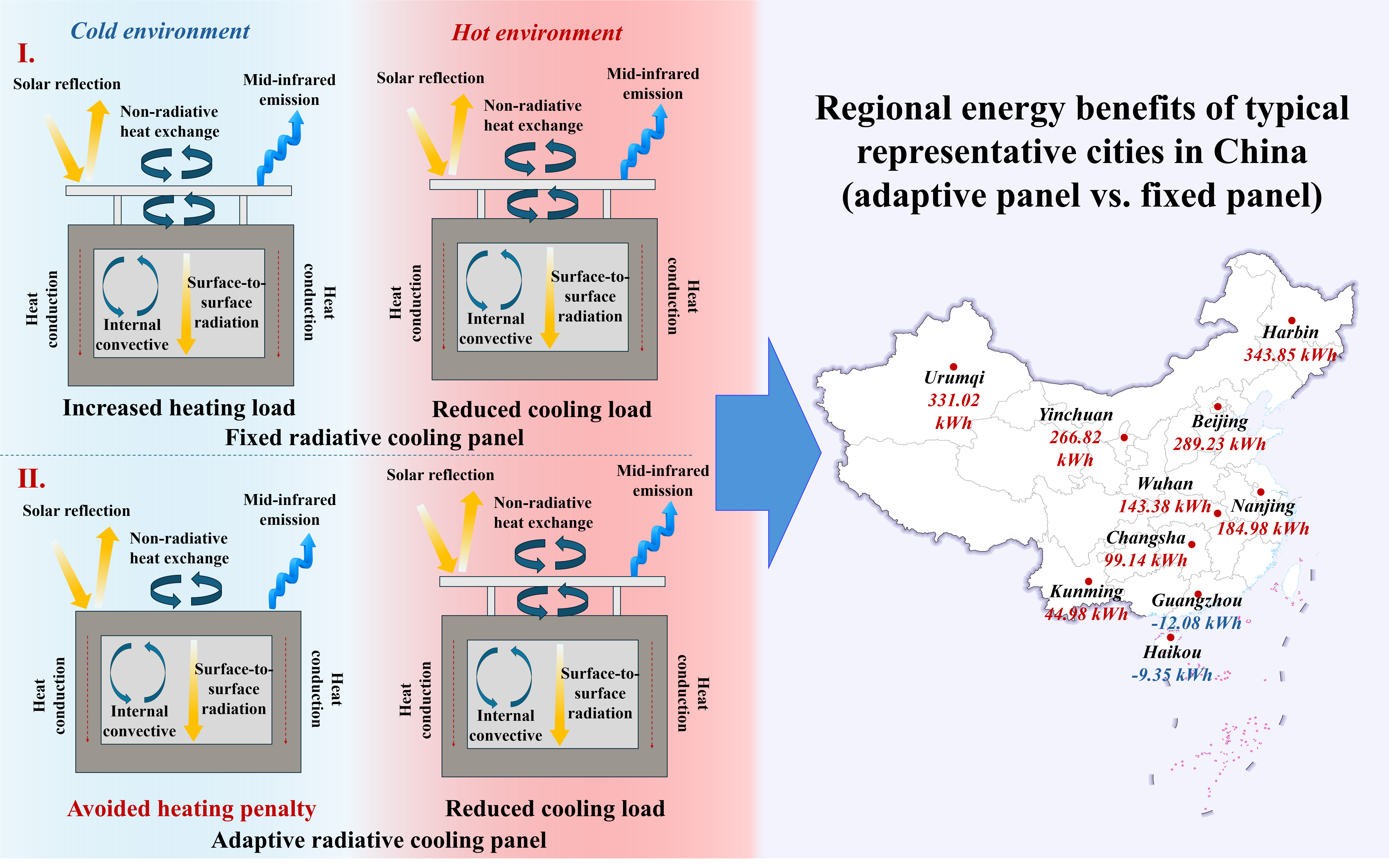
Radiative cooling (RC) roofs can reduce cooling energy use but may impose heating penalties in climates with cold seasons. This study evaluates an adaptive RC roof panel deployed only during cooling-dominated months to provide effective building cooling and energy savings under hot conditions while avoiding heating penalties under cold conditions. A transient multi-node model was used to couple heat transfer among the panel, roof, and indoor air, with hourly ERA5 data serving as boundary conditions. Nanjing was examined in detail, followed by a cross-climate assessment of nine additional Chinese cities. For Nanjing, baseline annual HVAC electricity use was 2763.8 kWh, of which 65.2% was attributable to cooling. A fixed panel reduced annual HVAC electricity use by 24.0%, whereas monthly adaptive deployment increased annual savings to 30.7% by preserving cooling-season benefits while avoiding most winter heating penalties. The panel coverage ratio exerted a substantially stronger influence than the panel-to-roof gap. Across cities, the adaptive strategy provided the greatest incremental benefit over fixed installation in colder climates, with additional annual savings of 343.85 kWh in Harbin, 331.02 kWh in Urumqi, 289.23 kWh in Beijing, and 266.82 kWh in Yinchuan. By contrast, this advantage diminished in cooling-dominated climates and became negligible in Guangzhou and Haikou. These findings indicate that RC roofs should be evaluated as seasonally controlled building-envelope systems rather than static surfaces, particularly where both heating and cooling demands are substantial.
- Open Access
- Article
An Adaptive Radiative Cooling Roof Panel Approach for Balancing Building Cooling Benefits and Heating Penalties
- Yang Hu 1,*,
- Baoshuang Zhu 1,
- Yujie Zhang 2,3,
- Weixian Mu 4,*
Author Information
Received: 14 Jul 2026 | Revised: 06 Aug 2026 | Accepted: 17 Aug 2026 | Published: 21 Aug 2026
Abstract
Graphical Abstract
Keywords
radiative cooling | adaptive roof | energy consumption | climate-responsive
References
- 1.
Zhong, X.; Voogt, J.; Zhan, W.; et al. UAV-based low-altitude remote sensing in built-environment thermal studies: A review across different spatial scales. Build. Environ. 2026, 303, 114937.
- 2.
Wang, D.; Zhou, Y.; Zheng, X.; et al. Optimizing Urban Morphology for Net-Zero Energy Districts: A Data-Driven Planning Framework. Energy Use 2026, 2, 100040.
- 3.
Santamouris, M. Cooling the cities—A review of reflective and green roof mitigation technologies to fight heat island and improve comfort in urban environments. Sol. Energy 2014, 103, 682–703.
- 4.
Hughes, B.R.; Chaudhry, H.N.; Ghani, S.A. A review of sustainable cooling technologies in buildings. Renew. Sustain. Energy Rev. 2011, 15, 3112–3120.
- 5.
Leo Samuel, D.G.; Shiva Nagendra, S.M.; Maiya, M.P. Passive alternatives to mechanical air conditioning of building: A review. Build. Environ. 2013, 66, 54–64.
- 6.
Oropeza-Perez, I.; Østergaard, P.A. Active and passive cooling methods for dwellings: A review. Renew. Sustain. Energy Rev. 2018, 82, 531–544.
- 7.
Akbari, H.; Menon, S.; Rosenfeld, A. Global cooling: Increasing world-wide urban albedos to offset CO2. Clim. Change 2009, 94, 275–286.
- 8.
Synnefa, A.; Santamouris, M.; Akbari, H. Estimating the effect of using cool coatings on energy loads and thermal comfort in residential buildings in various climatic conditions. Energy Build. 2007, 39, 1167–1174.
- 9.
Pisello, A.L. State of the art on the development of cool coatings for buildings and cities. Sol. Energy 2017, 144, 660–680.
- 10.
Raman, A.P.; Anoma, M.A.; Zhu, L.; et al. Passive radiative cooling below ambient air temperature under direct sunlight. Nature 2014, 515, 540–544.
- 11.
Rephaeli, E.; Raman, A.; Fan, S. Ultrabroadband Photonic Structures To Achieve High-Performance Daytime Radiative Cooling. Nano Lett. 2013, 13, 1457–1461.
- 12.
Gentle, A.R.; Smith, G.B. Radiative Heat Pumping from the Earth Using Surface Phonon Resonant Nanoparticles. Nano Lett. 2010, 10, 373–379.
- 13.
Mandal, J.; Fu, Y.; Overvig, A.C.; et al. Hierarchically porous polymer coatings for highly efficient passive daytime radiative cooling. Science 2018, 362, 315–319.
- 14.
Li, X.; Peoples, J.; Huang, Z.; et al. Full daytime sub-ambient radiative cooling in commercial-like paints with high figure of merit. Cell Rep. Phys. Sci. 2020, 1, 100221.
- 15.
Li, X.; Peoples, J.; Yao, P.; et al. Ultrawhite BaSO4 paints and films for remarkable daytime subambient radiative cooling. ACS Appl. Mater. Interfaces 2021, 13, 21733–21739.
- 16.
Zhao, B.; Hu, M.; Ao, X.; et al. Radiative cooling: A review of fundamentals, materials, applications, and prospects. Appl. Energy 2019, 236, 489–513.
- 17.
Fan, S.; Li, W. Photonics and thermodynamics concepts in radiative cooling. Nat. Photonics 2022, 16, 182–190.
- 18.
Munday, J.N. Tackling climate change through radiative cooling. Joule 2019, 3, 2057–2060.
- 19.
Liang, J.; Wu, J.; Guo, J.; et al. Radiative cooling for passive thermal management towards sustainable carbon neutrality. Natl. Sci. Rev. 2023, 10, nwac208.
- 20.
Kousis, I.; D’Amato, R.; Pisello, A.L.; et al. Daytime Radiative Cooling: A Perspective toward Urban Heat Island Mitigation. ACS Energy Lett. 2023, 8, 3239–3250.
- 21.
Anand, J.; Sailor, D.J.; Baniassadi, A. The relative role of solar reflectance and thermal emittance for passive daytime radiative cooling technologies applied to rooftops. Sustain. Cities Soc. 2021, 65, 102612.
- 22.
Pirvaram, A.; Talebzadeh, N.; Leung, S.N.; et al. Radiative cooling for buildings: A review of techno-enviro-economics and life-cycle assessment methods. Renew. Sustain. Energy Rev. 2022, 162, 112415.
- 23.
Zeyghami, M.; Goswami, D.Y.; Stefanakos, E. A review of clear sky radiative cooling developments and applications in renewable power systems and passive building cooling. Sol. Energy Mater. Sol. Cells 2018, 178, 115–128.
- 24.
Zhang, K.; Zhao, D.; Yin, X.; et al. Energy saving and economic analysis of a new hybrid radiative cooling system for single-family houses in the USA. Appl. Energy 2018, 224, 371–381.
- 25.
Peoples, J.; Hung, Y.-W.; Fang, Z.; et al. Energy savings of radiative cooling paints applied to residential buildings. Int. J. Heat Mass Transf. 2022, 194, 123001.
- 26.
Zhang, W.; Jiao, D.; Zhao, B.; et al. Experimental and numerical investigation of the effects of passive radiative cooling-based cool roof on building energy consumption. Appl. Energy 2024, 376, 124161.
- 27.
Bu, F.; Yan, D.; Tan, G.; et al. Systematically incorporating spectrum-selective radiative cooling into building performance simulation: Numerical integration method and experimental validation. Appl. Energy 2022, 312, 118733.
- 28.
Li, X.; Sun, B.; Sui, C.; et al. Integration of daytime radiative cooling and solar heating for year-round energy saving in buildings. Nat. Commun. 2020, 11, 6101.
- 29.
Tang, K.; Dong, K.; Li, J.; et al. Temperature-adaptive radiative coating for all-season household thermal regulation. Science 2021, 374, 1504–1509.
- 30.
An, Y.; Fu, Y.; Dai, J.-G.; et al. Switchable radiative cooling technologies for smart thermal management. Cell Rep. Phys. Sci. 2022, 3, 101098.
- 31.
Zhao, X.; Li, J.; Dong, K.; et al. Switchable and Tunable Radiative Cooling: Mechanisms, Applications, and Perspectives. ACS Nano 2024, 18, 18118−18128.
- 32.
Sui, C.; Pu, J.; Chen, T.; et al. Dynamic electrochromism for all-season radiative thermoregulation. Nat. Sustain. 2023, 6, 428–437.
- 33.
Zhang, H.; Huang, J.; Fan, D. Switchable radiative cooling from temperature-responsive thermal resistance modulation. ACS Appl. Energy Mater. 2022, 5, 6003–6010.
- 34.
Kommandur, S.; Kishore, R. A. Contact-Based Passive Thermal Switch with a High Rectification Ratio. ACS Eng. Au 2023, 3, 76–83.
- 35.
Hersbach, H.; Bell, B.; Berrisford, P.; et al. ERA5 Hourly Data on Single Levels from 1940 to Present; Copernicus Climate Change Service (C3S) Climate Data Store (CDS), 2023. Available online: https://climatereanalyzer.org/clim/t2_daily/ (accessed on 5 April 2026).
- 36.
Hu, Y.; Guo, T.; Qu, X.; et al. Replaceable cement-based radiative cooling panels for buildings: Thermal and economic superiority over coatings. J. Build. Eng. 2026, 121, 115634.
- 37.
Fuentes, M.K. A Simplified Thermal Model for Flat-Plate Photovoltaic Arrays; Sandia National Labs: Albuquerque, NM, USA, 1987.
- 38.
Fabiani, C.; Pisello, A.L.; Bou-Zeid, E.; et al. Adaptive measures for mitigating urban heat islands: The potential of thermochromic materials to control roofing energy balance. Appl. Energy 2019, 247, 155–170.
- 39.
Palyvos, J.A. A survey of wind convection coefficient correlations for building envelope energy systems’ modeling. Appl. Therm. Eng. 2008, 28, 801–808.
- 40.
Hu, Y.; Guo, T.; Qu, X.; et al. Enhanced passive radiative cooling of cementitious composites for efficient photovoltaic thermal management. Energy Convers. Manag. 2025, 344, 120268.
- 41.
Chen, Z.; Wen, J.; Bushby, S.T.; et al. An Analysis of the Hybrid Internal Mass Modeling Approach in EnergyPlus. In Proceedings of the 12th eSim Building Simulation Conference, Ottawa, ON, Canada, 22–23 June 2022.
- 42.
Carlos, J.S.; Corvacho, H. Evaluation of the performance indices of a ventilated double window through experimental and analytical procedures: SHGC-values. Energy Build. 2015, 86, 886–897.
- 43.
Hoyt, T.; Arens, E.; Zhang, H. Extending air temperature setpoints: Simulated energy savings and design considerations for new and retrofit buildings. Build. Environ. 2015, 88, 89–96.
- 44.
Hu, Y.; Shen, B. Development and field demonstration of residential air source integrated heat pump using a three-stage compressor. Energy Build. 2025, 328, 115202.
- 45.
Wijesuriya, S.; Kishore, R.A.; Bianchi, M.V.A.; et al. Potential energy savings benefits and limitations of radiative cooling coatings for U.S. residential buildings. J. Clean. Prod. 2022, 379, 134763.
- 46.
Bhuvad, S.S. Investigation of annual performance of a building shaded by rooftop PV panels in different climate zones of India. Renew. Energy 2022, 189, 1337–1357.
- 47.
An, J.; Li, H.; Bu, F.; et al. A systematic analysis of energy-saving potential of spectrum-selective radiative cooling materials in buildings. J. Build. Eng. 2024, 91, 109620.
- 48.
Yang, Y.; Zhang, G.; Rong, L. Temperature adaptive passive daytime radiative cooling: The impact of their essential properties on energy performance of different building types. Energy Build. 2024, 325, 114955.
- 49.
Yazdani, H.; Baneshi, M. Building energy comparison for dynamic cool roofs and green roofs under various climates. Sol. Energy 2021, 230, 764–778.


This work is licensed under a Creative Commons Attribution 4.0 International License.
