
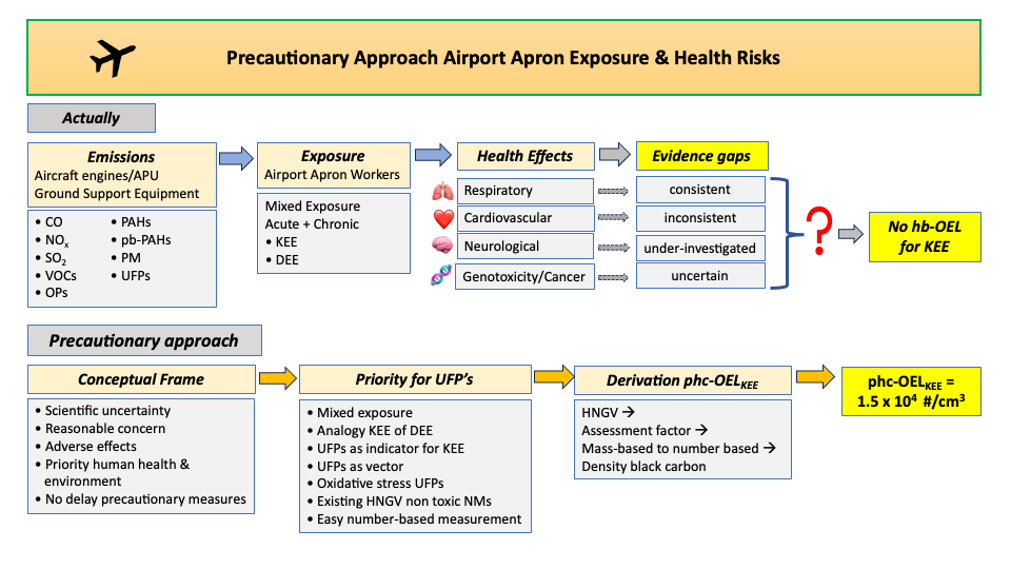
Airport apron workers are exposed to complex mixtures of volatile and particulate substances generated by jet fuel, exhaust from aircraft main engine and auxiliary power units (APU), and ground-service equipment. Evidence from both commercial and military airport settings indicates potentially serious health risks associated with acute and chronic exposure to these heterogeneous emissions. Emissions include CO, NOx, SO2, PAHs, UFPs, and larger particulates. In addition, there is chronic low-dose exposure to volatile organic compounds (VOCs) and organophosphates (OPs). The limited number of epidemiological studies specifically targeting apron workers report chronic respiratory symptoms. Evidence for cardiovascular effects is inconsistent, and potential neurological impacts are insufficiently explored. Some studies suggest genotoxic effects or elevated cancer risks but are insufficient to support unequivocal conclusions regarding the necessity of stringent risk management measures. Especially combined acute and chronic exposure to the mentioned volatile and airborne substances may represent a substantial but underrecognized risk, particularly with respect to neurotoxic health effects. This emphasizes the need for prospective cohort studies incorporating detailed exposure assessment, biomonitoring critical toxicological endpoints. At the same time, significant uncertainties and the limited availability of up-to-date, well-characterized exposure data, hinder effective risk assessment and management on the apron. This urges for a precautionary approach with priority for kerosene combustion-derived UFPs, due to their potential toxicity at low concentrations and their role as carriers of carcinogenic particle-bound PAHs (pb-PAHs). However, no widely accepted health-based occupational exposure limit (hb-OEL) currently exists for this nanoscale fraction, while UFPs represent a practical indicator for exposure and a useful tool for risk management. Based on existing risk assessment approaches, a combined number-based and mass-based precautionary health-considered OEL for kerosene exhaust emissions (phc-OELKEE) has been proposed. Field measurements indicate that this precautionary threshold is frequently exceeded on the airport apron.
- Open Access
- Article
Precautionary Approach to Reduce Occupational Exposures among Airport Apron Workers in the Context of Many Unknowns—A Methodological Position Paper
Author Information
Received: 03 May 2026 | Revised: 11 Jun 2026 | Accepted: 25 Jun 2026 | Published: 17 Jul 2026
Abstract
Graphical Abstract
Keywords
aircraft emissions | airport air quality | ultrafine particles | kerosene exhaust emission | occupational exposure limits | precautionary approach
References
- 1.
van Broekhuizen, P.; Säämänen, A.; Schuurbiers, D.; et al. Tyre wear nanoparticles as test for a nano risk governance framework. Front. Environ. Sci. 2022, 10, 1045246. https://doi.org/10.3389/fenvs.2022.1045246.
- 2.
Vouitsis, I.; Portugal, J.; Kontses, A.; et al. Transport-related airborne nanoparticles: Sources, different aerosol modes, and their toxicity. Atmos. Environ. 2023, 301, 119698. https://doi.org/10.1016/j.atmosenv.2023.119698.
- 3.
Sarazin, P.; Pomerleau, M.; Almadin, C.; et al. Cumulative chemical risk and associated toxic effect classes across US industries from regulatory inspections. Ann. Work. Expos Health 2026, 70, wxag002. https://doi.org/10.1093/annweh/wxag002.
- 4.
Ritchie, G.D.; Still, K.R.; Rossi, J.; et al. Biological and health effects of exposure to kerosene-based jet fuels and performance additives. J. Toxicol. Environ. Health Part. B 2003, 6, 357–451. https://doi.org/10.1080/10937400390198655.
- 5.
ICAO (International Civil Aviation Organization). Millions of People Working in Airports May be Affected by Potentially Damaging Air. Working Paper 2013; A38-WP/327. 2013. Available online: https://www.icao.int/sites/default/files/Meetings/AMC/ArchivedAssembly/en/A38/WP/wp-261-350/wp327_en.PDF (accessed on 15 April 2026).
- 6.
Keuken, M.P.; Moerman, M.; Zandveld, P.; et al. Total and size-resolved particle number and black carbon concentrations in urban areas near Schiphol airport (The Netherlands). Atmos. Environ. 2015, 104, 132–142. https://doi.org/10.1016/j.atmosenv.2015.01.015.
- 7.
Schiphol, 2025; Annual Traffic Review 2024. Available online: https://www.schiphol.nl/nl/schiphol-group/traffic-review (accessed on 15 April 2026).
- 8.
Eurostat. Air Passenger Transport Statistics. Extracted Dec 2025. Available online: https://ec.europa.eu/eurostat/statistics-explained/index (accessed on 15 April 2026).
- 9.
Anderson, B.E.; Chen, G.; Blake, D.R. Hydrocarbon emissions from a modern commercial airliner. Atmos. Environ. 2006, 40, 3601–3612. https://doi.org/10.1016/j.atmosenv.2005.09.072.
- 10.
Iavicoli, I.; Carelli, G.; Bergamaschi, A. Exposure evaluation to airborne polycyclic aromatic hydrocarbons in an Italian airport. J. Occup. Environ. Med. 2006, 48, 815–822.
- 11.
Agrawal, H.; Sawant, A.A.; Jansen, K.; et al. Characterization of chemical and particulate emissions from aircraft engines. Atmos. Environ. 2008, 42, 4380–4392. https://doi.org/10.1016/j.atmosenv.2008.01.069.
- 12.
Smith, K.W.; Proctor, S.P.; Ozonoff, A.I.; et al. Inhalation exposure to jet fuel (JP8) among U.S. Air Force personnel. J. Occup. Environ. Hyg. 2010, 7, 563–572. https://doi.org/10.1080/15459624.2010.503755.
- 13.
Solbu, K.; Daae, H.L.; Thorud, S.; et al. Exposure to airborne organophosphates from hydraulic and turbine oils among aviation technicians and loaders. J. Environ. Monit. 2010, 12, 2259–2268. https://doi.org/10.1039/c0em00273a.
- 14.
Targino, A.C.; Machado, B.L.F.; Krecl, P. Concentrations of personal exposure to black carbon particles at airports and on commercial flights. Transport Res. Part. D 2017, 52, 128–138. https://doi.org/10.1016/j.trd.2017.03.003.
- 15.
Mazaheri, M.; Bostrom, T.E.; Johnson, G.; et al. Composition and morphology of particle emissions from in-use aircraft during takeoff and landing. Environ. Sci. Technol. 2013, 47, 5235–5242. https://doi.org/10.1021/es3046058.
- 16.
Masiol, M.; Harrison, R.M. Aircraft engine exhaust emissions and other airport-related contributions to ambient air pollution: A review. Atmos. Environ. 2014, 95, 409–455. https://doi.org/10.1016/j.atmosenv.2014.05.070.
- 17.
Schindler, B.K.; Koslitz, S.; Weiss, T.; et al. Exposure of aircraft maintenance technicians to organophosphates from hydraulic fluids and turbine oils: A pilot study. Intern. J. Hyg. Environ. Health 2014, 217, 34–37. https://doi.org/10.1016/j.ijheh.2013.03.005.
- 18.
Møller, K.L.; Brauer, C.; Mikkelsen, S.; et al. Copenhagen airport cohort: Air pollution, manual baggage handling and health. BMJ Open 2017, 7, e012651. https://doi.org/10.1136/bmjopen-2016-012651.
- 19.
Habre, R.; Zhou, H.; Eckel, S.P.; et al. Short-term effects of airport-associated ultrafine particle exposure on lung function and inflammation in adults with asthma. Environ. Int. 2018, 18, 48–59. https://doi.org/10.1016/j.envint.2018.05.031.
- 20.
Bendtsen, K.M.; Bengtsen, E.; Saber, A.T.; et al. A review of health effects associated with exposure to jet engine emissions in and around airports. Environ. Health 2021, 20, 10. https://doi.org/10.1186/s12940-020-00690-y.
- 21.
Heitz, E.R.; Tilton, N.A.; Bergeron, J.G.; et al. The long-term impact of fuel exposure (LIFE) study: A tri-service cohort of United States veterans with military occupational exposure to jet fuels. Int. J. Environ. Res. Publ. Health 2025, 22, 1337. https://doi.org/10.3390/ijerph22091337.
- 22.
Kinsey, J.S.; Timko, M.T.; Herndon, S.C.; et al. Determination of the emissions from an aircraft auxiliary power unit (APU) during the alternative aviation fuel experiment (AAFEX). J. Air Waste Manag. Ass 2012, 62, 420–430. https://doi.org/10.1080/10473289.2012.655884.
- 23.
Padhra, A. Emissions from auxiliary power units and ground power units during intraday aircraft turnarounds at European airports. Transport Res. Part. D 2018, 63, 433–444. https://doi.org/10.1016/j.trd.2018.06.015.
- 24.
Christopher-De Vries, Y.; Brouwer, M. Aircraft Engine Emissions (AEE): An Overview of the Available Data on Mutagenicity, Carcinogenicity and other Health Effects. Bilthoven, The Netherlands: National Institute for Public Health and the Environment (RIVM) 2024. Available online: https://rivm.openrepository.com/entities/publication/23f6c73e-620f-4d25-a7ac-723ae02cf5cc (accessed on 15 April 2026).
- 25.
Winther, M.; Kousgaard, U.; Ellermann, T.; et al. Emissions of NOx, particle mass and particle numbers from aircraft main engines, APU’s and handling equipment at Copenhagen Airport. Atm. Env. 2015, 100, 218–229. https://doi.org/10.1016/j.atmosenv.2014.10.045.
- 26.
van Broekhuizen P. Airborne Release of Tyre Wear Particles—Update January 2024. Available online: https://www.researchgate.net/publication/378309611_Airborne_release_of_tyre_wear_particles_-_update_2024?channel=doi&linkId=65d38ffe01325d465211d375&showFulltext=true (accessed on 15 April 2026)
- 27.
Colognato, R.; Park, M.V.D.Z.; Wick, P.; et al. De Jong WH. Interactions with the Human Body In Adverse effects of engineered nanomaterials—Exposure, Toxicology, and Impact on Human Health; Fadeel, B., Pietroiusti, A., Shvedova, A.A.; Eds.; Academic Press: Cambridge, MA, USA, 2012.
- 28.
Passchier, W.; Knottnerus, A.; Albering, H.; et al. Public health impact of large airports. Rev. Environ. Health 2000, 15, 83–96. https://doi.org/10.1515/reveh.2000.15.1-2.83.
- 29.
De Groot, N.; Schuring, B.; Pikaar, D. Analyse Werksituatie Bagageafhandeling Schiphol 2023, Mei 2023, GO13R-NAI, Ergos Enschede NL. 2023. Available online: https://www.nlarbeidsinspectie.nl/documenten/2023/07/11/analyse-werksituatie-bagageafhandeling-schiphol-2023 (accessed on 15 April 2026)
- 30.
Baines Simmons, Schiphol Integral Safety Management System (ISMS) Performance Assessment Report 2022. Available online: https://nieuws.schiphol.nl/download/d77cd12a-68ff-4d79-b40e-97600625cb81/ismsperformanceassessment2022finalreport.pdf (accessed on 15 April 2026).
- 31.
Stil, H.S. Schiphol voert Toezicht op Vieze Uitstoot op: ‘Schrijnend dat de komst van een Gezondere Werkplek Achterblijft’, Parool, 23 March 2026. Available online: https://www.parool.nl/amsterdam/schiphol-voert-toezicht-op-vieze-uitstoot-op-schrijnend-dat-de-komst-van-een-gezondere-werkplek-achterblijft~bcf080ae/ (accessed on 15 April 2026).
- 32.
Gössling, S.; Hopkins, D.; Schweiggart, N.; et al. Beyond the Rhetoric of “Sustainable Aviation”: A Counterfactual Confrontation. J. Travel. Res. 2026, 1, 18. https://doi.org/10.1177/00472875251411867.
- 33.
Mihalache, R.; Verbeek, J.; Graczyk, H.; et al. Occupational exposure limits for manufactured nanomaterials, a systematic review. Nanotoxicol 2017, 11, 7–19. https://doi.org/10.1080/17435390.2016.1262920.
- 34.
Visser, M.; Gosens, I.; Bard, D.; et al. Towards health-based nano reference values (HNRVs) for occupational exposure: Recommendations from an expert panel. NanoImpact 2022, 26, 10039636. https://doi.org/10.1016/j.impact.2022.100396.
- 35.
van Kesteren, P.C.E.; van Berlo, D.; Bard, D.; et al. Health-based nanomaterial guidance value (HNGV) for occupational exposure to spheroidal biodurable engineered nanomaterials of relatively low substance-specific toxicity. Nanoimpact 2026, 42, 100621. https://doi.org/10.1016/j.impact.2026.100621.
- 36.
DECOS/NEG, (Dutch Expert Committee on Occupational Safety and Subcommittee on the Classification of Carcinogenic Substances in Collaboration with the Nordic Expert Group for Criteria Documentation of Health Risks from Chemicals). Kerosene Engine Exhaust Recommendations for the Classification of Mutagenicity and Carcinogenicity and a Health-Based Occupational Exposure Limit. Health Council of the Netherlands | No. 2026/13, The Hague, The public draft used, published on January 5, 2026, Is no longer available. Final Version Publication Expected 2 July 2026. Available on: https://www.gezondheidsraad.nl/documenten/2026/07/02/advies-kerosinemotoremissie (accessed on 3 July 2026).
- 37.
EC, European Union (EU). Regulation (EC) No 1272/2008 of the European Parliament and of the Council on Classification, Labelling and Packaging of Substances and Mixtures. 2009. Available online: https://eur-lex.europa.eu/eli/reg/2008/1272/oj/eng (accessed on 15 April 2026).
- 38.
EC, European Commission, Directive 2004/37/EC—Carcinogens, Mutagens or Reprotoxic Substances at Work. 2004. Available online: https://osha.europa.eu/en/legislation/directive/directive-200437ec-carcinogens-or-mutagens-work (accessed on 15 April 2026).
- 39.
SER (2012) Sociaal Economische Raad, Voorlopige Nanoreferentiewaarden Voor Synthetische Nanomaterialen. Rapport 12/1, March 2012, The Hague (Dutch). Available online: https://www.ser.nl/-/media/ser/downloads/adviezen/2012/voorlopige-nanoreferentievoorwaarden.pdf (accessed on 15 April 2026)
- 40.
Buist, H.; Oosterwijk, T. Applicability of provisional NRVs to synthetic nanomaterials—A study within the frame of the project Update of the NRVs. TNO 2017, R10424, 48.
- 41.
EC, European Commission, Communication of the Commission on the Precautionary Principle, COM, 2000: 1 Final. Available online: https://eur-lex.europa.eu/LexUriServ/LexUriServ.do?uri=COM:2000:0001:FIN:en:PDF (accessed on 17 March 2026).
- 42.
Von Schomberg R. The Precautionary Principle: Its Use Within Hard and Soft Law, Sympo¬sium on the European Parliament’s Role in Risk Governance. Eur. J. Risk Regul. 2012, 2, 147–156.
- 43.
De Smedt, K.; Vos, E. The Application of the Precautionary Principle in the EU. In The “Responsibility of Science”, Studies in History and Philosophy of Science; Mieg, H.A., Ed.; Springer: Berlin/Heidelberg, Germany, 2022; Volume 57. https://doi.org/10.1007/978-3-030-91597-1.
- 44.
von Schomberg, R. The precautionary principle and its normative challenges. In Implementing the Precautionary Principle—Perspectives and Prospects; Fisher, E., Jones, J., von Schomberg, R., Eds.; Edward Elgar Publishing Ltd.: Cheltenham, UK, 2006; pp. 19–42.
- 45.
Van Broekhuizen, P.; van Broekhuizen, F.; Cornelissen, R.; et al. Workplace exposure to nanoparticles and the application of provisional nanoreference values in times of uncertain risks. J. Nanopart Res. 2012, 14, 770. https://doi.org/10.1007/s11051-012-0770-3.
- 46.
Van Broekhuizen, P.; Dorbeck-Jung, B. Exposure Limit Values for Nanomaterials—Capacity and Willingness of Users to Apply a Precautionary Approach. J. Occup. Environm Hyg. 2013, 10, 46–53. https://doi.org/10.1080/15459624.2012.744253.
- 47.
van Broekhuizen, J.C. thesis Nano matters: Building blocks for a precautionary approach. 2012. Available online: https://dare.uva.nl/id/84997b8a-0640-409e-9017-c716ad8e1995.
- 48.
NanoDIODE. Developing Innovative Outreach and Dialogue on Responsible Nanotechnologies in EU Civil Society. 2013–2016. Available online: https://cordis.europa.eu/project/id/608891 (accessed on 15 April 2026).
- 49.
NanoRIGO. NANOtechnology RIsk Governance, NMBP-13-2018—Risk Governance of Nanotechnology. 2019–2023. Available online: https://nanorigo.eu (accessed on 15 April 2026).
- 50.
Backhaus T. Exploring the mixture assessment or allocation factor (MAF): A brief overview of the current discourse. Curr. Opin. Toxicol. 2024, 37, 100460. https://doi.org/10.1016/j.cotox.2024.100460.
- 51.
Backhaus, T.; Scholze, M.; Brack, W.; et al. Include a mixture allocation factor to improve EU chemical risk management—Science Revision of the REACH chemical regulation should enable more realistic understanding and management. Science 2025, 390, 678–680. https://doi.org/10.1126/science.aeb6374.
- 52.
Van Broekhuizen, F.A.; Posthuma, L.; Traas, T.P. Addressing Combined Effects of Chemicals in Environmental Safety Assessment under REACH—A thought Starter, RIVM Letter Report 2016-0162, 2026. Available online: https://www.rivm.nl/bibliotheek/rapporten/2016-0162.pdf (accessed on 15 April 2026).
- 53.
Van Broekhuizen, P. Applicability of Provisional NRVs to PGNPs and FCNPs, Bureau KLB Amsterdam. 2017. Available online: https://www.researchgate.net/publication/318562315_Applicability_of_provisional_NRVs_to_PGNPs_and_FCNPs (accessed on 15 April 2026).
- 54.
van der Meer, N.; Houba, R.; Houba, T.; et al. Blootstelling aan Deeltjesvormige Verontreiniging van Medewerkers Schiphol Airside (Dutch). Final Report, Institute for Risk Assessment Sciences (IRAS), Utrecht University April 8, 2024. Available online:https://www.uu.nl/sites/default/files/240408%20Rapport%20Blootstelling%20deeltjesvormige%20verontreiniging%20Schiphol%20Definitief_0.pdf (accessed on 15 April 2026)
- 55.
Morawska, L.; Wierzbicka, A.; Buonanno, G.; et al. Ambient Ultrafine Particles: Evidence for Policy Makers. White Paper, 2019. Available online: https://www.cleanaircompany.eu/wp-content/uploads/2025/09/White-Paper-Ambient-UFP-evidence-for-policy-makers-25-OCT-2019-2.pdf (accessed on 15 April 2026).
- 56.
Heland, J.; Schäfer, K. Determination of major combustion products in aircraft exhausts by FTIR emission spectroscopy. Atmos. Environ. 1998, 32, 3067–3072. https://doi.org/10.1016/S1352-2310(97)00395-6.
- 57.
WHO (World Health Organisation). Global Air Quality Guidelines, 2021. Particulate matter (PM2.5 and PM10), Ozone, Nitrogen Dioxide, Sulfur Dioxide and Carbon Monoxide. Available online: https://www.who.int/publications/i/item/9789240034228 (accessed on 15 April 2026)
- 58.
European Commission Guideline for Occupational Exposure 2017/164, Based on Guideline 98/24/EG, January 31, 2017. Available online: https://osha.europa.eu/en/legislation/directive/directive-2017164eu-indicative-occupational-exposure-limit-values (accessed on 15 April 2026)
- 59.
Diez, D.M.; Dominici, F.; Zarubiak, D.; et al. Statistical approaches for identifying air pollutant mixtures associated with aircraft departures at Los Angeles International airport. Environ. Sci. Technol. 2012, 46, 8229–8235. https://doi.org/10.1021/es3007172.
- 60.
Du, B.; Tandoc, M.C.; Mack, M.L.; et al. Indoor CO2 concentrations and cognitive function: A critical review. Indoor Air 2020, 30, 1067–1082. https://doi.org/10.1111/ina.12706.
- 61.
Westerdahl, D.; Fruin, S.A.; Fine, P.L.; et al. The Los Angeles international airport as a source of ultrafine particles and other pollutants to nearby communities. Atmos. Environ. 2008, 42, 3143–3155. https://doi.org/10.1016/j.atmosenv.2007.09.006.
- 62.
SCOEL. Scientific Committee on Occupational Exposure Limits for Nitrogen Dioxide, 2014 Recommendation Report SCOEL/SUM/53. European Commission Available online: https://ec.europa.eu/social/BlobServlet (accessed on 15 April 2026).
- 63.
I-OEL Guideline for Occupational Exposure EU-2017/164, Bruxelles, January 2017. Available online: https://eur-lex.europa.eu/eli/dir/2017/164/oj (accessed on 15 April 2026).
- 64.
Childers, J.W.; Witherspoon, C.L.; Smith, L.B.; et al. Real-time and integrated measurement of potential human exposure to particle-bound polycyclic aromatic hydrocarbons (PAHs) from aircraft exhaust. Env. Health Perspect. 2000, 108, 853–862.
- 65.
Cavallo, D.; Ursini, C.L.; Carelli, G.; et al. Occupational exposure in airport personnel: Characterization and evaluation of genotoxic and oxidative effects. Toxicol 2006, 223, 26–35. https://doi.org/10.1016/j.tox.2006.03.003.
- 66.
SER. Grenswaarden Gevaarlijke Stoffen. Polycyclische Aromatische Koolwaterstoffen Afkomstig van Steenkool (als benzo(a)pyreen). 2026. Available online: https://www.ser.nl/nl/thema/arbeidsomstandigheden/grenswaarden-gevaarlijke-stoffen/grenswaarden (accessed on 15 April 2026).
- 67.
Zhu, Y.; Fanning, E.; Yu, R.C.; et al. Aircraft emissions and local air quality impacts from takeoff activities at a large international airport. Atmos. Environ. 2011, 45, 6526–6533. https://doi.org/10.1016/j.atmosenv.2021.08.062.
- 68.
American Conference of Governmental Industrial Hygienists (ACGIH). Threshold Limit Values for Mixtures. TLVs and BEIs Based on the Documentation of Threshold Limit Values for Chemical Substances, Physical Agents and Biological Exposure Indices, Appendix E, p.86, 2021. Available online: https://bpsepako.com/wp-content/uploads/2024/08/ACGIH-2024-TLV-Book.pdf (accessed on 15 April 2026).
- 69.
Egeghy, P.P.; Hauf-Cabalo, L.; Gibson, R.; et al. Benzene and naphthalene in air and breath as indicators of exposure to jet fuel. Occup. Environ. Med. 2003, 60, 969–976. https://doi.org/10.1136/oem.60.12.969.
- 70.
Ellermann, T.; Massling, A.; Løfstrøm, P.; et al. Assessment of the Air Quality at the Apron of Copenhagen Airport Kastrup in Relation to the Working Environment. Technical Report from the Danish Centre for Environment and Energy, 2012, no 15. Available online: http://www2.dmu.dk/Pub/TR15.pdf (accessed on 15 April 2026).
- 71.
Herndon, S.C.; Wood, E.C.; Northway, M.J.; et al. Aircraft hydrocarbon emissions at Oakland International airport. Environ. Sci. Technol. 2009, 43, 1730–1736. https://doi.org/10.1021/es801307m.
- 72.
Schürmann, G.; Schäfer, K.; Jahn, C.; et al. The impact of NOx, CO and VOC emissions on the air quality of Zurich airport. Atmos. Environ. 2007, 41, 103–118. https://doi.org/10.1016/j.atmosenv.2006.07.030.
- 73.
Hu, S.; Fruin, S.; Kozawa, K.; et al. Aircraft emission impacts in a neighbourhood adjacent to a general aviation airport in southern California. Environ. Sci. Technol. 2009, 43, 8039–8045. https://doi.org/10.1021/es900975f.
- 74.
Van Broekhuizen, P.; van Veelen, W.; Streekstra, W.-H.; et al. Exposure Limits for Nanoparticles: Report of an International Workshop on Nano Reference Values. Ann. Occup. Hyg. 2012, 56, 515–524.
- 75.
Bendtsen, K.M.; Brostrøm, A.; Koivisto, A.J.; et al. Airport emission particles: Exposure characterization and toxicity following intratracheal instillation in mice. Part. Fibre Toxicol. 2019, 16, 23. https://doi.org/10.1186/s12989-019-0305-5.
- 76.
Artous, A.; Zimmermann, E.; Philippot, C.; et al. Emission characteristics and potential exposure assessments of aerosols and ultrafine particles at two French airports. Air 2024, 2, 73–85. https://doi.org/10.3390/air2010005.
- 77.
Sommar, J.N.; Andersson, E.M.; Andersson, N.; et al. Long-term exposure of particulate air pollution and black carbon in relation to natural and cause-specific mortality: A multicohort study in Sweden. BMJ Open 2021, 11, 046040. https://doi.org/10.1136/bmjopen-2020-046040.
- 78.
Masiol, M.; Vu, T.V.; Beddows, D.C.S.; et al. Source appointment of wide range particle size spectra and black carbon collected at the airport of Venice (Italy). Atmos. Environ. 2016, 139, 56–74. https://doi.org/10.1016/j.atmosenv.2016.05.018.
- 79.
Tromp, P.C.; van Dinther, D.; de Bie, S.E.; et al. Verkennend onderzoek ultrafijnstof op het Schipholterrein met behulp van mobiele metingen (Dutch). TNO Rep. 2021, 60, 42646.
- 80.
Brănisteanu, R.; Aiking, H. Exposure to polycyclic aromatic hydrocarbons in occupational versus urban environmental air. Int. Arch. Occup. Environ. Health 1998, 71, 533–536. https://doi.org/10.1007/s004200050319.
- 81.
Lai, C.H.; Chuang, K.Y.; Chang, J.-W. Characteristics of nano-/ultrafine particle bound PAHs in ambient air at an international airport. Environ. Sci. Pollut. Res. 2013, 20, 1772–1780. https://doi.org/10.1007/s11356-012-1083-x.
- 82.
Hudda, N.; Gould, T.; Hartin, K.; et al. Emissions from an International airport increase particle number concentrations 4-fold at 10 km downwind. Environ. Sci. Technol. 2014, 48, 6628–6635. https://doi.org/10.1021/es5001566.
- 83.
Zhang, B.; Hu, X.; Chang, L.; et al. A phenomenological model for predicting the size of soot primary particles emitted from an aero-engine combustor. Combust. Flame 2024, 260, 113259. https://doi.org/10.1016/j.combustflame.2023.113259.
- 84.
Buonanno, G.; Bernabei, M.; Avino, P.; et al. Occupational exposure to airborne particles and other pollutants in an aviation base. Environ. Pollut. 2012, 170, 78–87. https://doi.org/10.1016/j.envpol.2012.05.027.
- 85.
Møller, K.L.; Thygesen, L.C.; Schipperijn, J.; et al. Occupational exposure to ultrafine particles among airport employees-combining personal monitoring and global positioning system. PLoS ONE 2014, 9, e106671. https://doi.org/10.1371/journal.pone.0106671.
- 86.
Mazaheri, M.; Johnson, G.R.; Morawska, L. Particle and gaseous emissions from commercial aircraft at each stage of the landing and takeoff cycle. Environ. Sci. Technol. 2009, 43, 441–446. https://doi.org/10.1021/es8013985.
- 87.
Cheng, M.D.; Corporan, E. A study of extractive and remote-sensing sampling and measurement of emissions from military aircraft engines. Atmos. Environ. 2010, 44, 4867–4878. https://doi.org/10.1016/j.atmosenv.2010.08.033.
- 88.
Lobo, P.; Hagen, D.E.; Whitefield, P.D. Measurement and analysis of aircraft engine PM emissions downwind of an active runway at the Oakland International airport. Atmos. Environ. 2012, 61, 114–123. https://doi.org/10.1016/j.atmosenv.2012.07.028.
- 89.
Lobo, P.; Hagen, D.E.; Whitefield, P.D.; et al. PM emission measurements of in-servicecommercial aircraft engines during the Delta-Atlanta Hartsfield study. Atmos. Environ. 2015, 104, 237–245. https://doi.org/10.1016/j.atmosenv.2015.01.020.
- 90.
Campagna, M.; Frattolillo, A.; Pili, S.; et al. Environmental exposure to ultrafine particles inside and nearby a military airport. Atmos. 2016, 7, 138. https://doi.org/10.3390/atmos7100138.
- 91.
Moore, R.H.; Shook, M.A.; Ziemba, L.D.; et al. Take-off engine particle emission indices for in-service aircraft at Los Angeles International airport. Nature Sci. Data 2017, 4, 170198. https://doi.org/10.1038/sdata.2017.198.
- 92.
Stacey, B.; Harrison, R.M.; Pope, F.D. Emissions of ultrafine particles from civil aircraft: Dependence upon aircraft type and passenger load. NPJ Climate Atmos. Sci. 2023, 6, 161. https://doi.org/10.1038/s41612-023-00477-1.
- 93.
Psanis, C.; Triantafyllou, E.; Giamarelou, M.; et al. Particulate matter pollution from aviation-related activity at a small airport of the Aegean Sea Insular Region. Sci. Total Environ. 2017, 596–597, 187–193. https://doi.org/10.1016/j.scitotenv.2017.04.078.
- 94.
Zhang, X.; Karl, M.; Zhang, L.; et al. Influence of aviation emission on the particle number concentration near Zurich airport. Environ. Sci. Technol. 2020, 54, 14161–14171. https://doi.org/10.1021/acs.est.0c02249.
- 95.
Marcias, G.; Casula, M.F.; Uras, M.; et al. Occupational fine/ultrafine particles and noise exposure in aircraft personnel operating in airport taxiway. Environ. 2019, 6, 35. https://doi.org/10.3390/environments6030035.
- 96.
Brem, B.T.; Durdina, L.; Siegerist, F.; et al. Effects of fuel aromatic content on nonvolatile particulate emissions of an in-production aircraft gas turbine. Environ. Sci. Technol. 2015, 49, 13149–13157. https://doi.org/10.1021/acs.est.5b04167.
- 97.
Yu, Z.; Herndon, S.C.; Ziemba, L.D.; et al. Identification of lubricating oil in the particulate matter emissions from engine exhaust of in-service commercial aircraft. Environ. Sci. Technol. 2012, 46, 9630–9637. https://doi.org/10.1021/es301692t.
- 98.
Fushimi, A.; Saitoh, K.; Fujitani, Y.; et al. Identification of jet lubrication oil as a major component of aircraft exhaust particles. Atmos. Chem. Phys. 2019, 19, 6389–6399. https://doi.org/10.5194/acp-19-6389-2019.
- 99.
Ungeheuer, F.; Caudillo LDitas, F.; et al. Nucleation of jet engine vapours is a large source of aviation-related ultrafine particles. Comm. Earth Environ. 2022, 3, 319. https://doi.org/10.1038/s43247-022-00653-w.
- 100.
Webb, S.; Whitefield, P.D.; Miake Lye, R.C.; et al. Research Needs Associated with Particulate Matter Emissions at Airports; ACRP report 6, 2008; Transportation Research Board: Washington D.C., DC, USA, 2008
- 101.
Bennett, M.; Christie, S.M.; Graham, A.; et al. Composition of smoke generated by landing aircraft. Environ. Sci. Technol. 2011, 45, 3533–3538. https://doi.org/10.1021/es1027585.
- 102.
Hartikainen, A.; Ihalainen, M.; Shukla, D.; et al. Photochemical aging of aviation emissions: Transformation of chemical and physical properties of exhaust emissions from a laboratory-scale jet engine combustion chamber. Atmos. Chem. Phys. 2025, 25, 9275–9294. https://doi.org/10.5194/acp-25-9275-2025.
- 103.
Stacey B. Measurement of ultrafine particles at airports: A review. Atmos. Environ. 2019, 198, 463–477. https://doi.org/10.1016/j.atmosenv.2018.10.041.
- 104.
Riley, K.; Cook, R.; Carr, E.; et al. A systematic review of the impact of commercial aircraft activity on air quality near airports. City Environ. Interact. 2021, 11, 100066. https://doi.org/10.1016/j.cacint.2021.100066.
- 105.
Pecorari, E.; Mantovani, A.; Franceschini, C.; et al. Analysis of the effects of meteorology on aircraft exhaust dispersion and deposition using a Lagrangian model. Sci. Total Environ. 2016, 541, 839–856. https://doi.org/10.1016/j.scitotenv.2015.08.147.
- 106.
Vujović, D.; Todorović, N. An assessment of pollutant emissions due to air traffic at Nikola Tesla International airport, Belgrade, and the link between local air quality and weather types. Transp. Res. Part. D 2017, 56, 85–94. https://doi.org/10.1016/j.trd.2017.08.003.
- 107.
Stafoggia, M.; Cattani, G.; Forastiere, F.; et al. Particle number concentrations near the Rome-Ciampino city airport. Atmos. Environ. 2016, 147, 264–273. https://doi.org/10.1016/j.atmosenv.2016.09.062.
- 108.
Brouwer, D. Exposure to manufactured nanoparticles in different workplaces. Toxicology 2010, 269, 120–127. https://doi.org/10.1016/j.tox.2009.11.017.
- 109.
Ramachandran, G.; Ostraat, M.; Evans, D.E.; et al. A Strategy for Assessing Workplace Exposures to Nanomaterials. J. Occup. Environ. Hyg. 2011, 8, 673–685. https://doi.org/10.1080/15459624.2011.623223.
- 110.
Morawska, L.; Ristovski, Z.; Jayaratne, E.R.; et al. Ambient nano and ultrafine particles from motor vehicle emissions: Characteristics, ambient processing and implications on human exposure. Atmos. Environ. 2008, 42, 8113–8138. https://doi.org/10.1016/j.atmosenv.2008.07.050.
- 111.
Viitanen, A.-K.; Uuksulainen, S.; Koivisto, A.J.; et al. Workplace Measurements of Ultrafine Particles—A Literature Review. Ann. Work. Expo. Health 2017, 61, 749–758. https://doi.org/10.1093/annweh/wxx049.
- 112.
Hsu, H.H.; Adamkiewicz, G.; Houseman, E.A.; et al. The relationship between aviation activities and ultrafine particulate matter concentrations near a mid-sized airport. Atmos. Environ. 2012, 50, 328–337. https://doi.org/10.1016/j.atmosenv.2011.12.002.
- 113.
Rodríguez-Maroto, J.J.; García-Alonso, S.; Rojas, E.; et al. Characterization of PAHs bound to ambient ultrafine particles around runways at an international airport. Chemosphere 2024, 352, 141440. https://doi.org/10.1016/j.chemosphere.2024.141440.
- 114.
Pleil, J.D.; Smith, L.B.; Zelnick, S.D. Personal exposure to JP-8 jet fuel vapors and exhaust at air force bases. Environ. Health Perspect. 2000, 108, 183–192.
- 115.
Howlett, L.; Shephard, R.J. Carbon monoxide as a hazard in aviation. J. Occup. Med. 1973, 15, 874–877.
- 116.
Dowell, C.H. Evaluation of carbon monoxide exposure among airport cargo material handlers. In Health Hazard. Evaluation Report. HETA 2007-0144-3087; Transportation Security Administration: Erlanger, KY, USA, 2009.
- 117.
Schlenker, W.; Walker, W.R. Airports, air pollution, and contemporaneous health. Rev. Econ. Stud. 2016, 83, 768–809. https://doi.org/10.1093/restud/rdv043.
- 118.
Schäfer, K.; Jahn, C.; Sturm, P.; et al. Aircraft emission measurements by remote sensing methodologies at airports. Atmos. Environ. 2003, 37, 5261–5271. https://doi.org/10.1016/j.atmosenv.2003.09.002.
- 119.
Ratliff, G.; Sequeira, C.; Waitz, I.; et al. Aircraft Impacts on Local and Regional Air Quality in the United States. Report no COE-2009-002, 2009 (PARTNER project 15 final report). Available online: https://web.mit.edu/aeroastro/partner/reports/caep8/caep8-nox-using-apmt.pdf. (accessed on 15 April 2026).
- 120.
Touri, L.; Tarantini, A.; Suehs, C.; et al. Occupational exposure to aerosols in two French airports: Multi-year lung function changes. Ann. Work. Expos Health 2025, 69, 17–33. https://doi.org/10.1183/09059180.00005712.
- 121.
Tunnicliffe, W.S.; O’Hickey, S.P.; Fletcher, T.J.; et al. Pulmonary function and respiratory symptoms in a population of airport workers. Occup. Environ. Med. 1999, 56, 118–123. https://doi.org/10.1136/oem.56.2.118.
- 122.
Ryter, S.W.; Choi, A.M.K. Carbon monoxide in exhaled breath testing and therapeutics. J. Breath. Res. 2013, 7, 017111. https://doi.org/10.1088/1752-7155/7/1/017111.
- 123.
Ryan, C.M. Memory disturbances following chronic, low-level carbon monoxide exposure. Arch. Clin. Neuropsychol. 1990, 5, 59–67.
- 124.
Ely, E.W.; Moorehead, B.; Haponik, E.F. Warehouse workers’ headache: Emergency evaluation and management of 30 patients with carbon monoxide poisoning. Am. J. Med. 1995, 98, 145–154. https://doi.org/10.1016/s0002-9343(99)80398-2.
- 125.
Dutch Expert Committee on Occupational Safety (DECOS), Health Council of the Netherlands. Carbon Monoxide, Health-Based Recommended Occupational Exposure Level. Version December 20, 2023, Available online: https://www.healthcouncil.nl/documents/2024/09/09/carbon-monoxide (accessed on 15 April 2026).
- 126.
Masiol, M.; Harrison, R.M. Quantification of air quality impacts of London Heathrow airport (UK) from 2005–2012. Atmos Environ 2015, 116, 308–319. https://doi.org/10.1016/j.atmosenv.2015.06.048.
- 127.
Huang, S.; Li, H.; Wang, M.; et al. Long-term exposure to nitrogen dioxide and mortality: A systematic review and meta-analysis. Sci. Total Environ. 2021, 776, 145968. https://doi.org/10.1016/j.scitotenv.2021.145968.
- 128.
Huangfu, P.; Atkinson, R. Long-term exposure to NO2 and O3 and all cause and respiratory mortality: A systematic review and meta-analysis. Environ. Int. 2020, 144, 105998. https://doi.org/10.1016/j.envint.2020.105998.
- 129.
Herndon, S.C.; Rogers, T.; Dunlea, E.J.; et al. Hydrocarbon emissions from in-use commercial aircraft during airport operations. Environ. Sci. Technol. 2006, 40, 4406–4413. https://doi.org/10.1021/es051209.
- 130.
Yu, K.N.; Cheung, Y.P.; Cheung, T.; et al. Identifying the impact of large urban airports on local air quality by nonparametric regression. Atmos. Environ. 2004, 38, 4501–4507. https://doi.org/10.1016/j.atmosenv.2004.05.034.
- 131.
Herndon, S.C.; Shorter, J.H.; Zahniser, M.S.; et al. NO and NO2 emission ratios measured from in-use commercial aircraft during taxi and takeoff. Environ. Sci. Technol. 2004, 38, 6078–6084. https://doi.org/10.1021/es049701c.
- 132.
Karremans, V. Dutch minister of Infrastructure and Water Affairs, Questions to the Dutch Psrliament, Beantwoording Kamervragen over het Zwavelgehalte van op Schiphol Gebunkerde Kerosine, 2026 (IENW/BSK-2026/41221). Available online: https://www.rijksoverheid.nl/documenten/kamerstukken/2026/03/26/beantwoording-kamervragen-over-het-zwavelgehalte-van-op-schiphol-gebunkerde-kerosine. (accessed on 15 April 2026).
- 133.
Benosa, G.; Zhu, S.; Mac Kinnon, M.; et al. Air quality impacts of implementing emission reduction strategies at southern California airports. Atmos. Environ. 2018, 185, 121–127. https://doi.org/10.1016/jatmosenv.2018.04.048.
- 134.
Mazaheri, M.; Johnson, G.R.; Morawska, L. An inventory of particle and gaseous emissions from large aircraft thrust engine operations at an airport. Atmos. Environ. 2011, 45, 3500–3507. https://doi.org/10.1016/j.atmosenv.2010.12.012.
- 135.
Yim, S.H.L.; Stettler, M.E.J.; Barrett, S.R.H. Air quality and public health impacts of UK airports. Part 2: Impacts and policy assessment. Atmos. Environ. 2013, 67, 184–192. https://doi.org/10.1016/j.atmosenv.2012.10.017.
- 136.
Arter, C.A.; Buonocore, J.J.; Moniruzzaman, C.; et al. Air quality and health-related impacts of traditional and alternate jet fuels from airport aircraft operations in the U.S. Environ. Int. 2022, 158, 106958. https://doi.org/10.1016/j.envint.2021.106958.
- 137.
Wright, J. Chronic and occult carbon monoxide poisoning: We don’t know what we’re missing. Emerg. Med. J. 2002, 19, 386–390. https://doi.org/10.1136/emj.19.5.386.
- 138.
Annane, D.; Chevret, S.; Jars-Guincestre, M.C.; et al. Prognostic factors in unintentional mild carbon monoxide poisoning. Intens. Care Med. 2001, 27, 1776–1781. https://doi.org/10.1007/s00134-001-1127-z.
- 139.
Newby, D.E.; Mannuci, P.M.; Tell, G.S.; et al. Expert position paper on air pollution and cardiovascular disease. Eur. Heart J. 2015, 36, 83–93.
- 140.
Heeb, N.V.; Muñoz, M.; Haag, R.; et al. Corelease of genotoxic polycyclic aromatic hydrocarbons and nanoparticles from a commercial aircraft jet engine-dependence on fuel and thrust. Environ. Sci. Technol. 2024, 58, 1615–1624. https://doi.org/10.1021/acs.est.3c08152.
- 141.
Leikauf, G.D.; Kim, S.H.; Jang, A.S. Mechanisms of ultrafine particle-induced respiratory health effects. Exp. Mol. Med. 2020, 52, 329–337. https://doi.org/10.1038/s12276-020-0394-0.
- 142.
Iavicoli, I.; Chiarotti, M.; Bergamaschi, A.; et al. Determination of airborne polycyclic aromatic hydrocarbons at an airport by gas chromatography-mass spectrometry and evaluation of occupational exposure. J. Chromatogr. A 2007, 1150, 226–235. https://doi.org/10.1016/j.chroma.2006.08.010.
- 143.
WHO (World Health Organisation). Human health effects of polycyclic aromatic hydrocarbons as ambient air pollutants. In Report of the Working group on polycyclic aromatic hydrocarbons of the joint task force on the Health aspects of air pollution, 2021; Licence CC BY-NC-SA 3.0 IGO; WHO: Geneva, Switzerland, 2021, https://www.who.int/europe/publications/i/item/9789289056533
- 144.
Ramesh, A.; Harris, K.J.; Archibong, A.E. Reproductive toxicity of polycyclic aromatic hydrocarbons. In Reproductive and Developmental Toxicology, 3rd ed.; Academic Press: Cambridge, MA, USA, 2022.
- 145.
Mallah, M.A.; Changxing, L.; Mallah, M.A.; et al. Polycyclic aromatic hydrocarbons and its effects on human health: An overeview. Chemosph 2022, 296, 133948. https://doi.org/10.1016/j.chemosphere.2022.133948.
- 146.
Ollson, A.; Guha, N.; Bouaoun, L.; et al. Occupational exposure to polycyclic aromatic hydrocarbons and lung cancer risk: Results from a pooled analysis of case-control studies (SYNERGY. Cancer Epidemiol. Biomark. Prev. 2022, 31, 1433–1442. https://doi.org/10.1158/1055-9965.EPI-21-1428.
- 147.
Carlton, G.N.; Smith, L.B. Exposures to jet fuel and benzene during aircraft fuel tank repair in the U.S. Air Force. Appl. Occup. Environ. Hyg. 2000, 15, 485–491. https://doi.org/10.1080/104732200301278.
- 148.
Lee, S.; Kim, I.; Park, D.; et al. A case of acute organic solvent poisoning during epoxy coating. Ann. Occup. Environ. Hyg. 2019, 31, e9. https://doi.org/10.35371/aoem.2019.31.e9.
- 149.
Mishra, A.P.; Sahoo, S.K.; Sahoo, L.K.; et al. Peripheral neuropathy resembling CIDP following exposure to toxic fumes in shoe factory. D Y Patil. J. Health Sci. 2024, 12, 26–28. https://doi.org/10.4103/DYPJ.DYPJ_6_24.
- 150.
Terry, A.V. Functional consequences of repeated organophosphate exposure: Potential non-cholinergic mechanisms. Pharmacol. Ther. 2012, 134, 355–365. https://doi.org/10.1016/j.pharmthera.2012.03.001.
- 151.
Burdon, J.; Budnik, L.T.; Baur, X.; et al. Health consequences of exposure to aircraft contaminated air and fume events: A narrative review and medical protocol for the investigation of exposed aircrew and passengers. Environ. Health 2023, 22, 43. https://doi.org/10.1186/s12940-023-00987-8.
- 152.
Khalaf, E.M.; Mohammadi, M.J.; Sulistiyani, S.; et al. Effects of sulfur dioxide inhalation on human health: A review. Rev. Environ. Health 2022, 39, 331–337. https://doi.org/10.1515/reveh-2022-0237.
- 153.
Møller, K.L.; Brauer, C.; Mikkelsen, S.; et al. Cardiovascular disease and long-term occupational exposure to ultrafine particles: A cohort study of airport workers. Intern. J. Hyg. Environ. Health 2020, 223, 214–219. https://doi.org/10.1016/j.ijheh.2010.08.010.
- 154.
Spirtas, R.; Stewart, P.A.; Lee, J.S.; et al. Retrospective cohort mortality study of workers at an aircraft maintenance facility. 1. Epidemiological results. Brit J. Indus Med. 1991, 48, 515–530. https://doi.org/10.1136/oem.48.8.515.
- 155.
Stewart, P.A.; Lee, J.S.; Marano, D.E.; et al. Retrospective cohort mortality study of workers at an aircraft maintenance facility. 2. Exposures and their assessment. Brit J. Indus Med. 1991, 48, 531–537. https://doi.org/10.1136/oem.48.8.531.
- 156.
Blair, A.; Hartge, P.; Stewart, P.A.; et al. Mortality and cancer incidence of aircraft maintenance workers exposed to trichloroethylene and other organic solvents and chemicals: Extended follow-up. Occup. Environ. Med. 1998, 55, 161–171. https://doi.org/10.1136/oem.55.3.161.
- 157.
Radican, L.; Blair, A.; Stewart, P.; et al. Mortality of aircraft maintenance workers exposed to trichloroethylene and other hydrocarbons and chemicals: Extended follow-up. J. Occup. Environ. Med. 2008, 50, 1306–1319. https://doi.org/10.1097/JOM.0b013e3181845f7f.
- 158.
Yost, E.E.; Galizia, A.; Kaproun, D.F.; et al. Health effects of naphthalene exposure: A systematic evidence map and analysis of potential considerations for dose-response evaluation. Environ. Health Persp 2021, 129, 076002. https://doi.org/10.1289/EHP7381.
- 159.
Pitarque, M.; Creus, A.; Marcos, R.; et al. Examination of various biomarkers measuring genotoxic endpoints from Barcelona airport personnel. Mutat. Res. 1999, 440, 195–204. https://doi.org/10.1016/s1383-5718(99)00026-1.
- 160.
Yang, C.Y.; Wu, T.N.; Wu, J.J.; et al. Adverse respiratory and irritant health effects in airport workers in Taiwan. J. Toxicol. Environ. Health Part. A 2003, 66, 799–806. https://doi.org/10.1080/15287390390156218.
- 161.
Lecca, L.I.; Marcias, G.; Uras, M.; et al. Response of the cardiac autonomic control to exposure to nanoparticles and noise: A cross-sectional study of airport ground staff. Intern. J. Environ. Res. Publ. Health 2021, 18, 2507. https://doi.org/10.3390/ijerph18052507.
- 162.
Olsen, D.M.; Mattie, D.R.; Gould, W.D.; et al. A Pilot Study of Occupational Assessment of Air Force Personnel to Jet Fuel Before and After Conversion to JP-8; Air Force Research Lab Report AFRL-HE-WP-TR-1998-0107; Air Force Research Lab Wright-Patterson AFB OH Human Effectiveness Directorate: Dayton, OH. USA, 1998. Available online: https://apps.dtic.mil/sti/html/tr/ADA367582/index.html (accessed on 15 April 2026)
- 163.
LeMasters, G.K.; Livingston, G.K.; Lockey, J.E.; et al. Genotoxic changes after low-level solvent and fuel exposure on aircraft maintenance personnel. Mutagen. 1997, 12, 237–243. https://doi.org/10.1093/mutage/12.4.237.
- 164.
D’Este, C.; Attia, J.R.; Brown, A.M. Cancer incidence and mortality in aircraft maintenance workers. Am. J. Industr Med. 2008, 51, 16–23. https://doi.org/10.1002/ajim.20540.
- 165.
Erdem, O.; Sayal, A.; Eken, A.; et al. Evaluation of genotoxic and oxidative effects in workers exposed to jet propulsion fuel. Int. Arch. Environ. Health 2012, 85, 353–361. https://doi.org/10.1007/s00420-011-0676-x.
- 166.
Krieg, E.F.; Mathias, P.I.; Toennis, C.A.; et al. Detection of DNA damage in workers exposed to JP-8 jet fuel. Mutat. Res-Gen. Toxicol. Environ. Mutag 2012, 747, 218–227. https://doi.org/10.1016/j.mrgentox.2012.05.005.
- 167.
Heaton, K.J.; Maule, A.L.; Smith, K.W.; et al. JP8 exposure and neurocognitive performance among US Air Force personnel. Neurotoxicol 2017, 62, 170–180. https://doi.org/10.1016/j.neuro.2017.07.001.
- 168.
Andersen, M.H.G.; Saber, A.T.; Frederiksen, M.; et al. Occupational exposure and markers of genetic damage, systemic inflammation and lung function: A Danish cross-sectionel study among air force personnel. Nature Sci. Rep. 2021, 11, 17998. https://doi.org/10.1038/s41598-021-97382-5.
- 169.
Pabin, A.; Bojarczuk, A.; Kade, G.; et al. Cardiometabolic biomarkers and cardiovascular risk stratification in Polish military personnel: A chemometric approach. Intern. J. Molec Sci. 2025, 26, 11109. https://doi.org/10.3390/ijms262211109.
- 170.
Herndon, S.C.; Jayne, J.T.; Lobo, P.; et al. Commercial aircraft engine emissions characterization of in-use aircraft at Hartsfield-Jackson Atlanta International airport. Environ. Sci. Technol. 2008, 42, 1877–1883. https://doi.org/10.1021/es072029.
- 171.
Santibáñez, M.; Bolumar, F.; Garcia, A.M. Occupational risk factors in Alzheimer’s disease: A review assessing the quality of published epidemiological studies. Occup. Environ. Med. 2007, 64, 723–732. https://doi.org/10.1136/oem.2006.028209.
- 172.
Gash, D.M.; Rutland, K.; Hudson, N.L.; et al. Trichloroethylene: Parkinsonism and complex 1 mitochondrial neurotoxicity. Ann. Neurol. 2008, 63, 184–192. https://doi.org/10.1002/ana.21288.
- 173.
Caudle, W.M.; Guillot, T.S.; Lazo, C.R.; et al. Industrial toxicants and Parkinson’s disease. Neurotoxicol 2012, 33, 178–188. https://doi.org/10.1016/j.neuro.2012.01.010.
- 174.
Goldman, S.M.; Quinlan, P.J.; Ross, G.W.; et al. Solvent exposures and Parkinson’s disease risk in twins. Ann. Neurol. 2012, 71, 776–784. https://doi.org/10.1002/ana.22629.
- 175.
Wang, A.; Cockburn, M.; Ly, T.T.; et al. The association between ambient exposure to organophosphates and Parkinson’s disease risk. Occup. Environ. Med. 2014, 71, 275–281. https://doi.org/10.1136/oemed-2013-101394.
- 176.
Van der Mark, M.; Vermeulen, R.; Nijssen, P.C.G.; et al. Occupational exposure to pesticides and endotoxin and Parkinson’s disease in the Netherlands. Occup. Environ. Med. 2014, 71, 757–764. https://doi.org/10.1136/oemed-2014-102170.
- 177.
Sánchez-Santed, F.; Colomina, M.T.; Hernández, E.H. Organophosphate pesticide exposure and neurodegeneration. Cortex 2016, 74, 417–426. https://doi.org/10.1016/j.cortex.2015.10.003.
- 178.
Merwin, S.J.; Obis, T.; Nunez, Y.; et al. Organophosphate neurotoxicity to the voluntary motor system on the trail of environment-caused amyotrophic lateral sclerosis: The known, the misknown and the unknown. Arch. Toxicol. 2017, 91, 2939–2952. https://doi.org/10.1007/s00204-016-1926-1.
- 179.
Jokanović, M. Neurotoxic effects of organophosphorus pesticides and possible association with neurodegenerative diseases in man: A review. Toxicol. 2018, 410, 125–131. https://doi.org/10.1016/j.tox.2018.09.009.
- 180.
Flood-Garibay, J.A.; Angulo-Molina, A.; Mendez-Rojas, M.A. Particulate matter and ultrafine particles in urban air pollution and their effect on the nervous system. Environ. Sci. 2023, 25, 704–726.
- 181.
Parent, P.; Laffon, C.; Marhaba, I.; et al. Nanoscale characterization of aircraft soot: A high-resolution transmission electron microscopy, Raman spectroscopy, X-ray photoelectron and near-edge X-ray absorption spectroscopy study. Carbon 2016, 101, 86–100. http://dx.doi.org/10.1016/j.carbon.2016.01.040.
- 182.
Latvala, S.; Hedberg, J.; Möller, L.; et al. Optimization of an air-liquid interface exposure system for assessing toxicity of airborne nanoparticles. J. Applied Toxicol. 2016, 36, 1294–1301. https://doi.org/10.1002/jat.3304.
- 183.
Jonsdottir, H.R.; Delaval, M.; Leni, Z.; et al. Non-volatile particle emissions from aircraft turbine engines at ground-idle induce oxidative stress in bronchial cells. Comm. Biol. 2019, 2, 90. https://doi.org/10.1038/s42003-019-0332-7.
- 184.
He, R.W.; Gerlofs-Nijland, M.E.; Boere, J.; et al. Comparitive toxicity of ultrafine particles around a major airport in human bronchial epithelial (Calu-3) cell model at the air-liquid interface. Toxicol. Vitro 2020, 68, 104950. https://doi.org/10.1016/j.tiv.2020.104950.
- 185.
Yang, J.-W.; Shen, Y.-C.; Lin, K.-C.; et al. Organ-on-a-chip: Opportunities for assessing the toxicity of particulate matter. Front. Bioengin Biotechnol. 2020, 8, 519. https://doi.org/10.3389/fbioe.2020.00519.
- 186.
Horie, M.; Tabei, Y. Role of oxidative stress in nanoparticle toxicity. Free Radic. Res. 2021, 55, 331–342. https://doi.org/10.1080/10715762.2020.1859108.
- 187.
Mills, N.L.; Miller, M.R.; Lucking, A.J.; et al. Combustion-derived nanoparticulate induces the adverse vascular effects of diesel exhaust inhalation. Eur. Heart J. 2011, 32, 2660–2671. https://doi.org/10.1093/eurheartj/ehr195.
- 188.
Tόren, K.; Bergdahl, I.A.; Nilsson, T.; et al. Occupational exposure to particulate air pollution and mortality due to ischaemic heart disease and cerebrovascular disease. Occup. Environ. Med. 2007, 64, 515–519. https://doi.org/10.1136/oem.2006.029488.
- 189.
Fang, S.C.; Cassidy, A.; Christiani, D.C. A systematic review of occupational exposure to particulate matter and cardiovascular disease. Int. J. Environ. Res. Public. Health 2010, 7, 1773–1806. https://doi.org/10.3390/ijerph7041773.
- 190.
Moorthy, B.; Chu, C.; Carlin, D.J. Polycyclic aromatic hydrocarbons: From metabolism to lung cancer. Toxicol. Sci. 2015, 145, 5–15. https://doi.org/10.1093/toxsci/kfv040.
- 191.
Ramanakumar, A.V.; Parent, M.E.; Latreille, B.; et al. Risk of lung cancer following exposure to carbon black, titanium dioxide and talc: Results from two case-control studies in Montreal. Int. J. Cancer 2008, 122, 183–189. https://doi.org/10.1002/ijc.23021.
- 192.
Wu, A.H.; Fruin, S.; Larson, T.V.; et al. Association between airport-related ultrafine particles and risk of malignant brain cancer: A multiethnic cohort study. Cancer Res. 2021, 81, 4360–4369. https://doi.org/10.1158/0008-5472.CAN-21-1138.
- 193.
Romanczyk, M. Chemical compositional analysis of jet fuels: Contributions of mass spectrometry in the 21st century. Mass. Spectrom. Rev. 2024, 43, 345–368. https://doi.org/10.1002/mas.21825.
- 194.
International Agency for Research on Cancer (IARC) (2010) Evaluation of carcinogenic risk of chemicals to humans. Polycyclic aromatic compounds, part 1, chemical, environmental and experimental data. Monogr. Database. 1983, 32, 477.
- 195.
Senkayi, S.N.; Sattler, M.L.; Rowe, N.; et al. Investigation of an association between childhood leukemia incidences and airports in Texas. Atmos. Pollut. Res. 2014, 5, 189–195. https://doi.org/10.5094/APR.2014.023.
- 196.
Cattaneo, I.; Kalian, A.D.; Nicola, M.R.; et al. Risk assessment of combined exposure to multiple chemicals at the European Food Safety Authority: Principles, guidance documents, applications and future challenges. Toxins 2023, 15, 40. https://doi.org/10.3390/toxins15010040.
- 197.
Kortenkamp, A. Distinctions between similarly and dissimilarly acting mixture components unnecessarily complicate mixture risk assessments: Implications for assessing low dose mixture exposures. Curr. Opin. Toxicol. 2023, 35, 100418. https://doi.org/10.1016/j.cotox.2023.100418.
- 198.
European Food and Safety Authority (EFSA). International frameworks dealing with human risk assessment of combined exposure to multiple chemicals. EFSA J. 2013, 11, 3313. https://doi.org/10.2903/j.efsa.2013.3313.
- 199.
Braun, G.; Herberth, G.; Krauss, M.; et al. Neurotoxic mixture effects of chemicals extracted from blood of pregnant women. Science 2024, 386, 301–309. https://doi.org/10.1126/science.adq0336.
- 200.
Boberg, J.; Dybdahl, M.; Petersen, A.; et al. A pragmatic approach for human risk assessment of chemical mixtures. Curr. Opin. Toxicol. 2019, 15, 1–7. https://doi.org/10.1016/j.cotox.2018.11.004.
- 201.
DECOS. Health Council of the Netherlands, BaP and PAH from Coal-Derived Sources—Health-Based Calculated Occupational Cancer Risk Values of benzo[a]pyrene and Unsubstituted non-Heterocyclic Polycyclic Aromatic Hydrocarbons from Coal-Derived Sources. 2006. Available online: https://www.gezondheidsraad.nl/documenten/2006/02/21/bap-and-pah-from-coal-derived-sources (accessed on 15 April 2026).
- 202.
Bolt, H.M.; Heederik, D.; Papameletiou, D.; et al. SCOEL/REC/404, Polycyclic Aromatic Hydrocarbon mixtures containing benzo[a]pyrene (PAH) Recommendation from the Scientific Committee on Occupational Exposure Limits, 2016. Available online: https://www.google.com/url?sa=t&source=web&rct=j&opi=89978449&url=https://www.ser.nl/api/Mfiles/DownloadFirstDocument%3FId%3D86b2c80f-3a7a-4e03-a011-90260c62edba&ved=2ahUKEwiq3PrrvduTAxUc0AIHHZPPGEsQFnoECBcQAQ&usg=AOvVaw2hNC7imfJAp200jvEhXvUC. (accessed on 15 April 2026).
- 203.
European Chemical Agency (ECHA) Committee for Risk Assessment. Opinion on Scientific Evaluation of Occupational Exposure Limits for Polycyclic Aromatic Hydrocarbons; ECHA/RAC/OEL-O-0000007198-66-01/F, Helsinki 2022. Available online: file:///C:/Users/%E5%88%B6%E4%BD%9C7/Downloads/ECHA-RAC-Biomonitoring.pdf (accessed on 15 April 2026).
- 204.
Directive C. 107/EC of the European Parliament and of the Council of 15 December 2004 Relating to Arsenic, Cadmium, Mercury, Nickel and Polycyclic Aromatic Hydrocarbons in Ambient Air. From the Official Journal of the European Communities 26, 2004. Available online: https://eur-lex.europa.eu/eli/dir/2004/107/oj/eng (accessed on 15 April 2026).
- 205.
Ren, J.; Chen, L.; Liu, J.; et al. The density of ambient black carbon retrieved by a new method: Implications for cloud condensation nuclei prediction. Atmos. Chem. Phys. 2023, 23, 4327–4342. https://doi.org/10.5194/acp-23-4327-2023.
- 206.
Liati, A.; Schreiber, D.; Alpert, P.A.; et al. Aircraft soot from conventional fuels and biofuels during ground idle and climb-out conditions: Electron Microscopy and X-ray micro-spectroscopy. Environ. Pollut. 2019, 247, 658–667. https://doi.org/10.1016/j.envpol.2019.01.078.
- 207.
Barrett, S.R.H.; Yim, S.H.L.; Gilmore, C.K.; et al. Public health, climate, and economic impacts of desulfurizing jet fuel. Environ. Sci. Technol. 2012, 46, 4275–4282. https://doi.org/10.1021/es203325a.
- 208.
Speth, R.L.; Rojo, C.; Malina, R.; et al. Black carbon emissions from combustion of alternative jet fuels. Atmos. Environ. 2015, 105, 37–42. https://doi.org/10.1016/j.atmosenv.2015.01.040.


This work is licensed under a Creative Commons Attribution 4.0 International License.
