
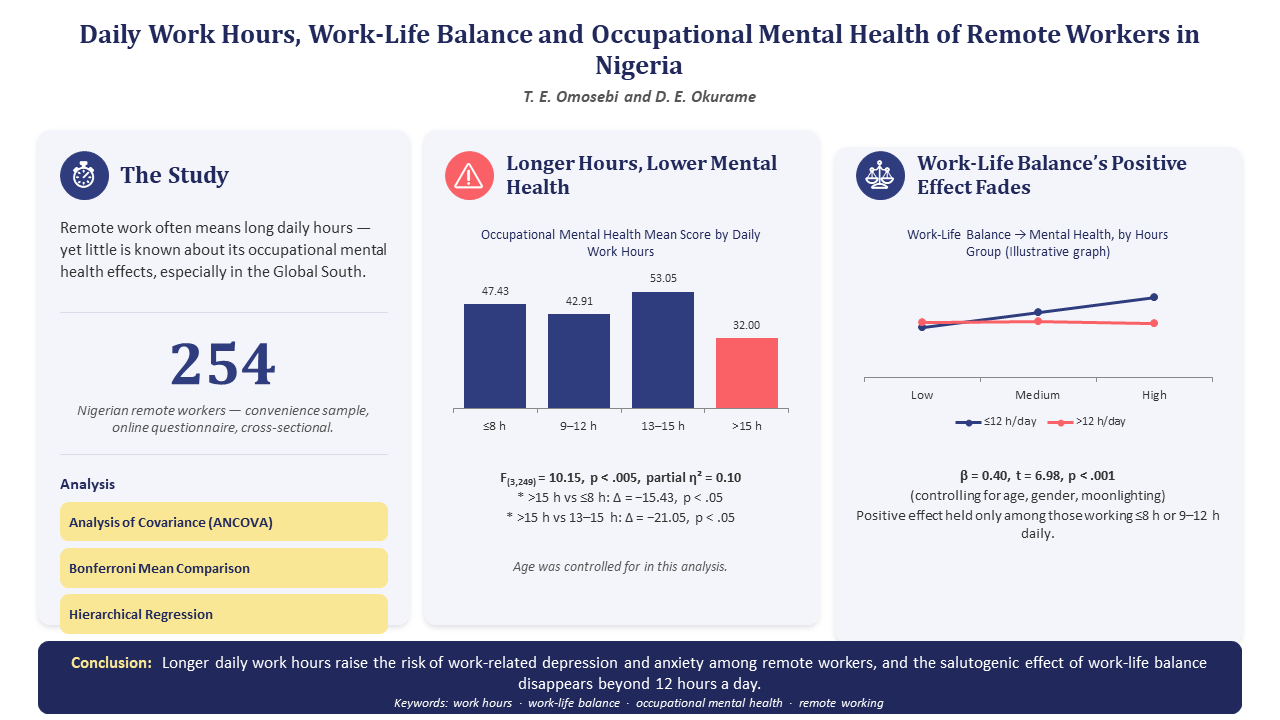
Remote working is characterised by long daily work hours. Yet there are few empirical studies on the work-related mental health effects of daily work hours among remote workers, especially in the Global South. Cross-sectional data were collected from 254 Nigerian remote workers via a convenience sampling approach and an online questionnaire. The statistical investigations were conducted using analysis of covariance, Bonferroni mean comparison, and hierarchical regression. It was found that daily work hours had a statistically significant differential effect on occupational mental health (F(3,249) = 10.15, p < 0.005, partial η2 = 0.10) while controlling for age. Mean comparison analysis showed that remote workers working above 15 h daily scored significantly lower on occupational mental health than those working 8 h (Mean Diff. = −15.43, p < 0.05), and significantly lower than those working 13 to 15 h (Mean Diff. = −21.05, p < 0.05). Work-life balance had a statistically significant positive effect on occupational mental health (β = 0.40, t = 6.98, p < 0.001), after controlling for age, gender and moonlighting. However, further analysis showed that the significant positive effect of work-life balance occurred only among those who work 8 h or less or 9–12 h daily. The study concluded that longer daily work hours increase the risk of work-related depression and anxiety among remote workers.
- Open Access
- Article
Daily Work Hours, Work-Life Balance and Occupational Mental Health of Remote Workers in Nigeria
Author Information
Received: 30 Mar 2026 | Revised: 25 Jun 2026 | Accepted: 03 Jul 2026 | Published: 27 Jul 2026
Abstract
Graphical Abstract
Keywords
work hours | work-life balance | occupational mental health | remote working
References
- 1.
Oginni, B.; Ayantunji, I.; Muyideen, A.; et al. Influence of work-life balance on occupational stress of employee in the Nigeria banking industry Ogun state, Nigeria. Afr. Multidiscip. J. Dev. 2023, 12, 60–73.
- 2.
Osifo, J.A. An overview of occupational mental health: Challenges and prospects for Nigeria. Int. J. Humanit. Soc. Sci. Invent. 2016, 5, 64–67.
- 3.
Oyewunmi, A.E.; Oyewunmi, O.A.; Iyiola, O.O.; et al. Mental health and the Nigerian workplace: Fallacies, facts and the way forward. Int. J. Psychol. Couns. 2015, 7, 106–111.
- 4.
Olaniyan, O. Employee Mental Health and Workforce Productivity. Businessday NG. 2023. Available online: https://businessday.ng/opinion/article/employee-mental-health-and-workforce-productivity/ (accessed on 26 January 2026).
- 5.
Nigerian Freelance Master. 45% of Freelancers in Nigeria Highlight Mental Health. Nigerian Freelance Master. 2023. Available online: https://freelancemaster.ng/freelancers-in-nigeria-highlight-mental-health/ (accessed on 26 January 2026).
- 6.
Mahomed, F.; Oba, P.; Sony, M. Exploring employee well-being during the COVID-19 remote work: Evidence from South Africa. Eur. J. Train. Dev. 2023, 47, 91–111.
- 7.
Winkler-Titus, N.; Gerber, C.; Ngalo, V. Well-being of remote workers: Work characteristics and challenges. SA J. Hum. Resour. Manag. 2025, 23, 2876.
- 8.
Lyzwinski, L.-N. Organizational and occupational health issues with working remotely during the pandemic: A scoping review of remote work and health. J. Occup. Health 2024, 66, uiae005.
- 9.
Okeya, O.E.; Ajayi, O.S.; Owoniyi, M.O. Effects of work-life balance on health and wellbeing of employees in the Nigerian banking industry. Int. J. Res. Rev. 2020, 7, 472–479.
- 10.
Akanji, B.; Mordi, C.; Ajonbadi, H.A. The experiences of work-life balance, stress, and coping lifestyles of female professionals: Insights from a developing country. Empl. Relat. Int. J. 2020, 42, 999–1015.
- 11.
Baker, R.; Puzi, N.F.H.M.; Saudi, N.S.M.; et al. The influence of work-life balance on emotional intelligence, depression, anxiety, and stress. Kurd. Stud. 2024, 12, 43–57.
- 12.
Fricker, R.D. Sampling Methods for Web and E-mail Surveys. In The SAGE Handbook of Online Research Methods; SAGE Publications, Ltd.: London, UK, 2008; pp. 195–216. Available online: https://methods.sagepub.com/book/the-sage-handbook-of-online-research-methods/n11.xml (accessed on 6 March 2026).
- 13.
Pearson, R.H.; Mundform, D.J. Recommended sample size for conducting exploratory factor analysis on dichotomous data. J. Mod. Appl. Stat. Methods 2010, 9, 359–368.
- 14.
Tucker, P.; Folkard, S. Working Time, Health and Safety: A Research Synthesis Paper; Report No.: 31; International Labour Organisation: Geneva, Switzerland, 2012.
- 15.
Brough, P.; Timms, C.; O’Driscoll, M.P.; et al. Work-life balance: A longitudinal evaluation of a new measure across Australia and New Zealand workers. Int. J. Hum. Resour. Manag. 2014, 25, 2724–2744.
- 16.
Duradoni, M.; Serritella, E.; Avolio, C.; et al. Development and Validation of the Digital Life Balance (DLB) Scale: A Brand-New Measure for Both Harmonic and Disharmonic Use of ICTs. Behav. Sci. 2022, 12, 489.
- 17.
Joseph, J. Discriminant validity of Work-life balance from Work-family balance. In Disruption of Globalization; Bloomsbury: London, UK, 2019.
- 18.
Ugwu, F.O.; Enwereuzor, I.K.; Mazei, J. Is Working from Home a Blessing or a Burden? Home Demands as a Mediator of the Relationship Between Work Engagement and Work-Life Balance. Appl. Res. Qual. Life 2023, 18, 341–364.
- 19.
Warr, P. The measurement of well-being and other aspects of mental health. J. Occup. Psychol. 1990, 63, 193–210.
- 20.
Maganda, A.L.; Ameh, B.; Yusuf, T.A.; et al. Remote work and employee productivity in Nigeria breweries PLC. Glob. J. Hum. Resour. Manag. 2025, 13, 18–34.
- 21.
Hong, Y.; Zhang, Y.; Xue, P.; et al. The influence of long working hours, occupational stress, and well-being on depression among couriers in Zhejiang, China. Front. Psychol. 2022, 13, 928928.
- 22.
Ma, X.; Kawakami, A.; Inui, T. Impact of Long Working Hours on Mental Health Status in Japan: Evidence from a National Representative Survey. Int. J. Environ. Res. Public Health 2024, 21, 842.
- 23.
Sato, K.; Kuroda, S.; Owan, H. Mental health effects of long work hours, night and weekend work, and short rest periods. Soc. Sci. Med. 2019, 246, 112774.
- 24.
Ochiai, Y.; Takahashi, M.; Matsuo, T.; et al. Characteristics of long working hours and subsequent psychological and physical responses: JNIOSH cohort study. Occup. Environ. Med. 2023, 80, 304–311.
- 25.
Ricketts, C.F.; Campbell, R.C.; Rezek, J.P. The effects of work hours on physical and mental health of late prime age men and women. Am. Econ. 2019, 64, 216–236.
- 26.
Chu, L. Impact of long working hours on health based on observations in China. BMC Public Health 2021, 21, 1347.
- 27.
Hsu, Y.-Y.; Bai, C.-H.; Yang, C.-M.; et al. Long Hours’ Effects on Work-Life Balance and Satisfaction. BioMed Res. Int. 2019, 2019, 5046934.
- 28.
Bakker, A.B.; Demerouti, E. The Job Demands-Resources model: State of the art. J. Manag. Psychol. 2007, 22, 309–328.
- 29.
Voglino, G.; Savatteri, A.; Gualano, M.R.; et al. How the reduction of working hours could influence health outcomes: A systematic review of published studies. BMJ Open 2022, 12, e051131.
- 30.
Uzonwanne, F.C.; Ijide, W.O.V. Dimensions of work-life balance as predictors of anxiety among a sample of Nigerian bankers. IFE Psychol. Int. J. 2017, 25, 148–168.
- 31.
Yang, X.; Qiu, D.; Lau, M.C.M.; et al. The mediation role of work-life balance stress and chronic fatigue in the relationship between workaholism and depression among Chinese male workers in Hong Kong. J. Behav. Addict. 2020, 9, 483–490.

This work is licensed under a Creative Commons Attribution 4.0 International License.
