
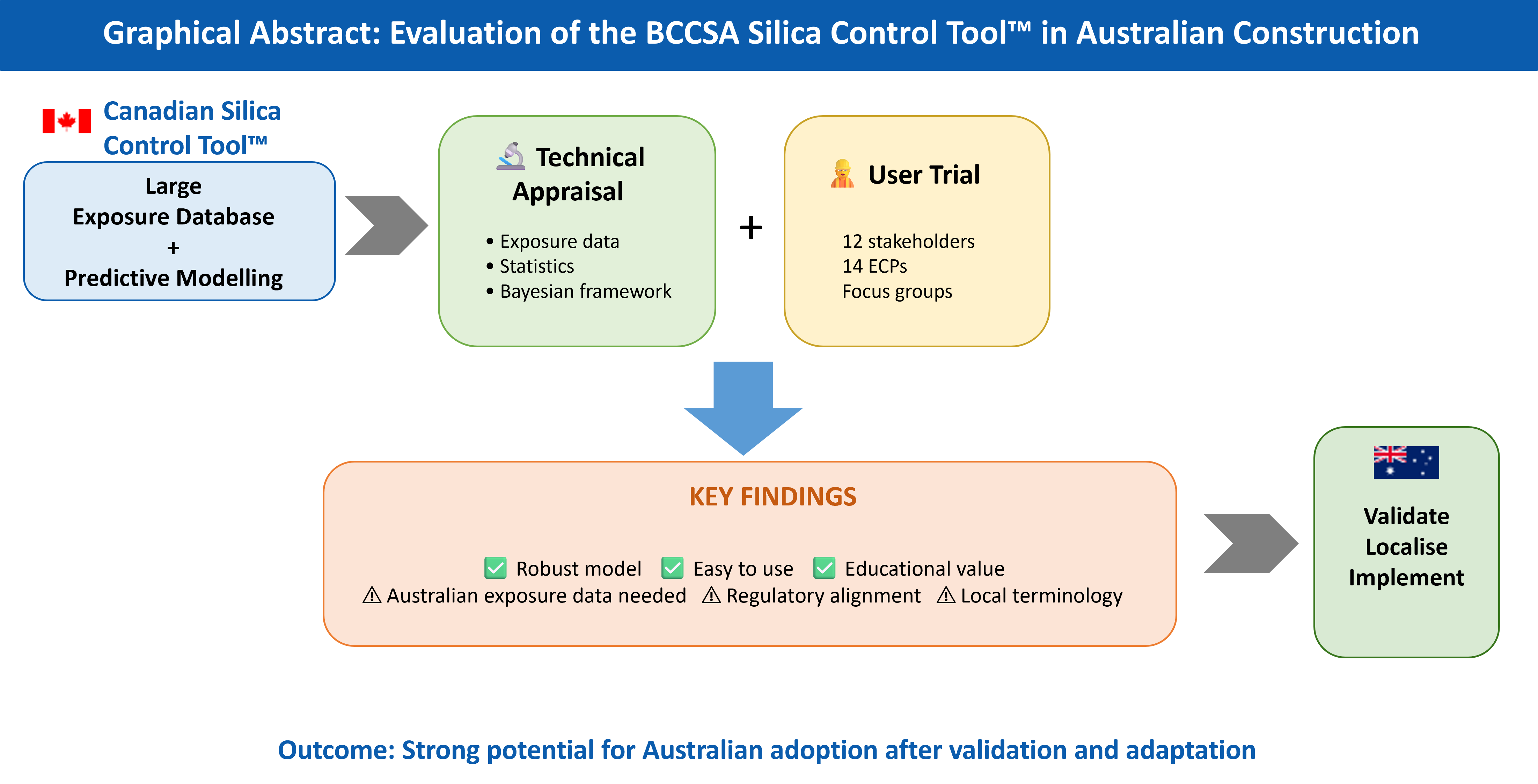
Background: Respirable crystalline silica (RCS) presents persistent health risks in construction, and predictive exposure models offer a potential complement to traditional monitoring. This study evaluated the applicability of the British Columbia Construction Safety Alliance (BCCSA) Silica Control ToolTM for use in the construction sector in Victoria, Australia. Methods: A two-phase evaluation was undertaken. First, a desktop interrogation of the Tool’s underpinning data, statistical model development and documented limitations was performed, including statistical review. Second, a user trial was conducted with 12 Victorian industry stakeholders who completed realistic task scenarios within the Tool and generated Exposure Control Plans (ECPs). Qualitative feedback was obtained through observation and focus group discussion. Results: The interrogation demonstrated that the Tool is built on a large, iteratively improved North American exposure database, with well developed and statistically sound modelling framework; however, its predictive validity has not yet been independently evaluated using Australian exposure data. Stakeholders produced 14 ECPs across diverse silica-generating tasks, showing that the Tool responded sensitively to changes in task parameters and control selections. Thematic analysis identified five key themes: usability, regulatory alignment, clarity of terminology, gaps in task representation, and adherence to the hierarchy of controls. Participants saw strong potential for the Tool but emphasised the need for Australian data integration, clearer definitions, enhanced usability, and localised terminology. Conclusions: The BCCSA Silica Control ToolTM demonstrates a technically robust North American modelling framework and strong stakeholder acceptability, but Australian-specific validation and adaptation are required before adoption in Victoria. Incorporating Australian exposure data, tailoring terminology and ensuring alignment with local legislation are critical next steps.
- Open Access
- Article
Evaluation of a Web-Based Silica Exposure Risk Assessment Tool in Construction: Data Appraisal and User Trial
- Sharyn Gaskin 1,*,
- Leonid Turczynowicz 1,
- Sarina Subedi 1,
- Chandnee Ramkissoon 1,
- Yonatal Tefera 1,2,
- Halil Ahmet 3
Author Information
Received: 14 May 2026 | Revised: 20 Jul 2026 | Accepted: 29 Jul 2026 | Published: 10 Sep 2026
Abstract
Graphical Abstract
Keywords
silica | exposure | predictive exposure modelling | construction | risk assessment
References
- 1.
Jacobs, N.F.; Zisook, E.; Tarpey, T.A. Reported exposures to respirable crystalline silica during construction tasks and guidance for harmonizing future research. J. Occup. Environ. Hyg. 2024, 21, 602–622.
- 2.
Mundt, K.A.; Thompson, W.J.; Dhawan, G.; et al. Systematic review of the epidemiological evidence of associations between quantified occupational exposure to respirable crystalline silica and the risk of silicosis and lung cancer. Front. Public Health 2025, 13, 1554006. https://doi.org/10.3389/fpubh.2025.1554006.
- 3.
Kalatehjari, R.; Rotimi, F.E.; Sachinthaka, R.; et al. Trends and Future Directions in Mitigating Silica Exposure in Construction: A Systematic Review. Buildings 2025, 15, 2924. https://doi.org/10.3390/buildings15162924.
- 4.
Safe Work Australia. Model Work Health and Safety Regulations (Crystalline Silica Substances) Amendment 2024. Available online: https://www.safeworkaustralia.gov.au/sites/default/files/2024-06/model_work_health_and_safety_regulations_crystalline_silica_substances_amendment_2024.pdf (accessed on 27 May 2025).
- 5.
Tefera, Y.; Cole, K.; Ramkissoon, C.; et al. Opening the policy window: How Australia banned engineered stone. Public Health Res. Pract. 2025, 35, 25031. https://doi.org/10.1071/PU25031.
- 6.
Tischer, M.; Lamb, J.; Hesse, S.; et al. Evaluation of Tier One Exposure Assessment Models (ETEAM): Project Overview and Methods. Ann. Work Expo. Health 2017, 61, 911–920.
- 7.
Wolfe, C.; Chubb, L.; Walker, R.; et al. Monitoring Worker Exposure to Respirable Crystalline Silica: Application for Data-driven Predictive Modeling for End-of-Shift Exposure Assessment. Ann Work Expo Health 2022, 11, 1010–1021. https://doi.org/10.1093/annweh/wxac040.
- 8.
Kalyva, M.E.; Vist, G.E.; Diemar, M.G.; et al. Accessible methods and tools to estimate chemical exposure in humans to support risk assessment: A systematic scoping review. Environ. Pollut. 2024, 352, 124109.
- 9.
Davies, H.; Gorman-Ng, M. Development of a Web-Based Tool for Risk Assessment and Exposure Control Planning of Silica-Producing Tasks in the Construction Sector. Front. Public Health 2020, 8, 1–10. https://doi.org/10.3389/fpubh.2020.00371.
- 10.
Gorman-Ng, M.; Li, A.M.; Lavoué, J.; et al. Determinants of respirable crystalline silica exposure in construction in western Canada. Ann. Work Expo. Health 2023, 67, 847–857.
- 11.
Park, H.; Hwang, E.; Yoon, C. Respirable crystalline silica exposure among concrete finishing workers at apartment complex construction sites. Aerosol Air Qual. Res. 2019, 19, 2804–2814.
- 12.
Sauvé, J.F.; Beaudry, C.; Bégin, D.; et al. Statistical modeling of crystalline silica exposure by trade in the construction industry using a database compiled from the literature. J. Environ. Monit. 2012, 14, 2512–2520. https://doi.org/10.1039/c2em30443k.
- 13.
Sauvé, J.F.; Beaudry, C.; Bégin, D.; et al. Silica Exposure During Construction Activities: Statistical Modeling of Task-Based Measurements from the Literature. Ann. Occup. Hygiene. May 2013, 57, 432–443. https://doi.org/10.1093/annhyg/mes089.
- 14.
Gorman-Ng, M.; Davies, H.W. Evaluating a Respirable Crystalline Silica Risk Assessment Model for the Construction Industry in Alberta. In School of Population and Public Health; University of British Columbia: Vancouver, BC, Canada, 2018.
- 15.
Davies, H.; Gorman-Ng, M.; Lavoue, J. Respirable Crystalline Silica in the Manitoba Construction Sector: Advancing Knowledge to Reduce Exposure. In Report for Research and Workplace Innovation Program of the Workers Compensation Board of Manitoba; Workers Compensation Board of Manitoba: Winnipeg, MB, Canada, 2021.
- 16.
Beaudry, C.; Lavoué, J.; Sauvé, J.F. Occupational exposure to silica in construction workers: A literature based exposure database. J. Occup. Environ. Hyg. 2013, 10, 71–77. https://doi.org/10.1080/15459624.2012.7473990.


This work is licensed under a Creative Commons Attribution 4.0 International License.
