
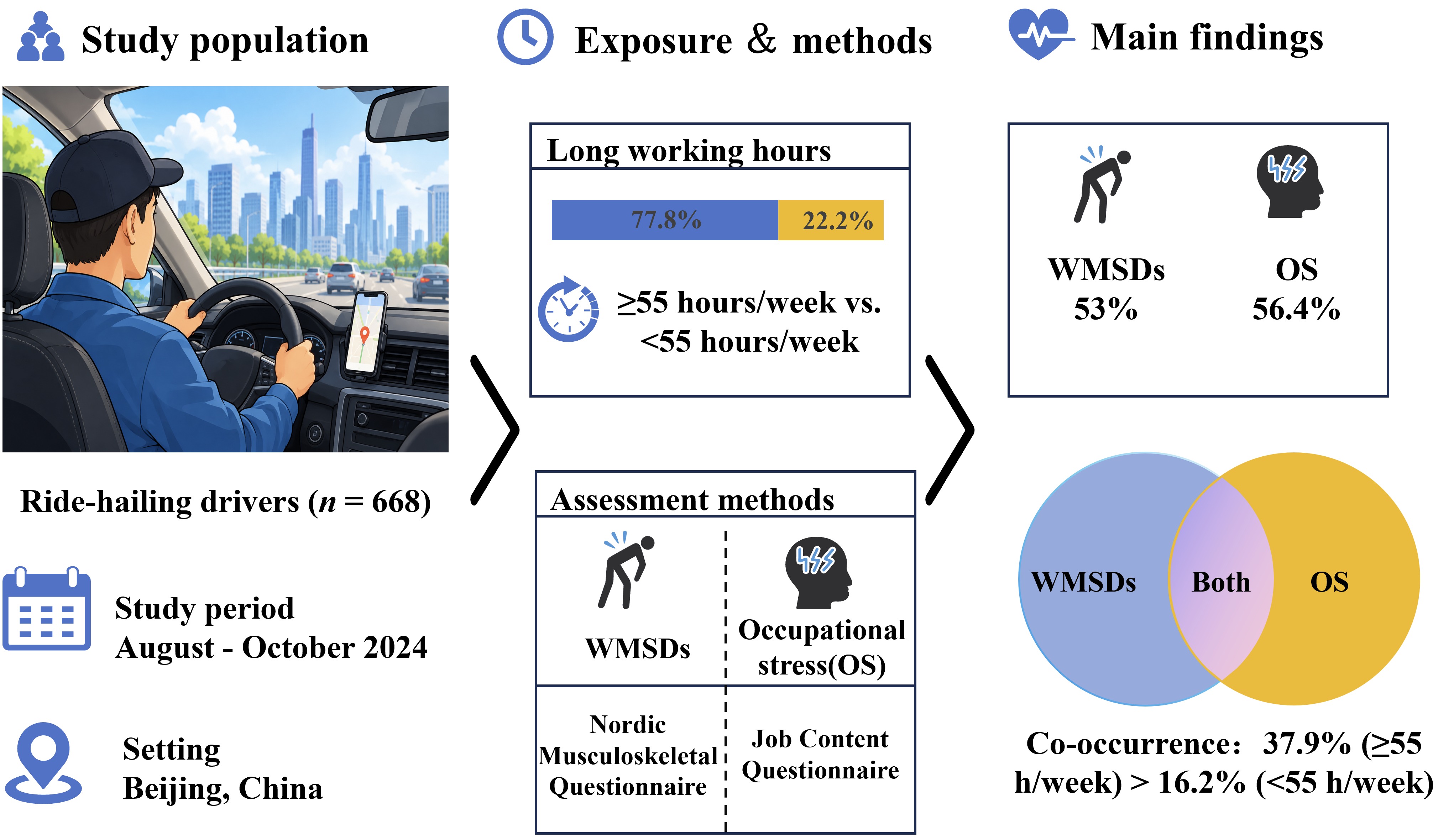
Long working hours may be associated with adverse health outcomes among ride-hailing drivers. The study aims to examine the associations between long working hours, work-related musculoskeletal disorders (WMSDs) and occupational stress. Additionally, it explores the association between long working hours and the co-occurrence of WMSDs and occupational stress. A cross-sectional survey was conducted among 668 ride-hailing drivers in Beijing, China, from August to October 2024. WMSDs were assessed using the Nordic Musculoskeletal Questionnaire (NMQ). Occupational stress was assessed using the Job Content Questionnaire (JCQ). In this study, co-occurrence was defined as the joint classification of WMSDs and occupational stress in the same individual. Participants were categorized into groups of <55 and ≥55 working hours per week. Binary and logistic regression models were used to examine the associations between weekly working hours and health outcomes. Overall, 77.8% of participants worked ≥55 h per week. The prevalence of WMSDs and occupational stress was 53.0% and 56.4%, respectively. Weekly working hours ≥55 h were significantly associated with higher odds of occupational stress after full adjustment (aOR = 3.99, 95% CI: 2.59–6.13), but were not significantly associated with WMSDs (aOR = 1.12, 95% CI: 0.74–1.70). Occupational stress was associated with higher odds of WMSDs (aOR = 1.56, 95% CI: 1.11–2.18). Compared with drivers working <55 h per week, those working ≥55 h per week had higher odds of having one condition (aOR = 1.95, 95% CI: 1.21–3.14) and co-occurrence of occupational stress and WMSDs (aOR = 4.64, 95% CI: 2.57–8.36). The prevalence of co-occurrence was 37.9% in the ≥55 h group and 16.2% in the <55 h group. Long working hours were associated with occupational stress and with the co-occurrence of occupational stress and WMSDs among ride-hailing drivers. However, no independent association was observed between long working hours and WMSDs. These findings highlight the need for comprehensive occupational health interventions targeting ride-hailing drivers.
- Open Access
- Article
Long Working Hours and the Co-Occurrence of Work-Related Musculoskeletal Symptoms and Occupational Stress among Ride-Hailing Drivers in Beijing, China
- Zhihui Wang 1,†,
- Binshuo Hu 1,†,
- Xin Song 1,
- Xiaoshun Wang 1,
- Rui Guan 2,
- Hong Yu 2,
- Siyuan Wang 3,
- Dongsheng Niu 1,
- Tenglong Yan 1,*,
- Xiaowen Ding 1,*
Author Information
Received: 22 May 2026 | Revised: 05 Sep 2026 | Accepted: 16 Sep 2026 | Published: 10 Oct 2026
Abstract
Graphical Abstract
Keywords
long working hours | work-related musculoskeletal disorders | occupational stress | co-occurrence | ride-hailing drivers
References
- 1.
Pega, F.; Náfrádi, B.; Momen, N.C.; et al. Global, regional, and national burdens of ischemic heart disease and stroke attributable to exposure to long working hours for 194 countries, 2000–2016: A systematic analysis from the WHO/ILO Joint Estimates of the Work-related Burden of Disease and Injury. Environ. Int. 2021, 154, 106595. https://doi.org/10.1016/j.envint.2021.106595.
- 2.
Wong, K.; Chan, A.H.S.; Ngan, S.C. The effect of long working hours and overtime on occupational health: A meta-analysis of evidence from 1998 to 2018. Int. J. Environ. Res. Public Health 2019, 16, 2102. https://doi.org/10.3390/ijerph16122102.
- 3.
Lopes, M.; Lages, M. Work-related musculoskeletal disorders: Prevalence and contributing risk factors—A narrative review. Explor. Musculoskelet. Dis. 2026, 4, 1007117. https://doi.org/10.37349/emd.2026.1007117.
- 4.
Sun, L.; Zhao, Y.; Ran, X. Ride-hailing drivers’ working conditions and social protection in China. J. Asian Public Policy 2026, 19, 140–155. https://doi.org/10.1080/17516234.2024.2352809.
- 5.
National Institute for Occupational Safety and Health (NIOSH). Musculoskeletal Health Program. Available online: https://www.cdc.gov/niosh/research-programs/portfolio/musculoskeletal.html (accessed on 10 August 2026).
- 6.
Tahernejad, S.; Makki, F.; Bameri, A.; et al. Musculoskeletal disorders among truck drivers: A systematic review and meta-analysis. BMC Public Health 2024, 24, 3146. https://doi.org/10.1186/s12889-024-20611-9.
- 7.
Joseph, L.; Standen, M.; Paungmali, A.; et al. Prevalence of musculoskeletal pain among professional drivers: A systematic review. J. Occup. Health 2020, 62, e12150. https://doi.org/10.1002/1348-9585.12150.
- 8.
Lee, P.; Xia, T.; Zomer, E.; et al. Exploring the health and economic burden among truck drivers in Australia: A health economic modelling study. J. Occup. Rehabil. 2023, 33, 389–398. https://doi.org/10.1007/s10926-022-10081-4.
- 9.
European Commission Work-Related Stress Prevention. Available online: https://knowledge4policy.ec.europa.eu/health-promotion-knowledge-gateway/work-related-stress_en (accessed on 10 August 2026).
- 10.
Wang, W.; Ren, H.; Tian, Q.; et al. Effects of occupational stress on blood lipids, blood sugar and immune function of doctors. Iran. J. Public Health 2019, 48, 825–833. https://doi.org/10.18502/ijph.v48i5.1798.
- 11.
Matilla-Santander, N.; Lundh, F.; Kvart, S.; et al. What is known about the health of location-based and online web-based digital labour platform workers? A scoping review of the literature. BMC Public Health 2025, 25, 2635. https://doi.org/10.1186/s12889-025-23916-5.
- 12.
Vignola, E.F.; Baron, S.; Abreu Plasencia, E.; et al. Workers’ health under algorithmic management: Emerging findings and urgent research questions. Int. J. Environ. Res. Public Health 2023, 20, 1239. https://doi.org/10.3390/ijerph20021239.
- 13.
Zhou, M.; Yin, J.; Tang, Y.; et al. What drives the drivers away? An empirical study on the factors influencing the turnover intention of full-time online ride-hailing drivers in China. Transp. Res. Part A Policy Pract. 2024, 186, 104134. https://doi.org/10.1016/j.tra.2024.104134.
- 14.
Margerison, C.E.; Joachim, G.E.; Michling, T.R.; et al. Platform-Mediated Gig Work and Health: A Scoping Review. Am. J. Ind. Med. 2025, 68, 729–739. https://doi.org/10.1002/ajim.70007.
- 15.
Ganpule-Rao, A.V.; Bhat, D.; Yajnik, C.S.; et al. Dietary diversity scores, nutrient intakes and biomarkers vitamin B12, folate and Hb in rural youth from the Pune Maternal Nutrition Study. Br. J. Nutr. 2021, 126, 236–243. https://doi.org/10.1017/s0007114520004018.
- 16.
Wang, Z.; Chen, Y.; Tang, S.; et al. Dietary diversity and nutrient intake of Han and Dongxiang smallholder farmers in poverty areas of Northwest China. Nutrients 2021, 13, 3908. https://doi.org/10.3390/nu13113908.
- 17.
World Health Organization and International Labour Organization. WHO/ILO Joint Estimates of the Work-Related Burden of Disease and Injury, 2000–2016: Global Monitoring Report; World Health Organization and International Labour Organization: Geneva, Switzerland, 2021.
- 18.
Hu, B.; Wu, Y.; Pan, Y.; et al. Association of long working hours and multi-site work-related musculoskeletal disorders among transportation industry workers in Beijing, China. Int. Arch. Occup. Environ. Health 2024, 97, 1063–1071. https://doi.org/10.1007/s00420-024-02110-x.
- 19.
Kuorinka, I.; Jonsson, B.; Kilbom, A.; et al. Standardised Nordic questionnaires for the analysis of musculoskeletal symptoms. Appl. Ergon. 1987, 18, 233–237. https://doi.org/10.1016/0003-6870(87)90010-x.
- 20.
Fang, Y.; Li, S.; Zhang, Y.; et al. Test-retest reliability of Nordic Musculoskeletal Questionnaire in nurses. Zhonghua Lao Dong Wei Sheng Zhi Ye Bing Za Zhi 2013, 31, 753–758.
- 21.
Sauter, S.; Swanson, N.; Waters, T.; et al. Musculoskeletal discomfort surveys used at NIOSH. In Handbook of Human Factors and Ergonomics Methods; Stanton, N.A., Hedge, A., Brookhuis, K., et al., Eds.; CRC Press: Boca Raton, FL, USA, 2004; pp. 27–38. https://doi.org/10.1201/9780203489925.ch4.
- 22.
Karasek, R.; Brisson, C.; Kawakami, N.; et al. The Job Content Questionnaire (JCQ): An instrument for internationally comparative assessments of psychosocial job characteristics. J. Occup. Health Psychol. 1998, 3, 322–355. https://doi.org/10.1037/1076-8998.3.4.322.
- 23.
Li, J.; Yang, W.; Liu, P.; et al. Psychometric Evaluation of the Chinese (Mainland) Version of Job Content Questionnaire: A Study in University Hospitals. Ind. Health 2004, 42, 260–267. https://doi.org/10.2486/indhealth.42.260.
- 24.
VanderWeele, T.J. Principles of confounder selection. Eur. J. Epidemiol. 2019, 34, 211–219. https://doi.org/10.1007/s10654-019-00494-6.
- 25.
Sonnentag, S.; Fritz, C. Recovery from job stress: The stressor-detachment model as an integrative framework. J. Organ. Behav. 2015, 36, S72–S103. https://doi.org/10.1002/job.1924.
- 26.
Karasek, R.A. Job demands, job decision latitude, and mental strain: Implications for job redesign. Adm. Sci. Q. 1979, 24, 285–308. https://doi.org/10.2307/2392498.
- 27.
Ma, X. Impact of long working hours on mental health: Evidence from China. Int. J. Environ. Res. Public Health 2023, 20, 1641. https://doi.org/10.3390/ijerph20021641.
- 28.
Ochiai, Y.; Takahashi, M.; Matsuo, T.; et al. Characteristics of long working hours and subsequent psychological and physical responses: JNIOSH cohort study. Occup. Environ. Med. 2023, 80, 304–311. https://doi.org/10.1136/oemed-2022-108672.
- 29.
Yin, C.; Ji, J.; Cao, X.; et al. Impact of long working hours on depressive symptoms among COVID-19 frontline medical staff: The mediation of job burnout and the moderation of family and organizational support. Front. Psychol. 2023, 14, 1084329. https://doi.org/10.3389/fpsyg.2023.1084329.
- 30.
Zadow, A.J.; Dollard, M.F.; Dormann, C.; et al. Predicting new major depression symptoms from long working hours, psychosocial safety climate and work engagement: A population-based cohort study. BMJ Open 2021, 11, e044133. https://doi.org/10.1136/bmjopen-2020-044133.
- 31.
Shockey, T.; Alterman, T.; Yang, H.; et al. Workplace Psychosocial Factors, Work Organization, and Physical Exertion as Risk Factors for Low Back Pain Among US Workers: Data from the 2015 National Health Interview Survey. J. Occup. Environ. Med. 2024, 66, 467–474. https://doi.org/10.1097/jom.0000000000003087.
- 32.
Bezzina, A.; Austin, E.; Nguyen, H.; et al. Workplace psychosocial factors and their association with musculoskeletal disorders: A systematic review of longitudinal studies. Workplace Health Saf. 2023, 71, 578–588. https://doi.org/10.1177/21650799231193578.
- 33.
Badarin, K.; Mangot-Sala, L.; Matilla Santander, N.; et al. Precarious employment, strenuous working conditions and the long-term risk of diagnosed chronic musculoskeletal disorders. Occup. Environ. Med. 2024, 81, 595–602. https://doi.org/10.1136/oemed-2024-109867.
- 34.
Park, S.; Lee, J.H. Precarious employment and increased incidence of musculoskeletal pain among wage workers in Korea: A cross-sectional study. Int. J. Environ. Res. Public Health 2021, 18, 6299. https://doi.org/10.3390/ijerph18126299.


This work is licensed under a Creative Commons Attribution 4.0 International License.

 Suite 4002 Level 4, 447 Collins Street, Melbourne, Victoria 3000, Australia
 General Inquiries: info@sciltp.com