
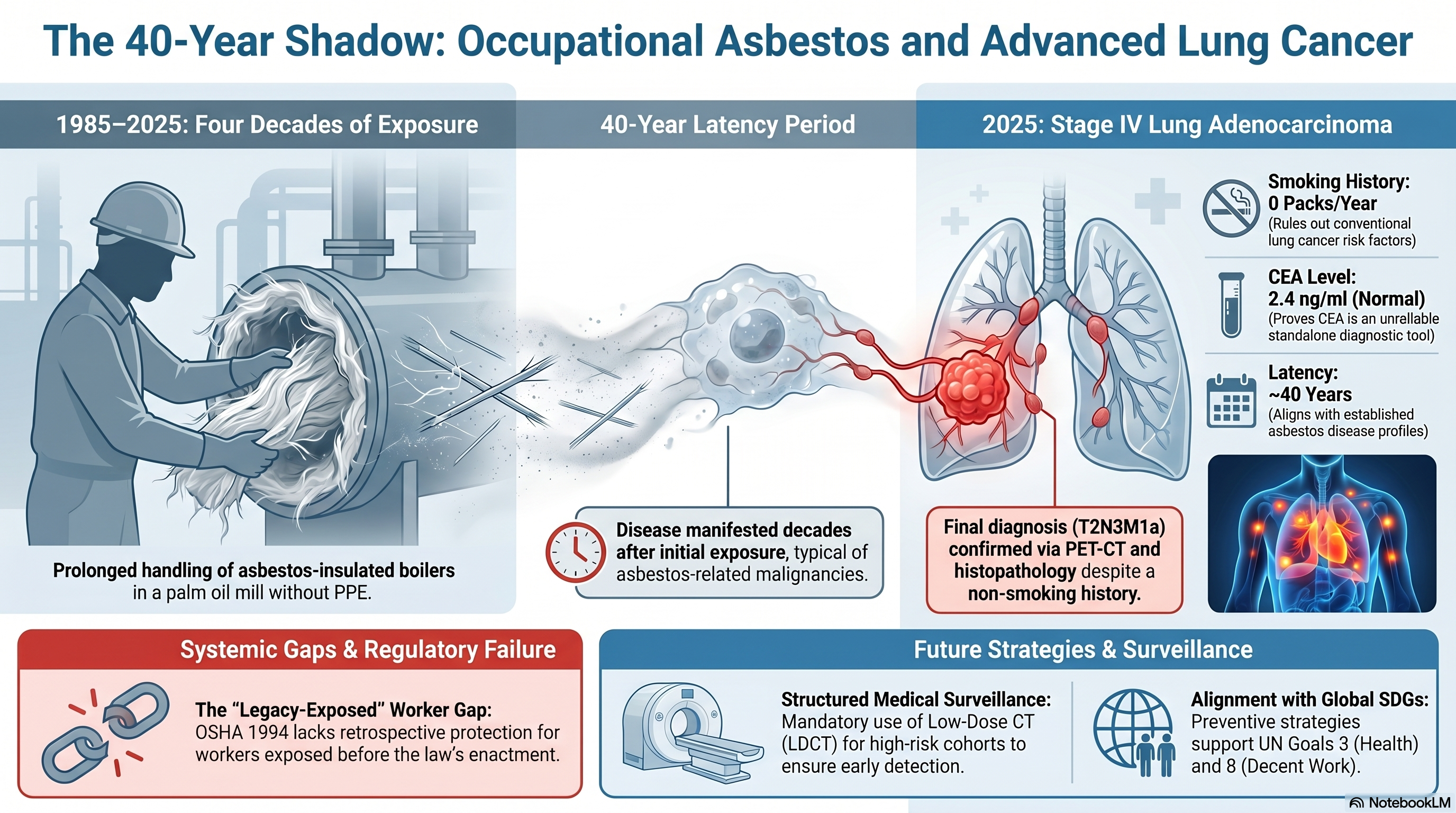
Asbestos exposure remains a significant occupational health hazard, particularly in developing countries where its use persists in industrial applications. This case report describes a 61-year-old lifelong non-smoker diagnosed with advanced lung adenocarcinoma (T2N3M1a, Stage IV) with a substantial history of occupational etiology. The patient presented with persistent hoarseness initially misdiagnosed as upper respiratory tract infection, leading to delayed definitive evaluation. A detailed occupational history revealed approximately four decades of cumulative exposure to asbestos during roles involving boiler maintenance and insulation handling in a palm oil mill. Notably, early employment years lacked essential safety measures, including personal protective equipment, engineering controls, and exposure monitoring. Radiological investigations, including contrast-enhanced computed tomography and PET-CT, confirmed metastatic disease, while histopathology established lung adenocarcinoma. Despite advanced malignancy, carcinoembryonic antigen (CEA) levels were not elevated, highlighting the recognized limitations of CEA as a standalone biomarker. Potential mechanisms reported in the literature include tumor heterogeneity and variation in CEACAM5 expression; however, these mechanisms were not evaluated in this patient and therefore remain speculative in the context of this case. Critically, this case illustrates systemic gaps in occupational health governance. The patient’s exposure began prior to the implementation of Malaysia’s Occupational Safety and Health Act 1994 and continued under suboptimal enforcement conditions, reflecting limitations in regulatory oversight and the absence of retrospective protection for legacy-exposed workers. The lack of structured medical surveillance further contributed to delayed detection of malignancy. This case emphasizes the need for strengthened enforcement, establishment of exposure registries, and implementation of long-term surveillance programs for high-risk occupational cohorts. It also highlights the importance of integrating occupational history into routine clinical assessment. Aligning with Sustainable Development Goals 3, 8, and 12, this report advocates for a shift towards preventive occupational health strategies to reduce the burden of asbestos-related diseases and improve worker safety globally.
- Open Access
- Case Report
Legacy Exposure and Regulatory Gaps: Advanced Lung Adenocarcinoma in a Lifelong Non-Smoker following Prolonged Occupational Asbestos Exposure
- Anantha Kumar Rajendran 1,*,†,
- Roszita Binti Ibrahim 1,*,†,
- Azimatun Noor Aizuddin 1,
- Rama Krishna Supramanian 2,
- Menaka Dharshinii Selvaraj 3,† and
- Izzul Haziq Bin Zahba 4
Author Information
Received: 17 June 2026 | Revised: 05 October 2026 | Accepted: 19 October 2026 | Published: 03 November 2026
Abstract
Graphical Abstract
Keywords
asbestos | lung neoplasms | occupational exposure | adenocarcinoma of lung | carcinoembryonic antigen
References
- 1.
Department of Occupational Safety and Health. Guidelines on Medical Surveillance Programme at the Workplace, 2nd ed.; Department of Occupational Safety and Health, Ministry of Human Resources: Putrajaya, Malaysia, 2023; Vol. 2.
- 2.
Indriyati, L.H.; Eitoku, M.; Awn, N.J.P.; et al. Significant risk of developing asbestos-related diseases in Japan’s industries: An analysis of workers’ compensation. AIMS Public Health 2025, 12, 1055–1068. https://doi.org/10.3934/publichealth.2025053.
- 3.
Van Orden, D.R. Asbestos. In Environmental Forensics: Contaminant Specific Guide; Morrison, R.D., Murphy, B.L., Eds.; Elsevier: Burlington, MA, USA, 2006; pp. 19–33. https://doi.org/10.1016/b978-012507751-4/50024-0.
- 4.
International Agency for Research on Cancer. Agents Classified by the IARC Monographs. Available online: https://monographs.iarc.who.int/agents-classified-by-the-iarc/ (accessed on 10 September 2026).
- 5.
Zen, I.S.; Ahamad, R.; Rampal, K.G.; et al. Use of asbestos building materials in Malaysia: Legislative measures, the management, and recommendations for a ban on use. Int. J. Occup. Environ. Health 2013, 19, 169–178. https://doi.org/10.1179/2049396713y.0000000028.
- 6.
Department of Occupational Safety and Health. Occupational Disease and Injury. Available online: https://dosh.gov.my/my/dashboard/statistik-kecederaan-dan-penyakit/ (accessed on 10 September 2026).
- 7.
Mohamad, N.; Rajendiran, S.; Khairul Hasni, N.A.; et al. Feasibility of acquiring occupational data from cancer patients’ medical records in Malaysian oncology centres. BMC Public Health 2025, 25, 3027. https://doi.org/10.1186/s12889-025-24284-w.
- 8.
Department of Occupational Safety and Health. A Manual of Recommended Practice on Assessment of the Health Risk from the Use of Chemicals Hazardous to Health at Workplace, 3rd ed.; Department of Occupational Safety and Health, Ministry of Human Resources: Putrajaya, Malaysia, 2018.
- 9.
Yon, H. The Compliance Status of Chemical Management among Industries in Malaysia: The USECHH after 20 years. J. Energy Saf. Technol. 2022, 5, 7–20. https://doi.org/10.11113/jest.v5n1.99.
- 10.
Wolff, H.; Vehmas, T.; Oksa, P.; et al. Asbestos, asbestosis, and cancer, the Helsinki criteria for diagnosis and attribution 2014: Recommendations. Scand. J. Work. Environ. Health 2015, 41, 5–15. https://doi.org/10.5271/sjweh.3462.
- 11.
Collegium Ramazzini. Comments on the 2014 helsinki consensus report on asbestos. J. Occup. Health 2016, 58, 224–227. https://doi.org/10.1539/joh.16-2004-lt.
- 12.
SPI Supplies Division. Safety Data Sheet: Asbestos, Chrysotile; SPI Supplies Division: West Chester, PA, USA, 2016.
- 13.
National Institute for Occupational Safety and Health. NIOSH Manual of Analytical Methods (NMAM), 5th ed.; National Institute for Occupational Safety and Health: Cincinnati, OH, USA, 2020.
- 14.
Chong, S.L.; Ahmad Asnawi, A.W.; Law, K.B.; et al. Reference Intervals in Malaysia: A Performance Evaluation and Comparison of Haematological Parameters between Sysmex XE-5000 and XN-3000. Int. J. Blood Res. Disord. 2021, 8, 072. https://doi.org/10.23937/2469-5696/1410072.
- 15.
Roshan, T.M.; Rosline, H.; Ahmed, S.A.; et al. Hematological reference values of healthy Malaysian population. Int. J. Lab. Hematol. 2009, 31, 505–512. https://doi.org/10.1111/j.1751-553x.2008.01068.x.
- 16.
Abd Halim, N.H.A. Pathology Services Handbook, 9th ed.; Hospital Sungai Buloh, Ministry of Health Malaysia: Sungai Buloh, Malaysia, 2025.
- 17.
Dilek, O.N.; Arslan Kahraman, D.İ.; Kahraman, G. Carcinoembryonic antigen in the diagnosis, treatment, and follow-up of focal liver lesions. World J. Gastrointest. Surg. 2024, 16, 999–1007. https://doi.org/10.4240/wjgs.v16.i4.999.
- 18.
Ali, S.; Zehra, A.; Khalid, M.U.; et al. Role of C-reactive protein in disease progression, diagnosis and management. Discoveries 2023, 11, e179. https://doi.org/10.15190/d.2023.18.
- 19.
Ghosh, I.; Bhattacharjee, D.; Das, A.K.; et al. Diagnostic Role of Tumour Markers CEA, CA15-3, CA19-9 and CA125 in Lung Cancer. Indian J. Clin. Biochem. 2013, 28, 24–29. https://doi.org/10.1007/s12291-012-0257-0.
- 20.
Ko, Y.K.; Liu, Y.T.; Tai, C.Y.; et al. Beyond Carcinoembryonic Antigens: The Role of CA-125 and CA-199 in Predicting Prognosis of Lung Adenocarcinoma. Cancers 2025, 17, 1517. https://doi.org/10.3390/cancers17091517.
- 21.
Braun, M.; Sołek, J.; Stępień, G.J.; et al. TTF-1 and p40 co-expression defines a distinct subtype of non-small cell lung cancer with frequent TP53 mutations and FGFR pathway dysregulation. Transl. Lung Cancer Res. 2025, 14, 3988–4001. https://doi.org/10.21037/tlcr-2025-690.
- 22.
Marchetti, A.; Di Lorito, A.; Pace, M.V.; et al. ALK Protein Analysis by IHC Staining after Recent Regulatory Changes: A Comparison of Two Widely Used Approaches, Revision of the Literature, and a New Testing Algorithm. J. Thorac. Oncol. 2016, 11, 487–495. https://doi.org/10.1016/j.jtho.2015.12.111.
- 23.
Lei, Y.; Lei, Y.; Shi, X.; et al. EML4‑ALK fusion gene in non‑small cell lung cancer (Review). Oncol. Lett. 2022, 24, 277. https://doi.org/10.3892/ol.2022.13397.
- 24.
Kim, H.; Kwon, H.J.; Park, S.Y.; et al. PD-L1 immunohistochemical assays for assessment of therapeutic strategies involving immune checkpoint inhibitors in non-small cell lung cancer: A comparative study. Oncotarget 2017, 8, 98524–98532. https://doi.org/10.18632/oncotarget.21567.
- 25.
Fu, F.; Deng, C.; Sun, W.; et al. Distribution and concordance of PD-L1 expression by routine 22C3 assays in East-Asian patients with non-small cell lung cancer. Respir. Res. 2022, 23, 302. https://doi.org/10.1186/s12931-022-02201-8.
- 26.
Zhong, W.; Zhang, W.; Dai, L.; et al. The clinical, radiological, postoperative pathological, and genetic features of nodular lung adenocarcinoma: A real-world single-center data. J. Thorac. Dis. 2024, 16, 3228–3250. https://doi.org/10.21037/jtd-24-510.
- 27.
Sakao, Y.; Kuroda, H.; Saito, Y.; et al. Radiological imaging and pathological findings of small lung adenocarcinoma: A narrative review. J. Thorac. Dis. 2021, 13, 366–371. https://doi.org/10.21037/jtd-20-844.
- 28.
Kuo, Y.S.; Zheng, M.Y.; Shieh, Y.S.; et al. Prognostic and Monitoring Utility of Serum CEA in Lung Adenocarcinoma: Differential Roles in EGFR-TKI and Chemotherapy Treatments. Cancer Med. 2025, 14, e71170. https://doi.org/10.1002/cam4.71170. Correction in: Cancer Med. 2025, 15, e71830. https://doi.org/10.1002/cam4.71830.
- 29.
Kankanala, V.L.; Zubair, M.; Mukkamalla, S.K.R. Carcinoembryonic antigen. In StatPearls [Internet]; StatPearls Publishing: Treasure Island, FL, USA, 2024.
- 30.
Nasni Naseri, R.N.; Mohd Esa, M. A Review on Occupational Safety and Health in Malaysia. Int. J. Res. Innov. Soc. Sci. 2025, 9, 4289–4294. https://doi.org/10.47772/ijriss.2025.90300342.
- 31.
Koh, P.B.; Abas, N.H.; Deraman, R. Investigation on the Compliance of Occupational Safety and Health (OSH) Legislations among Contractors and Potential Interventions to Improve Construction Safety Performance. Int. J. Sustain. Constr. Eng. Technol. 2022, 13, 293–299. https://doi.org/10.30880/ijscet.2022.13.02.026.
- 32.
Abidin, Z. Accuppational Safety and Health Management System for Zero Accidents in Palm Oil Plantation Companies In West Borneo. J. Soc. Sci. 2024, 2, 1154–1173. https://doi.org/10.57185/joss.v2i12.261.
- 33.
Rajendran, A.K.; Yin, L.F.; Ibrahim, R.B.; et al. From Incident to Insight: Impact of a Modular Re-Training Approach in a Histopathology Laboratory of a Category I Hospital in Kuching, Sarawak, Malaysia †. Work. Health 2026, 2, 13. https://doi.org/10.53941/wah.2026.100013.
- 34.
Tham, Z.K.; Hassim, M.H. Influencing factors of occupational injury in the construction industry: Evaluating the effectiveness of new OSHA 2022 amendments. J. Energy Saf. Technol. 2025, 8, 57–74.
- 35.
Khairul Anwar, M.S. Amendment to Occupational Safety and Health Act (OSHA): Relevant Changes. Legal Memorandum, SSRN 2023, preprint. https://doi.org/10.2139/ssrn.4497209.
- 36.
Ibrahim, N.A.; Mohd Roze, A. Legal Duties and Moral Responsibilities in Occupational Safety and Health: A Framework for High-Risk Industrial Sectors; Universiti Teknologi MARA: Shah Alam, Malaysia, 2026.
- 37.
Madia, F.; Worth, A.; Whelan, M.; et al. Carcinogenicity assessment: Addressing the challenges of cancer and chemicals in the environment. Environ. Int. 2019, 128, 417–429. https://doi.org/10.1016/j.envint.2019.04.067.
- 38.
Espina, C.; Ritchie, D.; Riboli, E.; et al. European Code Against Cancer 5th edition: 14 ways you can help prevent cancer. Lancet Reg. Health Eur. 2026, 63, 101592. https://doi.org/10.1016/j.lanepe.2026.101592.
- 39.
Soleimani, M.; Ghazisaeedi, M.; Ayyoubzadeh, S.M.; et al. A systematic review and comparative evaluation to develop and validate a comprehensive framework for cancer surveillance systems. Arch. Public Health 2025, 83, 99. https://doi.org/10.1186/s13690-025-01584-6.
- 40.
Lancaster, H.L.; Heuvelmans, M.A.; Oudkerk, M. Low-dose computed tomography lung cancer screening: Clinical evidence and implementation research. J. Intern. Med. 2022, 292, 68–80. https://doi.org/10.1111/joim.13480.
- 41.
Markowitz, S.B. Lung Cancer Screening in Asbestos-Exposed Populations. Int. J. Environ. Res. Public Health 2022, 19, 2688. https://doi.org/10.3390/ijerph19052688.
- 42.
Brims, F.J.H.; Harris, E.J.A.; Murray, C.; et al. Lung cancer screening an asbestos exposed population: Existing lung cancer risk criteria are not sufficient. Respirology 2023, 28, 543–550. https://doi.org/10.1111/resp.14487.
- 43.
Qoronfleh, M.W.; Al-Dewik, N. Cancer Biomarkers: Reflection on Recent Progress, Emerging Innovations, and the Clinical Horizon. Cancers 2025, 17, 2981. https://doi.org/10.3390/cancers17182981.
- 44.
Das, S.; Dey, M.K.; Devireddy, R.; et al. Biomarkers in Cancer Detection, Diagnosis, and Prognosis. Sensors 2024, 24, 37. https://doi.org/10.3390/s24010037.
- 45.
Rodrigo, J.P.; de Lima-Souza, R.A.; López, F.; et al. Biomarkers for Predicting Malignant Transformation of Premalignant Lesions of the Larynx: A Systematic Review. Diagnostics 2026, 16, 236. https://doi.org/10.3390/diagnostics16020236.
- 46.
de la Pava-Cortés, C.; Peña Torres, E.; Driscoll, T.; et al. Surveillance of Non-Malignant Asbestos-Related Diseases in an Exposed Population: A Scoping Review. Ann. Glob. Health 2026, 92, 19. https://doi.org/10.5334/aogh.4983.
- 47.
Chellini, E.; Battisti, F.; Cristaudo, A.; et al. Health surveillance for former asbestos exposed worker: A specific programme developed in an Italian region. J. Thorac. Dis. 2018, 10, S383–S389. https://doi.org/10.21037/jtd.2017.10.84.
- 48.
Malaysian Medical Council. Code of Professional Conduct 2019. Available online: https://mmc.gov.my/wp-content/uploads/2022/04/Code-of-Professional-Conduct-2019.pdf (accessed on 10 September 2026).
- 49.
Koné Pefoyo, A.J.; Genesove, L.; Moore, K.; et al. Exploring the Usefulness of Occupational Exposure Registries for Surveillance. J. Occup. Environ. Med. 2014, 56, 1100–1110. https://doi.org/10.1097/jom.0000000000000235.
- 50.
United Nations. The 17 Sustainable Development Goals. Available online: https://sdgs.un.org/goals (accessed on 10 September 2026).


This work is licensed under a Creative Commons Attribution 4.0 International License.
