
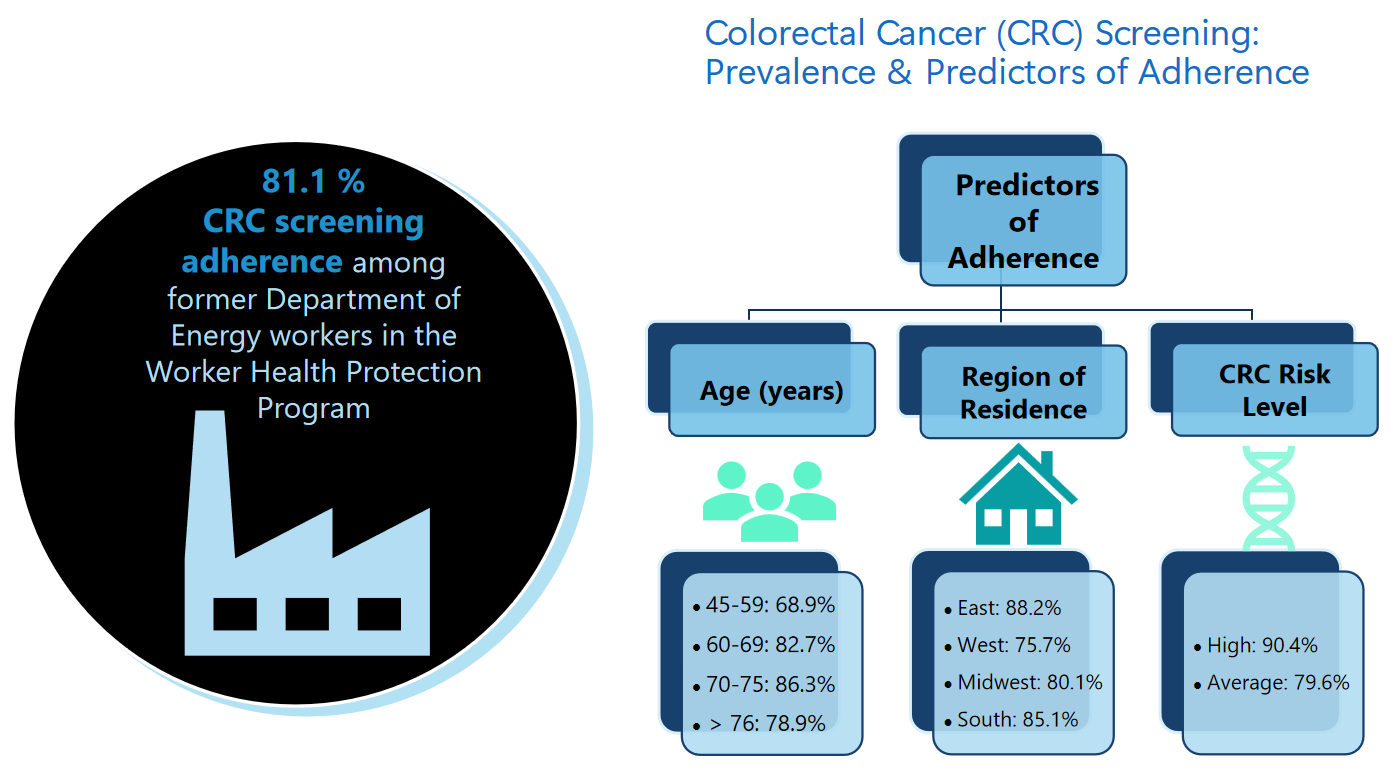
Objective: To assess colorectal cancer screening (CRC) practices in Department of Energy (DOE) workers enrolled in an occupational medical screening program. Methods: A telephone survey adapted from Behavioral Risk Factor Surveillance System 2020 questionnaire, addressing CRC screening history and CRC high risk conditions, was administered to participants aged 45–85 years, over 4 months in 2023. CRC screening adherence was reported as frequencies and percentages, and predictors of adherence as adjusted odds ratios (AOR) with 95% confidence intervals (CI), using multivariable logistic regression. Results: Overall, 823 (81%) of 1015 respondents reported a CRC screening history adherent to United States Preventive Service Task Force (USPSTF) guidelines. Age [45–59 years: AOR: 0.3 (0.2, 0.6), 60–69 years: AOR: 0.8 (0.5, 1.3), >75 years: AOR: 0.5 (0.3, 0.9) vs. 70–75 years], being high-risk for CRC [AOR: 2.6 (1.4, 5.0)], and geographic region of residence [South AOR: 2.0 (1.3, 2.9), Midwest AOR: 1.3 (0.8, 2.2), and East AOR: 3.3 (0.4, 26.4) vs. West] were associated with adherence to USPSTF CRC screening guidelines. Conclusion: Lower adherence to CRC screening recommendations among younger workers who are experiencing an increasing incidence in CRC offers occupational medicine programs an excellent opportunity to encourage CRC screening adherence among younger workers and thereby decrease the morbidity associated with colorectal cancer.
- Open Access
- Article
Colorectal Cancer Screening: Prevalence and Predictors of Adherence in Department of Energy Workers
Author Information
Received: 03 June 2026 | Revised: 15 October 2026 | Accepted: 19 October 2026 | Published: 06 November 2026
Abstract
Graphical Abstract
References
- 1.
World Health Organization. Colorectal Cancer. Key Facts. 2026. Available online: https://www.who.int/news-room/fact-sheets/detail/colorectal-cancer (accessed on 1 May 2026).
- 2.
NCI. Surveillance, Epidemiology, and End Results Program. Cancer Stat Facts: Common Cancer Sites. 2025. Available online: https://seer.cancer.gov/ (accessed on 1 May 2026).
- 3.
American Cancer Society. Colorectal Cancer Facts & Figures 2023-2025; American Cancer Society: Atlanta, GA, USA, 2023.
- 4.
Star, J.; Siegel, R.L.; Minihan, A.K.; et al. Colorectal cancer screening test exposure patterns in US adults 45 to 49 years of age, 2019–2021. J. Natl. Cancer Inst. 2024, 116, 613–617. https://doi.org/10.1093/jnci/djae003.
- 5.
Stoffel, E.M.; Murphy, C.C. Epidemiology and Mechanisms of the Increasing Incidence of Colon and Rectal Cancers in Young Adults. Gastroenterology 2020, 158, 341–353. https://doi.org/10.1053/j.gastro.2019.07.055.
- 6.
Sung, H.; Siegel, R.L.; Laversanne, M.; et al. Colorectal cancer incidence trends in younger versus older adults: An analysis of population-based cancer registry data. Lancet Oncol. 2025, 26, 51–63. https://doi.org/10.1016/s1470-2045(24)00600-4.
- 7.
Siegel, R.L.; Wagle, N.S.; Cercek, A.; et al. Colorectal cancer statistics, 2023. CA Cancer J. Clin. 2023, 73, 233–254. https://doi.org/10.3322/caac.21772.
- 8.
U.S. Bureau of Labor Statistics. Civilian Labor Force Participation Rate by Age, Sex, Race, and Ethnicity. 2025. Available online: https://www.bls.gov/emp/tables/civilian-labor-force-participation-rate.htm#:~:text=Table_title:%20Civilian%20labor%20force%20participation%20rate%20by,82.8%20%7C%20Participation%20rate%2C%202024:%2083.6%20%7C (accessed on 1 May 2026).
- 9.
U.S. Preventive Services Task Force. Screening for Colorectal Cancer: US Preventive Services Task Force Recommendation Statement. JAMA 2021, 325, 1965–1977. https://doi.org/10.1001/jama.2021.6238. Correction in JAMA 2021, 326, 773.
- 10.
Joseph, D.A.; King, J.B.; Dowling, N.F.; et al. Vital Signs: Colorectal Cancer Screening Test Use—United States, 2018. Morb. Mortal. Wkly. Rep. 2020, 69, 253–259. https://doi.org/10.15585/mmwr.mm6910a1.
- 11.
Santiago-Rodriguez, E.J.; Shariff-Marco, S.; Gomez, S.L.; et al. Disparities in Colorectal Cancer Screening by Time in the U.S. and Race/Ethnicity, 2010–2018. Am. J. Prev. Med. 2023, 65, 74–82. https://doi.org/10.1016/j.amepre.2023.01.033.
- 12.
Rollet, Q.; Tron, L.; De Mil, R.; et al. Contextual factors associated with cancer screening uptake: A systematic review of observational studies. Prev. Med. 2021, 150, 106692. https://doi.org/10.1016/j.ypmed.2021.106692.
- 13.
Anderson, A.E.; Henry, K.A.; Samadder, N.J.; et al. Rural vs Urban Residence Affects Risk-Appropriate Colorectal Cancer Screening. Clin. Gastroenterol. Hepatol. 2013, 11, 526–533. https://doi.org/10.1016/j.cgh.2012.11.025.
- 14.
Koehoorn, M.; McLeod, C.B.; Fan, J.; et al. Occupational asbestos exposure and gastrointestinal cancers: Systematic review and meta-analyses. Occup. Environ. Med. 2024, 81, 639–646. https://doi.org/10.1136/oemed-2024-109707.
- 15.
O’Sullivan, D.E.; Sutherland, R.L.; Town, S.; et al. Risk Factors for Early-Onset Colorectal Cancer: A Systematic Review and Meta-analysis. Clin. Gastroenterol. Hepatol. 2022, 20, 1229–1240.e5. https://doi.org/10.1016/j.cgh.2021.01.037.
- 16.
Oddone, E.; Modonesi, C.; Gatta, G. Occupational exposures and colorectal cancers: A quantitative overview of epidemiological evidence. World J. Gastroenterol. 2014, 20, 12431–12444. https://doi.org/10.3748/wjg.v20.i35.12431.
- 17.
Pukkala, E.; Martinsen, J.I.; Lynge, E.; et al. Occupation and cancer—Follow-up of 15 million people in five Nordic countries. Acta Oncol. 2009, 48, 646–790. https://doi.org/10.1080/02841860902913546.
- 18.
Ringen, K.; Dement, J.; Cloeren, M.; et al. Mortality of older construction and craft workers employed at Department of Energy (DOE) nuclear sites: Follow-up through 2021. Am. J. Ind. Med. 2024, 67, 261–273. https://doi.org/10.1002/ajim.23567.
- 19.
U.S. Department of Energy, Office of Environment, Health, Safety & Security. Former Worker Medical Screening Program. 2025. Available online: https://www.energy.gov/ehss/former-worker-medical-screening-program-0 (accessed on 23 July 2025).
- 20.
U.S. Department of Energy. Medical Screening Protocol for the Former Worker Medical Screening Program. 2020. Available online: https://www.energy.gov/sites/prod/files/2020/08/f77/FWP%20Medical%20Protocol_1.pdf (accessed on 9 September 2026).
- 21.
Tanadi, C.; Tandarto, K.; Stella, M.M.; et al. Colorectal cancer screening guidelines for average-risk and high-risk individuals: A systematic review. Rom. J. Intern. Med. 2024, 62, 101–123. https://doi.org/10.2478/rjim-2023-0038.
- 22.
National Center for Chronic Disease Prevention and Health Promotion, Division of Population Health. Behavioral Risk Factor Surveillance System. Survey Questionnaire. 2020. Available online: https://www.cdc.gov/brfss/questionnaires/index.htm (accessed on 23 July 2025).
- 23.
Issaka, R.B.; Chan, A.T.; Gupta, S. AGA Clinical Practice Update on Risk Stratification for Colorectal Cancer Screening and Post-Polypectomy Surveillance: Expert Review. Gastroenterology 2023, 165, 1280–1291. https://doi.org/10.1053/j.gastro.2023.06.033.
- 24.
American Cancer Society. American Cancer Society Guideline for Colorectal Cancer Screening. 2026. Available online: https://www.cancer.org/cancer/types/colon-rectal-cancer/detection-diagnosis-staging/acs-recommendations.html (accessed on 9 September 2026).
- 25.
National Center for Chronic Disease Prevention and Health Promotion, Division of Population Health. BRFSS Prevalence & Trends Data. 2025. Available online: https://www.cdc.gov/brfss/brfssprevalence/ (accessed on 21 July 2025).
- 26.
U.S. Preventive Services Task Force. Colorectal Cancer: Screening. Health People 2030. Increase the Proportion of Adults Who Get Screened for Colorectal Cancer—C‑07. 2021. Available online: https://odphp.health.gov/healthypeople/tools-action/browse-evidence-based-resources/colorectal-cancer-screening (accessed on 23 July 2025).
- 27.
Siegel, R.L.; Wagle, N.S.; Star, J.; et al. Colorectal cancer statistics, 2026. CA Cancer J. Clin. 2026, 76, e70067. https://doi.org/10.3322/caac.70067.
- 28.
King, S.C.; King, J.; Thomas, C.C.; et al. Baseline Estimates of Colorectal Cancer Screening Among Adults Aged 45 to 75 Years, Behavioral Risk Factor Surveillance System, 2022. Prev. Chronic Dis. 2025, 22, 250175. https://doi.org/10.5888/pcd22.250175.
- 29.
Sassano, M.; Seyyedsalehi, M.S.; Boffetta, P. Occupational benzene exposure and colorectal cancer: A systematic review and meta-analysis. Environ. Res. 2024, 257, 119213. https://doi.org/10.1016/j.envres.2024.119213.
- 30.
Lee, W.J.; Choi, Y.; Ko, S.; et al. Projected lifetime cancer risks from occupational radiation exposure among diagnostic medical radiation workers in South Korea. BMC Cancer 2018, 18, 1206. https://doi.org/10.1186/s12885-018-5107-x.
- 31.
Kachuri, L.; Villeneuve, P.J.; Parent, M.É.; et al. Workplace exposure to diesel and gasoline engine exhausts and the risk of colorectal cancer in Canadian men. Environ. Health 2016, 15, 4. https://doi.org/10.1186/s12940-016-0088-1.
- 32.
Talibov, M.; Sormunen, J.; Weiderpass, E.; et al. Workplace Diesel Exhausts and Gasoline Exposure and Risk of Colorectal Cancer in Four Nordic Countries. Saf. Health Work. 2019, 10, 141–150. https://doi.org/10.1016/j.shaw.2019.01.001.
- 33.
Rex, D.K.; Boland, C.R.; Dominitz, J.A.; et al. Colorectal cancer screening: Recommendations for physicians and patients from the U.S. Multi-Society Task Force on Colorectal Cancer. Gastrointest. Endosc. 2017, 86, 18–33. https://doi.org/10.1016/j.gie.2017.04.003.
- 34.
Khatlani, K.; Markowitz, S.; Griffon, M.; et al. Risk Factors of Incidental Thyroid Abnormalities Identified on Low-Dose Chest CT Scans in Department of Energy Workers. J. Occup. Environ. Med. 2026, 68, 181–188. https://doi.org/10.1097/jom.0000000000003547.
- 35.
Liu-Galvin, R.; Xie, Z.; Hong, Y.R. Colorectal cancer screening in adults aged 45–49: Provider availability, CT colonography access, and screening rates. J. Natl. Cancer Cent. 2025, 5, 414–425. https://doi.org/10.1016/j.jncc.2025.03.003.
- 36.
Sepassi, A.; Li, M.; Zell, J.A.; et al. Rural-Urban Disparities in Colorectal Cancer Screening, Diagnosis, Treatment, and Survivorship Care: A Systematic Review and Meta-Analysis. Oncologist 2024, 29, e431–e446. https://doi.org/10.1093/oncolo/oyad347.
- 37.
Levin, T.R.; Corley, D.A.; Jensen, C.D.; et al. Effects of Organized Colorectal Cancer Screening on Cancer Incidence and Mortality in a Large Community-Based Population. Gastroenterology 2018, 155, 1383–1391.e5. https://doi.org/10.1053/j.gastro.2018.07.017.
- 38.
Schreuders, E.H.; Ruco, A.; Rabeneck, L.; et al. Colorectal cancer screening: A global overview of existing programmes. Gut 2015, 64, 1637–1649. https://doi.org/10.1136/gutjnl-2014-309086.
- 39.
Adenusi, A.O.; Obaitan, I.; Monteiro, J.F.G.; et al. Endoscopic and stool-based colorectal cancer screening coverage among US veterans: A survey analysis using 2021 Behavioral Risk Factor Surveillance System (BRFSS) data. Gastroenterol. Endosc. 2024, 2, 181–185. https://doi.org/10.1016/j.gande.2024.06.003.
- 40.
Mehta, S.J.; Jensen, C.D.; Quinn, V.P.; et al. Race/Ethnicity and Adoption of a Population Health Management Approach to Colorectal Cancer Screening in a Community-Based Healthcare System. J. Gen. Intern. Med. 2016, 31, 1323–1330. https://doi.org/10.1007/s11606-016-3792-1.
- 41.
Cloeren, M.; Dement, J.; Ghorbanpoor, K.; et al. Colorectal Cancer (CRC) Screening in Occupational Health Surveillance Exams Is Associated with Decreased CRC Mortality. Am. J. Ind. Med. 2025, 68, 202–209. https://doi.org/10.1002/ajim.23688.
- 42.
Jalili, F.; Hajizadeh, M.; Mehrabani, S.; et al. The association between neighborhood socioeconomic status and the risk of incidence and mortality of colorectal cancer: A systematic review and meta-analysis of 1,678,582 participants. Cancer Epidemiol. 2024, 91, 102598. https://doi.org/10.1016/j.canep.2024.102598.


This work is licensed under a Creative Commons Attribution 4.0 International License.
