
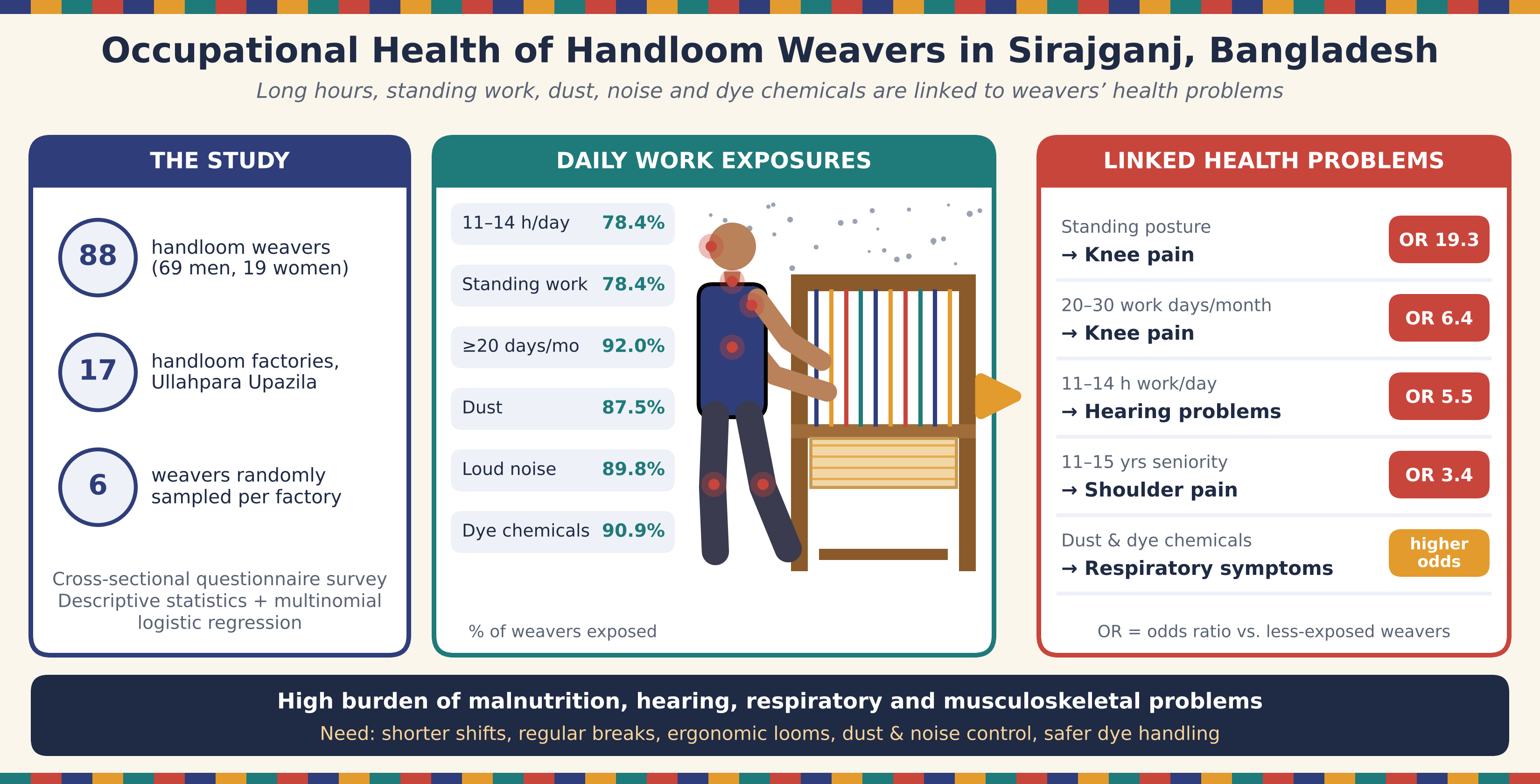
The handloom weaving industry is an important traditional activity and a major source of employment in Bangladesh. To explore the association between health problems, socio-demographic characteristics and workplace exposures among handloom weavers, we conducted a cross-sectional survey in Ullapara Upazila, Sirajganj District, Bangladesh. Methods: We used a structured questionnaire to inquire about self-reported workplace exposures, including working posture, dust, noise, and hazardous chemicals, and health outcomes, including malnutrition, hearing problems, respiratory and musculoskeletal issues, in a random sample of 88 handloom weavers. We analyzed the relationship between workplace hazards and health issues using descriptive statistics and multinomial logistic regression. Results: Male handloom weavers tended to have lower odds of malnutrition than female weavers, although the association was statistically significant (p = 0.004), and workers aged 30–55 years reported neck pain more frequently than younger workers (p = 0.003). Working 11–15 years as a hand loomer was associated with an excess risk of shoulder pain (OR = 3.4, 95% CI 2.0–11.5) compared to those with lesser seniority; weavers who worked 20–30 days per month reported knee pain (OR = 6.4, 95% CI 1.2–34) more frequently than those who worked 15–19 days. Working 11–14 hours daily was associated with hearing issues (OR = 5.5, 95% CI 1.4–22.4). A prolonged standing posture was associated with knee pain (OR = 19.3, 95% CI 3.6–103). Exposure to hazardous chemicals and dust was associated with respiratory symptoms. Conclusion: Although estimates were imprecise, this study highlights a high prevalence of malnutrition, hearing problems, respiratory issues, and musculoskeletal pain among Bangladeshi handloom weavers.
- Open Access
- Article
Exploring the Health Impacts of Handloom Weavers in Sirajganj District, Bangladesh
Author Information
Received: 29 April 2026 | Revised: 26 October 2026 | Accepted: 10 November 2026 | Published: 18 November 2026
Abstract
Graphical Abstract
Keywords
handloom weavers | malnourishment | hearing loss | knee pain | occupational health | epidemiology
References
- 1.
Akber, S.M.; Shabnam, S.; Roy, A. Present Condition & Contribution of SME Financing in the Economy of Bangladesh: A Study on Three Selected Banks. J. Financ. Econ. 2023, 11, 183. https://doi.org/10.12691/jfe-11-4–1.
- 2.
Ministry of Planning (MoP). Handloom Census 2018; Ministry of Planning: Dhaka, Bangladesh, 2018.
- 3.
Hossain, M.K.; Islam, M.E. An Analysis of Present Scenario of Handloom Industry of Bangladesh. Rabindra J. 2012, 03, 1–14.
- 4.
Bangladesh Bank. Quarterly Review on Readymade Garments (RMG); Bangladesh Bank: Dhaka, Bangladesh, 2021.
- 5.
Siddiqui, L.A.; Banerjee, A.; Chokhandre, P.; et al. Prevalence and predictors of musculoskeletal disorders (MSDs) among weavers of Varanasi, India: A cross-sectional study. Clin. Epidemiol. Glob. Health 2021, 12, 100918. https://doi.org/10.1016/j.cegh.2021.100918.
- 6.
Koiri, P. Occupational health problems of the handloom workers: A cross sectional study of Sualkuchi, Assam, Northeast India. Clin. Epidemiol. Glob. Health 2020, 8, 1264–1271. https://doi.org/10.1016/j.cegh.2020.04.025.
- 7.
Rahman, M.; Haque Khan, M.; Hossain, I.; et al. Musculoskeletal Problems among Handloom Workers. Texila Int. J. Public Heal. 2017, 5, 1–15.
- 8.
Nag, A.; Vyas, H.; Nag, P. Occupational health scenario of Indian informal sector. Ind. Health 2016, 54, 377–385. https://doi.org/10.2486/indhealth.2015-0112.
- 9.
ArulJothi, K.N.; Irusappan, S.; Amarnath, G.; et al. A Descriptive Study to Assess the Occupational Health Hazards and the Knowledge, Attitude, and, Practice Regarding the Prevention of Occupational Health Hazards among Workers in Selected Handloom Weaving Industries, Kerala. IJSR-Int. J. Sci. Res. 2020, 9 I, 63–65.
- 10.
Jamil, S.; Mukul, M.E.H.; Bari, Q.I.; et al. Prevalence and Factors Associated with Musculoskeletal Pain among Rural Handloom Weavers in Sirajganj, Bangladesh. Bangladesh Pharm. J. 2022, 25, 188–198. https://doi.org/10.3329/bpj.v25i2.60970.
- 11.
Hossain, A.; Kamrujjaman, M.; Maleque, A. Associated Factors & Pattern of Musculoskeletal Pain among Male Handloom Weavers Residing in Belkuchi, Shirajganj: A Cross Sectional Study Garment Workers View Project Speech and Language Pathology View Project Associated Factors & Pattern of Musculoskele. Int. J. Sci. Eng. Res. 2018, 9, 1447–1451.
- 12.
Ps, J. A Study on Health Issues of Handloom Weavers in Lakshmiyapuram, Sankarankovil, Tenkasi District, Tamilnadu, India. J. Xi’an Shiyou Univ. Nat. Sci. Ed. 2022, 18, 207–218.
- 13.
Bradshaw, L.M. Provision and perception of occupational health in small and medium-sized enterprises in Sheffield, UK. Occup. Med. 2001, 51, 39–44. https://doi.org/10.1093/occmed/51.1.39.
- 14.
Haftu, D.; Kerebih, H.; Terfe, A. Prevalence of work-related musculoskeletal disorders and its associated factors among traditional cloth weavers in Chencha district, Gamo zone, Ethiopia, an ergonomic study. PLoS ONE 2023, 18, e0293542. https://doi.org/10.1371/journal.pone.0293542.
- 15.
Talukdar, M.M.U. Influencing Factors of Workers’ Migration from Loom Industries to Other Professions: Evidence from Sirajganj District of Bangladesh. SSRN Electron. J. 2025, 26, 1–13. https://doi.org/10.2139/ssrn.5379826.
- 16.
Mekonnen, T.H. The magnitude and factors associated with work-related back and lower extremity musculoskeletal disorders among barbers in Gondar town, northwest Ethiopia, 2017: A cross-sectional study. PLoS ONE 2019, 14, e0220035. https://doi.org/10.1371/journal.pone.0220035.
- 17.
Durlov, S.; Chakrabarty, S.; Chatterjee, A.; et al. Prevalence of low back pain among handloom weavers in West Bengal, India. Int. J. Occup. Environ. Health 2014, 20, 333–339. https://doi.org/10.1179/2049396714y.0000000082.
- 18.
Geto, A.K.; Daba, C.; Desye, B.; et al. Prevalence of work-related musculoskeletal disorder and its associated factors among weavers in low- and middle-income countries: A systematic review and meta-analysis. BMJ Open 2025, 15, e093124. https://doi.org/10.1136/bmjopen-2024-093124.
- 19.
Rajendran, A.K.; Supramaniam, R.K.; Selvaraj, M.D. Prevalence of Work-Related Musculoskeletal Disorders and Their Associated Ergonomic Risk Factors among Glove Manufacturing Industry Workers in Malaysia. Work. Health 2026, 2, 8. https://doi.org/10.53941/wah.2026.100008.
- 20.
Wang, Z.; Hu, B.; Song, X.; et al. Long Working Hours and the Co-Occurrence of Work-Related Musculoskeletal Symptoms and Occupational Stress among Ride-Hailing Drivers in Beijing, China. Work. Health 2026, 2, 22. https://doi.org/10.53941/wah.2026.100022.
- 21.
Zinabu, F.S.; Getie, K.; Takele, M.D.; et al. Lower back pain and associated factors among weavers working in Bahir Dar City, Northwest Ethiopia: A cross-sectional study. Front. Public Health 2024, 12, 1–12. https://doi.org/10.3389/fpubh.2024.1400312.
- 22.
Omosebi, T.E.; Okurame, D.E. Daily Work Hours, Work-Life Balance and Occupational Mental Health of Remote Workers in Nigeria. Work. Health 2026, 2, 16 https://doi.org/10.53941/wah.2026.100016.
- 23.
Mukherjee, R.; Banerjee, T.; Roy, M. An analysis of production loan and future expansion plan of handloom weavers from West Bengal, India. Res. J. Text. Appar. 2026, 1–17. https://doi.org/10.1108/rjta-11-2025-0267.
- 24.
Lekharu, H.; Nath, S.K. Financial health of handloom micro-entrepreneurial units in Assam: A composite financial health index approach. Res. J. Text. Appar. 2026, 1–19. https://doi.org/10.1108/rjta-03-2026-0068.
- 25.
Bangladsh Handloom Board (BHB). Annual Report 2017-18; Bangladsh Handloom Board (BHB): Dhaka, Bangladesh, 2024; Volume 2.
- 26.
Banglapedia. Sirajgonj District and Upazillas Map; Asiatic Society of Bangladesh: Dhaka, Bangladesh, 2012.
- 27.
Madow, W.G. Elementary Sampling Theory. Technometrics 1968, 10, 621–622. https://doi.org/10.1080/00401706.1968.10490610.
- 28.
Pope, S.; Rhodus, J.; Fulk, F.; et al. The Health Impact Assessment (HIA) Resource and Tool Compilation. 2016. Available online: https://www.epa.gov/sites/production/files/2017-07/documents/hia_resource_and_tool_compilation.pdf (accessed on 02 September 2026).
- 29.
Rahaman, M.A. Mental health of handloom weavers in Bangladesh: A call for culturally adapted interventions. Camb. Prism. Glob. Ment. Health 2025, 12, 1–9. https://doi.org/10.1017/gmh.2025.10081.
- 30.
Wani, K.; Khan, R.; Evaluation of occupational exposure of carpet weavers in northern province of Madhya Pradesh (India) during different seasons. Indian J. Occup. Environ. Med. 2015, 19, 110. https://doi.org/10.4103/0019-5278.165331. (accessed on 02 September 2026).
- 31.
Terfe, A.; Jemal, T.; Waqkene, T. Prevalence of low back pain and its associated factors among traditional cloth weavers in Gulele sub-city, Addis Ababa, Ethiopia. Front. Public Health 2023, 11, 1181591. https://doi.org/10.3389/fpubh.2023.1181591.
- 32.
Zaw, A.K.; Myat, A.M.; Thandar, M.; et al. Assessment of Noise Exposure and Hearing Loss Among Workers in Textile Mill (Thamine), Myanmar: A Cross-Sectional Study. Saf. Health Work. 2020, 11, 199–206. https://doi.org/10.1016/j.shaw.2020.04.002.
- 33.
Blåder, S.; Barck-Holst, U.; Danielsson, S.; et al. Neck and shoulder complaints among sewing-machine operators. Appl. Ergon. 1991, 22, 251–257. https://doi.org/10.1016/0003-6870(91)90228-a.


This work is licensed under a Creative Commons Attribution 4.0 International License.
