
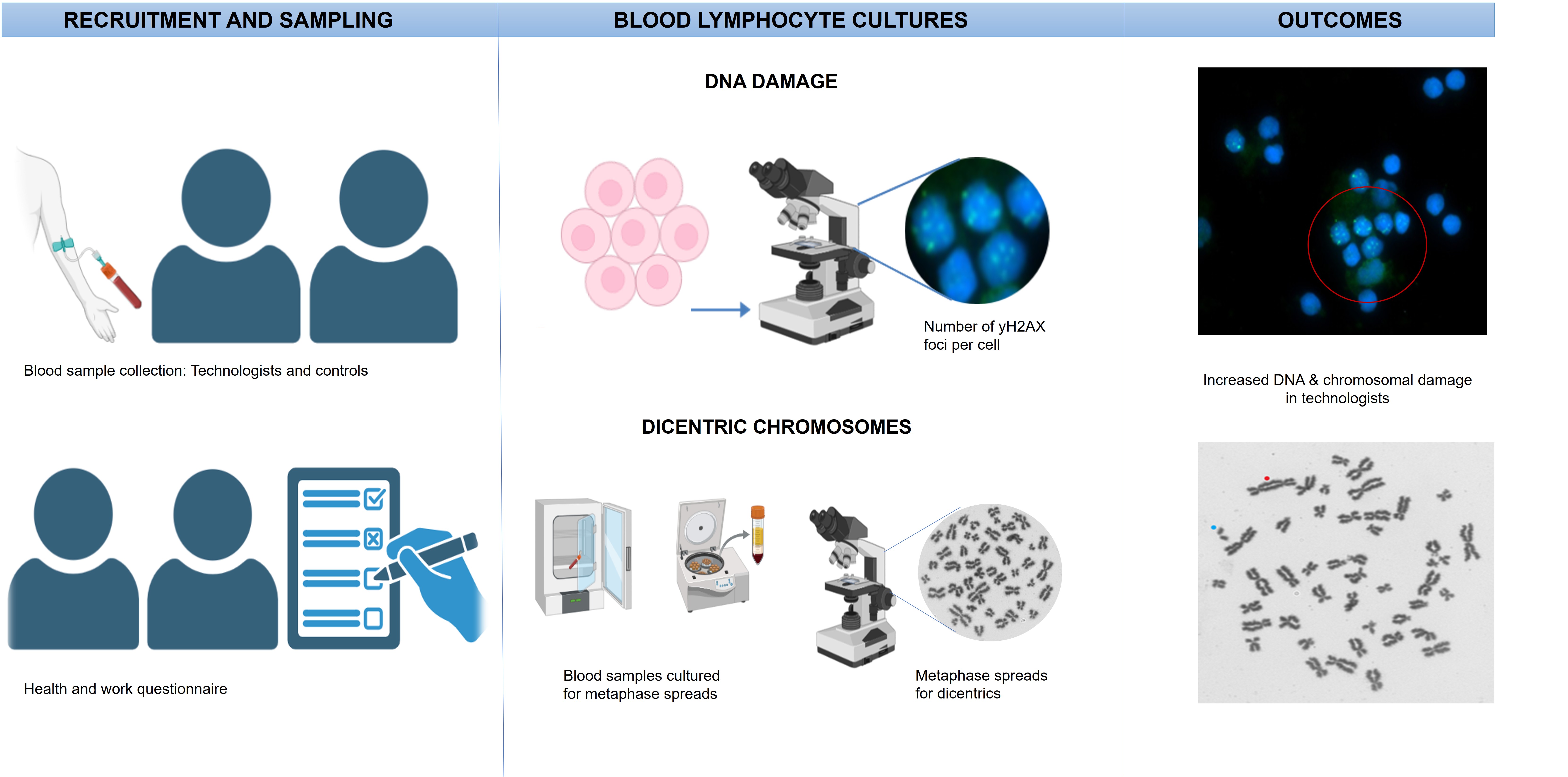
Objectives. Nuclear medicine technologists are chronically exposed to ionising radiation, yet the biological effects of chronic low-dose exposure remain poorly understood. This exploratory pilot study investigated DNA and chromosomal damage in technologists as biomarkers of occupational radiation exposure. Methods. DNA double-strand breaks were quantified by γH2AX immunofluorescence in cultured lymphocytes from blood samples of 20 technologists before and after radiotracer administration as well as from age- and sex-matched controls. The frequency of dicentric chromosomes, a well-established marker of radiation damage, was also scored. Participants completed questionnaires on occupational and lifestyle factors. Historical dose records were reviewed and dosimetry practices assessed by observation of dosimeter use. Results. Following routine radiopharmaceutical administration, technologists showed higher background γH2AX foci/cell than controls. Technologists also showed higher dicentric chromosome frequencies than controls while higher frequencies were observed among participants with a family history of cancer. There was a modest difference in the mean γH2AX foci/cell frequency between female and male participants. No significant associations were observed with smoking status and age. Weak correlations were noted with years of employment. Compliance with wearing personal dosimeters was high among technologists. Conclusions. γH2AX foci and dicentric chromosome frequencies were highly variable across groups and higher in nuclear medicine technologists. These findings provide preliminary evidence of differences in biomarkers of DNA and chromosomal damage in occupationally exposed technologists, suggesting that these biomarkers may have potential for detecting biological effects of low-dose occupational radiation exposure. Larger long-term studies are needed to determine whether these differences are related to occupational radiation exposure or to other factors that vary between individuals, and to assess the potential utility of these biomarkers for individualised routine biological monitoring as a supplement to dosimetry monitoring.
- Open Access
- Article
An Exploratory Study of DNA and Chromosomal Damage in UK Nuclear Medicine Technologists
- Irene Mbutu-Austin 1,2,
- Jayne Moquet 2,3,
- Hannah Mancey 2,3,
- Stephen Barnard 2,3,
- Bijan Modarai 2,4,
- Elizabeth Ainsbury 2,3,5 and
- Samantha Y. A. Terry 1,2,*
Author Information
Received: 26 June 2026 | Revised: 28 October 2026 | Accepted: 04 November 2026 | Published: 25 November 2026
Abstract
Graphical Abstract
Keywords
γH2AX | dicentric chromosomes | nuclear medicine technologist | biomarkers | occupational exposure
References
- 1.
Zakeri, F.; Hirobe, T. A cytogenetic approach to the effects of low levels of ionizing radiations on occupationally exposed individuals. Eur. J. Radiol. 2010, 73, 191–195. https://doi.org/10.1016/j.ejrad.2008.10.015.
- 2.
Djekidel, M. The changing landscape of nuclear medicine and a new era: The “NEW (Nu) CLEAR Medicine”: A framework for the future. Front. Nucl. Med. 2023, 3, 1213714. https://doi.org/10.3389/fnume.2023.1213714.
- 3.
Roberts, F.; Gunawardana, D.H.; Pathmaraj, K.; et al. Radiation dose to PET technologists and strategies to lower occupational exposure. J. Nucl. Med. Technol. 2005, 33, 44–47.
- 4.
Jaramillo-Garzón, W.; Díaz-Martínez, L.C. Occupational radiation exposure in a nuclear medicine department in Bogotá, Colombia. Radiat. Prot. Dosim. 2026, 202, 22–29. https://doi.org/10.1093/rpd/ncaf150.
- 5.
International Commission on Radiological Protection. Radiological Protection in PET and PET/CT. Task Group 117 Workshop. 2019. Available online: https://www.icrp.org/icrp_group.asp?id=183 (accessed on 27 August 2026).
- 6.
Zeff, B.W.; Yester, M.V. Patient self-attenuation and technologist dose in positron emission tomography. Med. Phys. 2005, 32, 861–865. https://doi.org/10.1118/1.1869552.
- 7.
Bolus, N.E. Review of Common Occupational Hazards and Safety Concerns for Nuclear Medicine Technologists. J. Nucl. Med. Technol. 2008, 36, 11–17. https://doi.org/10.2967/jnmt.107.043869.
- 8.
Carnicer, A.; Sans-Merce, M.; Baechler, S.; et al. Hand exposure in diagnostic nuclear medicine with 18F- and 99mTc-labelled radiopharmaceuticals—Results of the ORAMED project. Radiat. Meas. 2011, 46, 1277–1282. https://doi.org/10.1016/j.radmeas.2011.07.019.
- 9.
Yoshinaga, S.; Mabuchi, K.; Sigurdson, A.J.; et al. Cancer Risks among Radiologists and Radiologic Technologists: Review of Epidemiologic Studies. Radiology 2004, 233, 313–321. https://doi.org/10.1148/radiol.2332031119.
- 10.
Linet, M.S.; Kim, K.P.; Miller, D.L.; et al. Historical Review of Occupational Exposures and Cancer Risks in Medical Radiation Workers. Radiat. Res. 2010, 174, 793–808. https://doi.org/10.1667/rr2014.1.
- 11.
Brown, W.M.C.; Doll, R. Expectation of Life and Mortality from Cancer among British Radiologists. Br. Med. J. 1958, 2, 181–187. https://doi.org/10.1136/bmj.2.5090.181.
- 12.
Zielinski, J.; Garner, M.; Band, P.; et al. Health outcomes of low-dose ionizing radiation exposure among medical workers: A cohort study of the Canadian national dose registry of radiation workers. Int. J. Occup. Med. Environ. Health 2009, 22, 149–156. https://doi.org/10.2478/v10001-009-0010-y.
- 13.
Andersson, M.; Engholm, G.; Ennow, K.; et al. Cancer risk among staff at two radiotherapy departments in Denmark. Br. J. Radiol. 1991, 64, 455–460. https://doi.org/10.1259/0007-1285-64-761-455.
- 14.
Wang, J.X.; Zhang, L.A.; Li, B.X.; et al. Cancer incidence and risk estimation among medical x-ray workers in China, 1950–1995. Health Phys. 2002, 82, 455–466. https://doi.org/10.1097/00004032-200204000-00004.
- 15.
Jablon, S.; Miller, R.W. Army Technologists: 29-Year Follow Up for Cause of Death. Radiology 1978, 126, 677–679. https://doi.org/10.1148/126.3.677.
- 16.
Seltser, R.; Sartwell, P.E. The influence of occupational exposure to radiation on the mortality of American radiologists and other medical specialists. Am. J. Epidemiol. 1965, 81, 2–22. https://doi.org/10.1093/oxfordjournals.aje.a120493.
- 17.
Yoshinaga, S.; Aoyama, T.; Yoshimoto, Y.; et al. Cancer Mortality among Radiological Technologists in Japan: Updated Analysis of Follow-Up Data from 1969 to 1993. J. Epidemiol. 1999, 9, 61–72. https://doi.org/10.2188/jea.9.61.
- 18.
Kitahara, C.M.; Linet, M.S.; Drozdovitch, V.; et al. Cancer and circulatory disease risks in US radiologic technologists associated with performing procedures involving radionuclides. Occup. Environ. Med. 2015, 72, 770–776. https://doi.org/10.1136/oemed-2015-102834.
- 19.
Bernier, M.O.; Journy, N.; Villoing, D.; et al. Cataract Risk in a Cohort of U.S. Radiologic Technologists Performing Nuclear Medicine Procedures. Radiology 2018, 286, 592–601. https://doi.org/10.1148/radiol.2017170683.
- 20.
Bernier, M.O.; Doody, M.M.; Van Dyke, M.E.; et al. Work history and radioprotection practices in relation to cancer incidence and mortality in US radiologic technologists performing nuclear medicine procedures. Occup. Environ. Med. 2018, 75, 533–561. https://doi.org/10.1136/oemed-2017-104559.
- 21.
Boice, J.D., Jr.; Quinn, B.; Al-Nabulsi, I.; et al. A million persons, a million dreams: A vision for a national center of radiation epidemiology and biology. Int. J. Radiat. Biol. 2022, 98, 795–821. https://doi.org/10.1080/09553002.2021.1988183.
- 22.
Gharibdousty, T.S.; Zakeri, F.; Changizi, V.; et al. Low levels of ionizing radiation exposure and cytogenetic effects in radiopharmacists. Biosci. Biotechnol. Res. Commun. 2017, 10, 56–62. https://doi.org/10.21786/bbrc/10.1/9.
- 23.
Prasad, K.N.; Cole, W.C.; Hasse, G.M. Health Risks of Low Dose Ionizing Radiation in Humans: A Review. Exp. Biol. Med. 2004, 229, 378–382. https://doi.org/10.1177/153537020422900505.
- 24.
Mbutu-Austin, I.; Modarai, B.; Ainsbury, E.; et al. Potential biomarkers of chronic low-dose radiation exposure for nuclear medicine technologists. Int. J. Radiat. Biol. 2025, 101, 453–466. https://doi.org/10.1080/09553002.2025.2470225.
- 25.
International Atomic Energy Agency. Cytogenetic Dosimetry: Applications in Preparedness for and Response to Radiation Emergencies, 1st ed.; IAEA: Vienna, Austria, 2011.
- 26.
Romm, H.; Ainsbury, E.; Barnard, S.; et al. Automatic scoring of dicentric chromosomes as a tool in large scale radiation accidents. Mutat. Res. Genet. Toxicol. Environ. Mutagen. 2013, 756, 174–183. https://doi.org/10.1016/j.mrgentox.2013.05.013.
- 27.
Miszczyk, J.; Rawojć, K.; Panek, A.; et al. Assessment of the nuclear medicine personnel occupational exposure to radioiodine. Eur. J. Radiol. 2019, 121, 108712. https://doi.org/10.1016/j.ejrad.2019.108712.
- 28.
Hall, J.; Jeggo, P.A.; West, C.; et al. Ionizing radiation biomarkers in epidemiological studies—An update. Mutat. Res. Rev. Mutat. Res. 2017, 771, 59–84. https://doi.org/10.1016/j.mrrev.2017.01.001.
- 29.
El-Sayed, T.; Patel, A.S.; Cho, J.S.; et al. Radiation-Induced DNA Damage in Operators Performing Endovascular Aortic Repair. Circulation 2017, 136, 2406–2416. https://doi.org/10.1161/circulationaha.117.029550.
- 30.
Khan, K.; Tewari, S.; Awasthi, N.P.; et al. Flow cytometric detection of gamma-H2AX to evaluate DNA damage by low dose diagnostic irradiation. Med. Hypotheses 2018, 115, 22–28. https://doi.org/10.1016/j.mehy.2018.03.016.
- 31.
Młynarczyk, D.; Puig, P.; Armero, C.; et al. Radiation dose estimation with time-since-exposure uncertainty using the γ-H2AX biomarker. Sci. Rep. 2022, 12, 19877. https://doi.org/10.1038/s41598-022-24331-1.
- 32.
Heydenreich, J.; Otto, C.; Mayer, F.; et al. Reliability of a Fully Automated Interpretation of γ-H2AX Foci in Lymphocytes of Moderately Trained Subjects under Resting Conditions. J. Nutr. Metab. 2014, 2014, 478324. https://doi.org/10.1155/2014/478324.
- 33.
Moquet, J.; Higueras, M.; Donovan, E.; et al. Dicentric Dose Estimates for Patients Undergoing Radiotherapy in the RTGene Study to Assess Blood Dosimetric Models and the New Bayesian Method for Gradient Exposure. Radiat. Res. 2018, 190, 596–604. https://doi.org/10.1667/rr15116.1.
- 34.
Lusiyanti, Y.; Syaifudin, M.; Budiantari, T.; et al. Development of Dose-Response Calibration Curve for Dicentric Chromosome Induced by X-Rays. Genome Integr. 2019, 10, 2. https://doi.org/10.4103/genint.genint_1_19.
- 35.
Kim, K.; Kim, K.S.; Jang, W.I.; et al. Deep Neural Network-Based Automatic Dicentric Chromosome Detection Using a Model Pretrained on Common Objects. Diagnostics 2023, 13, 3191. https://doi.org/10.3390/diagnostics13203191.
- 36.
Scheid, W.; Weber, J.; Traut, H. Chromosome Aberrations Induced in Human Lymphocytes by An X-radiation Accident: Results of A 4-year Postirradiation Analysis. Int. J. Radiat. Biol. 1988, 54, 395–402. https://doi.org/10.1080/09553008814551781.
- 37.
Sari-Minodier, I.; Orsière, T.; Auquier, P.; et al. Cytogenetic monitoring by use of the micronucleus assay among hospital workers exposed to low doses of ionizing radiation. Mutat. Res. Genet. Toxicol. Environ. Mutagen. 2007, 629, 111–121. https://doi.org/10.1016/j.mrgentox.2007.01.009.
- 38.
Dobrzyńska, M.M.; Pachocki, K.A.; Gajowik, A.; et al. The Effect Occupational Exposure to Ionizing Radiation on the DNA Damage in Peripheral Blood Leukocytes of Nuclear Medicine Personnel. J. Occup. Health 2014, 56, 379–386. https://doi.org/10.1539/joh.13-0287-oa.
- 39.
Engin, A.B.; Ergun, M.A.; Yurtcu, E.; et al. Effect of ionizing radiation on the pteridine metabolic pathway and evaluation of its cytotoxicity in exposed hospital staff. Mutat. Res. Genet. Toxicol. Environ. Mutagen. 2005, 585, 184–192. https://doi.org/10.1016/j.mrgentox.2005.05.005.
- 40.
Bozkurt, G.; Yuksel, M.; Karabogaz, G.; et al. Sister chromatid exchanges in lymphocytes of nuclear medicine physicians. Mutat. Res. Genet. Toxicol. Environ. Mutagen. 2003, 535, 205–213. https://doi.org/10.1016/s1383-5718(02)00321-2.
- 41.
Sahin, A.; Tatar, A.; Oztas, S.; et al. Evaluation of the genotoxic effects of chronic low-dose ionizing radiation exposure on nuclear medicine workers. Nucl. Med. Biol. 2009, 36, 575–578. https://doi.org/10.1016/j.nucmedbio.2009.02.003.
- 42.
Young, A.M. Dose rates in nuclear medicine and the effectiveness of lead aprons: Updating the department’s knowledge on old and new procedures. Nucl. Med. Commun. 2013, 34, 254–264. https://doi.org/10.1097/mnm.0b013e32835c91d5.
- 43.
International Atomic Energy Agency. Practical Radiation Technical Manual, Personal Protective Equipment; IAEA: Vienna, Austria, 2004. Available online: https://www-pub.iaea.org/MTCD/Publications/PDF/PRTM-5_web.pdf (Accessed on 27 August 2026).


This work is licensed under a Creative Commons Attribution 4.0 International License.
