
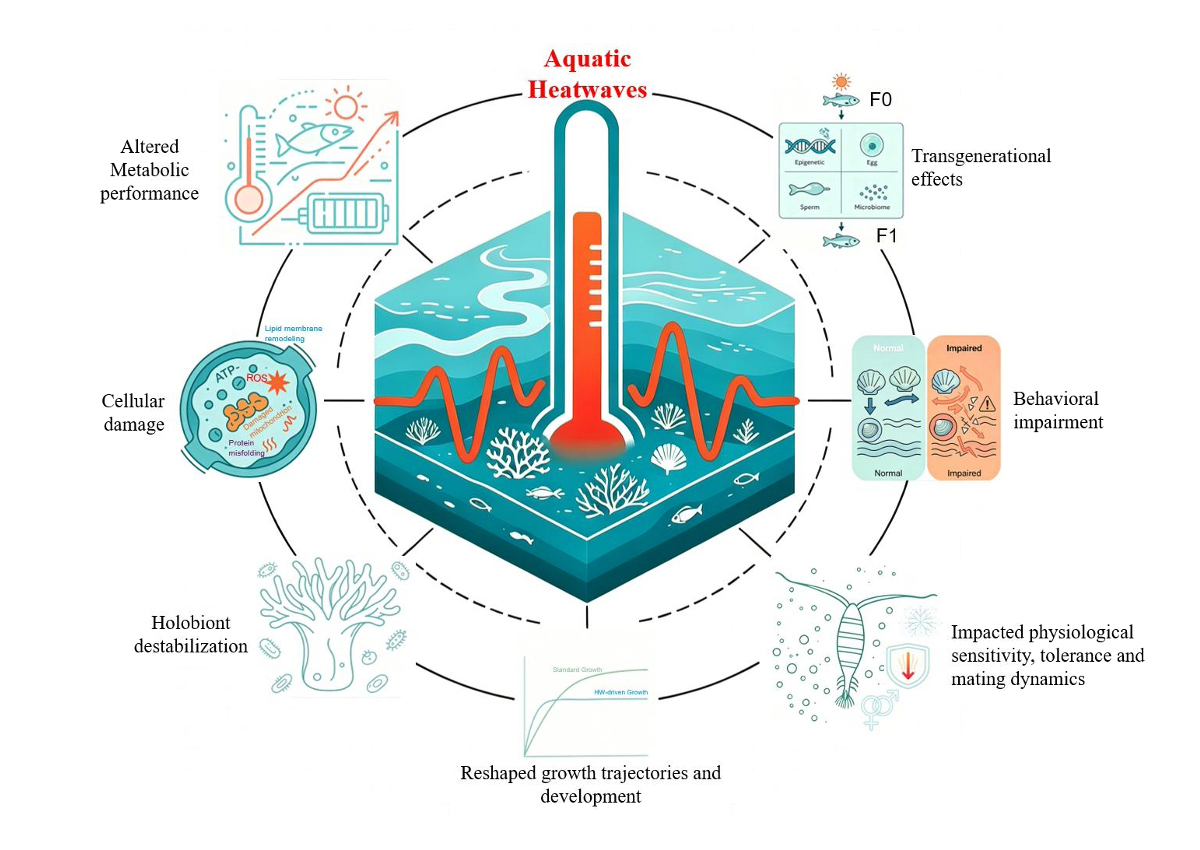
The frequency, intensity and duration of aquatic heatwaves are increasing due to climate change globally. However, the ecological consequences of heatwaves are still mainly assessed by acute mass mortality events. This emphasis overlooks the less visible but more pervasive fitness costs that persist after acute exposure. Here, we review the cryptic costs of heatwaves and show how sublethal, delayed and transgenerational effects can possibly depress population fitness and destabilize ecosystems even if the immediate mortality observed is limited. We synthesize evidence that aquatic heatwaves impose cryptic costs through four major pathways. First, heatwaves impair physiology by driving overload of bioenergy, oxidative damage, immune dysfunction and imbalance of host-microbiome interactions. These reactions force organisms to prioritize short-term survival and sacrifice self-maintenance and repair. Second, these physiological costs could alter the trajectories of growth, reduction of reproductive investment and trade-offs in stage-specific life-history. Third, behavioral responses caused by thermal stress often create new ecological liabilities by impairing cognition and locomotion, compressing usable habitat and increasing exposure risks to predators, pollutants and human activities. Fourth, parental heatwave exposure can modify offspring performance through altering provision behavior, disrupting microbiomes and causing epigenetic effects. Thus, these adverse effects extend across generations. In this review, we point out the priorities for future research should particularly focus on integrative frameworks that link multi-stressor environments with multigenerational processes. Therefore, assessments of aquatic heatwave impacts should extend beyond immediate resistance during exposure to include post-event recovery, recruitment and future population dynamics. Instead, aquatic heatwaves should be understood as disturbances that can leave lasting demographic and ecosystem legacies even in the absence of obvious die-offs. Therefore, integrating cryptic fitness costs into demographic models, multi-stressor experiments and ecosystem forecasting will be essential for predicting the effect of heatwaves in reshaping aquatic biodiversity in a warming world.
- Open Access
- Review
The Hidden Fitness Costs of Aquatic Heatwaves with Lasting Demographic and Ecosystem Impacts
- Jie Xiao 1, 2,
- Yiteng Xia 1, 2, *
Author Information
Received: 13 Apr 2026 | Revised: 24 Jun 2026 | Accepted: 07 Jul 2026 | Published: 29 Jul 2026
Abstract
Graphical Abstract
Keywords
climate change | aquatic heatwaves | fitness costs | sublethal effects | life-history trade-offs | transgenerational effects
References
- 1.
IPCC. Climate Change 2022: Impacts, Adaptation and Vulnerability; Cambridge University Press: Cambridge, UK, 2023; pp. 1841–1908.
- 2.
He, Q.; Silliman, B.R. Climate change, human impacts, and coastal ecosystems in the Anthropocene. Curr. Biol. 2019, 29, 1021–1035.
- 3.
Ummenhofer, C.C.; Meehl, G.A. Extreme weather and climate events with ecological relevance: a review. Philos. Trans. R. Soc. B Biol. Sci. 2017, 372, 20160135.
- 4.
Coumou, D.; Rahmstorf, S. A decade of weather extremes. Nat. Clim. Chang. 2012, 2, 491–496.
- 5.
Abram, P.K.; Boivin, G.; Moiroux, J., et al. Behavioural effects of temperature on ectothermic animals: unifying thermal physiology and behavioural plasticity. Biol. Rev. 2017, 92, 1859–1876.
- 6.
Ward, E.J.; Jannot, J.E.; Lee, Y.W.; et al. Using spatiotemporal species distribution models to identify temporally evolving hotspots of species co‐occurrence. Ecol. Appl. 2015, 25, 2198–2209.
- 7.
Pörtner, H.O. Integrating climate-related stressor effects on marine organisms: unifying principles linking molecule to ecosystem-level changes. Mar. Ecol. Prog. Ser. 2012, 470, 273–290.
- 8.
Schulte, P.M. The effects of temperature on aerobic metabolism: towards a mechanistic understanding of the responses of ectotherms to a changing environment. J. Exp. Biol. 2015, 218, 1856–1866.
- 9.
Morrongiello, J.R.; Thresher, R.E.; Smith, D.C. Aquatic biochronologies and climate change. Nat. Clim. Chang. 2012, 2, 849–857.
- 10.
Venegas, R.M.; Acevedo, J.; Treml, E.A. Three decades of ocean warming impacts on marine ecosystems: A review and perspective. Deep Sea Res. II Top. Stud. Oceanogr. 2023, 212, 105318.
- 11.
Shi, K.; Wang, X.; Qin, Y.; et al. Lake surface water temperature in 2024. Nat. Rev. Earth Environ. 2025, 6, 258–260.
- 12.
Barbarossa, V.; Bosmans, J.; Wanders, N.; et al. Threats of global warming to the world’s freshwater fishes. Nat. Commun. 2021, 12, 1701.
- 13.
Oliver, E.C.; Donat, M.G.; Burrows, M.T.; et al. Longer and more frequent marine heatwaves over the past century. Nat. Commun. 2018, 9, 1324.
- 14.
Woolway, R.I.; Jennings, E.; Shatwell, T.; et al. Lake heatwaves under climate change. Nature 2021, 589, 402–407.
- 15.
Hobday, A.J.; Alexander, L.V.; Perkins, S.E.; et al. A hierarchical approach to defining marine heatwaves. Prog. Oceanogr. 2016, 141, 227–238.
- 16.
Wernberg, T.; Thomsen, M.S.; Burrows, M.T.; et al. Marine heatwaves as hot spots of climate change and impacts on biodiversity and ecosystem services. Nat. Rev. Biodivers. 2025, 1, 461–479.
- 17.
Frölicher, T.L.; Fischer, E.M.; Gruber, N. Marine heatwaves under global warming. Nature 2018, 560, 360–364.
- 18.
Joyce, P.W.S.; Tong, C.B.; Yip, Y.L.; et al. Marine heatwaves as drivers of biological and ecological change: implications of current research patterns and future opportunities. Mar. Biol. 2024, 171, 20.
- 19.
Arnold, P.A.; Noble, D.W.A.; Nicotra, A.B.; et al. A Framework for Modelling Thermal Load Sensitivity Across Life. Glob. Change Biol. 2025, 31, e70315.
- 20.
Ørsted, M.; Jørgensen, L.B.; Overgaard, J. Finding the right thermal limit: a framework to reconcile ecological, physiological and methodological aspects of CTmax in ectotherms. J. Exp. Biol. 2022. 225, jeb244514.
- 21.
Desforges, J.E.; Birnie‐Gauvin, K.; Jutfelt, F.; et al. The ecological relevance of critical thermal maxima methodology for fishes. J. Fish Biol. 2023. 102, 1000–1016.
- 22.
Hughes, T.P.; Kerry, J.T.; Baird, A.H.; et al. Global warming transforms coral reef assemblages. Nature 2018. 556, 492–496.
- 23.
Hughes, T.P.; Anderson, K.D.; Connolly, S.R.; et al. Spatial and temporal patterns of mass bleaching of corals in the Anthropocene. Science 2018, 359, 80–83.
- 24.
Wernberg, T.; Bennett, S.; Babcock, R.C.; et al. Climate-driven regime shift of a temperate marine ecosystem. Science 2016, 353, 169–172.
- 25.
Barbeaux, S.J.; Holsman, K.; Zador, S. Marine heatwave stress test of ecosystem-based fisheries management in the Gulf of Alaska Pacific cod fishery. Front. Mar. Sci. 2020, 7, 703.
- 26.
Zhang, Q.; Han, X.Z.; Burraco, P.; et al. Oxidative stress mediates the impact of heatwaves on survival, growth and immune status in a lizard. Proc. R. Soc. B Biol. Sci. 2023. 290, 20231768.
- 27.
Strano, F.; Micaroni, V.; Thomas, T.; et al. Marine heatwave conditions drive carryover effects in a temperate sponge microbiome and developmental performance. Proc. R. Soc. B Biol. Sci. 2023, 290, 20222539.
- 28.
Martínez-De León, G.; Fahrni, M.; Thakur, M. P. Temperature-size responses during ontogeny are independent of progenitors' thermal environments. PeerJ 2024, 12, e17432.
- 29.
Martínez-De León, G.; Thakur, M.P. Ecological debts induced by heat extremes. Trends Ecol. Evol. 2024, 39, 1024–1034.
- 30.
Enriquez‐Urzelai, U.; Tingley, R.; Kearney, M.R.; et al. The roles of acclimation and behaviour in buffering climate change impacts along elevational gradients. J. Anim. Ecol. 2020, 89, 1722–1734.
- 31.
MEESTER, L.D.; Stoks, R.; Brans, K.I. Genetic adaptation as a biological buffer against climate change: potential and limitations. Integr. Zool. 2018, 13, 372–391.
- 32.
Donelson, J.M.; Salinas, S.; Munday, P.L.; et al. Transgenerational plasticity and climate change experiments: where do we go from here? Glob. Chang. Biol. 2018, 24, 13–34.
- 33.
Bowler, K. Acclimation, heat shock and hardening. J. Therm. Biol. 2005, 30, 125–130.
- 34.
Hoffmann, A.A.; Chown, S.L.; Clusella-Trullas, S. Upper thermal limits in terrestrial ectotherms: how constrained are they? Funct. Ecol. 2013, 27, 934–949.
- 35.
Seebacher, F.; White, C.R.; Franklin, C.E. Physiological plasticity increases resilience of ectothermic animals to climate change. Nat. Clim. Chang. 2015. 5, 61-66.
- 36.
Smith, K.E.; Burrows, M.T.; Hobday, A.J.; et al. Biological impacts of marine heatwaves. Annu. Rev. Mar. Sci. 2023, 15, 119–145.
- 37.
Xiao, J.; Wang, W.X. Complex and lasting impacts of heatwaves on life-history traits and fitness in Daphnia magna. J. Exp. Biol. 2025, 228, jeb250837.
- 38.
Tassone, S.J.; Besterman, A.F.; Buelo, C.D.; et al. Co-occurrence of aquatic heatwaves with atmospheric heatwaves, low dissolved oxygen, and low pH events in estuarine ecosystems. Estuaries Coasts 2022, 45, 707–720.
- 39.
Prioux, C.; Tignat-Perrier, R.; Gervais, O.; et al. Unveiling microbiome changes in Mediterranean octocorals during the 2022 marine heatwaves: quantifying key bacterial symbionts and potential pathogens. Microbiome 2023, 11, 271.
- 40.
Polazzo, F.; Roth, S.K.; Hermann, M.; et al. Combined effects of heatwaves and micropollutants on freshwater ecosystems: Towards an integrated assessment of extreme events in multiple stressors research. Glob. Chang. Biol. 2022, 28, 1248–1267.
- 41.
Martinez-Villalobos, C.; Fu, D.; Loikith, P.C.; et al. Accelerating increase in the duration of heatwaves under global warming. Nat. Geosci. 2025, 18, 716–723.
- 42.
Spence-Jones, H.C.; Scheibl, C.; Pein, C.M.; et al. Do you remember? Within-generation and transgenerational heat stress memory of recurring marine heatwaves in threespine stickleback. Proc. R. Soc. B Biol. Sci. 2025, 292, 20242913.
- 43.
Norin, T.; Metcalfe, N.B. Ecological and evolutionary consequences of metabolic rate plasticity in response to environmental change. Philos. Trans. R. Soc. Lond. B Biol. Sci. 2019, 374, 20180180.
- 44.
Pörtner, H.O.; Bock, C.; Mark, F.C. Oxygen- and capacity-limited thermal tolerance: bridging ecology and physiology. J. Exp. Biol. 2017, 220, 2685–2696.
- 45.
Tran, L.L.; Johansen, J.L. Seasonal variability in resilience of a coral reef fish to marine heatwaves and hypoxia. Glob. Chang. Biol. 2023, 29, 2522–2535.
- 46.
Johansen, J.L.; Nadler, L.E.; Habary, A.; et al. Thermal acclimation of tropical coral reef fishes to global heat waves. eLife 2021, 10, e59162.
- 47.
Morley, S.; Peck, L.; Sunday, J.; et al. Physiological acclimation and persistence of ectothermic species under extreme heat events. Glob. Ecol. Biogeogr. 2019, 28, 1018–1037.
- 48.
Nilsson, G.E.; Ostlund-Nilsson, S.; Munday, P. L. Effects of elevated temperature on coral reef fishes: loss of hypoxia tolerance and inability to acclimate. Comp. Biochem. Physiol. A Mol. Integr. Physiol. 2010, 156, 389–393.
- 49.
Wong, C.C.; Drazen, J.C.; Callan, C.K.; et al. Hypoxia tolerance in coral-reef triggerfishes (Balistidae). Coral Reefs 2018, 37, 215–225.
- 50.
Pörtner, H.O. Oxygen- and capacity-limitation of thermal tolerance: a matrix for integrating climate-related stressor effects in marine ecosystems. J. Exp. Biol. 2010, 213, 881–893.
- 51.
Olabarria, C.; Gestoso, I.; Lima, F.P.; et al. Response of two mytilids to a heatwave: the complex interplay of physiology, behaviour and ecological interactions. PLoS ONE 2016, 11, e0164330.
- 52.
Guppy, M.; Withers, P. Metabolic depression in animals: physiological perspectives and biochemical generalizations. Biol. Rev. Camb. Philos. Soc. 1999, 74, 1–40.
- 53.
He, G.; Xiong, X.; Peng, Y.; et al. Transcriptomic responses reveal impaired physiological performance of the pearl oyster following repeated exposure to marine heatwaves. Sci. Total Environ. 2023, 854, 158726.
- 54.
Xu, X.; Zhang, X.; Peng, J.; et al. Survival and physiological energetics of highly invasive mussels exposed to heatwaves. Mar. Environ. Res. 2023, 187, 105948.
- 55.
Xu, X.; Yang, K.; Liu, Y.; et al. Heatwaves hinder mussel invasion by weakening byssus production. Front. Mar. Sci. 2023, 10, 1239801.
- 56.
Xu, X.; Tong, Y.; Deng, Y.; et al. Impacts of marine heatwaves on byssus production in highly invasive fouling mussels. Mar. Environ. Res. 2023, 184, 105871.
- 57.
Staniek, M.A.; Pansch, C.; Shama, L.N.S.; et al. Heatwave intensity drives eco-physiological responses in infaunal bivalves: A mesocosm experiment. Limnol. Oceanogr. 2025, 70, S417–S431.
- 58.
Belhadj-Slimen, I.; Najar, T.; Ghram, A.; et al. Reactive oxygen species, heat stress and oxidative-induced mitochondrial damage. Int. J. Hyperth. 2014, 30, 513–523.
- 59.
Yang, L.; Tan, G.Y.; Fu, Y.Q.; et al. Effects of acute heat stress and subsequent stress removal on function of hepatic mitochondrial respiration, ROS production and lipid peroxidation in broiler chickens. Comp. Biochem. Physiol. C Toxicol. Pharmacol. 2010, 151, 204–208.
- 60.
Banh, S.; Wiens, L.; Sotiri, E.; et al. Mitochondrial reactive oxygen species production by fish muscle mitochondria: potential role in acute heat-induced oxidative stress. Comp. Biochem. Physiol. B Biochem. Mol. Biol. 2016, 191, 99–107.
- 61.
Grimmelpont, M.; Payton, L.; Lefrançois, C.; et al. Molecular and behavioural responses of the mussel Mytilus edulis exposed to a marine heatwave. Mar. Environ. Res. 2024, 196, 106418.
- 62.
Lanneau, D.; Brunet, M.; Frisan, E.; et al. Heat shock proteins: essential proteins for apoptosis regulation. J. Cell. Mol. Med. 2008, 12, 743–761.
- 63.
Britton, D.; Schmid, M.; Noisette, F.; et al. Adjustments in fatty acid composition is a mechanism that can explain resilience to marine heatwaves and future ocean conditions in the habitat‐forming seaweed Phyllospora comosa (Labillardière) C. Agardh. Glob. Chang. Biol. 2020, 26, 3512–3524.
- 64.
Leicht, K.; Jokela, J.; Seppälä, O. An experimental heat wave changes immune defense and life history traits in a freshwater snail. Ecol. Evol. 2013, 3, 4861–4871.
- 65.
Dittmar, J.; Janssen, H.; Kuske, A.; et al. Heat and immunity: an experimental heat wave alters immune functions in three‐spined sticklebacks (Gasterosteus aculeatus). J. Anim. Ecol. 2014, 83, 744–757.
- 66.
Stahlschmidt, Z.; French, S.; Ahn, A.; et al. A simulated heat wave has diverse effects on immune function and oxidative physiology in the corn snake (Pantherophis guttatus). Physiol. Biochem. Zool. 2017, 90, 434–444.
- 67.
Martins, S.; Ferreira, C.; Mateus, A. P.; et al. Immunological resilience of a temperate catshark to a simulated marine heatwave. J. Exp. Biol. 2024, 227, jeb247684.
- 68.
Scanes, E.; Siboni, N.; Rees, B.; et al. Acclimation in intertidal animals reduces potential pathogen load and increases survival following a heatwave. iScience 2023, 26, 106813.
- 69.
Sheikh, H.; Najiah, M.; Fadhlina, A.; et al. Temperature upshift mostly but not always enhances the growth of Vibrio species: a systematic review. Front. Mar. Sci. 2022, 9, 959830.
- 70.
Brumfield, K. D.; Usmani, M.; Chen, K. M.; et al. Environmental parameters associated with incidence and transmission of pathogenic Vibrio spp. Environ. Microbiol. 2021, 23, 7314–7340.
- 71.
Fontaine, S.S.; Kohl, K.D. Optimal integration between host physiology and functions of the gut microbiome. Philos. Trans. R. Soc. B Biol. Sci. 2020, 375, 20190594.
- 72.
Hacquard, S.; Garrido-Oter, R.; González, A.; et al. Microbiota and host nutrition across plant and animal kingdoms. Cell Host Microbe 2015, 17, 603–616.
- 73.
Zhai, X.; Zhang, Y.; Zhou, J.; et al. Physiological and microbiome adaptation of coral Turbinaria peltata in response to marine heatwaves. Ecol. Evol. 2024, 14, e10869.
- 74.
Claar, D. C.; Tietjen, K. L.; Cox, K. D.; et al. Chronic disturbance modulates symbiont (Symbiodiniaceae) beta diversity on a coral reef. Sci. Rep. 2020, 10, 4492.
- 75.
Claar, D. C.; Starko, S.; Tietjen, K. L., et al. Dynamic symbioses reveal pathways to coral survival through prolonged heatwaves. Nat. Commun. 2020, 11, 6097.
- 76.
Claar, D. C.; McDevitt‐Irwin, J. M.; Garren, M.; et al. Increased diversity and concordant shifts in community structure of coral‐associated Symbiodiniaceae and bacteria subjected to chronic human disturbance. Mol. Ecol. 2020, 29, 2477–2491.
- 77.
Gotthard, K. Growth Strategies of Ectothermic Animals in Temperate Environments. In Environment and Animal Development; Atkinson, D., Thorndyke, M., Eds.; Garland Science: New York, NY, USA, 2001; pp. 287–303.
- 78.
Kingsolver, J.; Huey, R. Size, temperature, and fitness: three rules. Evol. Ecol. Res. 2008, 10, 251–268.
- 79.
Zuo, W.;Moses, M. E.;West, G. B., et al. A general model for effects of temperature on ectotherm ontogenetic growth and development. Proc. Biol. Sci. 2012, 279, 1840–1846.
- 80.
Deschamps, M.;Giménez, L.;Astley, C., et al. Heatwave duration, intensity and timing as drivers of performance in larvae of a marine invertebrate. Sci. Rep. 2025, 15, 15949.
- 81.
Angilletta, M.J.Jr.; Steury, T.D.; Sears, M.W. Temperature, growth rate, and body size in ectotherms: fitting pieces of a life-history puzzle. Integr. Comp. Biol. 2004, 44, 498–509.
- 82.
Spinks, R.K.; Munday, P.L.; Donelson, J.M. Developmental effects of heatwave conditions on the early life stages of a coral reef fish. J. Exp. Biol. 2019, 222, jeb202713.
- 83.
Rosemond, R.C.; Head, M.A.; Heppell, S.A. Elevated fish growth yet postponed maturation during intense marine heatwaves. Ecol. Appl. 2025, 35, e70033.
- 84.
Van Wert, J.C.; Birnie-Gauvin, K.; Gallagher, J.; et al. Despite plasticity, heatwaves are costly for a coral reef fish. Sci. Rep. 2024, 14, 13320.
- 85.
Abrams, P.A.; Rowe, L. The effects of predation on the age and size of maturity of prey. Evolution 1996, 50, 1052–1061.
- 86.
Litvak, M.K.; Leggett, W.C. Age and size-selective predation on larval fishes: the bigger-is-better hypothesis revisited. Mar. Ecol. Prog. Ser. 1992, 81, 13–24.
- 87.
Maszczyk, P.; Brzezinski, T. Body size, maturation size, and growth rate of crustaceans. Nat. Hist. Crustac. 2018, 5, 35–65.
- 88.
Siegle, M.R.; Taylor, E.B.; O'Connor, M.I. Heat wave intensity drives sublethal reproductive costs in a tidepool copepod. Integr. Org. Biol. 2022, 4, obac005.
- 89.
Pilakouta, N.; Sellers, L.; Barratt, R.; et al. The consequences of heatwaves for animal reproduction are timing‐dependent. Funct. Ecol. 2023, 37, 2425–2433.
- 90.
Vermandele, F.; Sasaki, M.; Winkler, G.; et al. When the going gets tough, the females get going: sex‐specific physiological responses to simultaneous exposure to hypoxia and marine heatwave events in a ubiquitous copepod. Glob. Change Biol. 2024, 30, e17553.
- 91.
Chandrapavan, A.; Caputi, N.; Kangas, M.I. The decline and recovery of a crab population from an extreme marine heatwave and a changing climate. Front. Mar. Sci. 2019, 6, 510.
- 92.
Minuti, J. J.; Byrne, M.; Campbell, H.; et al. Live‐fast‐die‐young: Carryover effects of heatwave‐exposed adult urchins on the development of the next generation. Glob. Change Biol. 2022, 28, 5781–5792.
- 93.
Breedveld, M.C.; Dudine, L.; Padovan, S.; et al. Too hot to reason? Experimental heatwaves affect cognitive traits in male guppies. Behav. Ecol. 2025, 36, araf061.
- 94.
Mameri, D.; Branco, P.; Ferreira, M.T.; et al. Heatwave effects on the swimming behaviour of a Mediterranean freshwater fish, the Iberian barbel Luciobarbus bocagei. Sci. Total Environ. 2020, 730, 139152.
- 95.
Earhart, M.L.; Blanchard, T.S.; Strowbridge, N.; et al. Heatwave resilience of juvenile white sturgeon is associated with epigenetic and transcriptional alterations. Sci. Rep. 2023, 13, 15451.
- 96.
Liu, S.; Jonsson, B.; Greenberg, L.; et al. Stronger parental than temperature effects on methylation in juvenile Brown Trout (Salmo trutta). Ecol. Evol. 2025, 15, e72154.
- 97.
Godoy, R.S.; Weber, V.; Lanés, L.E.K.; et al. Effects of temperature and heat waves on embryonic development of annual fishes from Neotropical wetlands: Implications for climate change scenarios. Ecol. Freshw. Fish 2023, 32, 864–873.
- 98.
Seebacher, F.; Bamford, S.M.; Le Roy, A. Sex-specific transgenerational plasticity: developmental temperatures of mothers and fathers have different effects on sons and daughters. J. Exp. Biol. 2023, 226, jeb245798.
- 99.
Irish, S.D.; Sutter, A.; Pinzoni, L.; et al. Heatwave‐induced paternal effects have limited adaptive benefits in offspring. Ecol. Evol. 2024, 14, e70399.
- 100.
Barrett, R.; Stein, L.R. Short-term heat waves have long-term consequences for parents and offspring in stickleback. Behav. Ecol. 2024, 35, arae036.
- 101.
Clements, J.C.; Harrison, S.; Roussel, M.; et al. Fishing during extreme heatwaves alters ecological interactions and increases indirect fishing mortality in a ubiquitous nearshore system. Commun. Biol. 2025, 8, 735.
- 102.
Dinh, K.V.; Doan, K.L.; Doan, N.X.; et al. Parental exposures increase the vulnerability of copepod offspring to copper and a simulated marine heatwave. Environ. Pollut. 2021, 287, 117603.
- 103.
Liang, J.; Masanja, F.; Li, Y.; et al. Hard clam resilience to marine heatwaves in the face of climate change. Front. Mar. Sci. 2024, 11, 1382825.
- 104.
Zervoudaki, S.; Protopapa, M.; Koutsandrea, A.; et al. Zooplankton responses to simulated marine heatwave in the Mediterranean Sea using in situ mesocosms. Plos ONE 2024, 19, e0308846.
- 105.
Salo, T.; Stamm, C.; Burdon, F. J.; et al. Resilience to heat waves in the aquatic snail Lymnaea stagnalis: Additive and interactive effects with micropollutants. Freshw. Biol. 2017, 62, 1831–1846.
- 106.
Joyce, P.W.; Tang, W.Y.; Falkenberg, L.J. Marine heatwaves of different magnitudes have contrasting effects on herbivore behaviour. Sci. Rep. 2022, 12, 17309.
- 107.
Hermann, M.; Peeters, E.T.; Van den Brink, P.J. Heatwaves, elevated temperatures, and a pesticide cause interactive effects on multi-trophic levels of a freshwater ecosystem. Environ. Pollut. 2023, 327, 121498.
- 108.
Roth, S.K.; Polazzo, F.; García-Astillero, A.; et al. Multiple stressor effects of a heatwave and a herbicide on zooplankton communities: implications of global climate change. Front. Environ. Sci. 2022, 10, 920010.
- 109.
Santora, J.A.; Mantua, N.J.; Schroeder, I.D.; et al. Habitat compression and ecosystem shifts as potential links between marine heatwave and record whale entanglements. Nat. Commun. 2020, 11, 536.
- 110.
Leach, T.S.; BuyanUrt, B.; Hofmann, G.E. Exploring impacts of marine heatwaves: paternal heat exposure diminishes fertilization success in the purple sea urchin (Strongylocentrotus purpuratus). Mar. Biol. 2021, 168, 103.
- 111.
Li, Z.; He, L.; Zhang, H.; et al. Climate warming and heat waves affect reproductive strategies and interactions between submerged macrophytes. Glob. Chang. Biol. 2017, 23, 108–116.
- 112.
Haque, M.T.; Paul, S.; Khan, M.K. Heatwaves reduce mating frequency in an aquatic insect. Biol. Open 2025, 14, bio062091.
- 113.
Beever, E.A.; Hall, L.E.; Varner, J.; et al. Behavioral flexibility as a mechanism for coping with climate change. Front. Ecol. Environ. 2017, 15, 299–308.
- 114.
Welch, H.; Savoca, M.S.; Brodie, S.; et al. Impacts of marine heatwaves on top predator distributions are variable but predictable. Nat. Commun. 2023, 14, 5188.
- 115.
Barlow, D.R.; Klinck, H.; Ponirakis, D.; et al. Environmental conditions and marine heatwaves influence blue whale foraging and reproductive effort. Ecol. Evol. 2023, 13, e9770.
- 116.
Martino, C.; Savoca, D.; Mauro, M.; et al. Heatwave conditions increase the toxicity of phthalates in marine organisms. Sci. Total Environ. 2025, 979, 179479.
- 117.
Wernberg, T.; Thomsen, M.S.; Baum, J.K.; et al. Impacts of climate change on marine foundation species. Annu. Rev. Mar. Sci. 2024, 16, 247–282.
- 118.
118. Starko, S.; Epstein, G.; Chalifour, L.; et al. Ecological responses to extreme climatic events: A systematic review of the 2014–2016 Northeast Pacific marine heatwave. In Oceanography and Marine Biology; CRC Press: Boca Raton, FL, USA, 2025; pp. 42–96.
- 119.
Morosinotto, C.; Gasparini, C.; Pilastro, A.; et al. Cryptic reproductive costs of heatwaves for animal populations. Glob. Change Biol. 2025, 31, e70558.
- 120.
Dinh, K.V.; Vu, M.T. Species‐specific seasonal variations in thermal performance curves shape the direct and transgenerational vulnerability to marine heatwaves. J. Anim. Ecol. 2025, 94, 1478–1480.
- 121.
Sasaki, M.; Finiguerra, M.; Dam, H.G. Seasonally variable thermal performance curves prevent adverse effects of heatwaves. J. Anim. Ecol. 2025, 94, 1542–1552.
- 122.
Chamorro, J.D.; McDonald, A.M.; Hofmann, G.E. Transgenerational plasticity as a mechanism of response to marine heatwaves in the purple sea urchin, Strongylocentrotus purpuratus. Front. Mar. Sci. 2023, 10, 1212781.
- 123.
van der Meer, J. An introduction to Dynamic Energy Budget (DEB) models with special emphasis on parameter estimation. J. Sea Res. 2006, 56, 85–102.
- 124.
Schaum, C.E.; Comeau, S.; Mullarney, J.C. Mesocosms: Bridging the gap between in situ and laboratory studies. Limnol. Oceanogr. 2025, 70, S7–S13.
- 125.
Cedergreen, N.; Dalhoff, K.; Li, D.; et al. Can toxicokinetic and toxicodynamic modeling be used to understand and predict synergistic interactions between chemicals? Environ. Sci. Technol. 2017, 51, 14379–14389.
- 126.
O’Dea, R.E.; Noble, D.W.; Johnson, S.L.; et al. The role of non-genetic inheritance in evolutionary rescue: epigenetic buffering, heritable bet hedging and epigenetic traps. Environ. Epigenet. 2016, 2, dvv014.
- 127.
Abrahms, B.; Carter, N.H.; Clark-Wolf, T.J.; et al. Climate change as a global amplifier of human–wildlife conflict. Nat. Clim. Chang. 2023, 13, 224–234.
- 128.
Scheffers, B.R.; Edwards, D.P.; Diesmos, A.; et al. Microhabitats reduce animal's exposure to climate extremes. Glob. Chang. Biol. 2014, 20, 495–503.
- 129.
Smale, D.A.; Wernberg, T.; Oliver, E.C.; et al. Marine heatwaves threaten global biodiversity and the provision of ecosystem services. Nat. Clim. Chang. 2019, 9, 306–312.

This work is licensed under a Creative Commons Attribution 4.0 International License.
