
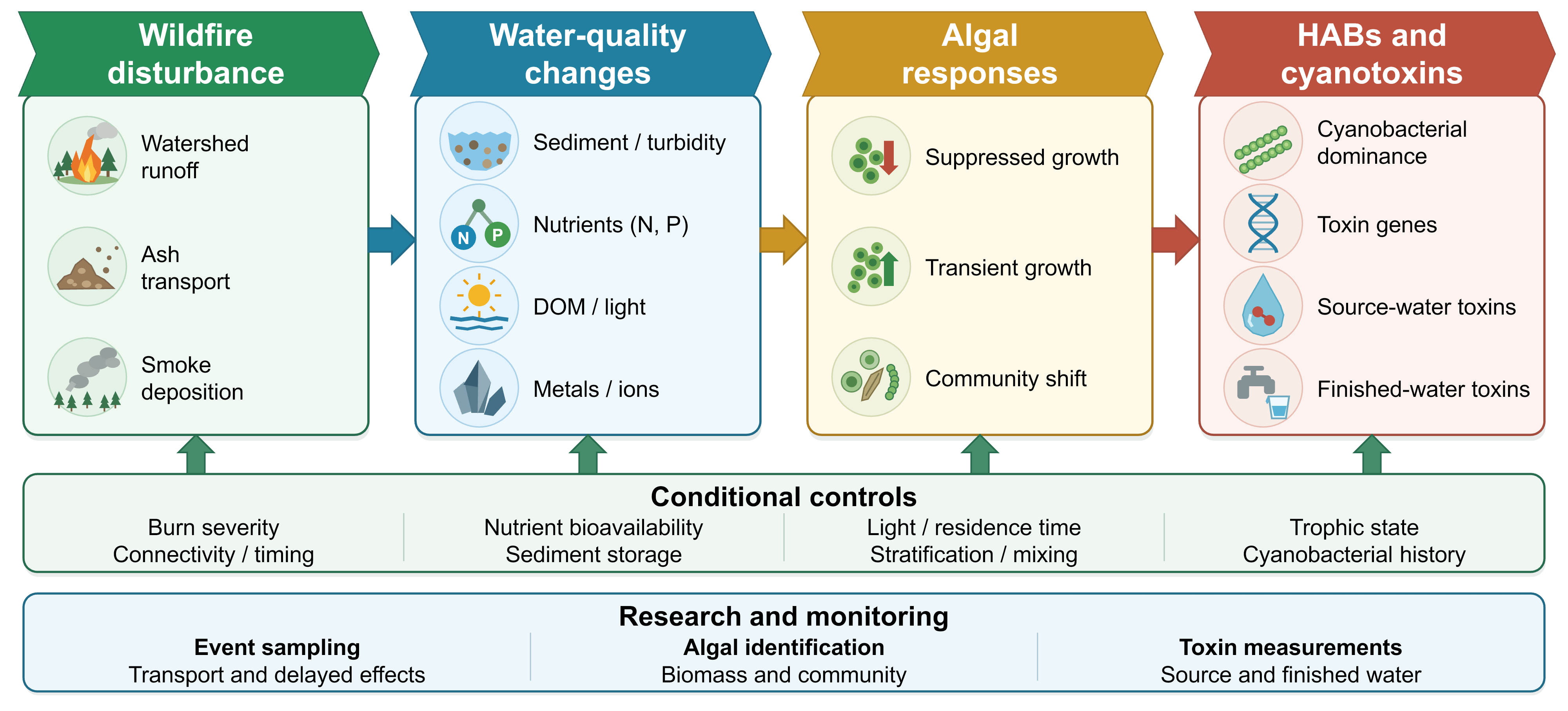
Wildfire can alter downstream water quality, aquatic productivity, and drinking-water treatability. Evidence for chemical and physical water-quality change is substantial, whereas evidence connecting those changes to harmful algal blooms (HABs) or cyanotoxins is less developed. This mini review examines evidence from freshwater receiving waters for post-fire water-quality change, algal or cyanobacterial responses, and cyanotoxin endpoints. Wildfire acts as a conditional amplifier of aquatic risk. Outcomes vary with fire severity, hydrologic connectivity, nutrient bioavailability, optical conditions, residence time, and receiving-water susceptibility. Evidence is strongest for changes in turbidity, sediment, nutrients, dissolved organic matter, and treatment-relevant chemistry; moderate for algal productivity and community responses; and limited for direct attribution of post-fire cyanotoxin occurrence. Event-coupled studies should link fire characteristics and hydrologic transport with water chemistry, cyanobacterial composition, cyanotoxins, and drinking-water outcomes in the same receiving water.
- Open Access
- Mini Review
From Ash to Algae: Wildfire-Driven Water-Quality Change and Emerging Cyanotoxin Risk in Aquatic Systems
Author Information
Received: 05 Jun 2026 | Revised: 16 Sep 2026 | Accepted: 17 Sep 2026 | Published: 28 Sep 2026
Abstract
Graphical Abstract
Keywords
wildfire | post-fire water quality | harmful algal blooms | cyanobacteria | cyanotoxin
References
- 1.
Nunes, J.P.; Doerr, S.H.; Sheridan, G.; et al. Assessing water contamination risk from vegetation fires: Challenges, opportunities and a framework for progress. Hydrol. Process. 2018, 32, 687–694. https://doi.org/10.1002/hyp.11434.
- 2.
Smith, H.G.; Sheridan, G.J.; Lane, P.N.J.; et al. Wildfire effects on water quality in forest catchments: A review with implications for water supply. J. Hydrol. 2011, 396, 170–192. https://doi.org/10.1016/j.jhydrol.2010.10.043.
- 3.
Paul, M.J.; LeDuc, S.D.; Lassiter, M.G.; et al. Wildfire Induces Changes in Receiving Waters: A Review with Considerations for Water Quality Management. Water Resour. Res. 2022, 58, e2021WR030699. https://doi.org/10.1029/2021wr030699.
- 4.
Hohner, A.K.; Rhoades, C.C.; Wilkerson, P.; et al. Wildfires Alter Forest Watersheds and Threaten Drinking Water Quality. Acc. Chem. Res. 2019, 52, 1234–1244. https://doi.org/10.1021/acs.accounts.8b00670.
- 5.
Writer, J.H.; Murphy, S.F. Wildfire Effects on Source-Water Quality-Lessons from Fourmile Canyon Fire, Colorado, and Implications for Drinking-Water Treatment; No. 2012-3095; US Geological Survey: Reston, VA, USA, 2012.
- 6.
Beaver, J.R.; Tausz, C.E.; Scotese, K.C.; et al. Environmental factors influencing the quantitative distribution of microcystin and common potentially toxigenic cyanobacteria in U.S. lakes and reservoirs. Harmful Algae 2018, 78, 118–128. https://doi.org/10.1016/j.hal.2018.08.004.
- 7.
Okello, W.; Kurmayer, R. Seasonal development of cyanobacteria and microcystin production in Ugandan freshwater lakes. Lakes Reserv. Res. Manag. 2011, 16, 123–135. https://doi.org/10.1111/j.1440-1770.2011.00450.x.
- 8.
Raoelison, O.D.; Valenca, R.; Lee, A.; et al. Wildfire impacts on surface water quality parameters: Cause of data variability and reporting needs. Environ. Pollut. 2023, 317, 120713. https://doi.org/10.1016/j.envpol.2022.120713.
- 9.
Abu-Ali, L.; Albert, R.J.; Davis, A.B.; et al. From bloom to tap: Connecting harmful algal bloom indicators in source water to cyanotoxin presence in treated drinking water. Harmful Algae 2025, 145, 102846. https://doi.org/10.1016/j.hal.2025.102846.
- 10.
Hampton, T.B.; Lin, S.; Basu, N.B. Forest fire effects on stream water quality at continental scales: A meta-analysis. Environ. Res. Lett. 2022, 17, 064003. https://doi.org/10.1088/1748-9326/ac6a6c.
- 11.
Brucker, C.P.; Livneh, B.; Rosario-Ortiz, F.L.; et al. Wildfires drive multi-year water quality degradation over the western United States. Commun. Earth Environ. 2025, 6, 489. https://doi.org/10.1038/s43247-025-02427-6.
- 12.
Rhoades, C.C.; Chow, A.T.; Covino, T.P.; et al. The legacy of a severe wildfire on stream nitrogen and carbon in headwater catchments. Ecosystems 2019, 22, 643–657. https://doi.org/10.1007/s10021-018-0293-6.
- 13.
Rust, A.J.; Hogue, T.S.; Saxe, S.; et al. Post-fire water-quality response in the western United States. Int. J. Wildland Fire 2018, 27, 203–216. https://doi.org/10.1071/wf17115.
- 14.
Son, J.H.; Kim, S.; Carlson, K.H. Effects of Wildfire on River Water Quality and Riverbed Sediment Phosphorus. Water Air Soil Pollut. 2015, 226, 26. https://doi.org/10.1007/s11270-014-2269-2.
- 15.
Emelko, M.B.; Stone, M.; Silins, U.; et al. Sediment-phosphorus dynamics can shift aquatic ecology and cause downstream legacy effects after wildfire in large river systems. Glob. Change Biol. 2016, 22, 1168–1184. https://doi.org/10.1111/gcb.13073.
- 16.
Reale, J.K.; Van Horn, D.J.; Condon, K.E.; et al. The effects of catastrophic wildfire on water quality along a river continuum. Freshw. Sci. 2015, 34, 1426–1442. https://doi.org/10.1086/684001.
- 17.
Clow, D.W.; Akie, G.A.; Murphy, S.F.; et al. Dynamic water-quality responses to wildfire in Colorado. Hydrol. Process. 2024, 38, e15291. https://doi.org/10.1002/hyp.15291.
- 18.
Mast, M.A.; Murphy, S.F.; Clow, D.W.; et al. Water-quality response to a high-elevation wildfire in the Colorado Front Range. Hydrol. Process. 2016, 30, 1811–1823. https://doi.org/10.1002/hyp.10755.
- 19.
Sherson, L.R.; Van Horn, D.J.; Gomez-Velez, J.D.; et al. Nutrient dynamics in an alpine headwater stream: Use of continuous water quality sensors to examine responses to wildfire and precipitation events. Hydrol. Process. 2015, 29, 3193–3207. https://doi.org/10.1002/hyp.10426.
- 20.
Akie, G.A.; Clow, D.W.; Murphy, S.F.; et al. An Intercomparison of DOC Estimated From fDOM Sensors in Wildfire Affected Streams of the Western United States. Hydrol. Process. 2024, 38, e70023. https://doi.org/10.1002/hyp.70023.
- 21.
Murphy, S.F.; Alpers, C.N.; Anderson, C.W.; et al. A call for strategic water-quality monitoring to advance assessment and prediction of wildfire impacts on water supplies. Front. Water 2023, 5, 1144225. https://doi.org/10.3389/frwa.2023.1144225.
- 22.
Schallenberg, M.; Burns, C.W. Effects of sediment resuspension on phytoplankton production: Teasing apart the influences of light, nutrients and algal entrainment. Freshw. Biol. 2004, 49, 143–159. https://doi.org/10.1046/j.1365-2426.2003.01172.x.
- 23.
Brito, D.Q.; Santos, L.H.G.; Passos, C.J.S.; et al. Short-Term Effects of Wildfire Ash on Water Quality Parameters: A Laboratory Approach. Bull. Environ. Contam. Toxicol. 2021, 107, 500–505. https://doi.org/10.1007/s00128-021-03220-9.
- 24.
Crouch, R.L.; Timmenga, H.J.; Barber, T.R.; et al. Post-fire surface water quality: Comparison of fire retardant versus wildfire-related effects. Chemosphere 2006, 62, 874–889. https://doi.org/10.1016/j.chemosphere.2005.05.031.
- 25.
Emmerton, C.A.; Cooke, C.A.; Hustins, S.; et al. Severe western Canadian wildfire affects water quality even at large basin scales. Water Res. 2020, 183, 116071. https://doi.org/10.1016/j.watres.2020.116071.
- 26.
Chow, A.T.; Tsai, K.P.; Fegel, T.S.; et al. Lasting Effects of Wildfire on Disinfection By-Product Formation in Forest Catchments. J. Environ. Qual. 2019, 48, 1826–1834. https://doi.org/10.2134/jeq2019.04.0172.
- 27.
Granath, G.; Evans, C.D.; Strengbom, J.; et al. The impact of wildfire on biogeochemical fluxes and water quality in boreal catchments. Biogeosciences 2021, 18, 3243–3261. https://doi.org/10.5194/bg-18-3243-2021.
- 28.
Townsend, S.A.; Douglas, M.M. The effect of a wildfire on stream water quality and catchment water yield in a tropical savanna excluded from fire for 10 years (Kakadu National Park, North Australia). Water Res. 2004, 38, 3051–3058. https://doi.org/10.1016/j.watres.2004.04.009.
- 29.
Klose, K.; Cooper, S.D.; Bennett, D.M. Effects of wildfire on stream algal abundance, community structure, and nutrient limitation. Freshw. Sci. 2015, 34, 1494–1509. https://doi.org/10.1086/683431.
- 30.
Graziano, A.M.; Fegel, T.S.; Rhea, A.E.; et al. Effects of River Beads on Algal Nutrient Limitation Following Severe Wildfire. Freshw. Biol. 2026, 71, e70220. https://doi.org/10.1111/fwb.70220.
- 31.
Rhea, A.E.; Covino, T.P.; Rhoades, C.C. Reduced N-Limitation and Increased In-Stream Productivity of Autotrophic Biofilms 5 and 15 Years After Severe Wildfire. J. Geophys. Res. Biogeosci. 2021, 126, e2020JG006095. https://doi.org/10.1029/2020jg006095.
- 32.
De Palma-Dow, A.; McCullough, I.M.; Brentrup, J.A. Turning up the heat: Long-term water quality responses to wildfires and climate change in a hypereutrophic lake. Ecosphere 2022, 13, e4271. https://doi.org/10.1002/ecs2.4271.
- 33.
Caroni, R.; Pinardi, M.; Free, G.; et al. Investigating the Impact of Wildfires on Lake Water Quality Using Earth Observation Satellites. Appl. Sci. 2024, 14, 2626. https://doi.org/10.3390/app14062626.
- 34.
Nitzsche, N.; Nunes, J.P.; Parente, J. Assessing post-fire water quality changes in reservoirs: Insights from a large dataset in Portugal. Sci. Total Environ. 2024, 912, 169463. https://doi.org/10.1016/j.scitotenv.2023.169463.
- 35.
Olson, N.E.; Boaggio, K.L.; Rice, R.B.; et al. Wildfires in the western United States are mobilizing PM2.5-associated nutrients and may be contributing to downwind cyanobacteria blooms. Environ. Sci. Process. Impacts 2023, 25, 1049–1066. https://doi.org/10.1039/d3em00042g.
- 36.
Olson, N.E.; Brehob, M.M.; Sabo, R.D.; et al. Algal Blooms in Lakes Increase After Wildfire Smoke Events in the Contiguous United States. Glob. Change Biol. Commun. 2026, 1, e70004. https://doi.org/10.1002/gcb4.70004.
- 37.
Farruggia, M.J.; Brahney, J.; Tanentzap, A.J.; et al. Wildfire smoke impacts lake ecosystems. Glob. Change Biol. 2024, 30, e17367. https://doi.org/10.1111/gcb.17367.
- 38.
Ladd, T.M.; Catlett, D.; Maniscalco, M.A.; et al. Food for all? Wildfire ash fuels growth of diverse eukaryotic plankton. Proc. R. Soc. B Biol. Sci. 2023, 290, 20231817. https://doi.org/10.1098/rspb.2023.1817.
- 39.
Kramer, S.J.; Bisson, K.M.; Fischer, A.D. Observations of Phytoplankton Community Composition in the Santa Barbara Channel During the Thomas Fire. J. Geophys. Res. Oceans 2020, 125, e2020JC016851. https://doi.org/10.1029/2020jc016851.
- 40.
Pierce, E.F.; Schnetzer, A. Microcystin Concentrations, Partitioning, and Structural Composition during Active Growth and Decline: A Laboratory Study. Toxins 2023, 15, 684. https://doi.org/10.3390/toxins15120684.
- 41.
Ruhl, N.; Sullivan, N. Disturbance-mediated Cyanobacterial Harmful Algal Bloom (CHAB) formation in a small Ohio reservoir. Lakes Reserv. Res. Manag. 2017, 22, 161–167. https://doi.org/10.1111/lre.12172.
- 42.
Pinardi, M.; Stroppiana, D.; Caroni, R.; et al. Assessing the impact of wildfires on water quality using satellite remote sensing: The Lake Baikal case study. Front. Remote Sens. 2023, 4, 1107275. https://doi.org/10.3389/frsen.2023.1107275.
- 43.
Bittencourt-Oliveira, M.D.C. Detection of potential microcystin-producing cyanobacteria in Brazilian reservoirs with a mcyB molecular marker. Harmful Algae 2003, 2, 51–60. https://doi.org/10.1016/s1568-9883(03)00004-0.
- 44.
Xiang, C.G.; Huang, W.; Wang, Z.W.; et al. Eutrophication risk assessment of tributaries in the Three Gorges Reservoir: A case study of the Pengxi River. J. Environ. Inform. 2024, 43, 92–104. https://doi.org/10.3808/jei.202400512.
- 45.
Basso, M.; Serpa, D.; Mateus, M.; et al. Advances on water quality modeling in burned areas: A review. PLOS Water 2022, 1, e0000025. https://doi.org/10.1371/journal.pwat.0000025.
- 46.
Wu, H.J.; Ye, X.D.; Zhang, B.Y.; et al. Assessment of uncertainty propagation from climate modeling to hydrologic forecasting under changing climatic conditions. J. Environ. Inform. 2025, 45, 27–41. https://doi.org/10.3808/jei.202500530.
- 47.
Chen, J.; Chang, H. Predicting Post-Wildfire Stream Temperature and Turbidity: A Machine Learning Approach in Western U.S. Watersheds. Water 2025, 17, 359. https://doi.org/10.3390/w17030359.
- 48.
Rocha, V.N.L.; Santos, C.A.G.; Silva, R.M. Estimation of water surface reflectance and total suspended solid using MODIS images for a reservoir in the Brazilian semiarid region. J. Environ. Inform. 2024, 44, 112–125. https://doi.org/10.3808/jei.202400527.
- 49.
Elliott, S.M.; Hornberger, M.I.; Rosenberry, D.O.; et al. A Conceptual Framework to Assess Post-Wildfire Water Quality: State of the Science and Knowledge Gaps. Water Resour. Res. 2024, 60, e2023WR036260. https://doi.org/10.1029/2023wr036260.

This work is licensed under a Creative Commons Attribution 4.0 International License.
