
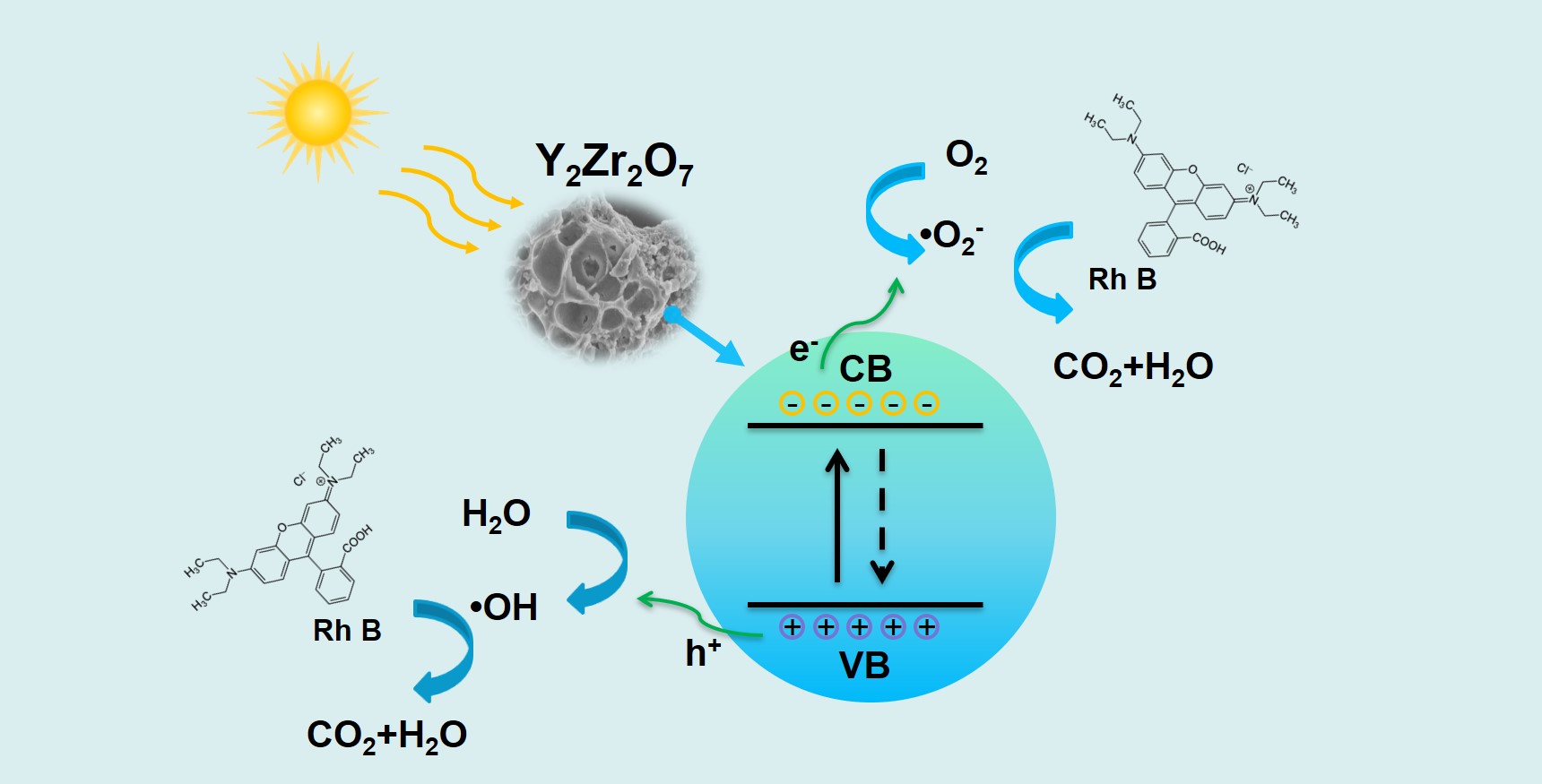
Y2Zr2O7, as a defect fluorite structure material, has found a wide range of applications in thermal barrier coatings, nuclear waste treatment, luminescent materials and photocatalysis. However, due to the high binding energy, the synthesis of high purity Y2Zr2O7 nanomaterials with uniform, fine, and highly active surfaces at low temperatures still remains a challenge. In this work, we successfully developed an effective protocol for preparing porous Y2Zr2O7 nanoparticles (NPs) by a facile and environmentally friendly citrate-gel combustion method at the low-temperature of 600 °C, in which citric acid (CA) is used as a chelating agent and fuel at the same time. The Y2Zr2O7 nanomaterials show a porous morphology formed by self-assembled NPs with a diameter of 5~10 nm. The porous morphology and photocatalytic ability of Y2Zr2O7 NPs can be enhanced by adjusting the CA content. Therefore, the optimal Y2Zr2O7 NPs prepared at a molar ratio of CA:Y = 0.8:1 achieved a degradation efficiency of up to 97% after 80 min of UV light irradiation. This work provides a strategy for producing other high-purity metal oxides of the same type in an economical, energy-saving, and large-scale manner.
- Open Access
- Article
Facile Fabrication of Porous Y2Zr2O7 Nanoparticles with Enhanced Photocatalytic Performance by Citrate-Gel-Combustion Method
Author Information
Received: 29 Mar 2026 | Revised: 17 May 2026 | Accepted: 22 Jun 2026 | Published: 10 Jul 2026
Abstract
Graphical Abstract
Keywords
Y2Zr2O7 | nanoparticles | combustion method | citric acid | photocatalyst
References
- 1.
Musso, M.; Cardozo, A.; Romero, M.; et al. High performance Ni-catalysts supported on rare-earth zirconates (La and Y) for hydrogen production through ethanol steam reforming. Characterization and assay. Catal. Today 2022, 394–396, 524–538. https://doi.org/10.1016/j.cattod.2021.07.001.
- 2.
Teng, Z.; Tan, Y.; Zeng, S.; et al. Preparation and phase evolution of high-entropy oxides A2B2O7 with multiple elements at A and B sites. J. Eur. Ceram. Soc. 2021, 41, 3614–3620. https://doi.org/10.1016/j.jeurceramsoc.2021.01.013.
- 3.
Xu, J.; Xi, R.; Xu, X.; et al. A2B2O7 pyrochlore compounds: A category of potential materials for clean energy and environment protection catalysis. J. Rare Earths 2020, 38, 840–849. https://doi.org/10.1016/j.jre.2020.01.002.
- 4.
Zhao, J.; Wang, J.; Xue, L.; et al. Surface Oxygen Defect Engineering of A2B2O7 Pyrochlore Semiconductors Boosts the Electrocatalytic Reduction of CO2-to-HCOOH. Small 2024, 20, 2402459. https://doi.org/10.1002/smll.202402459.
- 5.
Yaragalla, S.; Meera, A.P.; Kalarikkal, N.; et al. Chemistry associated with natural rubber–graphene nanocomposites and its effect on physical and structural properties. Ind. Crops Prod. 2015, 74, 792–802. https://doi.org/10.1016/j.indcrop.2015.05.079.
- 6.
Tong, Y.; Xue, P.; Jian, F.; et al. Preparation and characterization of Y2Zr2O7 nanocrystals and their photocatalytic properties. Mater. Sci. Eng. B 2008, 150, 194–198. https://doi.org/10.1016/j.mseb.2008.04.009.
- 7.
Zinatloo-Ajabshir, S.; Salavati-Niasari, M.; Sobhani, A.; et al. Rare earth zirconate nanostructures: Recent development on preparation and photocatalytic applications. J. Alloys Compd. 2018, 767, 1164–1185. https://doi.org/10.1016/j.jallcom.2018.07.198.
- 8.
Tong, Y.; Chen, X.; Wang, Q.; et al. Crystal growth dynamics and structural characterization of re-doped Y2Zr2O7 nanocrystals. Mater. Lett. 2015, 157, 106–108. https://doi.org/10.1016/j.matlet.2015.05.089.
- 9.
Zhang, K.; Kleit, A.N.; Nieto, A. An economics strategy for criticality-Application to rare earth element Yttrium in new lighting technology and its sustainable availability. Renew. Sustain. Energy Rev. 2017, 77, 899–915. https://doi.org/10.1016/j.rser.2016.12.127.
- 10.
Nandi, C.; Grover, V.; Kesari, S.; et al. Order-disorder structural transition and thermal expansion properties in Ce-substituted Y2Zr2O7 system. J. Nucl. Mater. 2024, 600, 155264. https://doi.org/10.1016/j.jnucmat.2024.155264.
- 11.
Du, Q.; Zhou, G.; Zhou, J.; et al. Enhanced luminescence of novel Y2Zr2O7:Dy3+ phosphors by Li+ co-doping. J. Alloys Compd. 2013, 552, 152–156. https://doi.org/10.1016/j.jallcom.2012.10.074.
- 12.
Xie, Y.; Wang, L.; Peng, Y.; et al. High temperature and high strength Y2Zr2O7 flexible fibrous membrane for efficient heat insulation and acoustic absorption. Chem. Eng. J. 2021, 416, 128994. https://doi.org/10.1016/j.cej.2021.128994.
- 13.
Parayil, R.T.; Gupta, S.K.; Rohilla, R.; et al. Luminescent Y2Zr2O7 for Ultrasensitive Detection of Volatile Organic Compounds Driven by Oxygen Vacancies. ACS Appl. Electron. Mater. 2023, 5, 5151–5163. https://doi.org/10.1021/acsaelm.3c00870.
- 14.
Koparkar, K.A.; Bajaj, N.S.; Omanwar, S.K. Combustion synthesis and photoluminescence properties of Eu3+ activated Y2Zr2O7 nano phosphor. Indian J. Phys. 2015, 89, 295–298. https://doi.org/10.1007/s12648-014-0554-y.
- 15.
Yang, F.; Wang, Y.; Zhao, X.; et al. Enhanced ionic conductivity in pyrochlore and fluorite mixed phase yttrium-doped lanthanum zirconate. J. Power Sources 2015, 273, 290–297. https://doi.org/10.1016/j.jpowsour.2014.09.067.
- 16.
Jovaní, M.; Sanz, A.; Beltrán-Mir, H.; et al. New red-shade environmental-friendly multifunctional pigment based on Tb and Fe doped Y2Zr2O7 for ceramic applications and cool roof coatings. Dyes Pigm. 2016, 133, 33–40. https://doi.org/10.1016/j.dyepig.2016.05.042.
- 17.
Gao, L.; An, Y.; Zhu, H.; et al. Hydrothermal synthesis and photoluminescence properties of Y2Zr2O7:Tb3+ phosphors. J. Mater. Sci. 2011, 46, 1337–1340. https://doi.org/10.1007/s10853-010-4924-3.
- 18.
Li, H.; Tao, Q.; Li, N.; et al. Pressure-induced structural transition of Y2Zr2O7. J. Alloys Compd. 2016, 660, 446–449. https://doi.org/10.1016/j.jallcom.2015.11.137.
- 19.
Wu, H.; Jiang, Y.; Shang, J.; et al. A novel nano-structured zirconium alloy prospective for high temperature applications. J. Alloys Compd. 2024, 991, 174520. https://doi.org/10.1016/j.jallcom.2024.174520.
- 20.
Kaliyaperumal, C.; Sankarakumar, A.; Paramasivam, T. Grain size engineering in nanocrystalline Y2Zr2O7: A detailed study on the grain size correlated electrical properties. J. Alloys Compd. 2020, 831, 154782. https://doi.org/10.1016/j.jallcom.2020.154782.
- 21.
Kumar, A.; Manam, J. Enhancement of dual-mode emission and temperature sensing performance in Y2Zr2O7: Er3+ nano phosphor by incorporation of lithium ions. Ceram. Int. 2022, 48, 13615–13625. https://doi.org/10.1016/j.ceramint.2022.01.241.
- 22.
Karthick, G.; Karati, A.; Murty, B.S. Low temperature synthesis of nanocrystalline Y2Ti2O7, Y2Zr2O7, Y2Hf2O7 with exceptional hardness by reverse co-precipitation technique. J. Alloys Compd. 2020, 837, 155491. https://doi.org/10.1016/j.jallcom.2020.155491.
- 23.
Lu, K.; Liu, Z.; Wang, Y.; et al. Optical transmission and transition properties of lanthanide doped highly transparent Y2Zr2O7 ceramics. J. Alloys Compd. 2022, 905, 164133. https://doi.org/10.1016/j.jallcom.2022.164133.
- 24.
Zhang, X.; Liu, Y.; Lee, S.-T.; et al. Coupling surface plasmon resonance of gold nanoparticles with slow-photon-effect of TiO2 photonic crystals for synergistically enhanced photoelectrochemical water splitting. Energy Environ. Sci. 2014, 7, 1409–1419. https://doi.org/10.1039/C3EE43278E.
- 25.
Guo, Y.; Li, J.; Gao, Z.; et al. A simple and effective method for fabricating novel p-n heterojunction photocatalyst g-C3N4/Bi4Ti3O12 and its photocatalytic performances. Appl. Catal. B 2016, 192, 57–71. https://doi.org/10.1016/j.apcatb.2016.03.054.
- 26.
Rong, J.; Zhang, T.; Qiu, F.; et al. Preparation of hierarchical micro/nanostructured Bi2S3-WO3 composites for enhanced photocatalytic performance. J. Alloys Compd. 2016, 685, 812–819. https://doi.org/10.1016/j.jallcom.2016.06.210.
- 27.
Li, K.; Gao, S.; Wang, Q.; et al. In-situ-reduced synthesis of Ti3+ self-doped TiO2/g-C3N4 heterojunctions with high photocatalytic performance under LED light irradiation. ACS Appl. Mater. Interfaces 2015, 7, 9023–9030. https://doi.org/10.1021/am508505n.
- 28.
Kaur, J.; Dubey, V.; Suryanarayana, N.S. Comparative study of ML and PL spectra of different impurity-doped (Zn, Cd)S mixed phosphors. Res. Chem. Intermed. 2013, 39, 4337–4349. https://doi.org/10.1007/s11164-012-0950-x.
- 29.
Fang, Z.; Li, Q.; Su, L.; et al. Efficient synergy of photocatalysis and adsorption of hexavalent chromium and rhodamine B over Al4SiC4/rGO hybrid photocatalyst under visible-light irradiation. Appl. Catal. B 2019, 241, 548–560. https://doi.org/10.1016/j.apcatb.2018.09.074.


This work is licensed under a Creative Commons Attribution 4.0 International License.
