
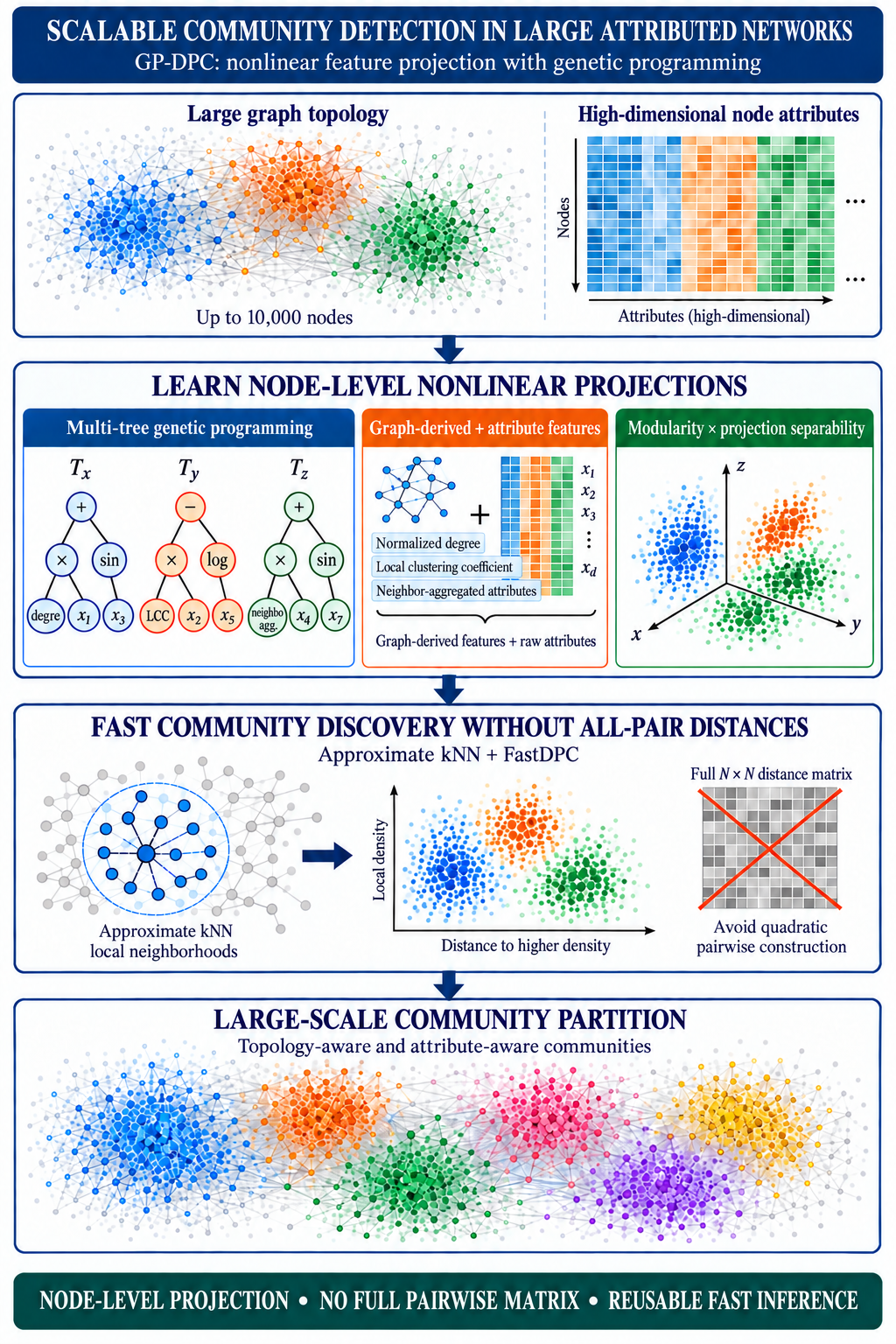
Attributed networks are widely used to model engineering systems in which both relational structure and node-specific information are important, such as social platforms, transportation networks, and knowledge graphs. Community detection in such networks requires methods that can jointly exploit graph topology and heterogeneous node attributes while remaining computationally feasible. To address this problem, this paper proposes GP-DPC, a genetic programming-driven framework for projectionguided community detection in attributed networks. Instead of evolving pairwise similarity functions, GP-DPC uses a multi-tree GP representation to learn three nodelevel nonlinear projection functions, which map attributed nodes into a compact lowdimensional space. Fast density peaks clustering is then performed in the learned space through an approximate kNN strategy, avoiding full pairwise distance computation. A community-aware fitness function combines structural modularity and projection-space separability to guide the evolutionary search. Experiments cover synthetic Handl and LFR benchmarks and five real-world attributed networks. Direct comparisons on the Handl 10c500d and 24c1800d benchmarks and on Cora, Citeseer, and ACM show competitive detection accuracy, while runtime analyses indicate practical inference efficiency. These results support GP-DPC as a promising framework for engineeringoriented attributed network community detection.
- Open Access
- Article
GP-DPC: Genetic Programming-Driven Nonlinear Feature Projection for Scalable Community Detection in Attributed Networks
- Chaoyi Ding 1,
- Jianfeng Wang 2,
- Haonan Li 3,
- Xingsi Xue 4,*
Author Information
Received: 29 Jun 2026 | Revised: 14 Sep 2026 | Accepted: 29 Sep 2026 | Published: 13 Oct 2026
Abstract
Graphical Abstract
Keywords
attributed networks | community detection | genetic programming | density peaks clustering | projection learning
References
- 1.
Li, J.; Lai, S.; Shuai, Z.; et al. A Comprehensive Review of Community Detection in Graphs. Neurocomputing 2024, 600, 128169. https://doi.org/10.1016/j.neucom.2024.128169.
- 2.
Khawaja, F.R.; Zhang, Z.; Memon, Y.; et al. Exploring Community Detection Methods and Their Diverse Applications in Complex Networks: A Comprehensive Review. Soc. Netw. Anal. Min. 2024, 14, 115. https://doi.org/10.1007/s13278-024-01274-1.
- 3.
Jin, D.; Yu, Z.; Jiao, P.; et al. A Survey of Community Detection Approaches: From Statistical Modeling to Deep Learning. IEEE Trans. Knowl. Data Eng. 2023, 35, 1149–1170. https://doi.org/10.1109/tkde.2021.3104155.
- 4.
Kumar, P.; Jain, R.; Chaudhary, S.; et al. Solving Community Detection in Social Networks: A Comprehensive Study. In Proceedings of the 2021 5th International Conference on Computing Methodologies and Communication (ICCMC), Erode, India, 8–10 April 2021; pp. 239–345. https://doi.org/10.1109/iccmc51019.2021.9418412.
- 5.
Naik, D.; Ramesh, D.; Gandomi, A.H.; et al. Parallel and Distributed Paradigms for Community Detection in Social Networks: A Methodological Review. Expert Syst. Appl. 2022, 187, 115956. https://doi.org/10.1016/j.eswa.2021.115956.
- 6.
Manipur, I.; Giordano, M.; Piccirillo, M.; et al. Community Detection in Protein-Protein Interaction Networks and Applications. IEEE/ACM Trans. Comput. Biol. Bioinform. 2023, 20, 217–237. https://doi.org/10.1109/tcbb.2021.3138142.
- 7.
Gasparetti, F.; Sansonetti, G.; Micarelli, A. Community Detection in Social Recommender Systems: A Survey. Appl. Intell. 2021, 51, 3975–3995. https://doi.org/10.1007/s10489-020-01962-3.
- 8.
Chen, D.; Su, H.; Zhang, H. Community Detection-Based Renormalization Method for Power Grids Topology. IEEE Trans. Ind. Inform. 2026, 22, 1916–1926. https://doi.org/10.1109/tii.2025.3632843.
- 9.
Safarzadeh, M.; Yousefi, G.R.; Latify, M.A.; et al. Power System Controlled Islanding Using Directed Motif-Based Spectral Clustering: A Novel Complex Network Perspective. IET Smart Grid 2025, 8, e70007. https://doi.org/10.1049/stg2.70007.
- 10.
Hu, H.; Qi, Y.; Kang, N.; et al. Optimizing Warehouse Product Allocation at JD.com: A Community Detection-Driven Approach. Eur. J. Oper. Res. 2026, 334, 315–335. https://doi.org/10.1016/j.ejor.2026.04.040.
- 11.
Wu, J.; Dai, T.; Guan, P.; et al. Opportunistic Routing for Mobile Edge Computing: A Community Detected and Task Priority Aware Approach. Comput. Netw. 2025, 258, 111000. https://doi.org/10.1016/j.comnet.2024.111000.
- 12.
Antosiewicz, M.; Szufel, P.; Kamiński, B.; et al. Clustering Problem in Self-Organising Communication Networks on the Example of Smart Vehicle Transportation System. Przegląd Stat. Stat. Rev. 2025, 72, 1–24. https://doi.org/10.59139/ps.2025.04.1.
- 13.
Hu, J.H.; Sun, Y.N.; Qin, W. A Key Process Identification Framework for Aircraft Assembly Production Based on the Network with Physical Attributes. J. Manuf. Syst. 2025, 80, 595–609. https://doi.org/10.1016/j.jmsy.2025.03.024.
- 14.
Makanda, I.L.D.; Yang, M.; Shi, H.; et al. Leveraging Natural Language Processing and Community Detection for Shaping Manufacturing Communities in Social Manufacturing. J. Manuf. Syst. 2024, 74, 1091–1105. https://doi.org/10.1016/j.jmsy.2024.05.020.
- 15.
El-Moussaoui, M.; Hanine, M.; Kartit, A.; et al. A Systematic Review of Deep Learning Methods for Community Detection in Social Networks. Front. Artif. Intell. 2025, 8, 1572645. https://doi.org/10.3389/frai.2025.1572645.
- 16.
Chunaev, P. Community Detection in Node-Attributed Social Networks: A Survey. Comput. Sci. Rev. 2020, 37, 100286. https://doi.org/10.1016/j.cosrev.2020.100286.
- 17.
Wang, Z.; Yang, J.; Guan, J.; et al. Enhanced Denesity Peak Clustering for High-Dimensional Data. In Proceedings of the Thirty-Ninth AAAI Conference on Artificial Intelligence and Thirty-Seventh Conference on Innovative Applications of Artificial Intelligence and Fifteenth Symposium on Educational Advances in Artificial Intelligence, Philadelphia, PA, USA, 25 February–4 March 2025; Volume 39, pp. 21411–21419. https://doi.org/10.1609/aaai.v39i20.35442.
- 18.
Lensen, A.; Xue, B.; Zhang, M. Genetic Programming for Evolving Similarity Functions for Clustering: Representations and Analysis. Evol. Comput. 2020, 28, 531–561. https://doi.org/10.1162/evco_a_00264.
- 19.
Blondel, V.D.; Guillaume, J.L.; Lambiotte, R.; et al. Fast Unfolding of Communities in Large Networks. J. Stat. Mech. Theory Exp. 2008, 2008, P10008. https://doi.org/10.1088/1742-5468/2008/10/p10008.
- 20.
Lu, H.; Halappanavar, M.; Kalyanaraman, A. Parallel Heuristics for Scalable Community Detection. Parallel Comput. 2015, 47, 19–37. https://doi.org/10.1016/j.parco.2015.03.003.
- 21.
Wang, Z.; Lin, X.; Li, X.; et al. Swift Unfolding of Communities: GPU-Accelerated Louvain Algorithm. In Proceedings of the 30th ACM SIGPLAN Annual Symposium on Principles and Practice of Parallel Programming, Las Vegas, NV, USA, 1–5 March 2025; pp. 441–454. https://doi.org/10.1145/3710848.3710884.
- 22.
Traag, V.A.; Waltman, L.; van Eck, N.J. From Louvain to Leiden: Guaranteeing Well-Connected Communities. Sci. Rep. 2019, 9, 5233. https://doi.org/10.1038/s41598-019-41695-z.
- 23.
Rodriguez, A.; Laio, A. Clustering by Fast Search and Find of Density Peaks. Science 2014, 344, 1492–1496. https://doi.org/10.1126/science.1242072.
- 24.
Chen, Y.; Hu, X.; Fan, W.; et al. Fast Density Peak Clustering for Large Scale Data Based on kNN. Knowl.-Based Syst. 2020, 187, 104824. https://doi.org/10.1016/j.knosys.2019.06.032.
- 25.
Berahmand, K.; Sheikhpour, R.; Saberi-Movahed, F.; et al. OA2H-SP: One-Step Anchor-Adaptive Hypergraph Spectral Clustering. In Proceedings of the 2025 IEEE International Conference on Data Mining (ICDM), Washington, DC, USA, 12–15 November 2025; pp. 1048–1054. https://doi.org/10.1109/icdm65498.2025.00113.
- 26.
Mohammadi, M.; Berahmand, K.; Forouzandeh, S.; et al. Dual-View Entropy-Regularized Nonnegative Matrix Factorization for Attributed Graph Clustering. Inf. Sci. 2025, 721, 122566. https://doi.org/10.1016/j.ins.2025.122566.
- 27.
Berahmand, K.; Mohammadi, M.; Sheikhpour, R.; et al. Relative Entropy-Based Regularized Non-Negative Matrix Factorization for Attributed Graph Clustering. ACM Trans. Knowl. Discov. Data 2025, 19, 1–28. https://doi.org/10.1145/3765742.
- 28.
Berahmand, K.; Bahadori, S.; Abadeh, M.N.; et al. SDAC-DA: Semi-Supervised Deep Attributed Clustering Using Dual Autoencoder. IEEE Trans. Knowl. Data Eng. 2024, 36, 6989–7002. https://doi.org/10.1109/tkde.2024.3389049.
- 29.
McCallum, A.K.; Nigam, K.; Rennie, J.; et al. Automating the Construction of Internet Portals with Machine Learning. Inf. Retr. 2000, 3, 127–163. https://doi.org/10.1023/a:1009953814988.
- 30.
Giles, C.L.; Bollacker, K.D.; Lawrence, S. CiteSeer: An Automatic Citation Indexing System. In Proceedings of the Third ACM Conference on Digital Libraries, Pittsburgh, PA, USA, 23–26 June 1998; pp. 89–98. https://doi.org/10.1145/276675.276685.
- 31.
Sen, P.; Namata, G.; Bilgic, M.; et al. Collective Classification in Network Data. AI Mag. 2008, 29, 93–106. https://doi.org/10.1609/aimag.v29i3.2157.
- 32.
Tang, J.; Zhang, J.; Yao, L.; et al. ArnetMiner: Extraction and Mining of Academic Social Networks. In Proceedings of the 14th ACM SIGKDD International Conference on Knowledge Discovery and Data Mining, Las Vegas, NV, USA, 24–27 August 2008; pp. 990–998. https://doi.org/10.1145/1401890.1402008.
- 33.
Krapivin, M.; Marchese, M.; Casati, F. Exploring and Understanding Citation-Based Scientific Metrics. Adv. Complex Syst. 2010, 13, 59–81. https://doi.org/10.1142/s0219525910002487.
- 34.
Ng, A.Y.; Jordan, M.I.; Weiss, Y. On Spectral Clustering: Analysis and an Algorithm. In Proceedings of the 15th International Conference on Neural Information Processing Systems: Natural and Synthetic, Vancouver, BC, Canada, 3–8 December 2001; pp. 849–856.
- 35.
Hasanzadeh, A.; Hajiramezanali, E.; Narayanan, K.; et al. Semi-Implicit Graph Variational Auto-Encoders. In Proceedings of the 33rd International Conference on Neural Information Processing Systems, Vancouver, BC, Canada, 8–14 December 2019; Volume 32, pp. 10712–10723.
- 36.
Ding, Y.; Tian, L.P.; Lei, X.; et al. Variational Graph Auto-Encoders for miRNA-Disease Association Prediction. Methods 2021, 192, 25–34. https://doi.org/10.1016/j.ymeth.2020.08.004.


This work is licensed under a Creative Commons Attribution 4.0 International License.

 Suite 4002 Level 4, 447 Collins Street, Melbourne, Victoria 3000, Australia
 General Inquiries: info@sciltp.com