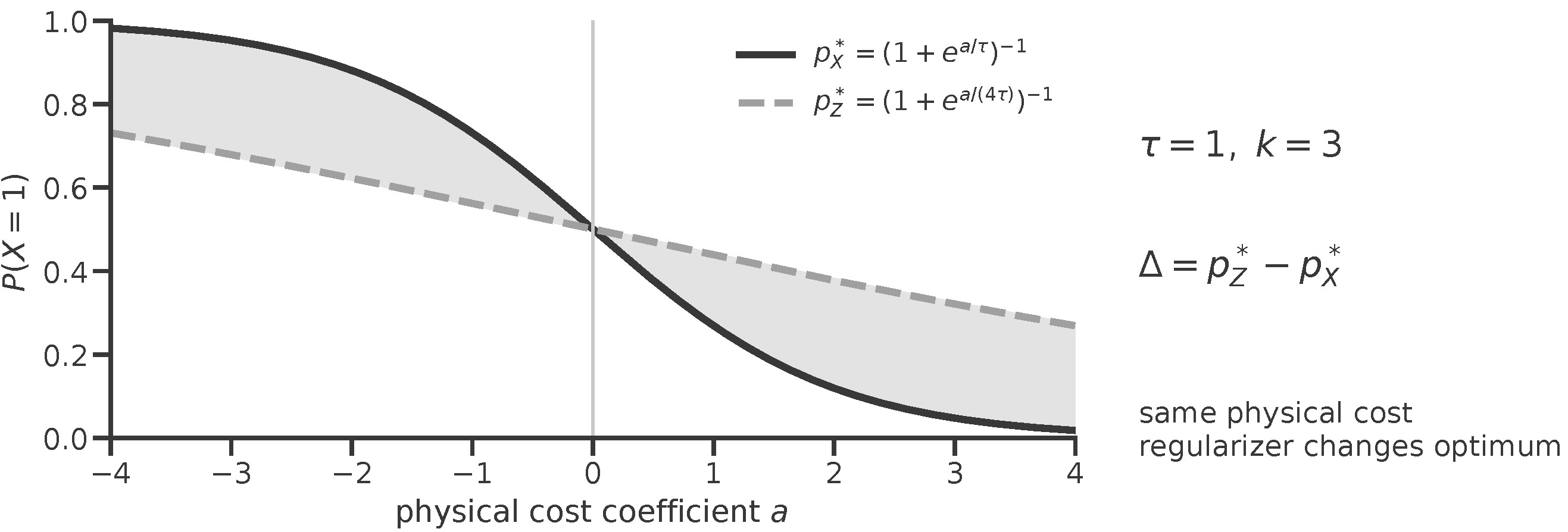
A representation change can leave an optimization problem’s feasible decisions and costs intact while altering how a stochastic decision layer uses it. We develop separate tests for the decoded probability law and the complete-policy relative-entropy objective of finite log-linear policies with deterministic decoding and compatible positive reference laws. Equality of the weighted residual-feature spectra across decoder fibres characterizes preservation of the decoded law for every natural parameter. Given that equality, a common spectrum concentrated at one point also preserves the relative-entropy objective; a spectrum with several atoms adds a nonnegative conditional-divergence penalty. The penalties add across compatible reformulation stages, and an exact correction recovers the physical objective. For compact convex policy classes, preserving optimal values for every cost is stronger than preserving optimal physical policies. An exact rational checker and a bounded-integer compiler implement the certificates. In a designed six-period scheduling study with 20 cost vectors, four tied auxiliary bits per period give a median physical-policy total variation of 0.245 at unit regularization (95% percentile bootstrap interval, 0.224–0.254). The corrected and untied controls recover the physical implementation to floating-point accuracy. Checks with two optimizers and three initializations expose four unresolved gradient-tolerance failures. Analytically solved controls separate distortion caused by the representation from numerical optimization error.
- Open Access
- Article
Equivalent Optima, Different Policies: Certified Distribution-Preserving Reformulations for AI Decision Systems
Author Information
Received: 23 September 2026 | Revised: 08 October 2026 | Accepted: 13 October 2026 | Published: 21 October 2026
Abstract
Graphical Abstract
Keywords
AI decision systems | optimization reformulation | probabilistic compilation | relative entropy | certificate checking | constrained learning
References
- 1.
Dudek, J.M.; Phan, V.H.N.; Vardi, M.Y. ProCount: Weighted Projected Model Counting with Graded Project-Join Trees. In Theory and Applications of Satisfiability Testing—SAT 2021; Springer International Publishing: Cham, Switzerland, 2021; Volume 12831, pp. 152–170. https://doi.org/10.1007/978-3-030-80223-3_11.
- 2.
Gupta, R.; Sharma, S.; Roy, S.; et al. WAPS: Weighted and Projected Sampling. In Tools and Algorithms for the Construction and Analysis of Systems (TACAS 2019); Vojnar, T., Zhang, L., Eds.; Springer International Publishing: Cham, Switzerland, 2019; Volume 11427, pp. 59–76. https://doi.org/10.1007/978-3-030-17462-0 4. Correction in 2019, p. C1. https://doi.org/10.1007/978-3-030-17462-0_29.
- 3.
Chakraborty, S.; Fremont, D.; Meel, K.; et al. Distribution-Aware Sampling and Weighted Model Counting for SAT. In Proceedings of the AAAI Conference on Artificial Intelligence, Quebec City, QC, Canada, 27–31 July 2014; Volume 28, pp. 1722–1730. https://doi.org/10.1609/aaai.v28i1.8990.
- 4.
Bryant, R.E.; Tan, Y.K.; Heule, M.J.H. Certifying Projected Knowledge Compilation. In Proceedings of the 28th International Conference on Theory and Applications of Satisfiability Testing (SAT 2025), Glasgow, UK, 12–15 August 2025; Volume 341, pp. 8:1–8:22. https://doi.org/10.4230/lipics.sat.2025.8.
- 5.
Liberti, L. Reformulations in Mathematical Programming: Definitions and Systematics. RAIRO-Oper. Res. 2009, 43, 55–85. https://doi.org/10.1051/ro/2009005.
- 6.
Bentkamp, A.; Fernandez Mir, R.; Avigad, J. Verified Reductions for Optimization. In Tools and Algorithms for the Construction and Analysis of Systems; Springer Nature Switzerland: Cham, Switzerland, 2023; Volume 13994, pp. 74–92. https://doi.org/10.1007/978-3-031-30820-8_ 8.
- 7.
Robbins, H.; Lawless, C.; Udell, M.; et al. FLARE: Verifying MILP Reformulations with LLM-Based Theorem Proving. arXiv 2026, arXiv:2608.25220.
- 8.
Agrawal, A.; Verschueren, R.; Diamond, S.; et al. A Rewriting System for Convex Optimization Problems. J. Control. Decis. 2018, 5, 42–60. https://doi.org/10.1080/23307706.2017.1397554.
- 9.
Legat, B.; Dowson, O.; Dias Garcia, J.; et al. MathOptInterface: A Data Structure for Mathematical Optimization Problems. INFORMS J. Comput. 2022, 34, 672–689. https://doi.org/10.1287/ijoc.2021.1067.
- 10.
Amos, B.; Kolter, J.Z. OptNet: Differentiable Optimization as a Layer in Neural Networks. In Proceedings of the 34th International Conference on Machine Learning, Sydney, NSW, Australia, 6–11 August 2017; Volume 70, pp. 136–145. http://proceedings.mlr.press/v70/amos17a/amos17a.pdf.
- 11.
Agrawal, A.; Amos, B.; Barratt, S.; et al. Differentiable Convex Optimization Layers. In Proceedings of the 33rd International Conference on Neural Information Processing Systems, Vancouver, BC, Canada, 8–14 December 2019; Volume 32, pp. 9562–9574.
- 12.
Vlastelica, M.; Paulus, A.; Musil, V.; et al. Differentiation of Blackbox Combinatorial Solvers. In Proceedings of the Eighth International Conference on Learning Representations (ICLR 2020), Online, 26–30 April 2020.
- 13.
Besancon, M.; Dias Garcia, J.; Legat, B.; et al. Flexible Differentiable Optimization via Model Transformations. INFORMS J. Comput. 2024, 36, 456–478. https://doi.org/10.1287/ijoc.2022.0283.
- 14.
Mandi, J.; Kotary, J.; Berden, S.; et al. Decision-Focused Learning: Foundations, State of the Art, Benchmark and Future Opportunities. J. Artif. Intell. Res. 2024, 80, 1623–1701. https://doi.org/10.1613/jair.1.15320.
- 15.
Ahmaditeshnizi, A.; Gao, W.; Udell, M. OptiMUS: Scalable Optimization Modeling with (MI)LP Solvers and Large Language Models. In Proceedings of the International Conference on Machine Learning, Vienna, Austria, 21–27 July 2024; Volume 235, pp. 577–596. https://proceedings.mlr.press/v235/ahmaditeshnizi24a.html.
- 16.
Darwiche, A.; Marquis, P. A Knowledge Compilation Map. J. Artif. Intell. Res. 2002, 17, 229–264. https://doi.org/10.1613/jair.989.
- 17.
Kimmig, A.; Van den Broeck, G.; De Raedt, L. Algebraic Model Counting. J. Appl. Log. 2017, 22, 46–62. https://doi.org/10.1016/j.jal.2016.11.031.
- 18.
Maene, J.; De Raedt, L. The Gradient of Algebraic Model Counting. In Proceedings of the Thirty-Ninth AAAI Conference on Artificial Intelligence and Thirty-Seventh Conference on Innovative Applications of Artificial Intelligence and Fifteenth Symposium on Educational Advances in Artificial Intelligence, Philadelphia, PA, USA, 25 February–4 March 2025; Volume 39, pp. 19367–19377. https://doi.org/10.1609/aaai.v39i18.34132.
- 19.
Holtzen, S.; Van den Broeck, G.; Millstein, T. Scaling Exact Inference for Discrete Probabilistic Programs. Proc. ACM Program. Lang. 2020, 4, 1–31. https://doi.org/10.1145/3428208.
- 20.
Eberl, M.; Holzl, J.; Nipkow, T. A Verified Compiler for Probability Density Functions. In Programming Languages and Systems; Springer: Berlin/Heidelberg, Germany, 2015; Volume 9032, pp. 80–104. https://doi.org/10.1007/978-3-662-46669-8_4.
- 21.
Tassarotti, J.; Tristan, J.B. Verified Density Compilation for a Probabilistic Programming Language. Proc. ACM Program. Lang. 2023, 7, 615–637. https://doi.org/10.1145/3591245.
- 22.
Staton, S.; Yang, H.; Wood, F.; et al. Semantics for Probabilistic Programming: Higher-Order Functions, Continuous Distributions, and Soft Constraints. In Proceedings of the LICS’16: 31st Annual ACM/IEEE Symposium on Logic in Computer Science, New York, NY, USA, 5–8 July 2016; pp. 525–534. https://doi.org/10.1145/2933575.2935313.
- 23.
Valiant, L.G. The Complexity of Enumeration and Reliability Problems. SIAM J. Comput. 1979, 8, 410–421. https://doi.org/10.1137/0208032.
- 24.
Fichte, J.K.; Hecher, M.; Morak, M.; et al. Solving Projected Model Counting by Utilizing Treewidth and Its Limits. Artif. Intell. 2023, 314, 103810. https://doi.org/10.1016/j.artint.2022.103810.
- 25.
Ying, Y.; Zhai, Q.; Zhou, Y.; et al. An LSTM-Driven Efficient Solution Algorithm of Economic Dispatch with Integral Constraints for Energy-Intensive Enterprise Microgrids. AI Eng. 2025, 1, 5. https://doi.org/10.53941/aieng.2025.100005.
- 26.
Rabbanian, S.; Wang, H.; Wu, L. Adaptive Multi-Agent Reinforcement Learning for Electric Vehicle On-Road Charging Optimization under Dynamic Traffic Conditions. AI Eng. 2026, 2, 2. https://doi.org/10.53941/aieng.2026.100002.
- 27.
Zhang, B. NeSyWikiCompiler: A Neural-Symbolic Compiler for Verifiable AI Knowledge Engineering. AI Eng. 2026, 2, 11. https://doi.org/10.53941/aieng.2026.100011.
- 28.
Kumar, S.; Bist, S.H. A Comprehensive AI Security Pipeline: Drift Detection, Adversarial Robustness and Automated ML Testing. AI Eng. 2026, 2, 13. https://doi.org/10.53941/aieng.2026.100013.
- 29.
Yuan, X.; Chen, S.; Hu, B.; et al. Open-Set Semiconductor Defect Classification in SEM Images via Uncertainty-Aware Local Prototype Alignment. AI Eng. 2026, 2, 12. https://doi.org/10.53941/aieng.2026.100012.
- 30.
Pandey, A. A Five-Layer Reference Architecture for First-Party Enterprise Knowledge Graphs with GraphRAG Integration and Governance Controls. AI Eng. 2026, 2, 14. https://doi.org/10.53941/aieng.2026.100014.
- 31.
Geist, M.; Scherrer, B.; Pietquin, O. A Theory of Regularized Markov Decision Processes. In Proceedings of the International Conference on Machine Learning, Long Beach, CA, USA, 9–15 June 2019; Volume 97, pp. 2160–2169. https://proceedings.mlr.press/v97/geist19a.html.
- 32.
Peters, J.; Mulling, K.; Altun, Y. Relative Entropy Policy Search. In Proceedings of the AAAI Conference on Artificial Intelligence, Atlanta, GA, USA, 11–15 July 2010; Volume 24, pp. 1607–1612. https://doi.org/10.1609/aaai.v24i1.7727.
- 33.
Baram, N.; Tennenholtz, G.; Mannor, S. Action Redundancy in Reinforcement Learning. In Proceedings of the Thirty-Seventh Conference on Uncertainty in Artificial Intelligence, Online, 27–30 July 2021; Volume 161, pp. 376–385. https://proceedings.mlr.press/v161/baram21a.html.
- 34.
Bengio, Y.; Lahlou, S.; Deleu, T.; et al. GFlowNet Foundations. J. Mach. Learn. Res. 2023, 24, 1–55. https://jmlr.org/papers/v24/22-0364.html.
- 35.
Papandreou, G.; Yuille, A.L. Perturb-and-MAP Random Fields: Using Discrete Optimization to Learn and Sample from Energy Models. In Proceedings of the 2011 IEEE International Conference on Computer Vision (ICCV), Barcelona, Spain, 6–13 November 2011; pp. 193–200. https://doi.org/10.1109/iccv.2011.6126242.
- 36.
Hazan, T.; Jaakkola, T. On the Partition Function and Random Maximum a-Posteriori Perturbations. In Proceedings of the 29th International Conference on Machine Learning, Edinburgh, Scotland, 26 June–1 July 2012; pp. 1667–1674.
- 37.
Paulus, M.B.; Choi, D.; Tarlow, D.; et al. Gradient Estimation with Stochastic Softmax Tricks. In Proceedings of the 34th International Conference on Neural Information Processing Systems, Online, 6–12 December 2020; Volume 33, pp. 5691–5704.
- 38.
Ranganath, R.; Tran, D.; Blei, D. Hierarchical Variational Models. In Proceedings of the 33rd International Conference on Machine Learning, New York, NY, USA, 19–24 June 2016; Volume 48, pp. 324–333.
- 39.
Nielsen, D.; Jaini, P.; Hoogeboom, E.; et al. SurVAE Flows: Surjections to Bridge the Gap between VAEs and Flows. In Proceedings of the 34th Conference on Neural Information Processing Systems (NeurIPS 2020), Online, 6–12 December 2020; Volume 33, pp. 12685–12696.
- 40.
Nielsen, F.; Garcia, V. Statistical Exponential Families: A Digest with Flash Cards. arXiv 2009, arXiv:0911.4863v2.
- 41.
Louis, T.A. Finding the Observed Information Matrix when Using the EM Algorithm. J. R. Stat. Soc. Ser. B Stat. Methodol. 1982, 44, 226–233. https://doi.org/10.1111/j.2517-6161.1982.tb01203.x.


This work is licensed under a Creative Commons Attribution 4.0 International License.