
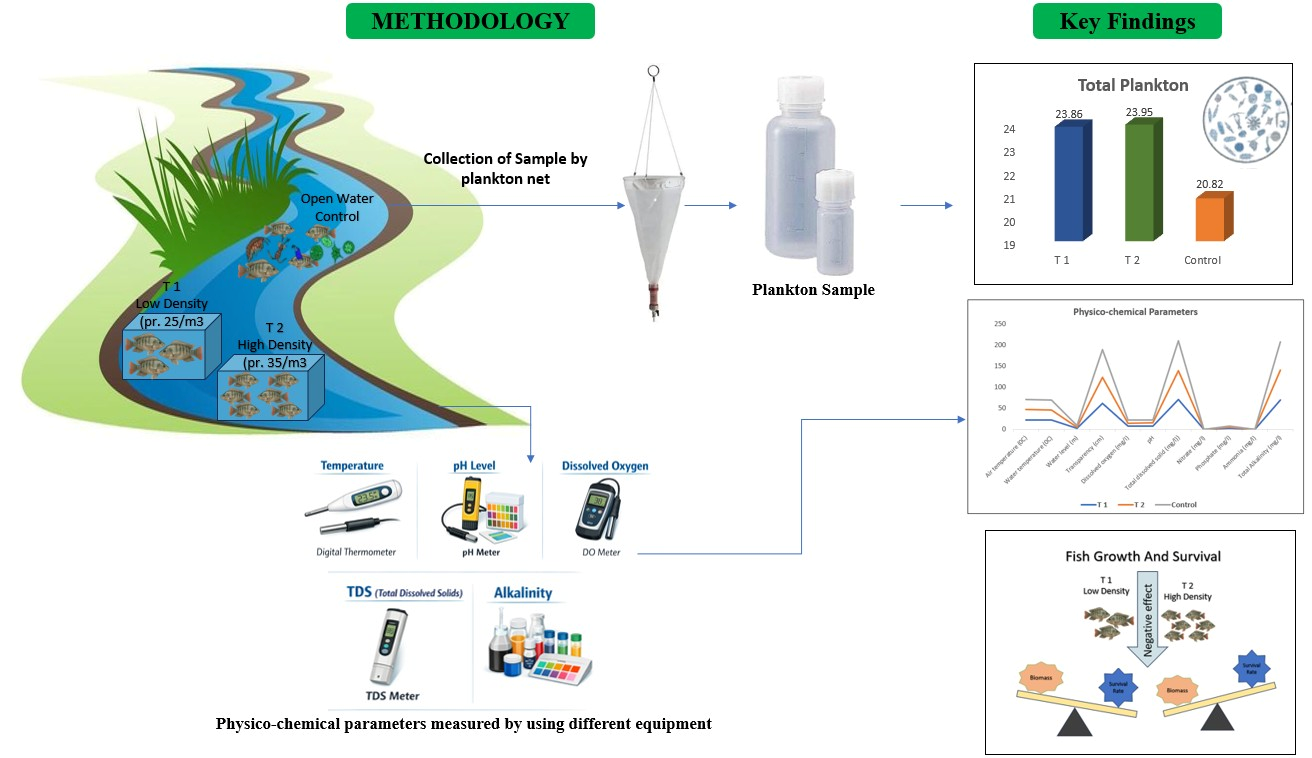
Cage culture systems in diverse aquatic habitats represent an emerging approach in aquaculture, but they face multiple challenges, including water quality management. The purpose of this study was to examine changes in biological and physicochemical water quality over 180 days in the Tangon River, Bangladesh, resulting from cage fish farming compared with open water. Oreochromis niloticus fingerlings were stocked in distinct cages with two diverse stocking densities (treatments): 25 fish/m3 (T I) and 35 fish/m3 (T II), while the non-cage farming site was treated as the control for the study. The study confirmed that the control and treatment sites had differing water quality. There were 67 different genera of plankton identified in the cages at the farming locations, compared to 44 at the control site. Cage farming site has a far higher total plankton count than the control site with total plankton mean values of 23.95 ± 7.41 × 10³ cells/L in cage farming sites and 20.82 ± 7.00 × 10³ cells/L in control sites. Cage farming sites exhibited higher mean plankton abundance than the control site; however, significant differences were detected primarily in Cyanophyceae, Copepoda and total zooplankton abundance, suggesting localized ecological responses rather than widespread ecosystem alteration. Overall, it was shown that Treatment I outperformed Treatment II in terms of fish biomass production and survival rate, suggesting that increased densities have a detrimental effect on growth.
- Open Access
- Article
Optimizing River Productivity: Comparative Insights into Ecological Integrity and Production Responses to River-Based Cage Fish Farming
- Zannatul Ferdoushi Ferdoushi 1,*,
- Rafat Hossain 2,
- K. M. Toufiq Hassan 1,
- Md. Shahanur Alam 1,
- Md. Masud Rana 3,
- Mst. Irin Akter Lima 1
Author Information
Received: 21 Apr 2026 | Revised: 17 Jun 2026 | Accepted: 26 Jun 2026 | Published: 16 Jul 2026
Abstract
Graphical Abstract
Keywords
water quality | plankton | abundance | cage farm | distribution, growth
References
- 1.
Shamsuzzaman, M.M.; Islam, M.M.; Tania, N.J.; et al. Fisheries resources of Bangladesh: Present status and future direction. Aquac. Fish. 2017, 2, 145–156. https://doi.org/10.1016/j.aaf.2017.03.006.
- 2.
Karnatak, G.; Das, B.K.; Mishal, P.; et al. Impact of stocking density on growth, feed utilization and survival of cage reared minor carp, Labeo bata (Hamilton, 1822) in Maithon reservoir, India. Aquaculture. 2020, 532, 736078. https://doi.org/10.1016/j.aquaculture.2020.736078.
- 3.
Hassan, M.A.; Mishal, P.; Karnatak, G.; et al. Towards the blue revolution in India: Prospects for inland open waters. World Aquac. 2017, 48, 25–28.
- 4.
Cornel, G.E.; Whoriskey, F.G. The effects of rainbow trout (Oncorhynchus mykiss) cage culture on the water quality, zooplankton, benthos and sediments of Lac du Passage, Quebec. Aquaculture 1993, 109, 101–117. https://doi.org/10.1016/0044-8486(93)90208-G.
- 5.
Ara, J.; Jewel, A.S.; Hossain, A.; et al. Determination of suitable species for cage fish farming in Chalan beel, Bangladesh. Int. J. Fish. Aquat. Stud. 2020, 8, 315–320.
- 6.
Sarkar, U.K.; Sandhya, K.M.; Mishal, P.; et al. Status, prospects, threats, and the way forward for sustainable management and enhancement of the tropical Indian reservoir fisheries: An overview. Rev. Fish. Sci. Aquac. 2018, 26, 155–175. https://doi.org/10.1080/23308249.2017.1373744.
- 7.
Riera, R.; Tuset, V.M.; Rodríguez, M.; et al. Analyzing functional diversity to determine the effects of fish cages in insular coastal wild fish assemblages. Aquaculture 2017, 479, 384–395. https://doi.org/10.1016/j.aquaculture.2017.06.014.
- 8.
Grigorakis, K.; Rigos, G. Aquaculture effects on environmental and public welfare–the case of Mediterranean mariculture. Chemosphere 2011, 85, 899–919. https://doi.org/10.1016/j.chemosphere.2011.07.015.
- 9.
Gondwe, M.J.; Guildford, S.J.; Hecky, R.E. Physical–chemical measurements in the water column along a transect through a tilapia cage fish farm in Lake Malawi, Africa. J. Great Lakes Res. 2011, 37, 102–113. https://doi.org/10.1016/j.jglr.2010.10.001.
- 10.
Aktan, Y.; Tufekci, V.; Tufekci, H.; et al. Distribution patterns, biomass estimates and diversity of phytoplankton in Izmit Bay (Turkey). Estuar. Coast. Shelf Sci. 2005, 64, 372–384. https://doi.org/10.1016/j.ecss.2005.03.003.
- 11.
Huang, G.; Wang, Q.; Yuan, T.; et al. Combined effects of fish cage culture and increased fishing pressure on wild fish assemblages in a large reservoir, Yangtze River basin, China. Aquaculture 2020, 526, 735373. https://doi.org/10.1016/j.aquaculture.2020.735373.
- 12.
Hossain, M.R.A.; Rahman, M.A.; Akter, S.; et al. Intervention of tilapia cage culture in the River Dakatia: Threaten or blessed to local fish diversity. Int. J. Fish. Aquat. Stud. 2017, 5, 228–232.
- 13.
APHA. Standard methods for the examination of water and wastewater. In American Public Health Association, 18th ed.; APHA: Washington, DC, USA, 1992.
- 14.
Stirling, H.P. Chemical and Biological Methods of Water Analysis for Aquaculturists; Institute of Aquaculture, University of Stirling: Stirling, UK, 1985.
- 15.
Boyd, C.E. Water quality for pond aquaculture. In Research and Development Series No.43; International Center for Aquaculture and Aquatic Environments, Alabama Agricultural Experiment Station, Auburn University: Auburn, AL, USA, 1998.
- 16.
Karikari, A.Y.; Akpabey, F.; Abban, E.K. Assessment of water quality and primary productivity characteristics of Volta Lake in Ghana. Acad. J. Environ. Sci. 2013, 1, 88–93.
- 17.
Asase, A. Effects of Stocking Density on the Production of Nile tilapia (Oreochromis niloticus) in Floating Net Cages on the Volta Lake. Ph.D. Dissertation, University of Ghana, Legon, Ghana, 2013.
- 18.
Islam, R.; Mia, J.; Lithi, U.J. Spatial and temporal disparity of fish assemblage relationship with hydrological factors in two rivers Tangon and Kulik, Thakurgaon, Bangladesh. Turkish J. Fish. Aquat. Sci. 2017, 17, 1209–1218. https://doi.org/10.4194/1303-2712-v17_6_14.
- 19.
Mobin, M.N.; Islam, M.S.; Mia, M.Y.; et al. Analysis of physicochemical properties of the Turag River water, Tongi, Gazipur in Bangladesh. J. Environ. Sci. Nat. Resour. 2014, 7, 27–33. https://doi.org/10.3329/jesnr.v7i1.22140.
- 20.
Nsonga, A. Indigenous fish species a panacea for cage aquaculture in Zambia: A case for Oreochromis macrochir (Boulenger, 1912) at Kambashi out-grower scheme. Int. J. Fish Aquat. Stud. 2014, 2, 102–105.
- 21.
Popma, T.; Masser, M. Tilapia–Life History and Biology. Southern Regional Aquaculture Center Publication No. 283. 1999. Available online: http://hdl.handle.net/20.500.12364/145 (accessed on 15 January 2026).
- 22.
Garg, R.K.; Rao, R.J.; Uchchariya, D.; et al. Seasonal variations in water quality and major threats to Ramsagar reservoir, India. African J. Environ. Sci. Technol. 2010, 4, 61–76.
- 23.
Sawant, R.; Chavan, N. Water quality status of Mahagaon reservoir from Gadhinglaj Tahsil from Maharashtra. Int. J. Sci. Environ. Technol. 2013, 2, 1196–1204.
- 24.
Samah, O.H. Microbiological and Physico-Chemical Assessment of Surface Water Quality Along Asukawkaw River in the Volta Region. Master’s Thesis, Kwame Nkrumah University of Science and Technology, Kumasi, Ghana, 2012.
- 25.
Santos, D.M.S.; Cruz, C.F.; Pereira, D.P.; et al. Microbiological water quality and gill histopathology of fish from fish farming in Itapecuru-Mirim County, Maranhão State. Acta Sci. Biol. Sci. 2012, 34, 199–205. https://doi.org/10.4025/actascibiolsci.v34i2.8460.
- 26.
Clottey, M.N.K.; Asmah, R.; Ofori-Danson, P.K.; et al. Impacts of cage culture on physico-chemical and bacteriological water quality in Lake Volta, Ghana. African J. Environ. Sci. Technol. 2016, 4, 473–480. https://doi.org/10.2989/16085914.2016.1255587.
- 27.
Nyanti, L.; Hii, K.M.; Sow, A.; et al. Impacts of aquaculture at different depths and distances from cage culture sites in Batang Ai Hydroelectric Dam Reservoir, Sarawak, Malaysia. World Appl. Sci. J. 2012, 19, 451–456.
- 28.
Sugunan, V.V. Handbook of Fisheries and Aquaculture. In Reservoir Fisheries; Trivedi, T.P., Ed.; Directorate of Knowledge Management in Agriculture ICAR: New Delhi, India, 2011; pp. 238–274.
- 29.
Rahman, M.S. Water Quality Management in Aquaculture BRAC Prokashana; BRAC Prokashana: Dhaka, Bangladesh, 1992; p. 84.
- 30.
Demir, N. Bodrum’da Kafeslerde Balik Yetistiriciliginin Fitoplanktona Etkisi. J. Agric. Sci. 2000, 6, 8–11.
- 31.
Hamaidi-Chergui, F.; Brahim Errahmani, M.; Benouaklil, F.; et al. Preliminary study on physico-chemical parameters and phytoplankton of Chiffa River (Blida, Algeria). J. Ecosyst. 2013, 148793, 9.
- 32.
Vincent, K.; Mwebaza-Ndawula, L.; Makanga, B.; et al. Variations in zooplankton community structure and water quality conditions in three habitat types in northern Lake Victoria. Lakes Reserv. Res. Manag. 2012, 17, 83–95. https://doi.org/10.1111/j.1440-1770.2012.00504.x.
- 33.
Dias, J.D. Impacto da Pisciculturaem Tanques-Rede Sobrea Estruturada Communidade Zooplanctonica em um Reservartorio Subtropical, Brasil. Master’s Thesis, Universidade Estadual de Maringa, Maringa, Brasil, 2008.
- 34.
Zevenboom, W.; Mur, L.R. N2-fixing cyanobacteria: Why they do not become dominant in Dutch, hypertrophic lakes. In Hypertrophic Ecosystem; Springer: Dordrecht, The Netherlands, 1980; pp. 123–130. https://doi.org/10.1007/978-94-009-9203-0_14.
- 35.
Mwaura, F.; Koyo, A.O.; Zech, B. Cyanobacterial blooms and the presence of cyanotoxins in small high altitude tropical headwater reservoirs in Kenya. J. Water Health. 2004, 2, 49–57. https://doi.org/10.2166/wh.2004.0005.
- 36.
Lodang, H.; Kurnia, N. Distribution and abundance of plankton in the downstream of Jeneberang River. J. Phys. Conf. Ser. 2019, 1244, 012011. https://doi.org/10.1088/1742-6596/1244/1/012011.
- 37.
Shapiro, J. Current beliefs regarding dominance by blue-greens: The case for the importance of CO2 and pH. Int. Vereinigung Theor. Angew. Limnol. Verhandlungen. 1990, 24, 38–54. https://doi.org/10.1080/03680770.1989.11898689.
- 38.
Sharma, R.C.; Singh, N.; Chauhan, A. The influence of physico-chemical parameters on phytoplankton distribution in a head water stream of Garhwal Himalayas: A case study. Egypt. J. Aquat. Res. 2016, 42, 11–21. https://doi.org/10.1016/j.ejar.2015.11.004.
- 39.
Haque, M.M.; Islam, M.A.; Ahmed, G.U.; et al. Intensive culture of Java Tilapia (Oreochromis mossambicus) in floating ponds at different stocking densities. Bangladesh J. fish. 1984, 7, 55–59.

This work is licensed under a Creative Commons Attribution 4.0 International License.

 Suite 4002 Level 4, 447 Collins Street, Melbourne, Victoria 3000, Australia
 General Inquiries: info@sciltp.com