
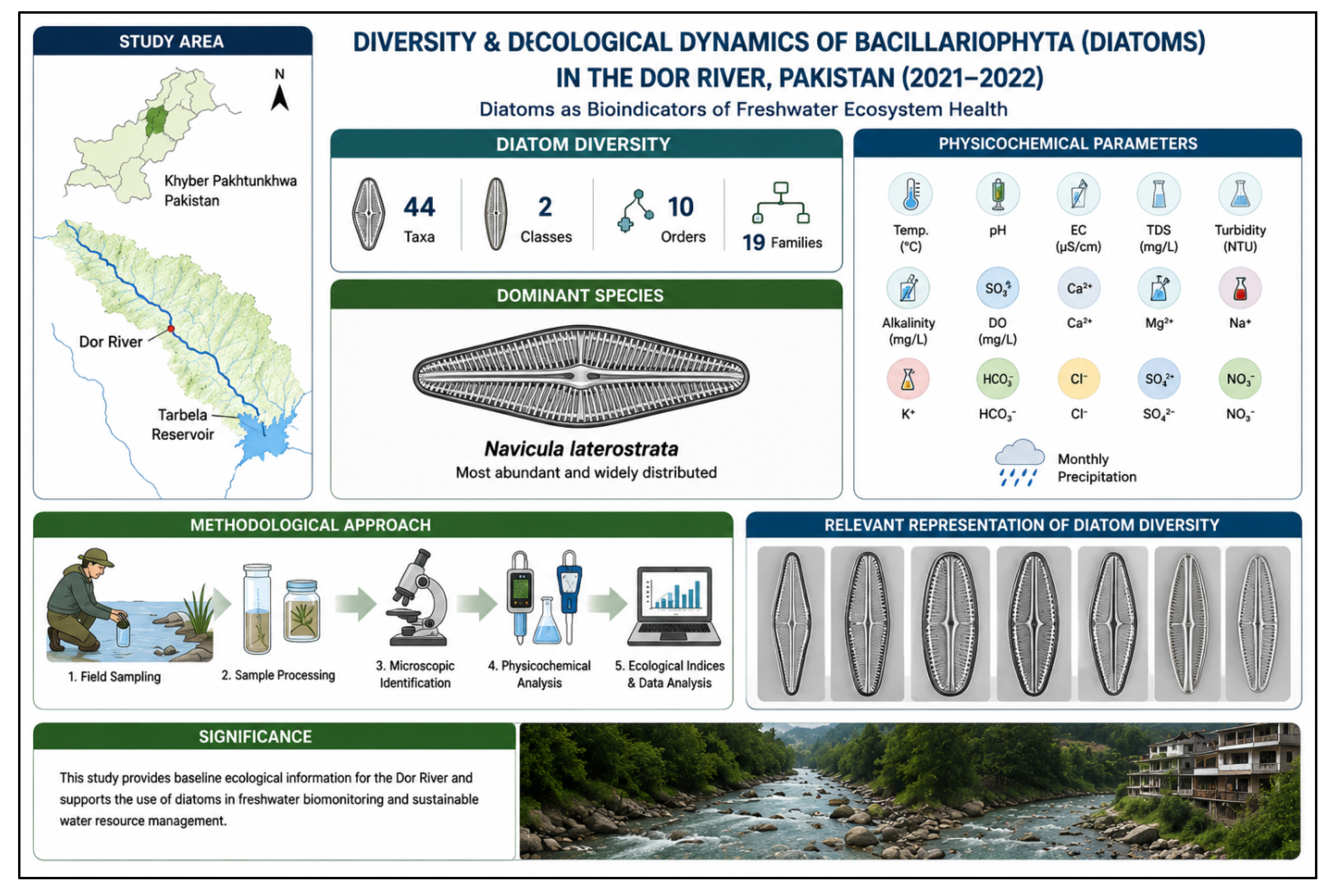
Bacillariophyta (diatoms) are important primary producers in freshwater ecosystems and are widely used as bioindicators of water quality and ecological conditions. This study investigated the taxonomic diversity, seasonal distribution, and relationships between Bacillariophyta assemblages and physicochemical characteristics of the Dor River, Abbottabad, Khyber Pakhtunkhwa, Pakistan, during 2021–2022. Monthly sampling was conducted at eight selected sites, and algal taxa were identified using standard morphological and taxonomic approaches. Physicochemical parameters were analyzed following standard protocols, while phytosociological indices and Principal Component Analysis (PCA) were used to characterize community structure and explore patterns in relation to environmental variables. A total of 46 Bacillariophyta taxa were recorded, representing two classes, ten orders, and nineteen families. Bacillariaceae, Gomphonemataceae, and Naviculaceae were among the most species-rich families, while Naviculales was the most species-rich order. Bacillariophyceae was the dominant class in the recorded assemblage. Seasonal patterns in diatom diversity and abundance varied throughout the study period, with higher values reported in December, February, and March. Navicula laterostrata had the highest reported density and Importance Value Index (IVI), whereas Navicula cryptocephala exhibited the highest frequency of occurrence. Diversity indices described variation in community structure across the sampling period. PCA revealed patterns of variation in diatom assemblages in relation to physicochemical parameters, suggesting potential relationships between environmental conditions and community composition without establishing direct causal effects. This study provides a baseline assessment of Bacillariophyta diversity in the Dor River and contributes information on the seasonal distribution of diatom assemblages and their relationships with measured water-quality parameters. Continued monitoring of diatom communities and physicochemical characteristics may support future assessments of river ecology and inform water-quality management and biodiversity conservation.
- Open Access
- Article
Diversity and Seasonal Distribution of Bacillariophyta in Relation to Physicochemical Characteristics of the Dor River, Abbottabad, Pakistan
Author Information
Received: 17 August 2026 | Revised: 21 October 2026 | Accepted: 26 October 2026 | Published: 05 November 2026
Abstract
Graphical Abstract
Keywords
bacillariophyta | freshwater diatoms | physicochemical parameters | seasonal distribution | water quality | bioindicators
References
- 1.
Tickner, D.; Opperman, J.J.; Abell, R.; et al. Bending the Curve of Global Freshwater Biodiversity Loss: An Emergency Recovery Plan. BioScience 2020, 70, 330–342. https://doi.org/10.1093/biosci/biaa002.
- 2.
IPCC. Climate Change 2023: Synthesis Report. In Contribution of Working Groups I, II and III to the Sixth Assessment Report of the Intergovernmental Panel on Climate Change; IPCC: Geneva, Switzerland, 2023. https://doi.org/10.59327/IPCC/AR6-9789291691647.
- 3.
Reynolds, C.S. The Ecology of Phytoplankton; Cambridge University Press: Cambridge, UK, 2006. https://doi.org/10.1017/cbo9780511542145.
- 4.
Mann, D.G.; Vanormelingen, P. An Inordinate Fondness? The Number, Distributions, and Origins of Diatom Species. J. Eukaryot. Microbiol. 2013, 60, 414–420. https://doi.org/10.1111/jeu.12047.
- 5.
Astuti, S.P.; Hashmi, Z.; Bilad, M.R.; et al. Freshwater microalgae as bioindicators: A review of trait-based advances, ecosystem insights, and biomonitoring innovations. Environ. Chall. 2026, 22, 101428. https://doi.org/10.1016/j.envc.2026.101428.
- 6.
Maitland, V.C.; Robinson, C.V.; Porter, T.M.; et al. Freshwater diatom biomonitoring through benthic kick-net metabarcoding. PLoS ONE 2020, 15, e0242143. https://doi.org/10.1371/journal.pone.0242143.
- 7.
Bellinger, E.G.; Sigee, D.C. Freshwater Algae: Identification, Enumeration and Use as Bioindicators, 2nd ed.; Wiley-Blackwell: Hoboken, NJ, USA, 2015. https://doi.org/10.1002/9781118917152.
- 8.
Prescott, G.W. Algae of the Western Great Lakes Area; Wm. C. Brown Company: Dubuque, IA, USA, 1962. https://doi.org/10.5962/bhl.title.4650.
- 9.
Smith, G.M. The Fresh-Water Algae of the United States, 2nd ed.; McGraw-Hill: New York, NY, USA, 1950.
- 10.
Patrick, R.; Reimer, C.W. The Diatoms of the United States, Exclusive of Alaska and Hawaii; Academy of Natural Sciences of Philadelphia: Philadelphia, PA, USA, 1966; Volume 1.
- 11.
Patrick, R.; Reimer, C.W. The Diatoms of the United States, Exclusive of Alaska and Hawaii; Academy of Natural Sciences of Philadelphia: Philadelphia, PA, USA, 1975; Volume 2; Part 1.
- 12.
Tiffany, L.H.; Britton, M.E. The Algae of Illinois; Hafner Publishing Company: New York, NY, USA, 1971.
- 13.
Krammer, K.; Lange-Bertalot, H. Bacillariophyceae; Gustav Fischer Verlag: Stuttgart, Germany, 1986.
- 14.
Wehr, J.D.; Sheath, R.G.; Kociolek, J.P. Freshwater Algae of North America: Ecology and Classification, 2nd ed.; Academic Press: Cambridge, MA, USA, 2015.
- 15.
Anjum, A.; Hussain, F.; Ilahi, I. Phytosociological studies of freshwater algae. Pak. J. Bot. 1983, 15, 123–132.
- 16.
Manikandan, S.; Elayasurya, R.; Vasanthapriya, M.; et al. Bio diversification and seasonal abundance of phycofloral scenedesmaceae in kothandaramar temple tank, West Mambalam, Chennai. Vegetos 2024, 38, 169–175. https://doi.org/10.1007/s42535-024-00924-1.
- 17.
Praseetha, A.P.; Jayaraj, R.; Sreekumar, V.B. Phytoplankton as environmental indicator for evaluating water pollution in the Kadambrayar River, Ernakulam District, Kerala, India. Vegetos 2026, 39, 1403–1420. https://doi.org/10.1007/s42535-025-01229-7.
- 18.
Keleş, S.; Çelik, K. Seasonal Distribution of Algae and Some Physical and Chemical Variables of the Shallow Çağış Pond (Balıkesir, Türkiye). Int. J. Nat. Life Sci. 2025, 9, 1–12. https://doi.org/10.47947/ijnls.1641443.
- 19.
Kumar, P.S.; Thomas, J. Seasonal distribution and population dynamics of limnic microalgae and their association with physico-chemical parameters of river Noyyal through multivariate statistical analysis. Sci. Rep. 2019, 9, 15021. https://doi.org/10.1038/s41598-019-51542-w.
- 20.
Neneng, L.; Louisa, K.; Yuliana, Y.; et al. Biodiversity and distribution of freshwater microalgae from the black-water ecosystem of Rungan River, Central Kalimantan, Indonesia. Biodiversitas J. Biol. Divers. 2025, 26, 1789–1798. https://doi.org/10.13057/biodiv/d260428.
- 21.
Muslim, T.M.; Saad, H. AL-Diwaniyah River water quality and impact on algae diversity. II. In Proceedings of the Dubai International Conference of Pure, Applied and Technological Sciences, Dubai, United Arab Emirates, 7–8 January 2025. https://doi.org/10.47832/dub.conf2-2.

This work is licensed under a Creative Commons Attribution 4.0 International License.
