
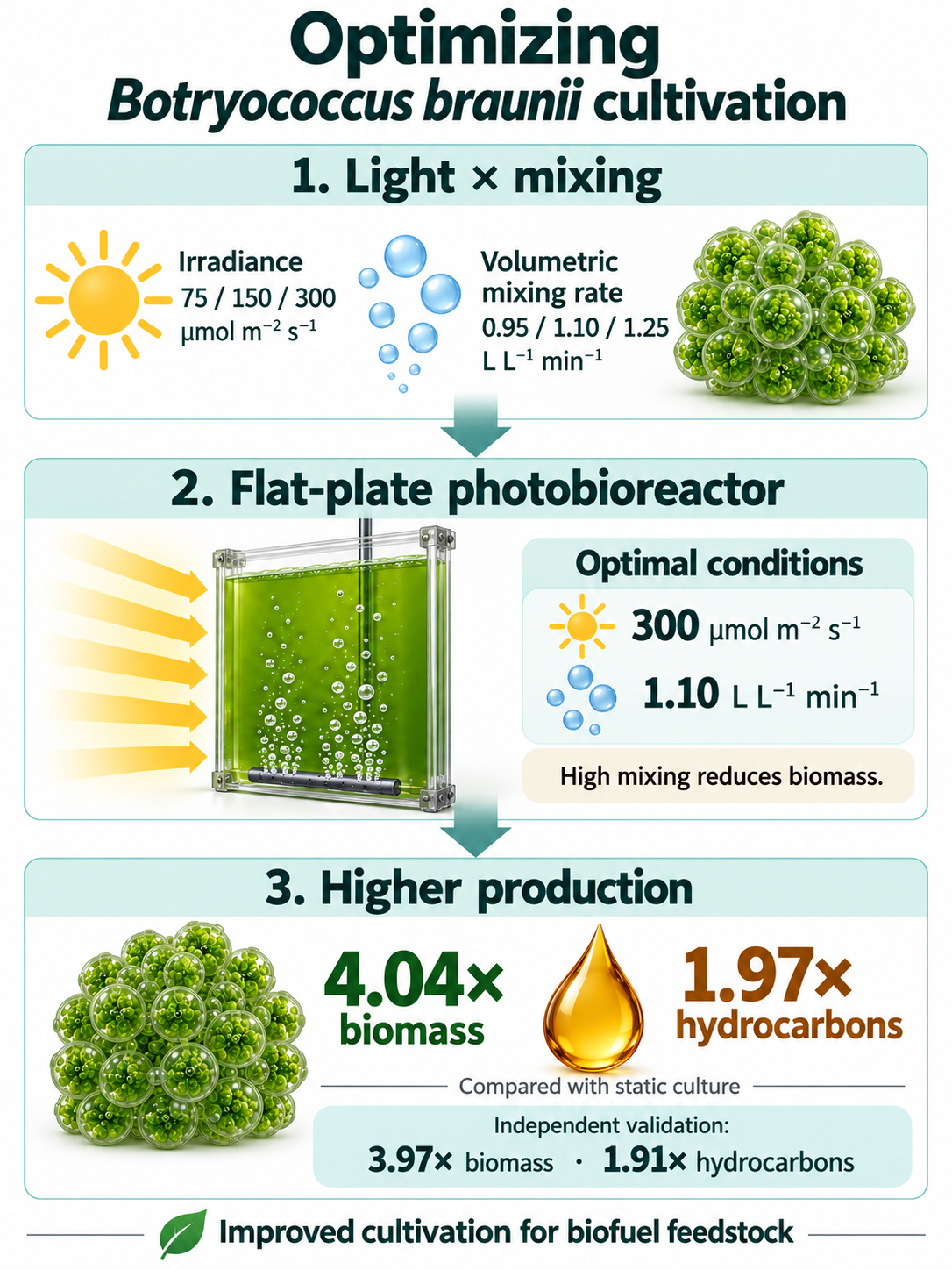
The slow growth of Botryococcus braunii impedes its large-scale cultivation as a feedstock for biofuel production despite its high hydrocarbon content. This study investigates how light and mixing regimes affect the growth performance of this green alga in a newly designed flat-plate photobioreactor. Three light intensities (75, 150 and 300 μmol s−1 m−2) and three mixing rates (0.95, 1.10 and 1.25 L L−1 min−1) were used to evaluate algal biomass and hydrocarbon production. The algal performance was then compared with a static culture under the same light and mixing conditions as in the photobioreactor. The results showed that light and mixing regimes significantly affected both biomass and hydrocarbon production in B. braunii. The best algal performance was obtained under high irradiance (300 μmol s−1 m−2) and medium mixing (1.10 L L−1 min−1). Mixing had no significant effect on biomass and hydrocarbon production under low light intensity (75 μmol s−1 m−2), while the high mixing rate (1.25 L L−1 min−1) reduced algal biomass at all light intensities. We again compared algal performance between the photobioreactor and the static culture system under the same light and mixing conditions to evaluate system efficacy. The photobioreactor produced 4.04- and 1.97-fold higher algal biomass and hydrocarbon yields, respectively, than the static culture. An independent study validated these results, showing that biomass growth and hydrocarbon production of B. braunii in the photobioreactor were 3.97-fold and 1.91-fold higher than in static culture, respectively. Therefore, a photobioreactor can increase biomass and hydrocarbon production in this slow-growing B. braunii under laboratory conditions, offering a promising strategy for future exploration of oil-producing algal species towards commercial production.
- Open Access
- Article
Hydrocarbon Production of Botryococcus braunii in a Photobioreactor: Optimization of Irradiance and Mixing Regimes
Author Information
Received: 14 September 2026 | Revised: 09 October 2026 | Accepted: 06 November 2026 | Published: 13 November 2026
Abstract
Graphical Abstract
Keywords
algae | photobioreactor | light | mixing | biomass | hydrocarbon
References
- 1.
Ashokkumar, V.; Flora, G.; Kumar, G.; et al. Cutting-Edge Advances in Alga Botryococcus for Eco-Friendly Biofuels and High-Value Bioproducts—A Critical Review. Algal Res. 2024, 83, 103676. https://doi.org/10.1016/j.algal.2024.103676.
- 2.
Nur, M.M.A.; Setyoningrum, T.M.; Budiaman, I.G.S. Potency of Botryococcus braunii Cultivated on Palm Oil Mill Effluent Wastewater as a Source of Biofuel. Environ. Eng. Res. 2017, 22, 417–425. https://doi.org/10.4491/eer.2017.053.
- 3.
de Lima, N.A.M.; Ecard, L.G.; Rodrigues, E.; et al. Use of Microalgae for Biofuel Production in the Northeast Region of Brazil, with Emphasis on Genus Botryococcus: A Review. Ind. Biotechnol. 2022, 18, 77–82. https://doi.org/10.1089/ind.2022.0008.
- 4.
Ruangsomboon, S.; Dimak, J.; Jongput, B.; et al. Outdoor Open Pond Batch Production of Green Microalga Botryococcus braunii for High Hydrocarbon Production: Enhanced Production with Salinity. Sci. Rep. 2020, 10, 2731. https://doi.org/10.1038/s41598-020-59645-5.
- 5.
Pulz, O. Photobioreactors: Production Systems for Phototrophic Microorganisms. Appl. Microbiol. Biotechnol. 2001, 57, 287–293. https://doi.org/10.1007/s002530100702.
- 6.
Richmond, A. Principles for Attaining Maximal Microalgal Productivity in Photobioreactors: An Overview. Hydrobiologia 2004, 512, 33–37. https://doi.org/10.1023/b:hydr.0000020365.06145.36.
- 7.
Cheng, P.; Okada, S.; Zhou, C.; et al. High-Value Chemicals from Botryococcus braunii and Their Current Applications—A Review. Bioresour. Technol. 2019, 291, 121911. https://doi.org/10.1016/j.biortech.2019.121911.
- 8.
Rahman, M.R.; Hellgardt, K. Flat-Plate Photobioreactors for Renewable Resources Production. In Algal Bioreactors: Science, Engineering and Technology of Upstream Processes; Elsevier: Amsterdam, The Netherlands, 2025; Vol. 1, pp. 423–447. https://doi.org/10.1016/b978-0-443-14058-7.00019-1.
- 9.
Loiselle, S.A.; Cózar, A.; Dattilo, A.; et al. Light Limitations to Algal Growth in Tropical Ecosystems. Freshw. Biol. 2007, 52, 305–312. https://doi.org/10.1111/j.1365-2427.2006.01693.x.
- 10.
Fu, W.; Chaiboonchoe, A.; Khraiwesh, B.; et al. Intracellular Spectral Recompositioning of Light Enhances Algal Photosynthetic Efficiency. Sci. Adv. 2017, 3, e1603096. https://doi.org/10.1126/sciadv.1603096.
- 11.
Nwoba, E.G.; Parlevliet, D.A.; Laird, D.W.; et al. Light Management Technologies for Increasing Algal Photobioreactor Efficiency. Algal Res. 2019, 39, 101433. https://doi.org/10.1016/j.algal.2019.101433.
- 12.
Zhang, K.; Kojima, E. Effect of Light Intensity on Colony Size of Microalga Botryococcus braunii in Bubble Column Photobioreactors. J. Ferment. Bioeng. 1998, 86, 573–576. https://doi.org/10.1016/s0922-338x(99)80009-9.
- 13.
Ahmad, I.; Abdullah, N.; Iwamoto, K.; et al. Efficient Pollutant and Nutrient Removal from Restaurant Wastewater Using Chlorella vulgaris in a Bubble Column Photobioreactor. Environ. Technol. Innov. 2025, 38, 104138. https://doi.org/10.1016/j.eti.2025.104138.
- 14.
Sforza, E.; Pastore, M.; Franke, S.M.; et al. Modeling the Oxygen Inhibition in Microalgae: An Experimental Approach Based on Photorespirometry. New Biotechnol. 2020, 59, 26–32. https://doi.org/10.1016/j.nbt.2020.06.003.
- 15.
Qiang, H.; Richmond, A. Productivity and Photosynthetic Efficiency of Spirulina platensis as Affected by Light Intensity, Algal Density and Rate of Mixing in a Flat Plate Photobioreactor. J. Appl. Phycol. 1996, 8, 139–145. https://doi.org/10.1007/bf02186317.
- 16.
Kim, J.; Lee, J.Y.; Lu, T. Effects of Dissolved Inorganic Carbon and Mixing on Autotrophic Growth of Chlorella vulgaris. Biochem. Eng. J. 2014, 82, 34–40. https://doi.org/10.1016/j.bej.2013.11.007.
- 17.
Berdalet, E.; Peters, F.; Koumandou, V.L.; et al. Species-Specific Physiological Response of Dinoflagellates to Quantified Small-Scale Turbulence. J. Phycol. 2007, 43, 965–977. https://doi.org/10.1111/j.1529-8817.2007.00392.x.
- 18.
Havskum, H.; Hansen, P.J. Net Growth of the Bloom-Forming Dinoflagellate Heterocapsa triquetra and pH: Why Turbulence Matters. Aquat. Microb. Ecol. 2006, 42, 55–62. https://doi.org/10.3354/ame042055.
- 19.
Wong, J.T.Y.; Kwok, A.C.M. Proliferation of Dinoflagellates: Blooming or Bleaching. BioEssays 2005, 27, 730–740. https://doi.org/10.1002/bies.20250.
- 20.
Provasoli, L.; McLaughlin, J.J.A.; Droop, M.R. The Development of Artificial Media for Marine Algae. Arch. Mikrobiol. 1957, 25, 392–428. https://doi.org/10.1007/bf00446694.
- 21.
Qin, J.G.; Li, Y. Optimization of the Growth Environment of Botryococcus braunii Strain CHN 357. J. Freshw. Ecol. 2006, 21, 169–176. https://doi.org/10.1080/02705060.2006.9664110.
- 22.
Benson, B.C.; Rusch, K.A. Investigation of the Light Dynamics and Their Impact on Algal Growth Rate in a Hydraulically Integrated Serial Turbidostat Algal Reactor (HISTAR). Aquac. Eng. 2006, 35, 122–134. https://doi.org/10.1016/j.aquaeng.2005.09.005.
- 23.
van Bergeijk, S.A.; Salas-Leiton, E.; Cañavate, J.P. Low and Variable Productivity and Low Efficiency of Mass Cultures of the Haptophyte Isochrysis Aff. galbana (T-Iso) in Outdoor Tubular Photobioreactors. Aquac. Eng. 2010, 43, 14–23. https://doi.org/10.1016/j.aquaeng.2010.03.001.
- 24.
Okada, S.; Devarenne, T.P.; Murakami, M.; et al. Characterization of Botryococcene Synthase Enzyme Activity, a Squalene Synthase-like Activity from the Green Microalga Botryococcus braunii, Race B. Arch. Biochem. Biophys. 2004, 422, 110–118. https://doi.org/10.1016/j.abb.2003.12.004.
- 25.
Kunjapur, A.M.; Eldridge, R.B. Photobioreactor Design for Commercial Biofuel Production from Microalgae. Ind. Eng. Chem. Res. 2010, 49, 3516–3526. https://doi.org/10.1021/ie901459u.
- 26.
Giannelli, L.; Scoma, A.; Torzillo, G. Interplay between Light Intensity, Chlorophyll Concentration and Culture Mixing on the Hydrogen Production in Sulfur-Deprived Chlamydomonas reinhardtii Cultures Grown in Laboratory Photobioreactors. Biotechnol. Bioeng. 2009, 104, 76–90. https://doi.org/10.1002/bit.22384.
- 27.
Li, Y.; Qin, J.G. Comparison of Growth and Lipid Content in Three Botryococcus braunii Strains. J. Appl. Phycol. 2005, 17, 551–556. https://doi.org/10.1007/s10811-005-9005-7.
- 28.
Suh, I.S.; Lee, C.G. Photobioreactor Engineering: Design and Performance. Biotechnol. Bioprocess Eng. 2003, 8, 313–321. https://doi.org/10.1007/bf02949274.
- 29.
Hu, Q.; Guterman, H.; Richmond, A. A Flat Inclined Modular Photobioreactor for Outdoor Mass Cultivation of Photoautotrophs. Biotechnol. Bioeng. 1996, 51, 51–60. https://doi.org/10.1002/(sici)1097-0290(19960705)51:1<51::aid-bit6>3.0.co;2-#.
- 30.
Ugwu, C.U.; Ogbonna, J.C.; Tanaka, H. Characterization of Light Utilization and Biomass Yields of Chlorella sorokiniana in Inclined Outdoor Tubular Photobioreactors Equipped with Static Mixers. Process Biochem. 2005, 40, 3406–3411. https://doi.org/10.1016/j.procbio.2005.01.023.
- 31.
Abbas, M.U.; Iftikhar, R.; Saleem, S.; et al. Impact of Mixing Duration on Growth and Nutrient Removal Efficiency of Scenedesmus sp. in a Novel Raceway Pond System. Sci. Rep. 2026, 16, 2239. https://doi.org/10.1038/s41598-025-31982-3.
- 32.
Kubar, A.A.; Mehmood, S.; Schagerl, M.; et al. Integrated Hybrid Nested-Bottled Photobioreactor for Enhanced Mixing, Mass Transfer, and CO2 Fixation in Arthrospira platensis Raceway Pond Cultivation Systems. Biotechnol. Biofuels Bioprod. 2025, 18, 67. https://doi.org/10.1186/s13068-025-02670-1.
- 33.
Zhu, C.; Ji, Y.; Du, X.; et al. A Smart and Precise Mixing Strategy for Efficient and Cost-Effective Microalgae Production in Open Ponds. Sci. Total Environ. 2022, 852, 158515. https://doi.org/10.1016/j.scitotenv.2022.158515.
- 34.
He, Q.; Wang, Y.; Li, M. Influences of Aeration Induced Turbulence on Growth and Competition of Microcystis and Scenedesmus in the Presence of Sediments with Varying Particle Sizes. J. Oceanol. Limnol. 2022, 40, 142–152. https://doi.org/10.1007/s00343-021-0317-5.
- 35.
Ren, Q.; Jiang, W.T.; Huang, X.J.; et al. An Experimental Device for Studying the Effects of Shear Stress on Cell Activity of Blue-Green Algae. J. Med. Biomech. 2017, 32, 280–283.
- 36.
Pruvost, J.; Pottier, L.; Legrand, J. Numerical Investigation of Hydrodynamic and Mixing Conditions in a Torus Photobioreactor. Chem. Eng. Sci. 2006, 61, 4476–4489. https://doi.org/10.1016/j.ces.2006.02.027.
- 37.
Levin, G.; Kulikovsky, S.; Liveanu, V.; et al. The Desert green alga Chlorella ohadii Thrives at Excessively High Light Intensities by Exceptionally Enhancing the Mechanisms that Protect Photosynthesis from Photoinhibition. Plant J. 2021, 106, 1260–1277. https://doi.org/10.1111/tpj.15232. Correction in Plant J. 2021, 108, 1851. https://doi.org/10.1111/tpj.15602.
- 38.
Mussgnug, J.H.; Thomas-Hall, S.; Rupprecht, J.; et al. Engineering Photosynthetic Light Capture: Impacts on Improved Solar Energy to Biomass Conversion. Plant Biotechnol. J. 2007, 5, 802–814. https://doi.org/10.1111/j.1467-7652.2007.00285.x.
- 39.
Han, M.; Park, J.; Kim, I.; et al. A Microalgae Photobioreactor System for Indoor Air Remediation: Empirical Examination of the CO2 Absorption Performance of Spirulina maxima in a NaHCO3-Reduced Medium. Appl. Sci. 2023, 13, 12991. https://doi.org/10.3390/app132412991.
- 40.
Ranjbar, R.; Inoue, R.; Katsuda, T.; et al. High Efficiency Production of Astaxanthin in an Airlift Photobioreactor. J. Biosci. Bioeng. 2008, 106, 204–207. https://doi.org/10.1263/jbb.106.204.
- 41.
Krichnavaruk, S.; Powtongsook, S.; Pavasant, P. Enhanced Productivity of Chaetoceros calcitrans in Airlift Photobioreactors. Bioresour. Technol. 2007, 98, 2123–2130. https://doi.org/10.1016/j.biortech.2006.08.010.
- 42.
Janssen, M.; Janssen, M.; de Winter, M.; et al. Efficiency of Light Utilization of Chlamydomonas reinhardtii under Medium-Duration Light/Dark Cycles. J. Biotechnol. 2000, 78, 123–137. https://doi.org/10.1016/s0168-1656(99)00233-3.

This work is licensed under a Creative Commons Attribution 4.0 International License.
