
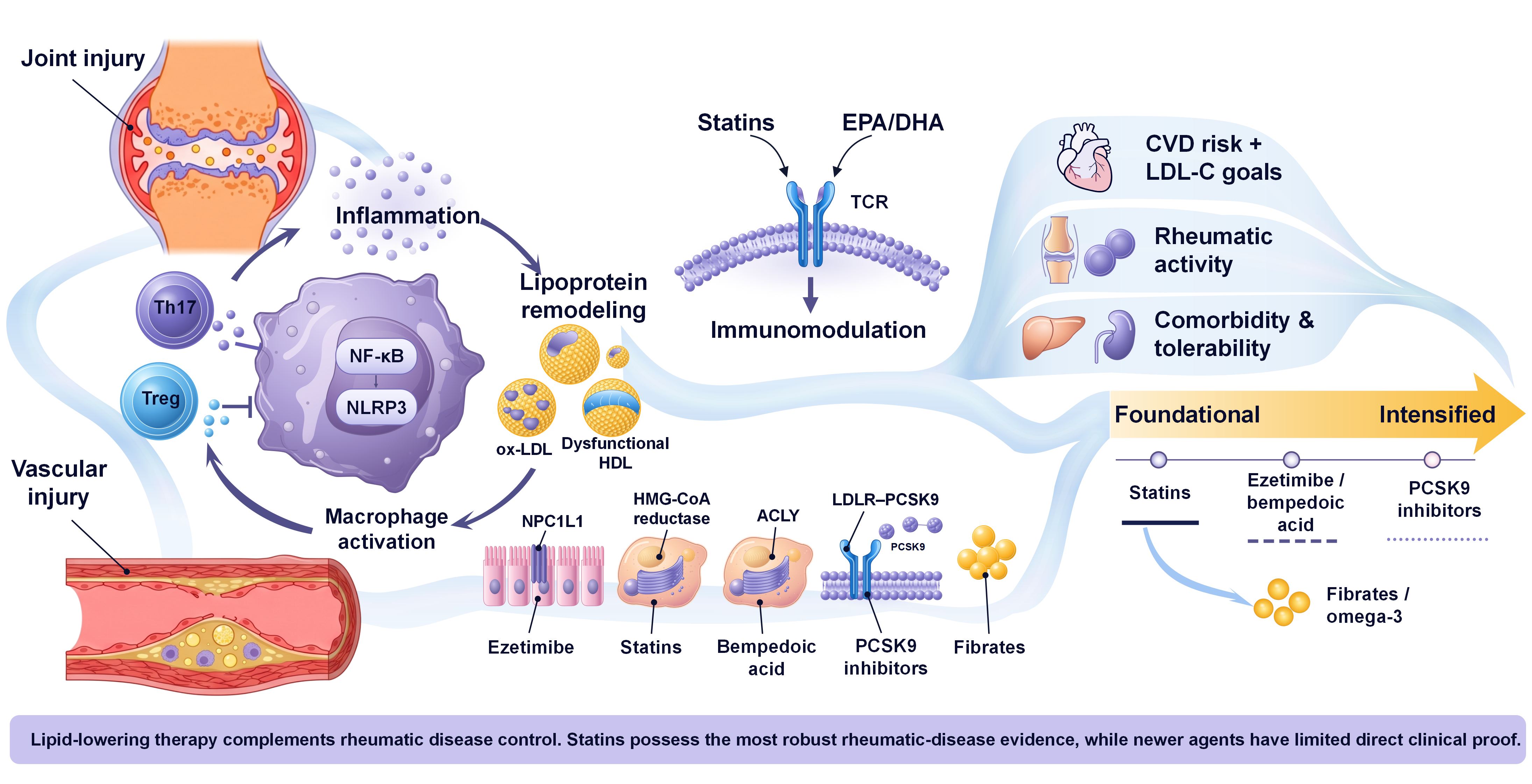
Rheumatic immune-mediated diseases, including rheumatoid arthritis (RA), systemic lupus erythematosus (SLE), and spondyloarthritis, combine persistent inflammation with increased cardiovascular risk. Inflammation alters lipoprotein production, remodeling, function, and clearance, explaining why low or apparently normal cholesterol concentrations may coexist with accelerated atherosclerosis. Modified lipids can influence nuclear factor-kappa B (NF-κB), the NLR family pyrin domain-containing 3 (NLRP3) inflammasome, and immune-cell signaling, creating a reciprocal lipid-inflammation circuit. This review examines established and emerging lipid-lowering agents, their molecular targets, and the clinical evidence across rheumatic diseases. Particular attention is given to dynamic cholesterol- and sphingolipid-enriched membrane nanodomains, cholesterol homeostasis, and the distinction between experimental immunomodulation and clinical outcomes. Statins have the most developed rheumatic-disease evidence; findings for other agents remain limited or are extrapolated from cardiovascular populations. Clinical use should be stratified by overall cardiovascular risk, low-density lipoprotein cholesterol goals, comorbidities, drug interactions, and tolerability, alongside assessment of rheumatic disease activity. Future studies should distinguish lipid-mediated vascular benefit from drug-specific immune effects using matched lipid-lowering comparators, validated rheumatic outcomes, and cardiovascular endpoints.
- Open Access
- Review
Mechanisms by Which Lipid-Lowering Agents Modulate the Lipid-Inflammation Circuit and Their Stratified Clinical Use in Rheumatic Immune-Mediated Diseases
- Lei Wang 1,2,†,
- Yao Wang 3,4,†,
- Baofeng Zhu 1,
- Mingjun Wang 2,* and
- Feng Li 1,*
Author Information
Received: 03 August 2026 | Revised: 26 October 2026 | Accepted: 30 October 2026 | Published: 04 November 2026
Abstract
Graphical Abstract
Keywords
rheumatic immune-mediated diseases | lipid-inflammation circuit | lipid-lowering agents | immunomodulation | cardiovascular comorbidity management
References
- 1.
Drosos, G.C.; Vedder, D.; Houben, E.; et al. EULAR Recommendations for Cardiovascular Risk Management in Rheumatic and Musculoskeletal Diseases, Including Systemic Lupus Erythematosus and Antiphospholipid Syndrome. Ann. Rheum. Dis. 2022, 81, 768–779. https://doi.org/10.1136/annrheumdis-2021-221733.
- 2.
Yan, J.; Yang, S.; Han, L.; et al. Dyslipidemia in Rheumatoid Arthritis: The Possible Mechanisms. Front. Immunol. 2023, 14, 1254753. https://doi.org/10.3389/fimmu.2023.1254753.
- 3.
Hannawi, S.; Hannawi, H.; Al Salmi, I. Cardiovascular Disease and Subclinical Atherosclerosis in Rheumatoid Arthritis. Hypertens. Res. 2020, 43, 982–984. https://doi.org/10.1038/s41440-020-0483-4.
- 4.
Wilkinson, M.J.; Shapiro, M.D. Immune-Mediated Inflammatory Diseases, Dyslipidemia, and Cardiovascular Risk: A Complex Interplay. Arterioscler. Thromb. Vasc. Biol. 2024, 44, 2396–2406. https://doi.org/10.1161/atvbaha.124.319983.
- 5.
Yan, J.; Horng, T. Lipid Metabolism in Regulation of Macrophage Functions. Trends Cell Biol. 2020, 30, 979–989. https://doi.org/10.1016/j.tcb.2020.09.006.
- 6.
Guo, C.; Chi, Z.; Jiang, D.; et al. Cholesterol Homeostatic Regulator SCAP-SREBP2 Integrates NLRP3 Inflammasome Activation and Cholesterol Biosynthetic Signaling in Macrophages. Immunity 2018, 49, 842–856.e7. https://doi.org/10.1016/j.immuni.2018.08.021.
- 7.
Li, G.M.; Zhao, J.; Li, B.; et al. The Anti-Inflammatory Effects of Statins on Patients with Rheumatoid Arthritis: A Systemic Review and Meta-Analysis of 15 Randomized Controlled Trials. Autoimmun. Rev. 2018, 17, 215–225. https://doi.org/10.1016/j.autrev.2017.10.013.
- 8.
Robinson, G.; Pineda-Torra, I.; Ciurtin, C.; et al. Lipid Metabolism in Autoimmune Rheumatic Disease: Implications for Modern and Conventional Therapies. J. Clin. Invest. Invest. 2022, 132, e148552. https://doi.org/10.1172/jci148552.
- 9.
Szabó, M.Z.; Szodoray, P.; Kiss, E. Dyslipidemia in Systemic Lupus Erythematosus. Immunol. Res. 2017, 65, 543–550. https://doi.org/10.1007/s12026-016-8892-9.
- 10.
Papagoras, C.; Voulgari, P.V.; Drosos, A.A. Cardiovascular Disease in Spondyloarthritides. Curr. Vasc. Pharmacol. 2020, 18, 473–487. https://doi.org/10.2174/1570161117666190426164306.
- 11.
Hintenberger, R.; Affenzeller, B.; Vladychuk, V.; et al. Cardiovascular Risk in Axial Spondyloarthritis—A Systematic Review. Clin. Rheumatol. 2023, 42, 2621–2633. https://doi.org/10.1007/s10067-023-06655-z.
- 12.
Fang, X.; Chen, H.; Yang, X.; et al. Lipid Metabolism at the Intersection of Rheumatoid Arthritis and Atherosclerosis. Front. Immunol. 2026, 17, 1790634. https://doi.org/10.3389/fimmu.2026.1790634.
- 13.
Myasoedova, E.; Crowson, C.S.; Kremers, H.M.; et al. Lipid Paradox in Rheumatoid Arthritis: The Impact of Serum Lipid Measures and Systemic Inflammation on the Risk of Cardiovascular Disease. Ann. Rheum. Dis. 2011, 70, 482–487. https://doi.org/10.1136/ard.2010.135871.
- 14.
McInnes, I.B.; Thompson, L.; Giles, J.T.; et al. Effect of Interleukin-6 Receptor Blockade on Surrogates of Vascular Risk in Rheumatoid Arthritis: MEASURE, a Randomised, Placebo-Controlled Study. Ann. Rheum. Dis. 2015, 74, 694–702. https://doi.org/10.1136/annrheumdis-2013-204345.
- 15.
Fleischmann, R.; Kremer, J.; Cush, J.; et al. Placebo-Controlled Trial of Tofacitinib Monotherapy in Rheumatoid Arthritis. N. Engl. J. Med. 2012, 367, 495–507. https://doi.org/10.1056/nejmoa1109071.
- 16.
Agca, R.; Heslinga, S.C.; Rollefstad, S.; et al. EULAR Recommendations for Cardiovascular Disease Risk Management in Patients with Rheumatoid Arthritis and Other Forms of Inflammatory Joint Disorders: 2015/2016 Update. Ann. Rheum. Dis. 2017, 76, 17–28. https://doi.org/10.1136/annrheumdis-2016-209775.
- 17.
Zeiser, R. Immune Modulatory Effects of Statins. Immunology 2018, 154, 69–75. https://doi.org/10.1111/imm.12902.
- 18.
Bonacina, F.; Zhang, X.; Manel, N.; et al. Lysosomes in the Immunometabolic Reprogramming of Immune Cells in Atherosclerosis. Nat. Rev. Cardiol. 2025, 22, 149–164. https://doi.org/10.1038/s41569-024-01072-4.
- 19.
Leishman, S.; Aljadeed, N.M.; Qian, L.; et al. Fatty Acid Synthesis Promotes Inflammasome Activation through NLRP3 Palmitoylation. Cell Rep. 2024, 43, 114516. https://doi.org/10.1016/j.celrep.2024.114516.
- 20.
Dehnavi, S.; Sohrabi, N.; Sadeghi, M.; et al. Statins and Autoimmunity: State-of-the-Art. Pharmacol. Ther. 2020, 214, 107614. https://doi.org/10.1016/j.pharmthera.2020.107614.
- 21.
Steffens, S.; Mach, F. Anti-Inflammatory Properties of Statins. Semin. Vasc. Med. 2004, 4, 417–422. https://doi.org/10.1055/s-2004-869599.
- 22.
Aminifar, E.; Tavakkol Afshari, H.S.; Sathyapalan, T.; et al. The Pleiotropic Effects of Statins in Rheumatoid Arthritis. J. Pharm. Pharmacol. 2023, 75, 910–920. https://doi.org/10.1093/jpp/rgad024.
- 23.
Rahmadi, A.R.; Pranata, R.; Raffaello, W.M.; et al. The Effect of Statin on Major Adverse Cardiovascular Events and Mortality in Patients with Rheumatoid Arthritis—A Systematic Review and Meta-Analysis. Eur. Rev. Med. Pharmacol. Sci. 2022, 26, 3171–3178. https://doi.org/10.26355/eurrev_202205_28734.
- 24.
McCarey, D.W.; McInnes, I.B.; Madhok, R.; et al. Trial of Atorvastatin in Rheumatoid Arthritis (TARA): Double-Blind, Randomised Placebo-Controlled Trial. Lancet 2004, 363, 2015–2021. https://doi.org/10.1016/s0140-6736(04)16449-0.
- 25.
Kitas, G.D.; Nightingale, P.; Armitage, J.; et al. A Multicenter, Randomized, Placebo-Controlled Trial of Atorvastatin for the Primary Prevention of Cardiovascular Events in Patients with Rheumatoid Arthritis. Arthritis Rheumatol. 2019, 71, 1437–1449. https://doi.org/10.1002/art.40892.
- 26.
Altmann, S.W.; Davis, H.R.; Zhu, L.J.; et al. Niemann-Pick C1 Like 1 Protein Is Critical for Intestinal Cholesterol Absorption. Science 2004, 303, 1201–1204. https://doi.org/10.1126/science.1093131.
- 27.
Mach, F.; Baigent, C.; Catapano, A.L.; et al. 2019 ESC/EAS Guidelines for the Management of Dyslipidaemias: Lipid Modification to Reduce Cardiovascular Risk: The Task Force for the Management of Dyslipidaemias of the European Society of Cardiology (ESC) and European Atherosclerosis Society (EAS). Eur. Heart J. 2020, 41, 111–188. https://doi.org/10.1093/eurheartj/ehz455.
- 28.
Mach, F.; Koskinas, K.C.; Roeters van Lennep, J.E.; et al. 2025 Focused Update of the 2019 ESC/EAS Guidelines for the Management of Dyslipidaemias: Developed by the Task Force for the Management of Dyslipidaemias of the European Society of Cardiology (ESC) and the European Atherosclerosis Society (EAS). Eur. Heart J. 2025, 46, 4359–4378. https://doi.org/10.1093/eurheartj/ehaf190.
- 29.
Ray, K.K.; Bays, H.E.; Catapano, A.L.; et al. Safety and Efficacy of Bempedoic Acid to Reduce LDL Cholesterol. N. Engl. J. Med. 2019, 380, 1022–1032. https://doi.org/10.1056/nejmoa1803917.
- 30.
Ballantyne, C.M.; Laufs, U.; Ray, K.K.; et al. Bempedoic Acid Plus Ezetimibe Fixed-Dose Combination in Patients with Hypercholesterolemia and High CVD Risk Treated with Maximally Tolerated Statin Therapy. Eur. J. Prev. Cardiol. 2020, 27, 593–603. https://doi.org/10.1177/2047487319864671.
- 31.
Nissen, S.E.; Menon, V.; Nicholls, S.J.; et al. Bempedoic Acid for Primary Prevention of Cardiovascular Events in Statin-Intolerant Patients. JAMA 2023, 330, 131–140. https://doi.org/10.1001/jama.2023.9696.
- 32.
Laufs, U.; Banach, M.; Mancini, G.B.J.; et al. Efficacy and Safety of Bempedoic Acid in Patients with Hypercholesterolemia and Statin Intolerance. J. Am. Heart Assoc. 2019, 8, e011662. https://doi.org/10.1161/jaha.118.011662.
- 33.
Goldberg, A.C.; Leiter, L.A.; Stroes, E.S.G.; et al. Effect of Bempedoic Acid vs Placebo Added to Maximally Tolerated Statins on Low-Density Lipoprotein Cholesterol in Patients at High Risk for Cardiovascular Disease: The CLEAR Wisdom Randomized Clinical Trial. JAMA 2019, 322, 1780–1788. https://doi.org/10.1001/jama.2019.16585.
- 34.
Ballantyne, C.M.; Banach, M.; Mancini, G.B.J.; et al. Efficacy and Safety of Bempedoic Acid Added to Ezetimibe in Statin-Intolerant Patients with Hypercholesterolemia: A Randomized, Placebo-Controlled Study. Atherosclerosis 2018, 277, 195–203. https://doi.org/10.1016/j.atherosclerosis.2018.06.002.
- 35.
Ray, K.K.; Nicholls, S.J.; Li, N.; et al. Efficacy and Safety of Bempedoic Acid among Patients with and without Diabetes: Prespecified Analysis of the CLEAR Outcomes Randomised Trial. Lancet Diabetes Endocrinol. 2024, 12, 19–28. https://doi.org/10.1016/s2213-8587(23)00316-9.
- 36.
Robillard, R.; Fontaine, C.; Chinetti, G.; et al. Fibrates. In Handbook of Experimental Pharmacology; Springer, Berlin/Heidelberg, Germany, 2005; pp. 389–406. https://doi.org/10.1007/3-540-27661-0_14.
- 37.
Fruchart, J.C.; Santos, R.D. SPPARM Alpha: The Lazarus Effect. Curr. Opin. Lipidol. 2019, 30, 419–427. https://doi.org/10.1097/mol.0000000000000640.
- 38.
Kraja, A.T.; Province, M.A.; Straka, R.J.; et al. Fenofibrate and Metabolic Syndrome. Endocr. Metab. Immune Disord.-Drug Targets 2010, 10, 138–148. https://doi.org/10.2174/187153010791213047.
- 39.
Jin, L.; Hua, H.; Ji, Y.; et al. Anti-Inflammatory Role of Fenofibrate in Treating Diseases. Biomol. Biomed. 2023, 23, 376–391. https://doi.org/10.17305/bb.2022.8534.
- 40.
Tsimihodimos, V.; Miltiadous, G.; Daskalopoulou, S.; et al. Fenofibrate: Metabolic and Pleiotropic Effects. Curr. Vasc. Pharmacol. 2005, 3, 87–98. https://doi.org/10.2174/1570161052773942.
- 41.
Rosenson, R.S. Fenofibrate: Treatment of Hyperlipidemia and Beyond. Expert Rev. Cardiovasc. Ther. 2008, 6, 1319–1330. https://doi.org/10.1586/14779072.6.10.1319.
- 42.
Sathasivam, S. Statin Induced Myotoxicity. Eur. J. Intern. Med. 2012, 23, 317–324. https://doi.org/10.1016/j.ejim.2012.01.004.
- 43.
Calder, P.C. Omega-3 Fatty Acids and Inflammatory Processes: From Molecules to Man. Biochem. Soc. Trans. 2017, 45, 1105–1115. https://doi.org/10.1042/bst20160474.
- 44.
Simopoulos, A.P. Omega-3 Fatty Acids in Inflammation and Autoimmune Diseases. J. Am. Coll. Nutr. 2002, 21, 495–505. https://doi.org/10.1080/07315724.2002.10719248.
- 45.
Calder, P.C. Omega-3 Fatty Acids and Inflammatory Processes. Nutrients 2010, 2, 355–374. https://doi.org/10.3390/nu2030355.
- 46.
Calder, P.C. Marine Omega-3 Fatty Acids and Inflammatory Processes: Effects, Mechanisms and Clinical Relevance. Biochim. Biophys. Acta Mol. Cell Biol. Lipids 2015, 1851, 469–484. https://doi.org/10.1016/j.bbalip.2014.08.010.
- 47.
Poggioli, R.; Hirani, K.; Jogani, V.G.; et al. Modulation of Inflammation and Immunity by Omega-3 Fatty Acids: A Possible Role for Prevention and to Halt Disease Progression in Autoimmune, Viral, and Age-Related Disorders. Eur. Rev. Med. Pharmacol. Sci. 2023, 27, 7380–7400. https://doi.org/10.26355/eurrev_202308_33310.
- 48.
Nikiphorou, E.; Philippou, E. Nutrition and Its Role in Prevention and Management of Rheumatoid Arthritis. Autoimmun. Rev. 2023, 22, 103333. https://doi.org/10.1016/j.autrev.2023.103333.
- 49.
Wang, W.; Xu, Y.; Zhou, J.; et al. Effects of Omega-3 Supplementation on Lipid Metabolism, Inflammation, and Disease Activity in Rheumatoid Arthritis: A Meta-Analysis of Randomized Controlled Trials. Clin. Rheumatol. 2024, 43, 2479–2488. https://doi.org/10.1007/s10067-024-07040-0.
- 50.
Calder, P.C. Omega-3 Polyunsaturated Fatty Acids and Inflammatory Processes: Nutrition or Pharmacology? Br. J. Clin. Pharmacol. 2013, 75, 645–662. https://doi.org/10.1111/j.1365-2125.2012.04374.x.
- 51.
Sigaux, J.; Mathieu, S.; Nguyen, Y.; et al. Impact of Type and Dose of Oral Polyunsaturated Fatty Acid Supplementation on Disease Activity in Inflammatory Rheumatic Diseases: A Systematic Literature Review and Meta-Analysis. Arthritis Res. Ther. 2022, 24, 100. https://doi.org/10.1186/s13075-022-02781-2.
- 52.
Liu, X.; Tang, Y.; Luo, Y.; et al. Role and Mechanism of Specialized Pro-Resolving Mediators in Obesity-Associated Insulin Resistance. Lipids Health Dis. 2024, 23, 234. https://doi.org/10.1186/s12944-024-02207-9.
- 53.
Seidah, N.G.; Prat, A. The Multifaceted Biology of PCSK9. Endocr. Rev. 2022, 43, 558–582. https://doi.org/10.1210/endrev/bnab035.
- 54.
Bao, X.; Liang, Y.; Chang, H.; et al. Targeting Proprotein Convertase Subtilisin/Kexin Type 9 (PCSK9): From Bench to Bedside. Signal Transduct. Target. Ther. 2024, 9, 13. https://doi.org/10.1038/s41392-023-01690-3.
- 55.
Shin, D.; Kim, S.; Lee, H.; et al. PCSK9 Stimulates Syk, PKCδ, and NF-κB, Leading to Atherosclerosis Progression Independently of LDL Receptor. Nat. Commun. 2024, 15, 2789. https://doi.org/10.1038/s41467-024-46336-2.
- 56.
Meng, Y.; Zheng, X.; Zhang, Z.; et al. Circulating PCSK9 Relates to Aggravated Disease Activity, Th17/Treg Imbalance, and Predicts Treatment Outcome of Conventional Synthetic DMARDs in Rheumatoid Arthritis Patients. Ir. J. Med. Sci. 2023, 192, 3187–3194. https://doi.org/10.1007/s11845-023-03323-8.
- 57.
Zimerman, A.; Kunzler, A.L.F.; Weber, B.N.; et al. Intensive Lowering of LDL Cholesterol Levels with Evolocumab in Autoimmune or Inflammatory Diseases: An Analysis of the FOURIER Trial. Circulation 2025, 151, 1467–1476. https://doi.org/10.1161/circulationaha.124.072756.
- 58.
Han, X.; Gao, Y.; He, M.; et al. Evolocumab Prevents Atrial Fibrillation in Rheumatoid Arthritis Rats through Restraint of PCSK9 Induced Atrial Remodeling. J. Adv. Res. 2024, 61, 211–221. https://doi.org/10.1016/j.jare.2023.09.007.
- 59.
Ministrini, S.; Carbone, F. PCSK9 and Inflammation: Their Role in Autoimmune Diseases, with a Focus on Rheumatoid Arthritis and Systemic Lupus Erythematosus. Curr. Med. Chem. 2022, 29, 970–979. https://doi.org/10.2174/0929867328666210810150940.
- 60.
O’Donoghue, M.L.; Rosenson, R.S.; Gencer, B.; et al. Small Interfering RNA to Reduce Lipoprotein(a) in Cardiovascular Disease. N. Engl. J. Med. 2022, 387, 1855–1864. https://doi.org/10.1056/nejmoa2211023.
- 61.
Raal, F.J.; Rosenson, R.S.; Reeskamp, L.F.; et al. Evinacumab for Homozygous Familial Hypercholesterolemia. N. Engl. J. Med. 2020, 383, 711–720. https://doi.org/10.1056/nejmoa2004215.
- 62.
Sylvers-Davie, K.L.; Davies, B.S.J. Regulation of Lipoprotein Metabolism by ANGPTL3, ANGPTL4, and ANGPTL8. Am. J. Physiol.-Endocrinol. Metab. 2021, 321, E493–E508. https://doi.org/10.1152/ajpendo.00195.2021.
- 63.
Gaudet, D.; Greber-Platzer, S.; Reeskamp, L.F.; et al. Evinacumab in Homozygous Familial Hypercholesterolaemia: Long-Term Safety and Efficacy. Eur. Heart J. 2024, 45, 2422–2434. https://doi.org/10.1093/eurheartj/ehae325.
- 64.
Rosenson, R.S.; Gaudet, D.; Hegele, R.A.; et al. Zodasiran, an RNAi Therapeutic Targeting ANGPTL3, for Mixed Hyperlipidemia. N. Engl. J. Med. 2024, 391, 913–925. https://doi.org/10.1056/nejmoa2404147.
- 65.
Dewey, F.E.; Gusarova, V.; Dunbar, R.L.; et al. Genetic and Pharmacologic Inactivation of ANGPTL3 and Cardiovascular Disease. N. Engl. J. Med. 2017, 377, 211–221. https://doi.org/10.1056/nejmoa1612790.
- 66.
Petri, M.A.; Kiani, A.N.; Post, W.; et al. Lupus Atherosclerosis Prevention Study (LAPS). Ann. Rheum. Dis. 2011, 70, 760–765. https://doi.org/10.1136/ard.2010.136762.
- 67.
Schanberg, L.E.; Sandborg, C.; Barnhart, H.X.; et al. Use of Atorvastatin in Systemic Lupus Erythematosus in Children and Adolescents. Arthritis Rheum. 2012, 64, 285–296. https://doi.org/10.1002/art.30645.
- 68.
Rajaei, E.; Mowla, K.; Ghorbani, A.; et al. The Effect of Omega-3 Fatty Acids in Patients with Active Rheumatoid Arthritis Receiving DMARDs Therapy: Double-Blind Randomized Controlled Trial. Glob. J. Health Sci. 2016, 8, 18–25. https://doi.org/10.5539/gjhs.v8n7p18.
- 69.
Dang, E.V.; McDonald, J.G.; Russell, D.W.; et al. Oxysterol Restraint of Cholesterol Synthesis Prevents AIM2 Inflammasome Activation. Cell 2017, 171, 1057–1071.e11. https://doi.org/10.1016/j.cell.2017.09.029.
- 70.
Bäck, M.; Yurdagul, A.; Tabas, I.; et al. Inflammation and Its Resolution in Atherosclerosis: Mediators and Therapeutic Opportunities. Nat. Rev. Cardiol. 2019, 16, 389–406. https://doi.org/10.1038/s41569-019-0169-2.
- 71.
Molnár, E.; Swamy, M.; Holzer, M.; et al. Cholesterol and Sphingomyelin Drive Ligand-Independent T-Cell Antigen Receptor Nanoclustering. J. Biol. Chem. 2012, 287, 42664–42674. https://doi.org/10.1074/jbc.m112.386045.
- 72.
Krishnan, S.; Nambiar, M.P.; Warke, V.G.; et al. Alterations in Lipid Raft Composition and Dynamics Contribute to Abnormal T Cell Responses in Systemic Lupus Erythematosus. J. Immunol. 2004, 172, 7821–7831. https://doi.org/10.4049/jimmunol.172.12.7821.
- 73.
Jury, E.C.; Isenberg, D.A.; Mauri, C.; et al. Atorvastatin Restores Lck Expression and Lipid Raft-Associated Signaling in T Cells from Patients with Systemic Lupus Erythematosus. J. Immunol. 2006, 177, 7416–7422. https://doi.org/10.4049/jimmunol.177.10.7416.
- 74.
Stulnig, T.M.; Huber, J.; Leitinger, N.; et al. Polyunsaturated Eicosapentaenoic Acid Displaces Proteins from Membrane Rafts by Altering Raft Lipid Composition. J. Biol. Chem. 2001, 276, 37335–37340. https://doi.org/10.1074/jbc.m106193200.
- 75.
Shaikh, S.R.; Rockett, B.D.; Carraway, K. Docosahexaenoic Acid Modifies the Clustering and Size of Lipid Rafts and the Lateral Organization and Surface Expression of MHC Class I of EL4 Cells. J. Nutr. 2009, 139, 1632–1639. https://doi.org/10.3945/jn.109.108720.
- 76.
Kim, W.; Fan, Y.Y.; Barhoumi, R.; et al. N-3 Polyunsaturated Fatty Acids Suppress the Localization and Activation of Signaling Proteins at the Immunological Synapse in Murine CD4+ T Cells by Affecting Lipid Raft Formation. J. Immunol. 2008, 181, 6236–6243. https://doi.org/10.4049/jimmunol.181.9.6236.
- 77.
Tang, T.T.; Song, Y.; Ding, Y.J.; et al. Atorvastatin Upregulates Regulatory T Cells and Reduces Clinical Disease Activity in Patients with Rheumatoid Arthritis. J. Lipid Res. 2011, 52, 1023–1032. https://doi.org/10.1194/jlr.m010876.
- 78.
van Hamburg, J.P.; Asmawidjaja, P.S.; Davelaar, N.; et al. Th17 Cells, but Not Th1 Cells, from Patients with Early Rheumatoid Arthritis Are Potent Inducers of Matrix Metalloproteinases and Proinflammatory Cytokines upon Synovial Fibroblast Interaction, Including Autocrine Interleukin-17A Production. Arthritis Rheum. 2011, 63, 73–83. https://doi.org/10.1002/art.30093.
- 79.
Moran, E.M.; Mullan, R.; McCormick, J.; et al. Human Rheumatoid Arthritis Tissue Production of IL-17A Drives Matrix and Cartilage Degradation: Synergy with Tumour Necrosis Factor-α, Oncostatin M and Response to Biologic Therapies. Arthritis Res. Ther. 2009, 11, R113. https://doi.org/10.1186/ar2772.
- 80.
Wong, C.Y.; Ma, B.M.Y.; Zhang, D.; et al. Cardiovascular Risk Factors and Complications in Patients with Systemic Lupus Erythematosus with and without Nephritis: A Systematic Review and Meta-Analysis. Lupus Sci. Med. 2024, 11, e001152. https://doi.org/10.1136/lupus-2024-001152.
- 81.
Artola, R.T.; Mihos, C.G.; Santana, O. Effects of Statin Therapy in Patients with Systemic Lupus Erythematosus. South. Med. J. 2016, 109, 705–711. https://doi.org/10.14423/smj.0000000000000561.
- 82.
Wu, T.; Ye, L.; Wang, S.; et al. Association of Lipid Lowering Drugs and the Risk of Systemic Lupus Erythematosus: A Drug Target Mendelian Randomization. Front. Pharmacol. 2023, 14, 1258018. https://doi.org/10.3389/fphar.2023.1258018.
- 83.
Piya, M.K. Metabolic Syndrome, Rheumatoid and Psoriatic Arthritis: Managing Cardiovascular Risk. Int. J. Rheum. Dis. 2021, 24, 1103–1105. https://doi.org/10.1111/1756-185x.14197.
- 84.
Elmets, C.A.; Leonardi, C.L.; Davis, D.M.R.; et al. Joint AAD-NPF Guidelines of Care for the Management and Treatment of Psoriasis with Awareness and Attention to Comorbidities. J. Am. Acad. Dermatol. 2019, 80, 1073–1113. https://doi.org/10.1016/j.jaad.2018.11.058.
- 85.
Gezer, H.H.; Acer Kasman, S.; Duruöz, M.T. Autonomic Dysfunction and Cardiovascular Risk in Psoriatic Arthritis. Clin. Rheumatol. 2023, 42, 2635–2649. https://doi.org/10.1007/s10067-022-06484-6.
- 86.
Porta, S.; Otero-Losada, M.; Kölliker Frers, R.A.; et al. Adipokines, Cardiovascular Risk, and Therapeutic Management in Obesity and Psoriatic Arthritis. Front. Immunol. 2021, 11, 590749. https://doi.org/10.3389/fimmu.2020.590749.
- 87.
Peluso, R.; Caso, F.; Tasso, M.; et al. Cardiovascular Risk Markers and Major Adverse Cardiovascular Events in Psoriatic Arthritis Patients. Rev. Recent Clin. Trials 2018, 13, 199–209. https://doi.org/10.2174/1574887113666180314105511.
- 88.
Guła, Z.; Łosińska, K.; Kuszmiersz, P.; et al. A Comparison of Comorbidities and Their Risk Factors Prevalence Across Rheumatoid Arthritis, Psoriatic Arthritis and Axial Spondyloarthritis with Focus on Cardiovascular Diseases: Data from a Single Center Real-World Cohort. Rheumatol. Int. 2024, 44, 2817–2828. https://doi.org/10.1007/s00296-024-05740-z.
- 89.
Misra, D.P.; Sharma, A.; Karpouzas, G.A.; et al. Cardiovascular Risk in Vasculitis. Best Pract. Res. Clin. Rheumatol. 2023, 37, 101831. https://doi.org/10.1016/j.berh.2023.101831.
- 90.
Kronbichler, A.; Leierer, J.; Gauckler, P.; et al. Comorbidities in ANCA-Associated Vasculitis. Rheumatology 2020, 59, iii79–iii83. https://doi.org/10.1093/rheumatology/kez617.
- 91.
Sarmad, A.; Gholizadeh Ghozloujeh, Z.; Hanna, P.E.; et al. Cardiovascular Involvement in ANCA-Associated Vasculitis. Nephrol. Dial. Transplant. 2025, 40, 2256–2267. https://doi.org/10.1093/ndt/gfaf070.
- 92.
Sener, S.; Arslanoglu Aydin, E.; Batu, E.D. Cardiac Involvement and Cardiovascular Risk Factors in Pediatric Primary Systemic Vasculitides. Clin. Rheumatol. 2023, 42, 673–686. https://doi.org/10.1007/s10067-022-06434-2.
- 93.
Atzeni, F.; Gozza, F.; Cafaro, G.; et al. Cardiovascular Involvement in Sjögren’s Syndrome. Front. Immunol. 2022, 13, 879516. https://doi.org/10.3389/fimmu.2022.879516.
- 94.
Melissaropoulos, K.; Bogdanos, D.; Dimitroulas, T.; et al. Primary Sjögren’s Syndrome and Cardiovascular Disease. Curr. Vasc. Pharmacol. 2020, 18, 447–454. https://doi.org/10.2174/1570161118666200129125320.
- 95.
Berardicurti, O.; Ruscitti, P.; Cipriani, P.; et al. Cardiovascular Disease in Primary Sjögren’s Syndrome. Rev. Recent Clin. Trials 2018, 13, 164–169. https://doi.org/10.2174/1574887113666180315130336.
- 96.
Bartoloni, E.; Alunno, A.; Valentini, V.; et al. The Prevalence and Relevance of Traditional Cardiovascular Risk Factors in Primary Sjögren’s Syndrome. Clin. Exp. Rheumatol. 2018, 36 Suppl 112, 113–120.
- 97.
Casian, M.; Jurcut, C.; Dima, A.; et al. Cardiovascular Disease in Primary Sjögren’s Syndrome: Raising Clinicians’ Awareness. Front. Immunol. 2022, 13, 865373. https://doi.org/10.3389/fimmu.2022.865373.
- 98.
Tremoulet, A.H. The Role of Statins in Inflammatory Vasculitides. Autoimmunity 2015, 48, 177–180. https://doi.org/10.3109/08916934.2015.1027818.
- 99.
Stroes, E.S.; Thompson, P.D.; Corsini, A.; et al. Statin-Associated Muscle Symptoms: Impact on Statin Therapy—European Atherosclerosis Society Consensus Panel Statement on Assessment, Aetiology and Management. Eur. Heart J. 2015, 36, 1012–1022. https://doi.org/10.1093/eurheartj/ehv043.
- 100.
Mammen, A.L.; Chung, T.; Christopher-Stine, L.; et al. Autoantibodies against 3-Hydroxy-3-Methylglutaryl-Coenzyme A Reductase in Patients with Statin-Associated Autoimmune Myopathy. Arthritis Rheum. 2011, 63, 713–721. https://doi.org/10.1002/art.30156.
- 101.
Banach, M.; Reiner, Ž.; Surma, S.; et al. 2024 Recommendations on the Optimal Use of Lipid-Lowering Therapy in Established Atherosclerotic Cardiovascular Disease and Following Acute Coronary Syndromes: A Position Paper of the International Lipid Expert Panel (ILEP). Drugs 2024, 84, 1541–1577. https://doi.org/10.1007/s40265-024-02105-5.
- 102.
Patel, S.B.; Belalcazar, L.M.; Afreen, S.; et al. American Association of Clinical Endocrinology Consensus Statement: Algorithm for Management of Adults with Dyslipidemia—2025 Update. Endocr. Pract. 2025, 31, 1207–1238. https://doi.org/10.1016/j.eprac.2025.07.014.


This work is licensed under a Creative Commons Attribution 4.0 International License.
