
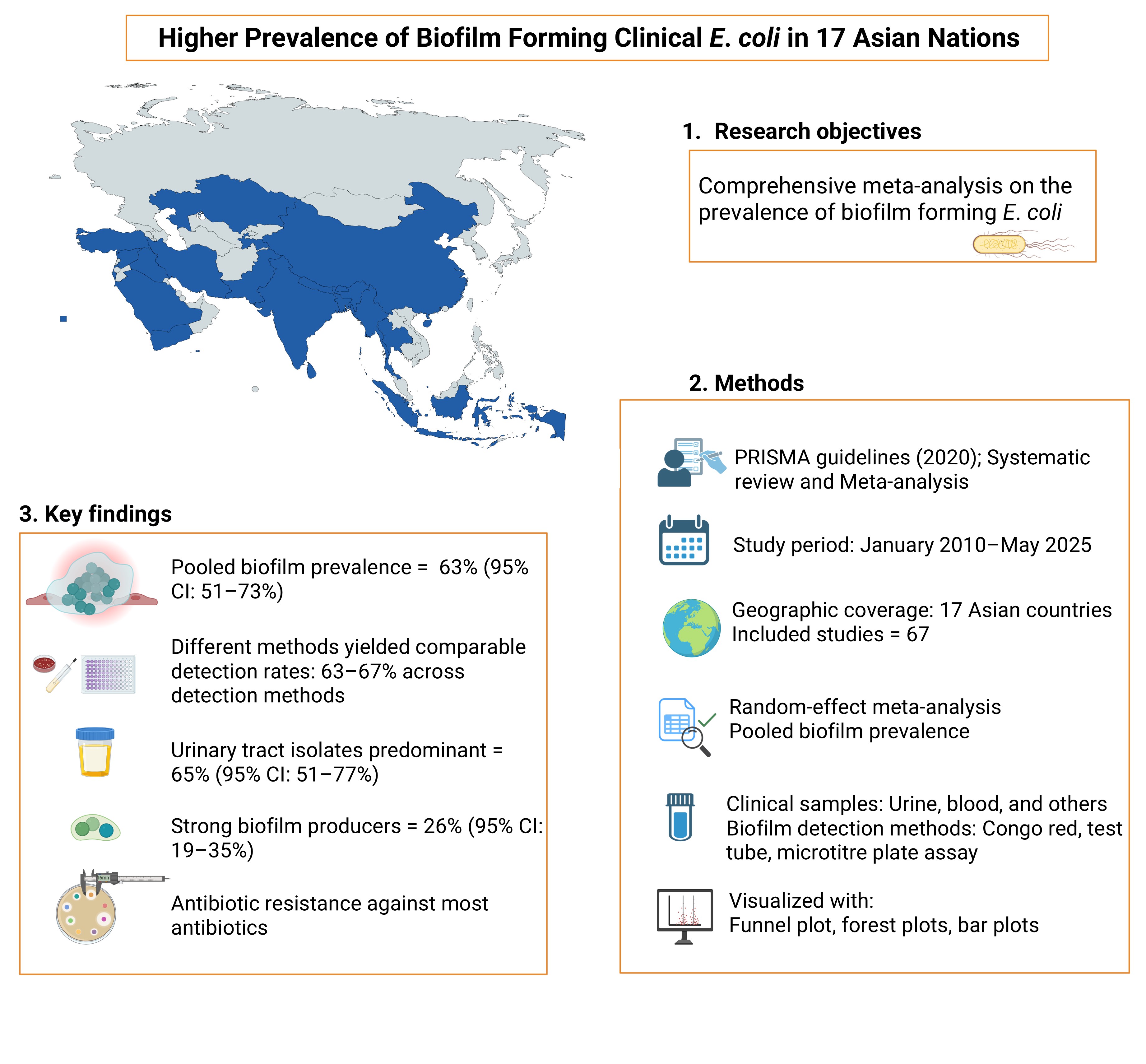
Biofilm formation in Escherichia coli promotes persistence, pathogenicity, and antibiotic resistance in the infections of urinary tract, bloodstream, and wounds, highlighting a global public health concern. This systematic review and meta-analysis evaluated the prevalence and antibiotic resistance patterns of biofilm-forming clinical E. coli isolates from 17 Asian countries. Following PRISMA guidelines, PubMed and Google Scholar were searched for studies spanning January 2010 and May 2025, and 67 studies were included. In a random-effects meta-analysis of 31 microtiter plate studies (logit-transformed proportions, DerSimonian–Laird τ2, Hartung–Knapp–Sidik–Jonkman confidence interval), the pooled biofilm prevalence was 63% (95% CI: 51–73%; 95% prediction interval [PI]: 17–93%; I2 = 95.6%, p < 0.0001). Pooled estimates were similar across the detection methods (63–67%). Urinary isolates, which dominated the dataset, had a pooled prevalence of 65% (95% CI: 51–77). Among the biofilm-producing isolates (microtiter plate assay), separately pooled proportions of strong, moderate and weak producers were 26%, 35% and 35%, respectively; non-producers accounted for 35% of all isolates tested (k = 40, any detection method). Among the biofilm producers, pooled resistance proportions were highest for ampicillin (84%) and amoxicillin–clavulanate (78%), and lowest for ertapenem (8%) and meropenem (18%); descriptive class-level means were highest for tetracyclines (66.4%) and fluoroquinolones (60.4%). These in vitro susceptibility data may not establish clinical effectiveness against biofilm-associated E. coli infections. Funnel-plot asymmetry was detected for four subgroups (Egger’s/Begg’s test, p < 0.10), and trim-and-fill sensitivity analyses shifted the estimates to inconsistent directions (e.g., total microtiter 50% [37–63%]; urine isolates 53% [37–68%]), consistent with small-study effects and heterogeneity rather than publication bias alone. Overall, the published evidence indicates that biofilm formation and resistance against common antibiotics are frequently reported among clinical E. coli isolates in Asia, particularly urinary isolates. However, the high heterogeneity and wide prediction interval indicate that prevalence in individual settings may differ substantially from the pooled estimate; thus, standardized multicenter surveillance is needed to inform catheter care and antibiotic stewardship for E. coli infections across Asia.
- Open Access
- Article
Prevalence and Antibiotic Resistance of Biofilm-Forming Clinical Escherichia coli Isolates in Asia: A Systematic Review and Meta-Analysis
- Prabin Dawadi 1,2,
- Saroj Nepal 1,
- Bivek Pokharel 1,
- Sunil Regmi 3,
- Megha Raj Banjara 2,* and
- Lok R. Pokhrel 4,*
Author Information
Received: 20 June 2026 | Revised: 26 October 2026 | Accepted: 03 November 2026 | Published: 11 November 2026
Abstract
Graphical Abstract
Keywords
antibiotic resistance | biofilm | antibiotic stewardship | Escherichia coli | urinary tract infections | systematic review | meta-analysis
References
- 1.
Zhao, A.; Sun, J.; Liu, Y. Understanding bacterial biofilms: From definition to treatment strategies. Front. Cell. Infect. Microbiol. 2023, 13, 1137947. https://doi.org/10.3389/fcimb.2023.1137947.
- 2.
Pokharel, P.; Dhakal, S.; Dozois, C.M. The diversity of Escherichia coli pathotypes and vaccination strategies against this versatile bacterial pathogen. Microorganisms 2023, 11, 344. https://doi.org/10.3390/microorganisms11020344.
- 3.
Whelan, S.; Lucey, B.; Finn, K. Uropathogenic Escherichia coli (UPEC)-associated urinary tract infections: The molecular basis for challenges to effective treatment. Microorganisms 2023, 11, 2169. https://doi.org/10.3390/microorganisms11092169.
- 4.
Öztürk, F.Y.; Darcan, C.; Kariptaş, E. The determination, monitoring, molecular mechanisms and formation of biofilm in E. coli. Braz. J. Microbiol. 2023, 54, 259–277. https://doi.org/10.1007/s42770-022-00895-y.
- 5.
Gandra, S.; Alvarez-Uria, G.; Turner, P.; et al. Antimicrobial resistance surveillance in low- and middle-income countries: Progress and challenges in eight South Asian and Southeast Asian countries. Clin. Microbiol. Rev. 2020, 33, e00048-19. https://doi.org/10.1128/cmr.00048-19.
- 6.
Syangtan, G.; Khanal, L.K.; Bista, S.; et al. Panton-Valentine leucocidin gene in methicillin resistant Staphylococcus aureus isolated from tertiary care hospital in Nepal. J. Infect. Dev. Ctries. 2024, 18, 1010–1019. https://doi.org/10.3855/jidc.17743.
- 7.
Bista, S.; Syangtan, G.; Darlami, K.; et al. Robotic versus manual disinfection of global priority pathogens at COVID-19-dedicated hospitals. Am. J. Infect. Control. 2025, 53, 588–595. https://doi.org/10.1016/j.ajic.2025.01.013.
- 8.
Bhusal, B.; Yadav, B.; Dawadi, P.; et al. Multi-drug resistance, β-lactamases production, and coexistence of blandm-1 and mcr-1 in Escherichia coli clinical isolates from a referral hospital in Kathmandu, Nepal. Microbiol. Insights 2023, 16, 11786361231152220. https://doi.org/10.1177/11786361231152220.
- 9.
Sidjabat, H.E.; Paterson, D.L. Multidrug-resistant Escherichia coli in Asia: Epidemiology and management. Expert Rev. Anti-Infect. Ther. 2015, 13, 575–591. https://doi.org/10.1586/14787210.2015.1028365.
- 10.
Khadka, C.; Shyaula, M.; Syangtan, G.; et al. Extended-spectrum β-lactamases producing Enterobacteriaceae (ESBL-PE) prevalence in Nepal: A systematic review and meta-analysis. Sci. Total Environ. 2023, 901, 166164. https://doi.org/10.1016/j.scitotenv.2023.166164.
- 11.
Dawadi, P.; Khanal, S.; Prasai Joshi, T.; et al. Antibiotic resistance, biofilm formation and sub-inhibitory hydrogen peroxide stimulation in uropathogenic Escherichia coli. Microbiol. Insights 2022, 15, 11786361221135224. https://doi.org/10.1177/11786361221135224.
- 12.
Yang, X.; Chen, H.; Zheng, Y.; et al. Disease burden and long-term trends of urinary tract infections: A worldwide report. Front. Public Health 2022, 10, 888205. https://doi.org/10.3389/fpubh.2022.888205.
- 13.
Qian, W.; Li, X.; Yang, M.; et al. Relationship between antibiotic resistance, biofilm formation, and biofilm-specific resistance in Escherichia coli isolates from Ningbo, China. Infect. Drug Resist. 2022, 15, 2865–2878. https://doi.org/10.2147/idr.s363652.
- 14.
Noie Oskouie, A.; Hasani, A.; Ahangarzadeh Rezaee, M.; et al. A Relationship between o-serotype, antibiotic susceptibility and biofilm formation in uropathogenic Escherichia coli. Microb. Drug Resist. 2019, 25, 951–958. https://doi.org/10.1089/mdr.2018.0330.
- 15.
Arafa, S.H.; Alshehri, W.A.; Organji, S.R.; et al. Antimicrobial resistance, virulence factor-encoding genes, and biofilm-forming ability of community-associated uropathogenic Escherichia coli in Western Saudi Arabia. Pol. J. Microbiol. 2022, 71, 325–339. https://doi.org/10.33073/pjm-2022-029.
- 16.
Daoud, N.; Abou Sulaiman, A.; Al Kwatli, K. Virulence determinants of Escherichia coli strains isolated from surgical site infections at selected hospitals in Syria. Bull. Pharm. Sci. Assiut 2020, 43, 255–264. https://doi.org/10.21608/bfsa.2020.127420.
- 17.
Vidyasagar, K.; Nagarathnamma, T. Study of catheter associated urinary tract infection and biofilm production by Escherichia coli. Indian J. Microbiol. Res. 2020, 5, 387–392. https://doi.org/10.18231/2394-5478.2018.0081.
- 18.
Tewawong, N.; Kowaboot, S.; Pimainog, Y.; et al. Distribution of phylogenetic groups, adhesin genes, biofilm formation, and antimicrobial resistance of uropathogenic Escherichia coli isolated from hospitalized patients in Thailand. PeerJ 2020, 8, e10453. https://doi.org/10.7717/peerj.10453.
- 19.
He, Y.; Zhao, J.; Wang, L.; et al. Epidemiological trends and predictions of urinary tract infections in the global burden of disease study 2021. Sci. Rep. 2025, 15, 4702. https://doi.org/10.1038/s41598-025-89240-5.
- 20.
Hamid, S.A.A.; Khoshabeh, R.M. Antibiotic resistance, biofilm formation, and identification of Fimh and Fima adhesion genes in uropathogenic Escherichia coli (UPEC) isolated from patients in Baghdad Province. Iraqi J. Sci. 2024, 65, 5546–5554. https://doi.org/10.24996/ijs.2024.65.10.19.
- 21.
Katongole, P.; Nalubega, F.; Florence, N.C.; et al. Biofilm formation, antimicrobial susceptibility and virulence genes of Uropathogenic Escherichia coli isolated from clinical isolates in Uganda. BMC Infect. Dis. 2020, 20, 453. https://doi.org/10.1186/s12879-020-05186-1.
- 22.
Uruén, C.; Chopo-Escuin, G.; Tommassen, J.; et al. Biofilms as promoters of bacterial antibiotic resistance and tolerance. Antibiotics 2020, 10, 3. https://doi.org/10.3390/antibiotics10010003.
- 23.
Ciofu, O.; Moser, C.; Jensen, P.Ø.; et al. Tolerance and resistance of microbial biofilms. Nat. Rev. Microbiol. 2022, 20, 621–635. https://doi.org/10.1038/s41579-022-00682-4.
- 24.
Page, M.J.; McKenzie, J.E.; Bossuyt, P.M.; et al. The PRISMA 2020 statement: An updated guideline for reporting systematic reviews. BMJ 2021, 372, n71. https://doi.org/10.1136/bmj.n71.
- 25.
IntHout, J.; Ioannidis, J.P.A.; Borm, G.F. The Hartung-Knapp-Sidik-Jonkman method for random effects meta-analysis is straightforward and considerably outperforms the standard DerSimonian-Laird method. BMC Med. Res. Methodol. 2014, 14, 25. https://doi.org/10.1186/1471-2288-14-25.
- 26.
IntHout, J.; Ioannidis, J.P.A.; Rovers, M.M.; et al. Plea for routinely presenting prediction intervals in meta-analysis. BMJ Open 2016, 6, e010247. https://doi.org/10.1136/bmjopen-2015-010247.
- 27.
Veroniki, A.A.; Jackson, D.; Viechtbauer, W.; et al. Methods to estimate the between-study variance and its uncertainty in meta-analysis. Res. Synth. Methods 2016, 7, 55–79. https://doi.org/10.1002/jrsm.1164.
- 28.
Egger, M.; Smith, G.D.; Schneider, M.; et al. Bias in meta-analysis detected by a simple, graphical test. BMJ 1997, 315, 629–634. https://doi.org/10.1136/bmj.315.7109.629.
- 29.
Begg, C.B.; Mazumdar, M. Operating characteristics of a rank correlation test for publication bias. Biometrics 1994, 50, 1088. https://doi.org/10.2307/2533446.
- 30.
Sterne, J.A.C.; Sutton, A.J.; Ioannidis, J.P.A.; et al. Recommendations for examining and interpreting funnel plot asymmetry in meta-analyses of randomised controlled trials. BMJ 2011, 343, d4002. https://doi.org/10.1136/bmj.d4002.
- 31.
Duval, S.; Tweedie, R. Trim and Fill: A Simple funnel-plot–based method of testing and adjusting for publication bias in meta-analysis. Biometrics 2000, 56, 455–463. https://doi.org/10.1111/j.0006-341x.2000.00455.x.
- 32.
Ottawa Hospital Research Institute. Available online: https://www.ohri.ca/programs/clinical_epidemiology/oxford.asp (accessed on 27 July 2025).
- 33.
Herzog, R.; Álvarez-Pasquin, M.J.; Díaz, C.; et al. Are healthcare workers’ intentions to vaccinate related to their knowledge, beliefs and attitudes? A systematic review. BMC Public Health 2013, 13, 154. https://doi.org/10.1186/1471-2458-13-154.
- 34.
Bhardwaj, A. An investigation on the detection and distribution of biofilm production caused uropathogenic Escherichia coli in tropical catheterized patients by tube adherence method. Asian J. Pharm. 2018, 12, S1424–S1427 https://doi.org/10.22377/ajp.v12i04.2945.
- 35.
Dumaru, R.; Baral, R.; Shrestha, L.B. Study of biofilm formation and antibiotic resistance pattern of gram-negative Bacilli among the clinical isolates at BPKIHS, Dharan. BMC Res. Notes 2019, 12, 38. https://doi.org/10.1186/s13104-019-4084-8.
- 36.
Stepanović, S.; Vuković, D.; Hola, V.; et al. Quantification of biofilm in microtiter plates: Overview of testing conditions and practical recommendations for assessment of biofilm production by Staphylococci. APMIS 2007, 115, 891–899. https://doi.org/10.1111/j.1600-0463.2007.apm_630.x.
- 37.
Zhang, W.; Wang, Q.; Zhang, L.; et al. Comparison of epidemiological characteristics between ESBL and non-ESBL isolates of clinically isolated Escherichia coli from 2014 to 2022: A single-center study. Infect. Drug Resist. 2023, 16, 5185–5195. https://doi.org/10.2147/idr.s414079.
- 38.
Zhao, F.; Yang, H.; Bi, D.; et al. A systematic review and meta-analysis of antibiotic resistance patterns, and the correlation between biofilm formation with virulence factors in uropathogenic E. coli isolated from urinary tract infections. Microb. Pathog. 2020, 144, 104196. https://doi.org/10.1016/j.micpath.2020.104196.
- 39.
Purbowati, R.; Utami, S.L.; Raharjo, D.; et al. Detection of csg and lux genes in biofilm-forming uropathogenic Escherichia coli associated with urinary tract infections. J. Multidiscip. Appl. Nat. Sci. 2024, 5, 1–9. https://doi.org/10.47352/jmans.2774-3047.222.
- 40.
Rajput, R.; Sarsaiya, S.; Shekhawat, S.; et al. Biofilm formation in UPEC isolates and its association with extended-spectrum β-Lactamase production and MDR in hospitalized patients: Gurugram, India. Int. J. Curr. Microbiol. Appl. Sci. 2021, 10, 673–685. https://doi.org/10.20546/ijcmas.2021.1002.081.
- 41.
Shrestha, B.; Bastola, A.; Pandey, P.; et al. Biofilm production among extended spectrum beta lactamase producing and non-producing Escherichia coli isolated from clinical specimen. Tribhuvan Univ. J. Microbiol. 2022, 9, 71–81. https://doi.org/10.3126/tujm.v9i1.50403.
- 42.
Abbood, D.H.A.; Obaid Alwan, Z.H. Molecular detection of genes encoding for adhesion factors in biofilm formation among uropathogenic Escherichia coli isolates. Med. J. Babylon 2023, 20, 258–263. https://doi.org/10.4103/mjbl.mjbl_233_22.
- 43.
Agarwal, J.; Mishra, B.; Srivastava, S.; et al. Genotypic characteristics and biofilm formation among Escherichia coli isolates from Indian women with acute cystitis. Trans. R. Soc. Trop. Med. Hyg. 2013, 107, 183–187. https://doi.org/10.1093/trstmh/trs090.
- 44.
Atray, D.; Atray, M. Correlation between biofilm production and antibiotic resistance pattern in uropathogenic Escherichia coli in tertiary care hospital in Southern Rajasthan, India. Int. J. Curr. Microbiol. Appl. Sci. 2015, 4, 640–646.
- 45.
Shrestha, B.; Shrestha, B.; Poudel, A.; et al. In-vitro biofilm detection among uropathogens and their antibiogram profile. Tribhuvan Univ. J. Microbiol. 2018, 5, 57–62. https://doi.org/10.3126/tujm.v5i0.22313.
- 46.
Baidya, S.; Sharma, S.; Mishra, S.K.; et al. Biofilm formation by pathogens causing ventilator-associated pneumonia at intensive care units in a tertiary care hospital: An armor for refuge. BioMed Res. Int. 2021, 2021, 8817700. https://doi.org/10.1155/2021/8817700.
- 47.
Ben-Amram, H.; Azrad, M.; Cohen-Assodi, J.; et al. Biofilm formation by hospital-acquired resistant bacteria isolated from respiratory samples. J. Epidemiol. Glob. Health 2024, 14, 291–297. https://doi.org/10.1007/s44197-024-00215-7.
- 48.
Bhatta, M.P.; Sapkota, A.; Subedi, P.; et al. Biofilm formation by uropathogens and their susceptibility towards antimicrobial therapy. Med. J. Shree Birendra Hosp. 2019, 18, 13–22. https://doi.org/10.3126/mjsbh.v18i1.20189.
- 49.
Bahakim, A.A.; Bin-Hameed, E.A. Analysis of the antibiogram profiles of biofilm forming Staphylococcus aureus and Escherichia coli. Univ. J. Pharm. Res. 2022, 6, 27–31. https://doi.org/10.22270/ujpr.v6i6.695.
- 50.
Boroumand, M.; Sharifi, A.; Ghatei, M.A.; et al. Evaluation of biofilm formation and virulence genes and association with antibiotic resistance patterns of uropathogenic Escherichia coli strains in Southwestern Iran. Jundishapur J. Microbiol. 2021, 14, e117785. https://doi.org/10.5812/jjm.117785.
- 51.
Boueroy, P.; Chopjitt, P.; Hatrongjit, R.; et al. Fluoroquinolone resistance determinants in carbapenem-resistant Escherichia coli isolated from urine clinical samples in Thailand. PeerJ 2023, 11, e16401. https://doi.org/10.7717/peerj.16401.
- 52.
Chaudhary, S.; Khatiwada, B.; Chaudhary, N.K. Antibiotic susceptibility pattern of biofilm forming uropathogenic Escherichia coli isolated from UTI infected patients of Koshi Zonal Hospital in Biratnagar, Nepal. Bibechana 2019, 16, 47–54. https://doi.org/10.3126/bibechana.v16i0.19192.
- 53.
Shrestha, D.; Thapa, P.; Bhandari, D.; et al. Biofilm production and antimicrobial resistance among uropathogens in pediatric cases: A Hospital Based Study. J. Nepal Health Res. Counc. 2018, 16, 178–183. https://doi.org/10.3126/jnhrc.v16i2.20307.
- 54.
Das, S.C.; Monjur-E-Elahi, M.; Sarker, S.; et al. Microorganism and antibiotic sensitivity pattern of urine and biofilm in patient with indwelling urinary catheter developing biofilm. Dinajpur Med. Col. J. 2017, 10, 306–313.
- 55.
Dash, D.; Sarangi, G.; Patro, P.; et al. Study of biofilm production in Escherichia coli causing urinary tract infection and its correlation with antimicrobial resistance. J. Acad. Clin. Microbiol. 2018, 20, 88–91. https://doi.org/10.4103/jacm.jacm_35_17.
- 56.
Davari Abad, E.; Khameneh, A.; Vahedi, L. Identification phenotypic and genotypic characterization of biofilm formation in Escherichia coli isolated from urinary tract infections and their antibiotics resistance. BMC Res. Notes 2019, 12, 796. https://doi.org/10.1186/s13104-019-4825-8.
- 57.
Detho, H.; Bano, S.; Tunio, S.A.; et al.Biofilm formation and antibiotic resistance in uropathogenic Escherichia coli: The quest for effective treatment of urinary tract infections. Pure Appl. Biol. 2024, 13, 38–46. https://doi.org/10.19045/bspab.2024.130004.
- 58.
Ebrahimi, M.T.; Hedayati, M.A.; Pirlar, R.F.; et al. Investigation of the biofilm formation in extra-intestinal pathogenic Escherichia coli ST131 strains and its correlation with the presence of fimH, afa, and kpsMSTII genes. J. Appl. Genet. 2023, 64, 367–373. https://doi.org/10.1007/s13353-023-00757-9.
- 59.
Tajbakhsh, E.; Ahmadi, P.; Abedpour-Dehkordi, E.; et al. Biofilm formation, antimicrobial susceptibility, serogroups and virulence genes of uropathogenic E. coli isolated from clinical samples in Iran. Antimicrob. Resist. Infect. Control 2016, 5, 11. https://doi.org/10.1186/s13756-016-0109-4.
- 60.
Kumar, G.; Kumar, Y.; Kumar, G.; et al. Characterization of uropathogenic E. coli from various geographical locations in India. J. Taibah Univ. Med. Sci. 2023, 18, 1527–1535. https://doi.org/10.1016/j.jtumed.2023.07.003.
- 61.
Kar, S.; Devnath, P. Biofilm formation and antibiotic resistance of urinary catheter associated bacteria from hospitalized patients, Bangladesh. Malays. J. Microbiol. 2021, 17, 635. https://doi.org/10.21161/mjm.211169.
- 62.
Lee, T.K.; Soleiman, H. Characterizing the biofilm-forming capacity of bacterial isolates from chronic suppurative otitis media in Bhutan. Sriwijaya J. Otorhinolaryngol. 2023, 1, 79–92. https://doi.org/10.59345/sjorl.v1i2.79.
- 63.
Liu, J.; Wu, B.L.; Zhu, W.Z.; et al. Effect of hypochloric acid on Escherichia coli biofilm and the clinical efficacy of hypochloric acid for wounds with Escherichia coli infection. Zhonghua Shao Shang Yu Chuang Mian Xiu Fu Za Zhi 2022, 38, 242–250. https://doi.org/10.3760/cma.j.cn501120-20201112-00471.
- 64.
Maharjan, G.; Khadka, P.; Siddhi Shilpakar, G.; et al. Catheter-associated urinary tract infection and obstinate biofilm producers. Can. J. Infect. Dis. Med. Microbiol. 2018, 2018, 7624857. https://doi.org/10.1155/2018/7624857.
- 65.
Mahshouri, P.; Alikhani, M.Y.; Momtaz, H.E.; et al. Analysis of phylogroups, biofilm formation, virulence factors, antibiotic resistance and molecular typing of uropathogenic Escherichia coli strains isolated from patients with recurrent and non-recurrent urinary tract infections. BMC Infect. Dis. 2025, 25, 267. https://doi.org/10.1186/s12879-025-10635-w.
- 66.
Nikzad, M.; Mirnejad, R.; Babapour, E. Evaluation of antibiotic resistance and biofilm formation ability uropathogenic E. coli (UPEC) isolated from pregnant women in Karaj. Iran. J. Med. Microbiol. 2021, 15, 195–211. https://doi.org/10.30699/ijmm.15.2.195.
- 67.
Mittal, S.; Sharma, M.; Chaudhary, U. Biofilm and multidrug resistance in uropathogenic Escherichia coli. Pathog. Glob. Health 2015, 109, 26–29. https://doi.org/10.1179/2047773215Y.0000000001.
- 68.
Mohsenzadeh, A.; Fazel, A.; Bavari, S.; et al. Detecting of biofilm formation in the clinical isolates of Pseudomonas aeruginosa and Escherichia coli: An evaluation of different screening methods. J. Curr. Biomed. Rep. 2021, 2, 56–61. https://doi.org/10.52547/jcbior.2.2.56.
- 69.
Mumin, Y.M.; Yüksel, G.; Özad Düzgün, A. Investigation of virulence factor genes and biofilm formation of antibiotic resistant clinical E. coli isolates. Microb. Pathog. 2025, 199, 107257. https://doi.org/10.1016/j.micpath.2024.107257.
- 70.
Myat, T.O.; Oo, K.M.; Mone, H.K.; et al. A prospective study of bloodstream infections among febrile adolescents and adults attending Yangon General Hospital, Yangon, Myanmar. PLoS Negl. Trop. Dis. 2020, 14, e0008268. https://doi.org/10.1371/journal.pntd.0008268.
- 71.
Srivastava, N.; Sujatha, R.; Diwakar, M.K. Study of biofilm formation and its correlation with drug resistance among E. coli positive samples in catheter-associated urinary tract infection. Flora Fauna 2022, 28, 379–384. https://doi.org/10.33451/florafauna.v28i2pp379-384.
- 72.
Neupane, S.; Pant, N.D.; Khatiwada, S.; et al. Correlation between biofilm formation and resistance toward different commonly used antibiotics along with extended spectrum beta lactamase production in uropathogenic Escherichia coli isolated from the patients suspected of urinary tract infections visiting Shree Birendra Hospital, Chhauni, Kathmandu, Nepal. Antimicrob. Resist. Infect. Control 2016, 5, 5. https://doi.org/10.1186/s13756-016-0104-9.
- 73.
Pootong, A.; Mungkornkeaw, N.; Norrapong, B.; et al. Phylogenetic background, drug susceptibility and virulence factors of uropathogenic E. coli isolate in a tertiary university hospital in central Thailand. Trop. Biomed. 2018, 35, 195–204.
- 74.
Qasemi, A.; Rahimi, F.; Katouli, M. Clonal groups of extended-spectrum β-lactamase and biofilm producing uropathogenic Escherichia coli in Iran. Pathog. Glob. Health 2022, 116, 485–497. https://doi.org/10.1080/20477724.2021.2011578.
- 75.
Gangashettappa, N.; Raksha, L.; Shantala, G.B.; et al. Study of biofilm formation in bacterial isolates from contact lens wearers. Indian J. Ophthalmol. 2020, 68, 23. https://doi.org/10.4103/ijo.IJO_947_19.
- 76.
Rastegar, E.; Malekzadegan, Y.; Khashei, R.; et al. Quinolone resistance and biofilm formation capability of uropathogenic Escherichia coli isolates from an Iranian inpatients' population. Mol. Biol. Rep. 2023, 50, 8073–8079. https://doi.org/10.1007/s11033-023-08704-x.
- 77.
Raya, S.; Belbase, A.; Dhakal, L.; et al. In-vitro biofilm formation and antimicrobial resistance of Escherichia coli in diabetic and nondiabetic patients. BioMed Res. Int. 2019, 2019, 1474578. https://doi.org/10.1155/2019/1474578.
- 78.
Risal, G.; Shrestha, A.; Kunwar, S.; et al. Detection of biofilm formation by Escherichia coli with its antibiogram profile. Int. J. Community Med. Public Health 2018, 5, 3771–3775. https://doi.org/10.18203/2394-6040.ijcmph20183562.
- 79.
Sabir, N.; Ikram, A.; Zaman, G.; et al. Bacterial biofilm-based catheter-associated urinary tract infections: Causative pathogens and antibiotic resistance. Am. J. Infect. Control 2017, 45, 1101–1105. https://doi.org/10.1016/j.ajic.2017.05.009.
- 80.
Shah, C.; Baral, R.; Bartaula, B.; et al. Virulence factors of uropathogenic Escherichia coli (UPEC) and correlation with antimicrobial resistance. BMC Microbiol. 2019, 19, 204. https://doi.org/10.1186/s12866-019-1587-3.
- 81.
Shrestha, R.; Khanal, S.; Poudel, P.; et al. Extended spectrum β-lactamase producing uropathogenic Escherichia coli and the correlation of biofilm with antibiotics resistance in Nepal. Ann. Clin. Microbiol. Antimicrob. 2019, 18, 42. https://doi.org/10.1186/s12941-019-0340-y.
- 82.
Singh, S.K.; Seema, K.; Gupta, M. Detection of AmpC β-lactamase and adherence factors in uropathogenic Escherichia coli isolated from aged patients. Microb. Pathog. 2016, 100, 293–298. https://doi.org/10.1016/j.micpath.2016.10.010.
- 83.
Zhang, Q.; Gao, H.-Y.; Li, D.; et al. Clinical outcome of Escherichia coli bloodstream infection in cancer patients with/without biofilm formation: A single-center retrospective study. Infect. Drug Resist. 2019, 12, 359–371. https://doi.org/10.2147/IDR.S192072.
- 84.
Ahsan, S.; Alam, N.E.; Sirajee, A.S. Determination of the efficacy of azithromycin on biofilm-forming uropathogenic Escherichia coli isolated from urinary tract infection samples. Dhaka Univ. J. Biol. Sci. 2021, 30, 1–11. https://doi.org/10.3329/dujbs.v30i1.51804.
- 85.
Gunathilaka, G.A.D.K.K.; Dewasmika, W.A.P.M.; Sandaruwan, U.M.; et al. Biofilm-forming ability, antibiotic resistance and phylogeny of Escherichia coli isolated from extra intestinal infections of humans, dogs, and chickens. Comp. Immunol. Microbiol. Infect. Dis. 2024, 105, 102123. https://doi.org/10.1016/j.cimid.2023.102123.
- 86.
Taghadosi, R.; Shakibaie, M.R.; Masoumi, S. Biochemical detection of N-Acyl homoserine lactone from biofilm-forming uropathogenic Escherichia coli isolated from urinary tract infection samples. Rep. Biochem. Mol. Biol. 2015, 3, 56–61.
- 87.
Tumbahangphe, M.; Shrestha, B.K.; Shakya, J.; et al. Comparison of biofilm producing and non-producing Escherichia coli isolated from urine samples of patients visiting a tertiary care hospital of Morang, Nepal. Tribhuvan Univ. J. Microbiol. 2019, 6, 76–81. https://doi.org/10.3126/tujm.v6i0.26588.
- 88.
Shahbazi, R.; Salmanzadeh-Ahrabi, S.; Aslani, M.M.; et al. The genotypic and phenotypic characteristics contributing to high virulence and antibiotics resistance in Escherichia coli O25-B2-ST131 in comparison to non-O25-B2-ST131. BMC Pediatr. 2023, 23, 59. https://doi.org/10.1186/s12887-023-03866-w.
- 89.
Zamani, H.; Salehzadeh, A. Biofilm formation in uropathogenic Escherichia coli: Association with adhesion factor genes. Turk. J. Med. Sci. 2018, 48, 162–167. https://doi.org/10.3906/sag-1707-3.
- 90.
Ponnusamy, P.; Natarajan, V.; Sevanan, M. In vitro biofilm formation by uropathogenic Escherichia coli and their antimicrobial susceptibility pattern. Asian Pac. J. Trop. Med. 2012, 5, 210–213. https://doi.org/10.1016/S1995-7645(12)60026-1.
- 91.
Lagha, R.; Ben Abdallah, F.; Al-Sarhan, B.O.; et al. Antibacterial and biofilm inhibitory activity of medicinal plant essential oils against Escherichia coli isolated from UTI patients. Molecules 2019, 24, 1161. https://doi.org/10.3390/molecules24061161.
- 92.
Golia, S.; Hittinahalli, V.; Karjigi, S.K.; et al. Correlation between biofilm formation of uropathogenic Escherichia coli and its antibiotic resistance pattern. J. Evol. Med. Dent. Sci. 2012, 1, 166–175.
- 93.
Shah, T.A.; Preethishree, P.; Ashwini; et al. Bacterial profile of urinary tract infections: Evaluation of biofilm formation and antibiotic resistance pattern of uropathogenic Escherichia coli. J. Pure Appl. Microbiol. 2020, 14, 2577–2584. https://doi.org/10.22207/JPAM.14.4.33.
- 94.
Cardiliya, A.P.; Chandrasekar, M.J.N.; Nanjan, M.J. Incidence of biofilms among the multidrug resistant E. coli, isolated from urinary tract infections in the Nilgiris district, South India. Braz. J. Microbiol. 2023, 54, 1809–1818. https://doi.org/10.1007/s42770-023-01028-9.
- 95.
Poursina, F.; Sepehrpour, S.; Mobasherizadeh, S. Biofilm formation in nonmultidrug-resistant Escherichia coli isolated from patients with urinary tract infection in Isfahan, Iran. Adv. Biomed. Res. 2018, 7, 40. https://doi.org/10.4103/abr.abr_116_17.
- 96.
Karigoudar, R.M.; Karigoudar, M.H.; Wavare, S.M.; et al. Detection of biofilm among uropathogenic Escherichia coli and its correlation with antibiotic resistance pattern. J. Lab. Physicians 2019, 11, 017–022. https://doi.org/10.4103/jlp.jlp_98_18.
- 97.
Sedgwick, P.; Marston, L. How to read a funnel plot in a meta-analysis. BMJ 2015, 351, h4718. https://doi.org/10.1136/bmj.h4718.
- 98.
Garousi, M.; Monazami Tabar, S.; Mirazi, H.; et al. A global systematic review and meta-analysis on correlation between biofilm producers and non-biofilm producers with antibiotic resistance in Uropathogenic Escherichia coli. Microb. Pathog. 2022, 164, 105412. https://doi.org/10.1016/j.micpath.2022.105412.
- 99.
Anderson, G.G.; Palermo, J.J.; Schilling, J.D.; et al. Intracellular bacterial biofilm-like pods in urinary tract infections. Science 2003, 301, 105–107. https://doi.org/10.1126/science.1084550.
- 100.
Jacobsen, S.M.; Stickler, D.J.; Mobley, H.L.T.; et al. Complicated catheter-associated urinary tract infections due to Escherichia coli and Proteus mirabilis. Clin. Microbiol. Rev. 2008, 21, 26–59. https://doi.org/10.1128/cmr.00019-07.
- 101.
Solomkin, J.S.; Mazuski, J.E.; Bradley, J.S.; et al. Diagnosis and management of complicated intra-abdominal infection in adults and children: Guidelines by the Surgical Infection Society and the Infectious Diseases Society of America. Surg. Infect. 2010, 11, 79–109. https://doi.org/10.1089/sur.2009.9930.
- 102.
Rampelotto, R.F.; Lorenzoni, V.V.; Silva, D.D.C.; et al. Assessment of different methods for the detection of biofilm production in coagulase-negative Staphylococci isolated from blood cultures of newborns. Rev. da Soc. Bras. de Med. Trop. 2018, 51, 761–767. https://doi.org/10.1590/0037-8682-0171-2018.
- 103.
Harika, K.; Shenoy, V.P.; Narasimhaswamy, N.; et al. Detection of biofilm production and its impact on antibiotic resistance profile of bacterial isolates from chronic wound infections. J. Glob. Infect. Dis. 2020, 12, 129. https://doi.org/10.4103/jgid.jgid_150_19.
- 104.
Niveditha, S.; Pramodhini, S.; Umadevi, S.; et al. The isolation and the biofilm formation of uropathogens in the patients with catheter associated urinary tract infections (UTIs). J. Clin. Diagn. Res. 2012, 6, 1478–1482. https://doi.org/10.7860/jcdr/2012/4367.2537.
- 105.
Valentini, M.; Filloux, A. Biofilms and cyclic di-GMP (c-di-GMP) signaling: Lessons from Pseudomonas aeruginosa and other bacteria. J. Biol. Chem. 2016, 291, 12547–12555. https://doi.org/10.1074/jbc.r115.711507.


This work is licensed under a Creative Commons Attribution 4.0 International License.
