
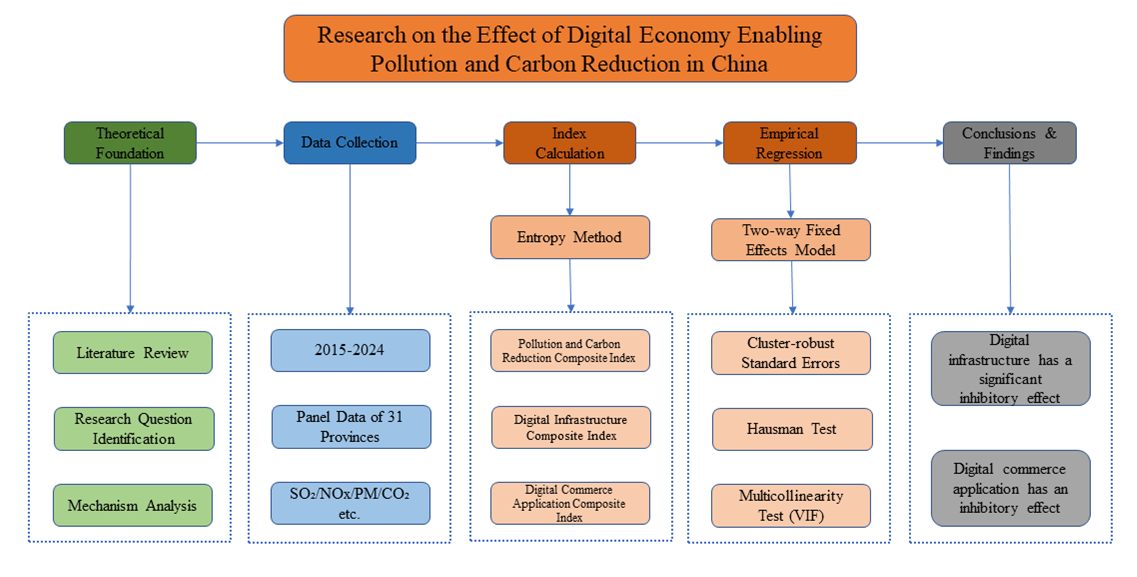
- The digital economy is decomposed into infrastructure and commerce dimensions.
- Composite indices are constructed using the entropy method.
- Digital infrastructure hinders pollution and carbon reduction.
- Digital commerce application hinders pollution and carbon reduction.
- Distinct environmental effects exist across digital economy dimensions.
- Open Access
- Article
Effect of Digital Economy Enabling Pollution and Carbon Reduction in China
- Zihao Peng 1 and
- Xueya Xu 2,*
Author Information
Received: 05 June 2026 | Revised: 10 July 2026 | Accepted: 21 July 2026 | Published: 24 July 2026
Highlights
Abstract
Since the introduction of China’s “dual carbon” goals, achieving synergistic pollution and carbon reduction has become a critical task for promoting ecological civilization and highquality development. As the digital economy expands rapidly, its role in facilitating green transformation has attracted increasing attention. Drawing on panel data from 31 Chinese provinces during 2015–2024, this study conceptualizes the digital economy from two dimensions—digital infrastructure and digital commerce application. The entropy method is employed to construct composite indices for both dimensions, and a two-way fixed effects model is applied to investigate their effects on pollution and carbon reduction. The results show that the growth of digital infrastructure has a significant negative effect on pollution and carbon reduction, likely due to intensive energy use and emissions during its construction and operation. Similarly, the development of digital commerce application also exhibits a negative effect, probably because of increased energy consumption from e-commerce logistics, data center operations, and enterprise digital transformation. Both dimensions currently hinder progress in pollution and carbon reduction, with digital infrastructure having a stronger adverse impact. Policy efforts should focus on promoting green and energyefficient development of digital infrastructure, accelerating the low-carbon transformation of digital commerce applications, and establishing an integrated evaluation framework linking digital economy development with pollution and carbon reduction. Such measures can provide targeted support for regional green transformation and sustainable development. This paper aims to answer whether the digital economy promotes or inhibits pollution and carbon reduction in China, and whether this effect operates through digital infrastructure or digital commerce application.
Graphical Abstract
Keywords
digital economy | digital infrastructure | digital commerce application | pollution reduction and carbon emission mitigation
References
- 1.
Wang, H.; Li, Y.; Lin, W.; et al. How does digital technology promote carbon emission reduction? Empirical evidence based on ecommerce pilot city policy in China. J. Environ. Manag. 2023, 325, 116524.
- 2.
Huang, C.; Lin, B. Digital economy solutions towards carbon neutrality: The critical role of energy efficiency and energy structure transformation. Energy 2024, 306, 132524.
- 3.
Li, R.; Guo, J.; Wang, Q.; et al. Exploring the impact of digital economy on energy transition: Insights from natural resource rent dynamics. Energy Environ. 2024, 37, 2360–2391.
- 4.
Qian, J.; Li, Z. The nonlinear impact of digital trade on green technology innovation in China: A dual environmental regulation perspective. Technol. Anal. Strateg. Manag. 2026, 1–15.
- 5.
Malmodin, J.; Lovehagen, N.; Bergmark, P.; et al. ICT sector electricity consumption and greenhouse gas emissions–2020 outcome. Telecommun. Policy 2024, 48, 102701.
- 6.
Appiah-Otoo, I.; Acheampong, A.O.; Song, N.; et al. The impact of information and communication technology (ICT) on carbon dioxide emissions: Evidence from heterogeneous ICT countries. Energy Environ. 2023, 34, 3080–3102.
- 7.
Wang, Q.; Cheng, X.; Li, R. Does the digital economy reduce carbon emissions? The role of technological innovation and trade openness. Energy Environ. 2025, 36, 1670–1695.
- 8.
Liang, C.; Chen, X.; Di, Q. Path to pollution and carbon reduction synergy from the perspective of the digital economy: Fresh evidence from 292 prefecture-level cities in China. Environ. Res. 2024, 252, 119050.
- 9.
Lin, S.; Shi, J.; Wang, Q.; et al. Spatial interdependence, spillover effects and moderating mechanisms of the digital economy on carbon productivity: Empirical analysis based on spatial econometric models. Sustainability 2025, 17, 10593.
- 10.
Zhu, H.; Bao, W.; Qin, M. Impact analysis of digital trade on carbon emissions from the perspectives of supply and demand. Sci. Rep. 2024, 14, 14540.
- 11.
Jiang, H.; Elahi, E.; Gao, M.; et al. Digital economy to encourage sustainable consumption and reduce carbon emissions. J. Clean Prod. 2024, 443, 140867.
- 12.
Chen, Y.; Ding, P.; Lu, Y.; et al. Has the digital economy facilitated regional collaborative carbon reduction? A complex network approach toward sustainable development goals. Sustainability 2025, 17, 10622.
- 13.
Lange, S.; Pohl, J.; Santarius, T. Digitalization and energy consumption. Does ICT reduce energy demand? Ecol. Econ. 2020, 176, 106760.
- 14.
Hao, X.; Li, Y.; Ren, S.; et al. The role of digitalization on green economic growth: Does industrial structure optimization and green innovation matter? J. Environ. Manag. 2023, 325, 116504.
- 15.
Chang, H.; Ding, Q.; Zhao, W.; et al. The digital economy, industrial structure upgrading, and carbon emission intensity—empirical evidence from China’s provinces. Energy Strateg. Rev. 2023, 50, 101218.
- 16.
Wang, Q.J.; Li,W.Z.; Gong, Z.Y.; et al. The coupling and coordination between digital economy and green economy: Evidence from China. Emerg. Mark. Finance Trade 2025, 61, 562–578.
- 17.
Li, Y.; Xu, H.; Li, H.; et al. Digital economy, environmental regulations, and green economic development. Finance Res. Lett. 2025, 75, 106858.
How to Cite
Peng, Z.; Xu, X. Effect of Digital Economy Enabling Pollution and Carbon Reduction in China. Earth Systems, Resources, and Sustainability 2026, 1 (3), 347–363. https://doi.org/10.53941/esrs.2026.100021.
RIS
BibTex
Copyright & License

Copyright (c) 2026 by the authors.
This work is licensed under a Creative Commons Attribution 4.0 International License.
Contents
References
