
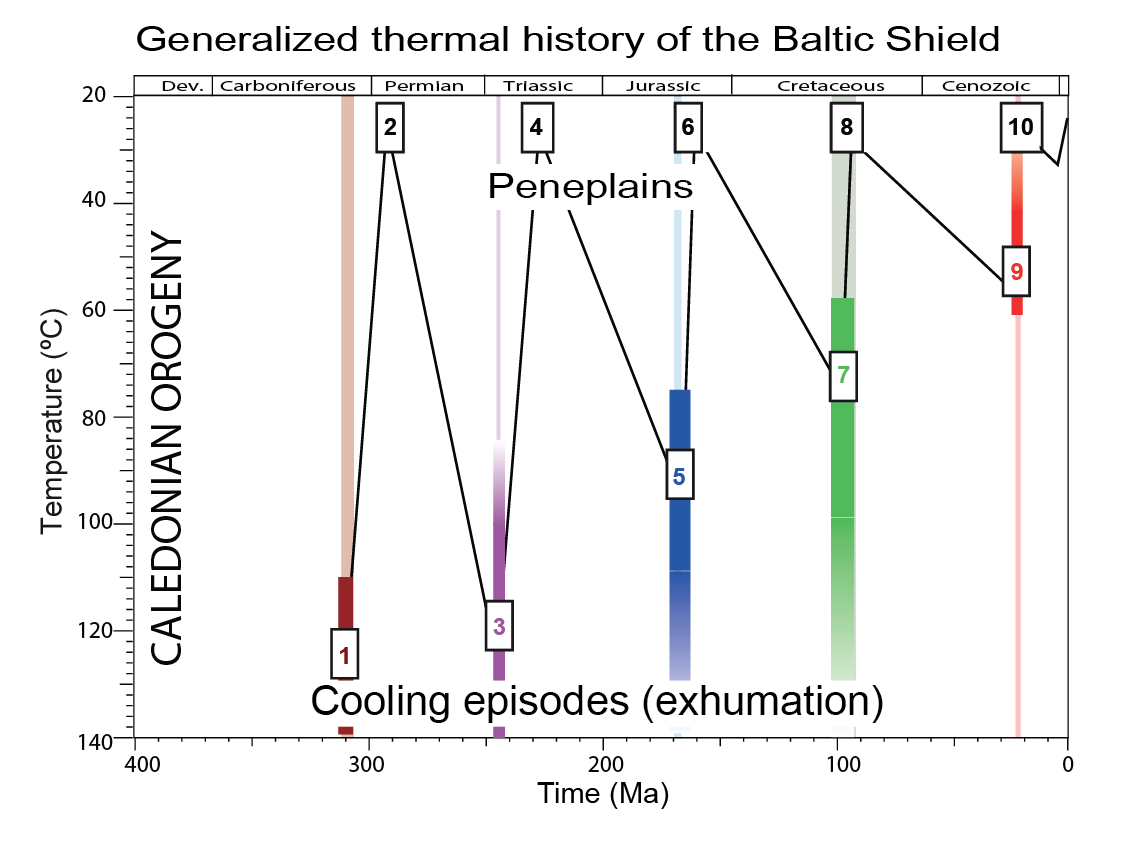
- Supposedly stable cratons have experienced multiple episodes of subsidence and uplift, involving deposition and removal of km-thick sedimentary covers.
- These episodes affected regions at a continental scale, including cratons as well as continental margins.
- It is time to reject the paradigm of cratonic stability.
- Open Access
- Article
Episodic Vertical Movements of Supposedly Stable Cratons
Author Information
Received: 23 June 2026 | Revised: 09 August 2026 | Accepted: 14 August 2026 | Published: 20 August 2026
Highlights
Abstract
Cratons are generally held to be stable, but stability means different things to different specialities. A key characteristic of cratons is the scarcity of cover rocks on Precambrian basement. This property has led many to assume—explicitly or indirectly—that the gap in the stratigraphic record represented by the lack of Phanerozoic cover implies tectonic stability over millions of years. Here we show that supposedly stable cratons have experienced multiple episodes of subsidence and uplift at the scale of kilometres, involving deposition and removal of sedimentary covers. These episodes affect regions at a continental scale, including cratons as well as continental margins.We present a series of case studies based on observations of regional landscapes in relation to stratigraphic constraints and thermal histories derived from apatite fission-track analysis. Evidence of former covers is commonly dismissed as unrealistic, but evidence of vertical movements of cratons has been known for decades, so we question why this is not widely accepted. Some may consider kmscale movements to be insignificant or choose to assume stability based on conventional thinking, while others dismiss the evidence due to the lack of an accepted mechanism by which such covers could have been deposited and removed. To counter that argument, we suggest a variety of lithospheric and sub-lithospheric processes that may explain the observations presented here. It is time to reject the paradigm of cratonic stability and accept that cratons have undergone positive and negative, km-scale vertical motions over geological timescales.
Graphical Abstract
Keywords
craton | stability | exhumation | burial | peneplain
References
- 1.
Stille, H. Wege und Ergebnisse der geologisch-tektonischen Forschung. In 25 Jahre Kaiser Wilhelm-Gesellschaft zur Forderung der Wissenschaften: Z–weiter Band Die Naturwissenschaften; Springer: Berlin, Germany, 1936; pp. 77–97. https://doi.org/10.1007/978-3-642-47338-8 6
- 2.
Stille, H. Einf ¨uhrung in der Bau Amerikas; Borntrager: Berlin, Germany, 1940; p. 717.
- 3.
Sloss, L.L. Introduction. In Sedimentary Cover—North American Craton; Decade of North American Geology (DNAG), Volume D-2; Geological Society of America: Boulder, CO, USA, 1988; pp. 1–3. https://doi.org/10.1130/dnag-gna-d2
- 4.
Hendriks, B.W.H.; Redfield, T.F. Apatite fission track and (U-Th)/He data from Fennoscandia: An example of underestimation of fission track annealing in apatite. Earth Planet. Sci. Lett. 2005, 236, 443–458. https://doi.org/10.1016/j.epsl.2005.05.027
- 5.
Artemieva, I. A lithospheric perspective on structure and evolution of Precambrian cratons. In Principles of Phanerozoic Regional Geology; Roberts, D.G., Bally, A.W., Eds.; Elsevier: Amsterdam, The Netherlands, 2012; pp. 94–111. http://doi.org/10.1016/B978-0-444-53042-4.00005-4
- 6.
Wang, H.L.; van Hunen, J.; Pearson, D.G.; et al. Craton stability and longevity: The roles of composition-dependent rheology and buoyancy. Earth Planet. Sci. Lett. 2014, 391, 224–233. https://doi.org/10.1016/j.epsl.2014.01.038
- 7.
Francois, T.; Burov, E.; Meyer, B.; et al. Surface topography as key constraint on thermo-rheological structure of stable cratons. Tectonophysics 2013, 602, 106–123. https://doi.org/10.1016/j.tecto.2012.10.009
- 8.
Kukkonen, I.T.; Kohn, B.; Kirsim¨ae, K.; et al. Phanerozoic evolution of Fennoscandia: Evidence from apatite fission track, fluid flow and geodynamic data in Finland and Estonia. Gondwana Res. 2025, 146, 74–92. https://doi.org/10.1016/j.gr.2025.05.011
- 9.
Pedersen, V.K.; Nielsen, S.B.; Gallagher, K. The postorogenic evolution of the Northeast Greenland Caledonides constrained from apatite fission track analysis and inverse geodynamic modelling. Tectonophysics 2012, 530–531, 318–330. https://doi.org/10.1016/j.tecto.2012.01.018
- 10.
Gallagher, K.; Brown, R.; Johnson, C. Fission track analysis and its applications to geological problems. Annu. Rev. Earth Planet. Sci. 1998, 26, 519–572. https://doi.org/10.1146/annurev.earth.26.1.519
- 11.
Rouby, D.; Loparev, A.; Chardon, D.; et al. Sediment routing systems to the Atlantic rifted margin of the Guiana Shield. Geosphere 2023, 19, 957–974. https://doi.org/10.1130/ges02561.1
- 12.
Egholm, D.L.; Knudsen, M.F.; Sandiford, M. Lifespan of mountain ranges scaled by feedbacks between landsliding and erosion by rivers. Nature 2013, 498, 475–478. https://doi.org/10.1038/nature12218
- 13.
Hall, A.M.; Putkinen, N.; Hietala, S.; et al. Ultra-slow cratonic denudation in Finland since 1.5 Ga indicated by tiered unconformities and impact structures. Precambrian Res. 2021, 352, 106000. https://doi.org/10.1016/j.precamres.2020.106000
- 14.
Pearson, D.G.; Scott, J.M.; Liu, J.; et al. Deep continental roots and cratons. Nature 2021, 596, 199–210. https://doi.org/10.1038/s41586-021-03600-5
- 15.
Bleeker, W. Archaean tectonics: A review, with illustrations from the Slave craton. Geol. Soc. Spec. Publ. 2002, 199, 151–181. https://doi.org/10.1144/gsl.sp.2002.199.01.09
- 16.
Hawkesworth, C.J.; Cawood, P.A.; Dhuime, B.; et al. Earth’s continental lithosphere through time. Annu. Rev. Earth Planet. Sci. 2017, 45, 169–198. https://doi.org/10.1146/annurev-earth-063016-020525
- 17.
Burgess, P.M. Phanerozoic evolution of the sedimentary cover of the North American craton. In The Sedimentary Basins of the United States and Canada; Miall, A.D., Ed.; Elsevier: Amsterdam, The Netherlands, 2019; pp. 39–75. https://doi.org/10.1016/b978-0-444-63895-3.00002-4
- 18.
Shirmard, H.; Mather, B.; Farahbakhsh, E.; et al. How subduction evolution drives sediment-hosted mineralisation along craton edges. Nat. Commun. 2026, 17, 7367. https://doi.org/10.1038/s41467-026-74134-5
- 19.
Sloss, L.L. Comparative anatomy of cratonic unconformities. In Interregional Unconformities and Hydrocarbon Accumulation; Schlee, J.S., Ed.; AAPG Memoir 36; American Association of Petroleum Geologists (AAPG): Tulsa, OK, USA, 1984; pp. 1–6. https://doi.org/10.1306/m36440c1
- 20.
Kohn, B.; Gleadow, A. Application of low-temperature thermochronology to Craton evolution. In Fission-Track Thermochronology and its Application to Geology; Springer: Berlin, Germany, 2019; pp. 373–393. https://doi.org/10.1007/978-3-319-89421-8 21
- 21.
Ager, D.V. The Nature of the Stratigraphical Record; Macmillan: London, UK, 1973. https://doi.org/10.1017/s0016756800046069
- 22.
Green, P.; Duddy, I.; Japsen, P. Episodic kilometre-scale burial and exhumation and the importance of missing section. Earth-Sci. Rev. 2022, 234, 104226. https://doi.org/10.1016/j.earscirev.2022.104226
- 23.
King, L.C. The Morphology of the Earth, 2nd ed.; Oliver and Boyd: Edinburgh, Scotland, 1967; p. 699. https://doi.org/10.1180/minmag.1967.036.279.23
- 24.
Bonow, J.M.; Lidmar-Bergstr¨om, K.; Japsen, P. Palaeosurfaces in central West Greenland as reference for identification of tectonic movements and estimation of erosion. Glob. Planet. Change 2006, 50, 161–183. https://doi.org/10.1016/j.gloplacha.2005.12.011
- 25.
Lidmar-Bergstrom, K. Relief and saprolites through time on the Baltic Shield. Geomorphology 1995, 12, 45–61. https://doi.org/10.1016/0169-555x(94)00076-4
- 26.
Lidmar-Bergstr¨om, K.; Bonow, J.M.; Japsen, P. Stratigraphic landscape analysis and geomorphological paradigms: Scandinavia as an example of Phanerozoic uplift and subsidence. Glob. Planet. Change 2013, 100, 153–171. https://doi.org/10.1016/j.gloplacha.2012.10.015
- 27.
Green, P.F.; Duddy, I.R. Thermal history reconstruction in sedimentary basins using apatite fission-track analysis and related techniques. In Analyzing the Thermal History of Sedimentary Basins: Methods and Case Studies; SEPM Special Publication 103; Society for Sedimentary Geology (SEPM): Tulsa, OK, USA, 2012; pp. 65–104. https://doi.org/10.2110/sepmsp.103.065
- 28.
Malusa, M.G.; Fitzgerald, P.G. Fission-track Thermochronology and its Application to Geology; Springer: Berlin, Germany, 2019; p. 314. https://doi.org/10.1007/978-3-319-89421-8
- 29.
Green, P.F.; Lidmar-Bergstr¨om, K.; Japsen, P.; et al. Stratigraphic Landscape Analysis, Thermochronology and the Episodic Development of Elevated Passive Continental Margins; Geological Survey of Denmark and Greenland Bulletin 2013/30; Geological Survey of Denmark and Greenland (GEUS): Copenhagen, Denmark, 2013; p. 150. https://doi.org/10.34194/geusb.v30.4673
- 30.
Green, P.; Duddy, I. Discussion: Extracting thermal history from low temperature thermochronology. A comment on recent exchanges between Vermeesch and Tian and Gallagher and Ketcham. Earth-Sci. Rev. 2021, 216, 103197. https://doi.org/10.1016/j.earscirev.2020.103197
- 31.
Davis, W.M. The geographical cycle. Geogr. J. 1899, 14, 481–504. https://doi.org/10.2307/1774538
- 32.
King, L.C. Planation remnants upon high lands. Z. Geomorphol. 1976, 20, 133–148. https://doi.org/10.1127/zfg/20/1976/133
- 33.
Panek, T.; Svennevig, K.; Brezny, M.; et al. The occurrence, mechanisms and hazards of large landslides along tablelands. Nat. Rev. Earth Environ. 2024, 5, 686–700. https://doi.org/10.1038/s43017-024-00587-1
- 34.
Penck,W. Die morphologishe Analyse; Geographische Abhandlungen Zweite Reihe 2; J. Engelhorn / J. Engelhorns Nachf.: Stuttgart, Germany, 1924.
- 35.
Lidmar-Bergstr¨om, K.; Ollier, C.D.; Sulebak, J.C. Landforms and uplift history of southern Norway. Glob. Planet. Change 2000, 24, 211–231. https://doi.org/10.1016/S0921-8181(00)00009-6
- 36.
Johnson, D. Stream Sculpture on the Atlantic Slope: A Study in the Evolution of Appalachian Rivers; Columbia University Press: New York, NY, USA, 1931.
- 37.
Bonow, J.M.; Chalmers, J.A.; Japsen, P. The high plains of Southern Norway: Result of Late Mesozoic – Cenozoic Episodic Tectonics. Tektonika 2026, 4, 132–161. https://doi.org/10.55575/tektonika2026.4.1.112
- 38.
Bezerra, F.H.R.; Neves, B.B.B.; Correa, A.C.B.; et al. Late Pleistocene tectonic-geomorphological development within a passive margin - The Cariata trough, northeastern Brazil. Geomorphology 2008, 97, 555–582. https://doi.org/10.1016/j.geomorph.2007.09.008
- 39.
Owono, F.M.; Ntamak-Nida, M.-J.; Dauteuil, O.; et al. Morphology and long-term landscape evolution of the South African plateau in South Namibia. Catena 2016, 142, 47–65. https://doi.org/10.1016/j.catena.2016.02.012
- 40.
Lidmar-Bergstr¨om, K. Pre-Quaternary geomorphological evolution in southern Fennoscandia. Sveriges Geol. Unders. 1982, 785, 202.
- 41.
Thomas, M.F. Geomorphology in the Tropics - A study of Weathering and Denudation in Low Latitudes; John Wiley and Sons: Chichester, England, UK, 1994. https://doi.org/10.1016/s0277-3791(97)90010-x
- 42.
Mig´on, P.; Lidmar-Bergstr¨om, K. Weathering mantles and their significance for geomorphological evolution of central and northern Europe since the Mesozoic. Earth-Sci. Rev. 2001, 56, 285–324. https://doi.org/10.1016/s0012-8252(01)00068-x
- 43.
Budel, J. Die ‘Doppelten Einebnungsfl¨achen’ in den feuchten Tropen (The ‘double planation surfaces’ in the humid tropics). Z. Geomorphol. 1957, 1, 201–228. https://doi.org/10.1127/zfg/1/1957/201
- 44.
Lidmar-Bergsrtrom, K.; Olvmo, M. Plains, Steps, Hilly Relief and Valleys in Northern Sweden-Review, Interpretations and Implications for Conclusions on Phanerozoic Tectonics; SGU Research Paper C 838; Sveriges geologiska unders¨okning: Uppsala, Sweden, 2015; p. 42.
- 45.
Artyushkov, E.V.; Lindstrom, M.; Popov, L.E. Relative sea-level changes in Baltoscandia in the Cambrian and early Ordovician: The predominance of tectonic factors and the absence of large scale eustatic fluctuations. Tectonophysics 2000, 320, 375–407. https://doi.org/10.1016/s0040-1951(00)00038-x
- 46.
Bonow, J.M.; Japsen, P.; Nielsen, T.F.D. High-level landscapes along the margin of East Greenland—A record of tectonic uplift and incision after breakup in the NE Atlantic. Glob. Planet. Change 2014, 116, 10–29. http://doi.org/10.1016/j.gloplacha.2014.01.010
- 47.
Bonow, J.M.; Japsen, P. Peneplains and tectonics in North-East Greenland after opening of the North-East Atlantic. GEUS Bull. 2021, 45, 1–39. https://doi.org/10.34194/ geusb.v45.5297
- 48.
Green, P.F.; Japsen, P.; Bonow, J.M.; et al. The post-Caledonian thermo-tectonic evolution of Fennoscandia. Gondwana Res. 2022, 107, 201–234. https://doi.org/10.1016/j.gr.2022.03.007
- 49.
Japsen, P.; Green, P.F.; Bonow, J.M. Ups and downs of the Guiana Shield and Amazon Basin over the last 500 Myr. Gondwana Res. 2025, 148, 415–444. https://doi.org/10.1016/j.gr.2025.06.020
- 50.
Kroonenberg, S.; Melitz, P. Summit levels, bedrock control and the etchplain concept in the basement of Suriname. Geol. Mijnbouw 1983, 62, 389–399.
- 51.
Bonow, J.M.; Lidmar-Bergstrom, K.; Naslund, J.O. Palaeosurfaces and major valleys in the area of the Kjølen Mountains, southern Norway - Consequences of uplift and climate change. Norsk Geogr. Tidsskr. 2003, 57, 83–101. https://doi.org/10.1080/00291950310001360
- 52.
Li, J.; Xie, S.; Kuang, M. Geomorphic evolution of the Yangtze Gorges and the time of their formation. Geomorphology 2001, 41, 125–135. https://doi.org/10.1016/s0169-555x(01)00110-6
- 53.
Lidmar-Bergstrom, K. Long term morphotectonic evolution in Sweden. Geomorphology 1996, 16, 33–59. https://doi.org/10.1016/0169-555x(95)00083-h
- 54.
Japsen, P.; Green, P.F.; Chalmers, J.A.; et al. Mountains of southernmost Norway: Uplifted Miocene peneplains and reexposed Mesozoic surfaces. J. Geol. Soc. 2018, 175, 721–741. https://doi.org/10.1144/jgs2017-157
- 55.
Gibbs, A.K.; Barron, C.N. The Geology of the Guiana Shield; Oxford University Press: New York, NY, USA, 1993.
- 56.
Kroonenberg, S.B.; de Roever, E.W. Geological evolution of the Amazonian Craton. In Amazonia: Landscape and Species Evolution: A Look into the Past; Wiley-Blackwell: Chichester, UK, 2010; pp. 7–28. https://doi.org/10.1002/9781444306408.ch2
- 57.
Cordani, U.G.; Teixeira, W.; D’Agrella-Filho, M.S.; et al. The position of the Amazonian Craton in supercontinents. Gondwana Res. 2009, 15, 396–407. https://doi.org/10.1016/j.gr.2008.12.005
- 58.
Pastana, J.M.d.N. Mapa Geologico, Municipio de Monte Alegre, 1: 500 000; Companhia de Pesquisa de Recursos Minerais (CPRM) / Servico Geologico do Brasil: Belem, Para, Brazil, 1999.
- 59.
Matsuda, N.; Winter, W.; Wanderley Filho, J.; et al. O Paleozoico da borda sul da Bacia do Amazonas, Rio Tapajos-Estado do Para. Bol. Geocienc. Petrobras 2010, 18, 123–152.
- 60.
Cunha, P.R.d.C.; Gonc¸alves de Melo, J.; da Silva, O.B. Bacia do Amazonas. Bol. Geociˆenc. Petrobras 2007, 15, 227–251.
- 61.
Wong, T.E.; de Kramer, R.; de Boer, P.; et al. The influence of sea-level changes on tropical coastal lowlands; the Pleistocene Coropina Formation, Suriname. Sediment. Geol. 2009, 216, 125–137. https://doi.org/10.1016/j.sedgeo.2009.02.003
- 62.
Griffith, C.; Kariodimedjo, R.; Chandoe, M.; et al. Suriname: New technology unlocks hydrocarbon potential. GEOExPro 2016, 13, 34–37.
- 63.
Bordossy, G.; Aleva, G.J.J. Lateritic Bauxites; Developments in Economic Geology 27; Elsevier Science Ltd: Amsterdam, The Netherlands, 1990.
- 64.
Sapin, F.; Davaux, M.; Dall’Asta, M.; et al. Post-rift subsidence of the French Guiana hyper-oblique margin: From rift-inherited subsidence to Amazon deposition effect. In Transform Margins: Development, Controls and Petroleum Systems; Geological Society: London, UK, 2016; Volume 431, p. 20. https://doi.org/10.1144/sp431.11
- 65.
Harman, R.; Gallagher, K.; Brown, R.; et al. Accelerated denudation and tectonic/geomorphic reactivation of the cratons of northeastern Brazil during the Late Cretaceous. J. Geophys. Res. Solid Earth 1998, 103, 27091–27105. https://doi.org/10.1029/98jb02524
- 66.
de Pina, A.; Moura, C.A.; Vignol-Lelarge, M.L. Termocronologia por trac¸os de fissao em apatita em rochas ıgneas do embasamento e sedimentar da Bacia do Amazonas, na regiao de Itaituba, PA, Brasil. Pesqui. Geociˆenc. 2014, 41, 39–50. https://doi.org/10.22456/1807-9806.78033
- 67.
Derycke, A.; Gautheron, C.; Barbarand, J.; et al. French Guiana margin evolution: From Gondwana break-up to Atlantic opening. Terra Nova 2021, 33, 415–422. https://doi.org/10.1111/ter.12526
- 68.
Fonseca, A.; Nachtergaele, S.; Bonilla, A.; et al. Extensional exhumation of cratons: Insights from the Early Cretaceous Rio Negro-Juruena belt (Amazonian Craton, Colombia). Solid Earth 2024, 15, 329–352. https://doi.org/10.5194/se-15-329-2024
- 69.
Marzoli, A.; Callegaro, S.; Dal Corso, J.; et al. The Central Atlantic magmatic province (CAMP): A review. In The Late Triassic World: Earth in a Time of Transition; Topics in Geobiology 46; Springer: Cham, Switzerland, 2018; pp. 91–125. https://doi.org/10.1007/978-3-319-68009-5 4
- 70.
Pinto, V.M.; Santos, J.O.S.; Ronchi, L.H.; et al. Field and geochemical constraints on the relationship between the Apoteri basalts (northern Brazil, southwestern Guyana) and the Central Atlantic Magmatic Province. J. S. Am. Earth Sci. 2017, 79, 384–393. https://doi.org/10.1016/j.jsames.2017.08.015
- 71.
King, L.C. A geomorfologia do Brasil Oriental. Rev. Bras. Geogr. 1956, 18, 147–265.
- 72.
Szatmari, P.; Milani, E.J. Tectonic control of the oil-rich large igneous-carbonate-salt province of the South Atlantic rift. Mar. Petrol. Geol. 2016, 77, 567–596. https://doi.org/10.1016/j.marpetgeo.2016.06.004
- 73.
Baby, P.; Prudhomme, A.; Brusset, S.; et al. The Northern Central Andes and Andean tectonic evolution revisited: An integrated stratigraphic and structural model of three superimposed orogens. Earth-Sci. Rev. 2025, 260, 104998. https://doi.org/10.1016/j.earscirev.2024.104998
- 74.
Stotz, I.L.; Vilac´ıs, B.; Hayek, J.N.; et al. Plume driven plate motion changes: New insights from the South Atlantic realm. J. S. Am. Earth Sci. 2023, 124, 104257. https://doi.org/10.1016/j.jsames.2023.104257
- 75.
Granot, R.; Dyment, J. The cretaceous opening of the South Atlantic Ocean. Earth Planet. Sci. Lett. 2015, 414, 156–163. https://doi.org/10.1016/j.epsl.2015.01.015
- 76.
Espinoza, V.; Iaffaldano, G. Rapid absolute plate motion changes inferred from high-resolution relative spreading reconstructions: A case study focusing on the South America plate and its Atlantic/Pacific neighbors. Earth Planet. Sci. Lett. 2023, 604, 118009. https://doi.org/10.1016/j.epsl.2023.118009
- 77.
Caputo, M.V.; Soares, E.A.A. Eustatic and tectonic change effects in the reversion of the transcontinental Amazon River drainage system. Braz. J. Geol. 2016, 46, 301–328. https://doi.org/10.1590/2317-4889201620160066
- 78.
Pastana, J.M.d.N. Sıntese geologica e favorabilidade para tipos de jazimentos minerais; CPRM: Belem, Para, Brazil, 1999; p. 42.
- 79.
Japsen, P.; Green, P.F.; Chalmers, J.A.; et al. Episodes of post-Caledonian burial and exhumation in Greenland and Fennoscandia. Earth-Sci. Rev. 2024, 248, 104626. https://doi.org/10.1016/j.earscirev.2023.104626
- 80.
Caputo, M.V. Juru´a orogeny: Brazil and Andean countries. Braz. J. Geol. 2014, 44, 181–190. https://doi.org/10.5327/Z2317-4889201400020001
- 81.
Loncke, L.; de L´epinay, M.M.; Basile, C.; et al. Compared structure and evolution of the conjugate Demerara and Guinea transform marginal plateaus. Tectonophysics 2022, 822, 229112. https://doi.org/10.1016/j.tecto.2021.229112
- 82.
Arai, M. A grande elevacao eust tica do Mioceno e sua influencia na origem da Grupo Barreiras. Geol. USP, Ser. Cient. 2006, 6, 1–6. https://doi.org/10.5327/s1519-874x2006000300002
- 83.
Gorini, C.; Haq, B.U.; dos Reis, A.T.; et al. Late Neogene sequence stratigraphic evolution of the Foz do Amazonas Basin, Brazil. Terra Nova 2014, 26, 179–185. https://doi.org/10.1111/ter.12083
- 84.
Heilbron, M.; Cordani, U.G.; Alkmim, F.F. The S˜ao Francisco craton and its margins. In Soo Francisco Craton, Eastern Brazil: Tectonic Genealogy of a Miniature Continent; Springer: Berlin, Germany, 2016; pp. 3–13. https://doi.org/10.1007/978-3-319-01715-0 1
- 85.
Sant’Anna, L.G.; Schorscher, H.D.; Riccomini, C. Cenozoic tectonics of the Fonseca Basin region, eastern Quadrilatero Ferrifero, MG, Brazil. J. S. Am. Earth Sci. 1997, 10, 275–284. https://doi.org/10.1016/s0895-9811(97)00016-3
- 86.
Bezerra, F.I.; Mendes, M.; De Souza, O. New record of Mastotermitidae from Fonseca Basin, Eocene-Oligocene boundary of southeastern Brazil. Biologia 2020, 75, 1881–1890. https://doi.org/10.2478/s11756-020-00441-x
- 87.
Japsen, P.; Bonow, J.M.; Green, P.F.; et al. Episodic burial and exhumation history of NE Brazil after opening of the South Atlantic. Geol. Soc. Am. Bull. 2012, 124, 800–816. https://doi.org/10.1130/B30515.1
- 88.
Peulvast, J.-P.; B´ etard, F. Morphostratigraphic constraints and low temperature thermochronology: Lessons from a review of recent geological and geomorphological studies in northeast Brazil. J. S. Am. Earth Sci. 2021, 111, 103464. https://doi.org/10.1016/j.jsames.2021.103464
- 89.
Morais Neto, J.M.; Hegarty, K.A.; Karner, G.D.; et al. Timing and mechanisms for the generation and modification of the anomalous topography of the Borborema Province, northeastern Brazil. Mar. Petrol. Geol. 2009, 26, 1070–1086. https://doi.org/10.1016/j.marpetgeo.2008.07.002
- 90.
Jelinek, A.R.; Chemale Jr, F.; van der Beek, P.A.; et al. Denudation history and landscape evolution of the northern East-Brazilian continental margin from apatite fission-track thermochronology. J. S. Am. Earth Sci. 2014, 54, 158–181. http://doi.org/10.1016/j.jsames.2014.06.001
- 91.
Lidmar-Bergstr¨om, K. Denudation surfaces of a shield area in south Sweden. Geogr. Ann. A: Phys. Geogr. 1988, 70, 337–350. https://doi.org/10.1080/04353676.1988.11880265
- 92.
Lidmar-Bergstr¨om, K. Denudation surfaces and tectonics in the southernmost part of the Baltic Shield. Precambrian Res. 1993, 64, 337–345. https://doi.org/10.1016/0301-9268(93)90086-h
- 93.
Lidmar-Bergstrom, K.; Olvmo, M.; Bonow, J.M. The South Swedish Dome: A key structure for identification of peneplains and conclusions on Phanerozoic tectonics of an ancient shield. GFF 2017, 139, 244–259. https://doi.org/10.1080/11035897.2017.1364293
- 94.
Japsen, P.; Bidstrup, T.; Lidmar-Bergstrom, K. Neogene uplift and erosion of southern Scandinavia induced by the rise of the South Swedish Dome. In Exhumation of the North Atlantic Margin: Timing, Mechanisms and Implications for Petroleum Exploration, Dore, A.G., Cartwright, J.A., Stoker, M.S.; et al., Eds.; Geological Society, London, Special Publications 196; Geological Society of London: London, UK, 2002; pp. 183–207. https://doi.org/10.1144/gsl.sp.2002.196.01.12
- 95.
Hestnes, ˚A.; Gasser, D.; Ksienzyk, A.K.; et al. The tectono-thermal evolution of Western Norway – New insights from low-temperature thermochronology. Tectonics 2025, 44, e2024TC008480. https://doi.org/10.1029/2024TC008480
- 96.
Japsen, P.; Green, P.F.; Bonow, J.M.; et al. Episodic burial and exhumation of the southern Baltic Shield: Epeirogenic uplifts during and after break-up of Pangea. Gondwana Res. 2016, 35, 357–377. https://doi.org/10.1016/j.gr.2015.06.005
- 97.
Zeck, H.; Andriessen, P.; Hansen, K.; et al. Paleozoic paleocover of the southern part of the Fennoscandian Shieldfission track constraints. Tectonophysics 1988, 149, 61–66. https://doi.org/10.1016/0040-1951(88)90118-7
- 98.
Buchardt, B.; Lewan, M.D. Reflectance of vitrinite-like macerals as a thermal maturity index for Cambrian-Ordovician Alum Shale, Southern Scandinavia. AAPG Bull. 1990, 74, 394–406. https://doi.org/10.1306/0c9b230d-1710-11d7-8645000102c1865d
- 99.
Samuelsson, J.; Middleton, M.F. The Caledonian foreland basin in Scandinavia: Constrained by the thermal maturation of the Alum Shale. GFF 1998, 120, 307–314. https://doi.org/10.1080/11035899809453224
- 100.
Larson, S.˚A.; Tullborg, E.L.; Cederbom, C.; et al. Sveconorwegian and Caledonian foreland basins in the Baltic Shield revealed by fission-track thermochonology. Terra Nova 1999, 11, 210–215. https://doi.org/10.1046/j.1365-3121.1999.00249.x
- 101.
Cederbom, C. Phanerozoic, pre-Cretaceous thermotectonic events in southern Sweden revealed by fission track thermochronology. Earth Planet. Sci. Lett. 2001, 188, 199–209. https://doi.org/10.1016/s0012-821x(01)00300-4
- 102.
Gee, D.G.; Fossen, H.; Henriksen, N.; et al. From the early Paleozoic platforms of Baltica and Laurentia to the Caledonide Orogen of Scandinavia and Greenland. Episodes 2008, 31, 44–51. https://doi.org/10.18814/epiiugs/2008/v31i1/007
- 103.
Sigmond, E.M.O. Geological Map. Land and Sea Areas of Northern Europe, Scale 1: 4 million; Geological Survey of Norway: Trondheim, Norway, 2002. https://hdl.handle.net/11250/3047302
- 104.
Beckholmen, M.; Tiren, S.A. The Geological History of the Baltic Sea: A Review of the Literature and Investigation Tools; SSM Report 2009:21; Swedish Radiation Safety Authority (SSM): Stockholm, Sweden, 2009.
- 105.
Bauck, M.; Faleide, J.; Fossen, H.; et al. Paleo-landscapes recorded by the Top Basement surface in the Norwegian North Sea. Mar. Petrol. Geol. 2025, 181, 107527. https://doi.org/10.1016/j.marpetgeo.2025.107527
- 106.
Glennie, K.; Higham, J.; Stemmerik, L. The Permian of the Northern North Sea. In Millennium Atlas: Petroleum Geology of the Central and Northern North Sea; Geological Society of London: London, UK, 2003; pp. 91–103.
- 107.
Freden, C. Geology. National Atlas of Sweden; SNA Publishing: Stockholm, Sweden, 1994; p. 208.
- 108.
Calner, M.; Ahlberg, P.; Lehnert, O.; et al. The Lower Palaeozoic of Southern Sweden and the Oslo Region, Norway. Field Guide for the 3rd Annual Meeting of the IGCP Project 591; Sveriges geologiska undersokning Rapporter och Meddelanden 133; Sveriges Geologiska Undersokning (SGU): Uppsala, Sweden, 2013.
- 109.
Lassen, A.; Thybo, H. Neoproterozoic and Palaeozoic evolution of SW Scandinavia based on integrated seismic interpretation. Precambrian Res. 2012, 204, 75–104. https://doi.org/10.1016/j.precamres.2012.01.008
- 110.
Bergstrom, J.; Holland, B.; Larsson, K.; et al. Guide to Excursions in Scania; SGU, Series Ca 54; Sveriges Geologiska Undersokning (SGU): Uppsala, Sweden, 1982; p. 95.
- 111.
Ramberg, I.B.; Bryhni, I.; Nøttvedt, A.; et al. (Eds.) The Making of a Land: Geology of Norway; Norsk Geologisk Forening (Norwegian Geological Association): Trondheim, Norway, 2008.
- 112.
Embry, A.; Beauchamp, B.; Dewing, K.; et al. Episodic tectonics in the Phanerozoic succession of the Canadian High Arctic and the “10-million-year flood”. In Circum-Arctic Structural Events: Tectonic Evolution of the Arctic Margins and Trans-Arctic Links with Adjacent Orogens; Geological Society of America Special Paper 541; Geological Society of America: Boulder, CO, USA, 2018. https://doi.org/10.1130/2018.2541(11)
- 113.
Oakey, G.N.; Chalmers, J.A. A new model for the Paleogene motion of Greenland relative to North America: Plate reconstructions of the Davis Strait and Nares Strait regions between Canada and Greenland. J. Geophys. Res. Solid Earth 2012, 117, 1–28. https://doi.org/10.1029/2011jb008942
- 114.
Gaina, C.; Nasuti, A.; Kimbell, G.S.; et al. Break-up and seafloor spreading domains in the NE Atlantic. In The NE Atlantic Region: A Reappraisal of Crustal Structure, Tectonostratigraphy and Magmatic Evolution; P´eron-Pinvidic, G., Hopper, J.R., Stoker, M.S.; et al., Eds.; Geological Society, London, Special Publications 447; The Geological Society of London: London, UK, 2017. https://doi.org/10.1144/SP447.12
- 115.
Dumais, M.-A.; Gernigon, L.; Olesen, O.; et al. New interpretation of the spreading evolution of the Knipovich Ridge derived from aeromagnetic data. Geophys. J. Int. 2021, 224, 1422–1428. https://doi.org/10.1093/gji/ggaa527
- 116.
Matthews, K.J.; Maloney, K.T.; Zahirovic, S.; et al. Global plate boundary evolution and kinematics since the late Paleozoic. Glob. Planet. Change 2016, 146, 226–250. https://doi.org/10.1016/j.gloplacha.2016.10.002
- 117.
Underhill, J.R.; Partington, M.A. Jurassic thermal doming and deflation in the North Sea: Implications of the sequence stratigraphic evidence. In Petroleum Geology of North West Europe, Proceedings of the 4th Conference; Parker, J.R., Ed.; The Geological Society of London: London, UK, 1993; pp. 337–345. https://doi.org/10.1144/0040337
- 118.
Green, P.; Duddy, I. Reply to Comment on “Discussion: Extracting thermal history from low temperature thermochronology/A comment on the recent exchanges between Vermeesch and Tian and Gallagher and Ketcham”, by Paul Green and Ian Duddy, Earth Science Reviews. Earth-Sci. Rev. 2021, 216, 103550. https://doi.org/10.1016/j.earscirev.2021.103550
- 119.
Dawes, P.R. Precambrian-Palaeozoic geology of Smith Sound, Canada and Greenland: Key constraint to palaeogeographic reconstructions of northern Laurentia and the North Atlantic region. Terra Nova 2009, 21, 1–13. https://doi.org/10.1111/j.1365-3121.2008.00845.x
- 120.
Dawes, P.R. The bedrock geology under the Inland Ice: The next major challenge for Greenland mapping. GEUS Bull. 2009, 17, 57–60. https://doi.org/10.34194/geusb.v17.5014
- 121.
Gow, A.J.; Meese, D.A.; Alley, R.B.; et al. Physical and structural properties of the Greenland Ice Sheet Project 2 ice core: A review. J. Geophys. Res. Oceans 1997, 102, 26559–26575. https://doi.org/10.1029/97JC00165
- 122.
Henriksen, N.; Higgins, A.K.; Kalsbeek, F.; et al. Greenland from Archean to Quaternary: Descriptive text to the 1995 Geological map of Greenland, 1:2,500,000. GEUS Bull. 2009, 18, 1–126. https://doi.org/10.34194/geusb.v18.4993
- 123.
Haller, J. Geology of the East Greenland Caledonides; Interscience: London, UK, 1971; p. 413.
- 124.
Surlyk, F. Timing, style and sedimentary evolution of Late Palaeozoic - Mesozoic extensional basins in East Greenland. In Tectonic Events Responsible for Britain’s Oil and Gas Reserves; Hardman, R.F.P., Brooks, J., Eds.; Geological Society, London, Special Publications 55; The Geological Society of London: London, UK, 1990; pp. 107–125. https://doi.org/10.1144/gsl.sp.1990.055.01.05
- 125.
Stemmerik, L.; Christiansen, F.G.; Piasecki, S.; et al. Depositional history and petroleum geology of the Carboniferous to Cretaceous sediments in the northern part of East Greenland. In Arctic Geology and Petroleum Potential; Vorren, T.O., Bergsager, E., Dahl-Stamnes, A.; et al., Eds.; NPF Special Publication 2; Elsevier: Amsterdam, The Netherlands, 1993; pp. 67–87. https://doi.org/10.1016/b978-0-444-88943-0.50009-5
- 126.
Bjerager, M.; Alsen, P.; Bojesen-Koefoed, J.; et al. Cretaceous lithostratigraphy of North-East Greenland. Bull. Geol. Soc. Den. 2020, 68, 37–93. https://doi.org/10.37570/bgsd-2020-68-04
- 127.
Larsen, L.M.; Watt, W.S.; Watt, M. Geology and Petrology of the Lower Tertiary Plateau Basalts of the Scoresby Sund Region, East Greenland; Bulletin 157; Grønlands Geologiske Undersøgelse: Copenhagen, Denmark, 1989; 164p. https://doi.org/10.34194/bullggu.v157.6699
- 128.
Brooks, C.K. The East Greenland rifted volcanic margin. GEUS Bull. 2011, 24, 1–96. https://doi.org/10.34194/ geusb.v24.4732
- 129.
Japsen, P.; Green, P.F.; Bonow, J.M.; et al. Episodic burial and exhumation in North-East Greenland before and after opening of the North-East Atlantic. GEUS Bull. 2021, 45, 5299. https://doi.org/10.34194/geusb.v45.5299
- 130.
Larsen, L.M.; Pedersen, A.K.; Tegner, C.; et al. Eocene to Miocene igneous activity in NE Greenland: Northward younging of magmatism along the East Greenland margin. J. Geol. Soc. 2014, 171, 539–553. https://doi.org/10.1144/jgs2013-118
- 131.
Nielsen, T.F.D.; Brooks, C.K. The E. Greenland rifted continental margin - An examination of the coastal flexure. J. Geol. Soc. 1981, 138, 559–568. https://doi.org/10.1144/gsjgs.138.5.0559
- 132.
Schiffer, C.; Jacobsen, B.H.; Balling, N.; et al. The East Greenland Caledonides—Teleseismic signature, gravity and isostasy. Geophys. J. Int. 2015, 203, 1400–1418. http://doi.org/10.1093/gji/ggv373
- 133.
Zielinski, G.A.; Mayewski, P.A.; Meeker, L.D.; et al. A 110,000-yr record of explosive volcanism from the GISP2 (Greenland) ice core. Quat. Res. 1996, 45, 109–118. https://doi.org/10.1006/qres.1996.0013
- 134.
Stoker, M.S.; Praeg, D.; Hjelstuen, B.O.; et al. Neogene stratigraphy and the sedimentary and oceanographic development of the NW European Atlantic margin. Mar. Petrol. Geol. 2005, 22, 977–1005. https://doi.org/10.1016/j.marpetgeo.2004.11.007
- 135.
Storey, M.; Pedersen, A.K.; Stecher, O.; et al. Long-lived postbreakup magmatism along the East Greenland margin: Evidence for shallow-mantle metasomatism by the Iceland plume. Geology 2004, 32, 173–176. https://doi.org/10.1130/G19889.1
- 136.
Ruddiman, W.F. A paleoclimatic enigma? Science 2010, 328, 838–839. https://doi.org/10.1126/science.1188292
- 137.
Larsen, P.H. Relay structures in a Lower Permian basementinvolved extension system, East Greenland. J. Struct. Geol. 1988, 10, 3–8. https://doi.org/10.1016/0191-8141(88)90122-8
- 138.
Paxman, G.J.; Tinto, K.J.; Austermann, J. Neogene-quaternary uplift and landscape evolution in Northern Greenland recorded by Subglacial Valley Morphology. J. Geophys. Res. Earth Surf. 2021, 126, e2021JF006395. https://doi.org/10.1029/2021JF006395
- 139.
Paxman, G.J.; Jamieson, S.S.; Dolan, A.M.; et al. Subglacial valleys preserved in the highlands of south and east Greenland record restricted ice extent during past warmer climates. Cryosphere 2024, 18, 1467–1493. https://doi.org/10.5194/tc-18-1467-2024
- 140.
Japsen, P.; Green, P.F.; Chalmers, J.A. Synchronous exhumation episodes across Arctic Canada, North Greenland and Svalbard in relation to the Eurekan Orogeny. Gondwana Res. 2023, 117, 207–229. https://doi.org/10.1016/j.gr.2023.01.011
- 141.
Japsen, P.; Bonow, J.M.; Green, P.F.; et al. Elevated, passive continental margins: Long-term highs or Neogene uplifts? New evidence from West Greenland. Earth Planet. Sci. Lett. 2006, 248, 315–324. https://doi.org/10.1016/j.epsl.2006.05.036
- 142.
Surlyk, F.; Ineson, J. The Jurassic of Denmark and Greenland: Key elements in the reconstruction of the North Atlantic Jurassic rift system. In The Jurassic of Denmark and Greenland; Ineson, J., Surlyk, F., Eds.; Geological Survey of Denmark and Greenland 1; Geological Survey of Denmark and Greenland (GEUS): Copenhagen, Denmark, 2003; pp. 9–20. https://doi.org/10.34194/geusb.v1.4644
- 143.
Larsen, L.M.; Heaman, L.M.; Creaser, R.A.; et al. Tectonomagmatic events during stretching and basin formation in the Labrador Sea and the Davis Strait: evidence from age and composition of Mesozoic to Palaeogene dyke swarms in West Greenland. J. Geol. Soc. Lond. 2009, 166, 999–1012. https://doi.org/10.1144/0016-76492009-038
- 144.
Nielsen, S.B.; Gallagher, K.; Leighton, C.; et al. The evolution of western Scandinavian topography: A review of Neogene uplift versus the ICE (isostasy–climate–erosion) hypothesis. J. Geodyn. 2009, 47, 72–95. https://doi.org/10.1016/j.jog.2008.09.001
- 145.
Japsen, P.; Green, P.F.; Chalmers, J.A. The mountains of North-East Greenland are not remnants of the Caledonian topography. A comment on Pedersen et al. (2012): Tectonophysics vol. 530–531, p. 318-330. Tectonophysics 2013, 589, 234–238. https://doi.org/10.1016/j.tecto.2012.07.026
- 146.
Johnson, C.; Gallagher, K. Preliminary Mesozoic and Cenozoic denudation history of the North East Greenland onshore margin. Glob. Planet. Change 2000, 24, 261–274. https://doi.org/10.1016/s0921-8181(00)00012-6
- 147.
Japsen, P.; Green, P.F.; Bonow, J.M.; et al. Episodic uplift and exhumation along North Atlantic passive margins: Implications for hydrocarbon prospectivity. In Petroleum Geology: From Mature Basins to New Frontiers—Proceedings of the 7th Petroleum Geology Conference; Vining, B.A., Pickering, S.C., Eds.; Geological Society: London, UK, 2010; pp. 979–1004. https://doi.org/10.1144/0070979
- 148.
Flowers, R.M.; Kelley, S.A. Interpreting data dispersion and “inverted” dates in apatite (U-Th)/He and fission-track datasets: An example from the US midcontinent. Geochim. Cosmochim. Acta 2011, 75, 5169–5186. https://doi.org/10.1016/j.gca.2011.06.016
- 149.
McDannell, K.T.; Pinet, N.; Issler, D.R. Exhuming the Canadian Shield: Preliminary interpretations from low-temperature thermochronology and significance for the sedimentary succession of the Hudson Bay Basin. Geol. Surv. Can., Bull. 2021, 609, 287–322. https://doi.org/10.4095/326100
- 150.
Sloss, L.L. Sequences in the cratonic interior of North America. Geol. Soc. Am. Bull. 1963, 74, 93–114. https://doi.org/10.1130/0016-7606(1963)74[93:SITCIO]2.0.CO;2
- 151.
Weber, U.D.; Kohn, B.P.; Gleadow, A.J.W.; et al. Low temperature Phanerozoic history of the northern Yilgarn Craton, Western Australia. Tectonophysics 2005, 400, 127–151. https://doi.org/10.1016/j.tecto.2005.03.008
- 152.
Holford, S.P.; Green, P.F.; Duddy, I.R.; et al. Preservation of late Palaeozoic glacial rock surfaces by burial prior to Cenozoic exhumation, Fleurieu Peninsula, southeastern Australia. J. Geol. Soc. 2021, 179, jgs2020-250. https://doi.org/10.1144/jgs2020-250
- 153.
Belton, D.; Brown, R.; Kohn, B.; et al. Quantitative resolution of the debate over antiquity of the central Australian landscape: Implications for the tectonic and geomorphic stability of cratonic interiors. Earth Planet. Sci. Lett. 2004, 219, 21–34. https://doi.org/10.1016/s0012-821x(03)00705-2
- 154.
Tingate, P.R.; Duddy, I.R. The thermal history of the eastern Officer Basin (South Australia): Evidence from apatite fission track analysis and organic maturity data. Tectonophysics 2002, 349, 251–275. https://doi.org/10.1016/s0040-1951(02)00056-2
- 155.
Tinker, J.; de Wit, M.; Brown, R. Mesozoic exhumation of the southern Cape, South Africa, quantified using apatite fission track thermochronology. Tectonophysics 2008, 455, 77–93. https://doi.org/10.1016/j.tecto.2007.10.009
- 156.
Green, P.F.; Duddy, I.R.; Japsen, P.; et al. Post-breakup burial and exhumation of the southern margin of Africa. Basin Res. 2017, 29, 96–127. https://doi.org/10.1111/bre.12167
- 157.
Gallagher, K.; Brown, R. The Mesozoic denudation history of the Atlantic margins of southern Africa and southeast Brazil and the relationship to offshroe sedimentation. In The Oil and Gas Habitats of the South Atlantic; Cameron, N., Bate, R.H., Clure, V.S., Eds.; Geological Society, London, Special Publications 153; Geological Society, London: London, UK, 1999; pp. 41–53. https://doi.org/10.1144/gsl.sp.1999.153.01.03
- 158.
Raab, M.J.; Brown, R.W.; Gallagher, K.; et al. Late Cretaceous reactivation of major crustal shear zones in northern Namibia: Constraints from apatite fission track analysis. Tectonophysics 2002, 349, 75–92. https://doi.org/10.1016/s0040-1951(02)00047-1
- 159.
Raab, M.J.; Brown, R.W.; Gallagher, K.; et al. Denudational and thermal history of the Early Cretaceous Brandberg and Okenyenya igneous complexes on Namibia’s Atlantic passive margin. Tectonics 2005, 24, TC3006. https://doi.org/10.1029/2004tc001688
- 160.
Brown, R.; Summerfield, M.; Gleadow, A.; et al. Intracontinental deformation in southern Africa during the Late Cretaceous. J. Afr. Earth Sci. 2014, 100, 20–41. https://doi.org/10.1016/j.jafrearsci.2014.05.014
- 161.
Dauteuil, O.; Deschamps, F.; Bourgeois, O.; et al. Post-breakup evolution and palaeotopography of the North Namibian Margin during the Meso-Cenozoic. Tectonophysics 2013, 589, 103–115. https://doi.org/10.1016/j.tecto.2012.12.022
- 162.
Green, P.F.; Machado, V. Pre-rift and synrift exhumation, post-rift subsidence and exhumation of the onshore Namibe Margin of Angola revealed from apatite fission track analysis. In Petroleum Geoscience of the West Africa Margin; Geological Society, London, Special Publications 438; Geological Society, London: London, UK, 2017; pp. 99–118. https://doi.org/10.1144/sp438.2
- 163.
da Silva, B.V.; Hackspacher, P.C.; Ribeiro, M.C.S.; et al. Evolution of the Southwestern Angolan Margin: Episodic burial and exhumation is more realistic than long-term denudation. Int. J. Earth Sci. 2019, 108, 89–113. https://doi.org/10.1007/s00531-018-1644-4
- 164.
Zhang, J.; Wang, Y.; Zhang, B.; et al. Tectonothermal events in the central North China Craton since the Mesozoic and their tectonic implications: Constraints from lowtemperature thermochronology. Tectonophysics 2021, 804, 228769. https://doi.org/10.1016/j.tecto.2021.228769
- 165.
Sahu, H.S.; Raab, M.J.; Kohn, B.P.; et al. Denudation history of Eastern Indian peninsula from apatite fission track analysis: Linking possible plume-related uplift and the sedimentary record. Tectonophysics 2013, 608, 1413–1428. https://doi.org/10.1016/j.tecto.2013.06.002
- 166.
Keller, G.; Adatte, T.; Bajpai, S.; et al. K–T transition in Deccan Traps of central India marks major marine Seaway across India. Earth Planet. Sci. Lett. 2009, 282, 10–23. https://doi.org/10.1016/j.epsl.2009.02.016
- 167.
Richards, F.; Hoggard, M.; White, N. Cenozoic epeirogeny of the Indian peninsula. Geochem. Geophys. Geosyst. 2016, 17, 4920–4954. https://doi.org/10.1002/2016GC006545
- 168.
Gunnell, Y. The interaction between geological structure and global tectonics in multistoreyed landscape development: A denudation chronology of the South Indian shield. Basin Res. 1998, 10, 281–310. https://doi.org/10.1046/j.1365-2117.1998.00072.x
- 169.
Japsen, P.; Chalmers, J.A.; Green, P.F.; et al. Elevated, passive continental margins: Not rift shoulders, but expressions of episodic, post-rift burial and exhumation. Glob. Planet. Change 2012, 90-91, 73–86. https://doi.org/10.1016/j.gloplacha.2011.05.004
- 170.
King, L.C. Canons of landscape evolution. Geol. Soc. Am. Bull. 1953, 64, 721–752. https://doi.org/10.1130/0016-7606(1953)64[721:COLE]2.0.CO;2
- 171.
Branagan, D. The Sydney Basin and its vanished sequence. J. Geol. Soc. Aust. 1983, 30, 75–84. https://doi.org/10.1080/00167618308729237
- 172.
Cope, M.J. An interpretation of vitrinite reflectance data from the southern North Sea Basin. In Habitat of Palaeozoic Gas in N.W. Europe; Brooks, J., Goff, J.C., van Hoorn, B., Eds.; Geological Society, London, Special Publications 23; Geological Society, London: London, UK, 1986; pp. 85–98. https://doi.org/10.1144/gsl.sp.1986.023.01.06
- 173.
Holliday, D.W. Mesozoic cover over northern England; interpretation of apatite fission track data. J. Geol. Soc. Lond. 1993, 150, 657–660. https://doi.org/10.1144/gsjgs.150.4.0657
- 174.
Peulvast, J.P.; Sales, V.C.; B´ etard, F.; et al. Low post-Cenomanian denudation depths across the Brazilian Northeast: Implications for long-term landscape evolution at a transform continental margin. Glob. Planet. Change 2008, 62, 39–60. https://doi.org/10.1016/j.gloplacha.2007.11.005
- 175.
Peulvast, J.-P.; B´ etard, F. A history of basin inversion, scarp retreat and shallow denudation: The Araripe basin as a keystone for understanding long-term landscape evolution in NE Brazil. Geomorphology 2015, 233, 20–40. https://doi.org/10.1016/j.geomorph.2014.10.009
- 176.
Friedrich, A.M.; Bunge, H.-P.; Rieger, S.M.; et al. Stratigraphic framework for the plume mode of mantle convection and the analysis of interregional unconformities on geological maps. Gondwana Res. 2018, 53, 159–188. https://doi.org/10.1016/j.gr.2017.06.003
- 177.
Molnar, P. An examination of evidence used to infer late cenozoic “Uplift” of mountain belts and other high terrain: What scientific question does such evidence pose? J. Geol. Soc. India 2007, 70, 395–410. https://doi.org/10.17491/jgsi/2007/700302
- 178.
Oreskes, N. The Rejection of Continental Drift; Oxford University Press: New York, NY, USA, 1999; p. 420. https://doi.org/10.1093/oso/9780195117325.001.0001
- 179.
Green, P.; Duddy, I. Apatite (U-Th-Sm)/He thermochronology on the wrong side of the tracks. Chem. Geol. 2018, 488, 21–33. https://doi.org/10.1016/j.chemgeo.2018.04.028
- 180.
Idleman, B.D.; Zeitler, P.K.; McDannell, K.T. Characterization of helium release from apatite by continuous ramped heating. Chem. Geol. 2018, 476, 223–232. https://doi.org/10.1016/j.chemgeo.2017.11.019
- 181.
Guo, H.; Zeitler, P.K.; Idleman, B.D.; et al. Helium diffusion systematics inferred from continuous ramped heating analysis of Transantarctic Mountains apatites showing age overdispersion. Geochim. Cosmochim. Acta 2021, 310, 113–130. https://doi.org/10.1016/j.gca.2021.07.015
- 182.
Hestnes, A.; Gasser, D.; Ketcham, R.A.; et al. The thermal evolution of Western Norway based on multi-sample models of an elevation transect: Implications for the formation of highelevation low-relief surfaces on an elevated rifted continental margin. Geochem. Geophys. Geosyst. 2024, 25, e2023GC010986. https://doi.org/10.1029/2023GC010986
- 183.
Flowers, R.M.; Bowring, S.A.; Reiners, P. Low long-term erosion rates and extreme continental stability documented by ancient (U-Th)/He dates. Geology 2006, 34, 925–928. https://doi.org/10.1130/g22670a.1
- 184.
Pinet, N.; McDannell, K. The Ups and Downs of the Canadian Shield. 3, Additional Apatite Fission-Track Analyses from the Musselwhite, Roberto, Meadowbank and Raglan Mines, Ontario, Quebec, and Nunavut; Geological Survey of Canada, Open File 8706; Geological Survey of Canada: Ottawa, ON, Canada, 2020; p. 51. https://doi.org/10.4095/321845
- 185.
Hoink, T.; Lenardic, A.; Richards, M. Depth-dependent viscosity and mantle stress amplification: implications for the role of the asthenosphere in maintaining plate tectonics. Geophys. J. Int. 2012, 191, 30–41. https://doi.org/10.1111/j.1365-246x.2012.05621.x
- 186.
Colli, L.; Ghelichkhan, S.; Bunge, H.-P.; et al. Retrodictions of Mid Paleogene mantle flow and dynamic topography in the Atlantic region from compressible high resolution adjoint mantle convection models: Sensitivity to deep mantle viscosity and tomographic input model. Gondwana Res. 2018, 53, 252–272. https://doi.org/10.1016/j.gr.2017.04.027
- 187.
Gurer, D.; Granot, R.; van Hinsbergen, D.J.J. Plate tectonic chain reaction constrained from noise in the Cretaceous quiet zone. Nat. Geosci. 2022, 15, 233–239. https://doi.org/10.1038/s41561-022-00893-7
- 188.
Medvedev, S.; Souche, A.; Hartz, E.H. Influence of ice sheet and glacial erosion on passive margins of Greenland. Geomorphology 2013, 193, 36–46. http://doi.org/10.1016/ j.geomorph.2013.03.029
- 189.
Medvedev, S.; Hartz, E.H. Evolution of topography of post-Devonian Scandinavia: Effects and rates of erosion. Geomorphology 2014, 231, 229–245. http://doi.org/10.1016/j.geomorph.2014.12.010
- 190.
Colli, L.; Stotz, I.; Bunge, H.P.; et al. Rapid South Atlantic spreading changes and coeval vertical motion in surrounding continents: Evidence for temporal changes of pressuredriven upper mantle flow. Tectonics 2014, 33, 1304–1321. https://doi.org/10.1002/2014tc003612
- 191.
Hoggard, M.; Austermann, J.; Randel, C.; et al. Observational estimates of dynamic topography through space and time. In Mantle Convection and Surface Expressions; Marquardt, H., Ballmer, M., Cottaar, S.; et al., Eds.; Geophysical Monograph Series, Volume 263; American Geophysical Union (AGU): Washington, DC, USA, 2021; pp. 371–411. https://doi.org/10.1002/9781119528609.ch15
- 192.
Bunge, H.-P.; Richards, M.A.; Baumgardner, J.R. Effect of depthdependent viscosity on the planform of mantle convection. Nature 1996, 379, 436–438. https://doi.org/10.1038/379436a0
- 193.
Worsley, T.R.; Nance, D.; Moody, J.B. Global tectonics and eustasy for the past 2 billion years. Mar. Geol. 1984, 58, 373–400. https://doi.org/10.1016/0025-3227(84)90209-3
- 194.
Veevers, J.J. Gondwanaland from 650-500 Ma assembly through 320 Ma merger in Pangea to 185-100 Ma breakup: Supercontinental tectonics via stratigraphy and radiometric dating. Earth-Sci. Rev. 2004, 68, 1–132. https://doi.org/10.1016/j.earscirev.2004.05.002
- 195.
Nance, R.D.; Murphy, J.B.; Santosh, M. The supercontinent cycle: A retrospective essay. Gondwana Res. 2014, 25, 4–29. https://doi.org/10.1016/j.gr.2012.12.026
- 196.
Phillips, B.R.; Bunge, H.-P. Supercontinent cycles disrupted by strong mantle plumes. Geology 2007, 35, 847–850. https://doi.org/10.1130/g23686a.1
- 197.
Campbell, I.H. Testing the plume theory. Chem. Geol. 2007, 241, 153–176. https://doi.org/10.1016/j.chemgeo.2007.01.024
- 198.
Burgess, P.M.; Gurnis, M.; Moresi, L. Formation of sequences in the cratonic interior of North America by interaction between mantle, eustatic, and stratigraphic processes. Geol. Soc. Am. Bull. 1997, 109, 1515–1535. https://doi.org/10.1130/0016-7606(1997)109<1515:FOSITC>2.3.CO;2
- 199.
Shephard, G.E.; Flament, N.; Williams, S.; et al. Circum-Arctic mantle structure and long-wavelength topography since the Jurassic. J. Geophys. Res. Solid Earth 2014, 119, 7889–7908. https://doi.org/10.1002/2014jb011078
- 200.
Butterworth, N.; Talsma, A.; M¨ uller, R.; et al. Geological, tomographic, kinematic and geodynamic constraints on the dynamics of sinking slabs. J. Geodyn. 2014, 73, 1–13. https://doi.org/10.1016/j.jog.2013.10.006
- 201.
Wang, Y.; Cao, Z.; Peng, L.; et al. Secular craton evolution due to cyclic deformation of underlying dense mantle lithosphere. Nat. Geosci. 2023, 16, 637–645. https://doi.org/10.1038/s41561-023-01203-5
- 202.
Van der Meer, D.G.; Van Hinsbergen, D.J.; Spakman, W. Atlas of the underworld: Slab remnants in the mantle, their sinking history, and a new outlook on lower mantle viscosity. Tectonophysics 2018, 723, 309–448. https://doi.org/10.1016/j.tecto.2017.10.004
- 203.
Hu, J.; Liu, L.; Faccenda, M.; et al. Modification of the Western Gondwana craton by plume–lithosphere interaction. Nat. Geosci. 2018, 11, 203–210. https://doi.org/10.1038/s41561-018-0064-1
- 204.
Gernon, T.M.; Jones, S.M.; Brune, S.; et al. Rift-induced disruption of cratonic keels drives kimberlite volcanism. Nature 2023, 620, 344–350. https://doi.org/10.1038/s41586-023-06193-3
- 205.
Kobussen, A.F.; Griffin, W.L.; O’Reilly, S.Y.; et al. Ghosts of lithospheres past: Imaging an evolving lithospheric mantle in southern Africa. Geology 2008, 36, 515–518. https://doi.org/10.1130/g24868a.1
- 206.
Gernon, T.M.; Hincks, T.; Brune, S.; et al. Coevolution of craton margins and interiors during continental break-up. Nature 2024, 632, 327–335. https://doi.org/10.1038/s41586-024-07717-1
How to Cite
Japsen, P.; Green, P. F.; Bonow, J. M. Episodic Vertical Movements of Supposedly Stable Cratons. Earth Systems, Resources, and Sustainability 2026, 1 (4), 381–415. https://doi.org/10.53941/esrs.2026.100023.
RIS
BibTex
Copyright & License

Copyright (c) 2026 by the authors.
This work is licensed under a Creative Commons Attribution 4.0 International License.
Contents
References
