
- Multi-archive synthesis reveals spatially heterogeneous Quaternary monsoon evolution across India.
- Archive-specific filtering explains major divergences among Indian palaeoclimate records.
- The 4.2 ka hydroclimatic transition was regionally significant but spatially non-uniform.
- Quaternary records reveal a dynamically coupled and non-stationary Indian monsoon system.
- Process-based modelling and data assimilation offer a pathway for future hydroclimate reconstruction.
- Open Access
- Article
Quaternary Hydroclimate Evolution of the Indian Subcontinent: A Multi-Archive Framework for Interpreting Monsoon Variability and Proxy-System Behaviour
Author Information
Received: 16 May 2026 | Revised: 11 August 2026 | Accepted: 16 August 2026 | Published: 01 September 2026
Highlights
Abstract
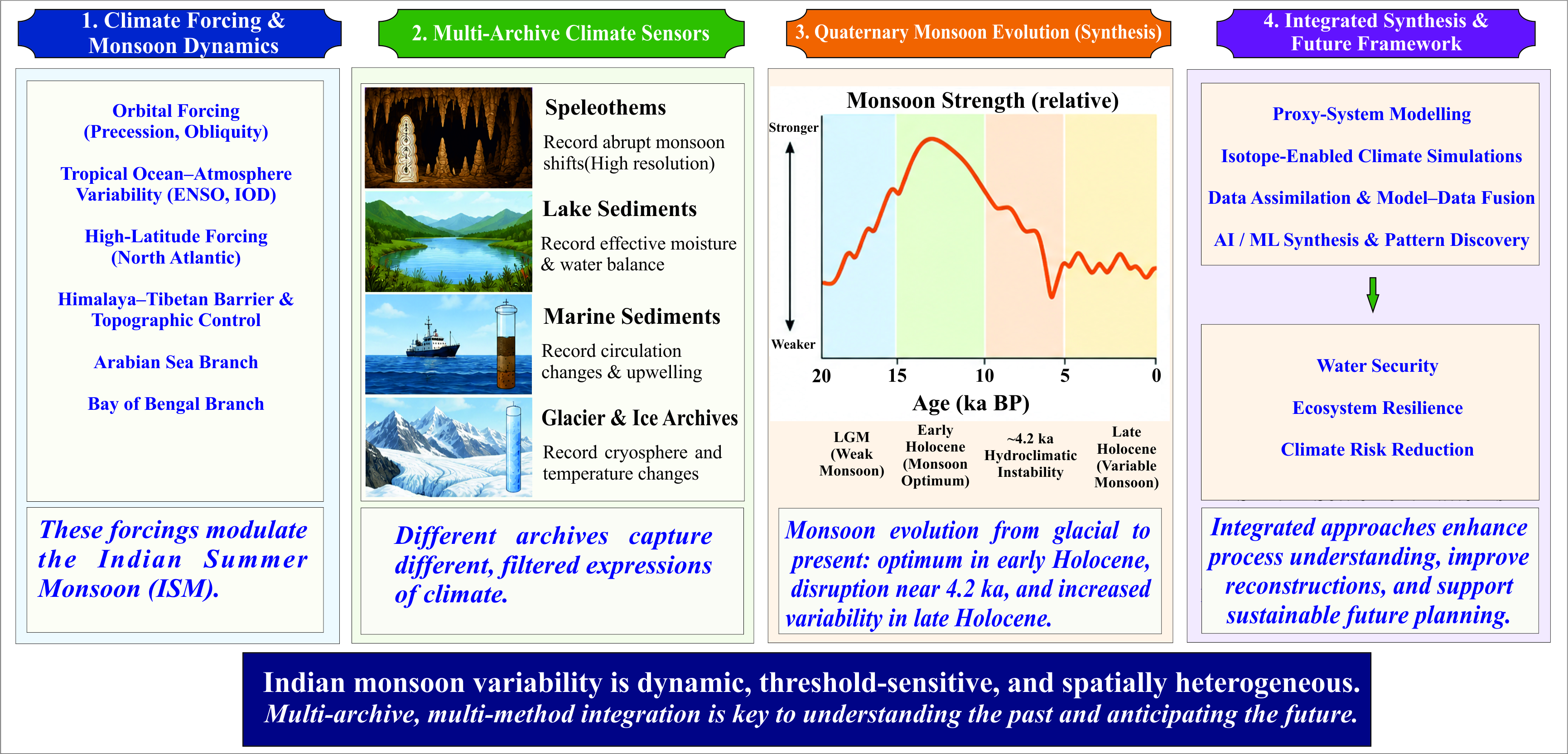
The Indian subcontinent preserves diverse Quaternary palaeoenvironmental archives that record Indian Summer Monsoon (ISM) variability across contrasting climatic and environmental settings. This review synthesizes speleothem, lacustrine, marine, fluvial, aeolian, cryospheric, ecological, and archaeological evidence within a multi-archive framework that explicitly considers proxy sensitivity, archive filtering, chronological uncertainty, and spatial heterogeneity. Multi-archive evidence indicates weakened monsoon circulation during the Last Glacial Maximum, rapid deglacial reorganization including the Younger Dryas, and widespread monsoon intensification during the early Holocene. The subsequent middle-tolate Holocene was characterized by generally declining monsoon strength superimposed by substantial centennial-scale variability. Hydroclimatic instability around 4.2 ka was regionally important but spatially heterogeneous and not uniformly expressed among archives, while the late Holocene and last millennium experienced recurrent drought–wet variability. A central outcome of this synthesis is that apparent disagreement among palaeoclimate records does not necessarily represent contradictory climate histories. Different archives record distinct components of hydroclimate and transform climatic forcing through seasonality, hydrological storage, sediment mixing, ecological response, temporal integration, and other archive-specific processes. Consequently, speleothem, lacustrine, marine, fluvial, and Himalayan records are most informative when interpreted as complementary constraints rather than directly interchangeable climate indicators. Future progress requires processbased and uncertainty-aware integration through proxy-system and isotope-enabled modelling, climate data assimilation, standardized multi-archive networks, and coordinated terrestrial–marine synthesis. This framework portrays the ISM as a spatially heterogeneous and dynamically coupled hydroclimatic system and provides a long-term context for evaluating contemporary hydroclimatic change across South Asia.
Graphical Abstract
Keywords
Indian Summer Monsoon | Quaternary palaeoclimate | hydroclimate | proxy system model | Indian subcontinent | Holocene
References
- 1.
Wang, P.; Clemens, S.; Beaufort, L.; et al. Evolution and variability of the Asian monsoon system: State of the art and outstanding issues. Quat. Sci. Rev. 2005, 24, 595–629. https://doi.org/10.1016/j.quascirev.2004.10.002
- 2.
Sinha, A.; Berkelhammer, M.; Stott, L.; et al. The leading mode of Indian Summer Monsoon precipitation variability during the last millennium. Geophys. Res. Lett. 2011, 38, L15703. https://doi.org/10.1029/2011gl047713
- 3.
Kathayat, G.; Sinha, A.; Breitenbach, S.F.M.; et al. Protracted Indian monsoon droughts of the past millennium and their societal impacts. Proc. Natl. Acad. Sci. USA 2022, 119, e2207487119. https://doi.org/10.1073/pnas.2207487119
- 4.
Sinha, A.; Steiger, N.J.; Tan, L.; et al. On Indian summer monsoon droughts and teleconnections over the past millennium. Innov. Geosci. 2025, 3, 100108. https://doi.org/10.59717/j.xinn-geo.2024.100108
- 5.
Gupta, A.K.; Anderson, D.M.; Overpeck, J.T. Abrupt changes in the Asian southwest monsoon during the Holocene and their links to the North Atlantic Ocean. Nature 2003, 421, 354–357. https://doi.org/10.1038/nature01340
- 6.
Staubwasser, M.; Sirocko, F.; Grootes, P.M.; et al. Climate change at the 4.2 ka BP termination of the Indus valley civilization and Holocene south Asian monsoon variability. Geophys. Res. Lett. 2003, 30, 1425. https://doi.org/10.1029/2002gl016822
- 7.
Dixit, Y.; Hodell, D.A.; Petrie, C.A. Abrupt weakening of the summer monsoon in northwest India 4100 yr ago. Geology 2014, 42, 339–342. https://doi.org/10.1130/g35236.1
- 8.
Cheng, H.; Edwards, R.L.; Sinha, A.; et al. The Asian monsoon over the past 640,000 years and ice age terminations. Nature 2016, 534, 640–646. https://doi.org/10.1038/nature18591
- 9.
Berkelhammer, M.; Sinha, A.; Stott, L.; et al. An abrupt shift in the Indian monsoon 4000 years ago. Clim. Landsc. Civiliz. 2013, 198, 75–88. https://doi.org/10.1029/2012gm001207
- 10.
Kathayat, G.; Cheng, H.; Sinha, A.; et al. Evaluating the timing and structure of the 4.2 ka event in the Indian summer monsoon domain from an annually resolved speleothem record from Northeast India. Clim. Past 2018, 14, 1869–1879. https://doi.org/10.5194/cp-14-1869-2018
- 11.
Kathayat, G.; Cheng, H.; Sinha, A.; et al. Indian monsoon variability on millennial-orbital timescales. Sci. Rep. 2016, 6, 24374. https://doi.org/10.1038/srep24374
- 12.
Dixit, Y.; Hodell, D.A.; Giesche, A.; et al. Intensified summer monsoon and the urbanization of Indus Civilization in northwest India. Sci. Rep. 2018, 8, 4225. https://doi.org/10.1038/s41598-018-22504-5
- 13.
Sun, H.; Liu, X.; Mao, X.; et al. Centennial-scale variability of the Indian Summer Monsoon during the middle to late Holocene and its links with ENSO activity. Palaeogeogr. Palaeoclimatol. Palaeoecol. 2023, 612, 111380. https://doi.org/10.1016/j.palaeo.2022.111380
- 14.
Arora, P.; Nawaz Ali, S.; Singh, P.; et al. An assessment of the correlations and causations of palaeo-hydroclimatic variability in India’s monsoon-dominated Central Himalaya. Holocene 2024, 34, 1386–1407. https://doi.org/10.1177/09596836241254480
- 15.
Jacobson, M.J.; Chawchai, S.; Scholz, D.; et al. Speleothem records from western Thailand indicate an early rapid shift of the Indian summer monsoon during the Younger Dryas termination. Quat. Sci. Rev. 2024, 330, 108597. https://doi.org/10.1016/j.quascirev.2024.108597
- 16.
Lachniet, M.S. Climatic and environmental controls on speleothem oxygen-isotope values. Quat. Sci. Rev. 2009, 28, 412–432. https://doi.org/10.1016/j.quascirev.2008.10.021
- 17.
Evans, M.N.; Tolwinski-Ward, S.E.; Thompson, D.M.; et al. Applications of proxy system modeling in high resolution paleoclimatology. Quat. Sci. Rev. 2013, 76, 16–28. https://doi.org/10.1016/j.quascirev.2013.05.024
- 18.
Clift, P.D.; Hodges, K.V.; Heslop, D.; et al. Correlation of Himalayan exhumation rates and Asian monsoon intensity. Nat. Geosci. 2008, 1, 875–880. https://doi.org/10.1038/ngeo351
- 19.
Dutt, S.; Gupta, A.K.; Clemens, S.C.; et al. Abrupt changes in Indian summer monsoon strength during 33,800 to 5500 years B.P. Geophys. Res. Lett. 2015, 42, 5526–5532. https://doi.org/10.1002/2015gl064015
- 20.
Singhvi, A.K.; Kar, A. The aeolian sedimentation record of the Thar desert. J. Earth Syst. Sci. 2004, 113, 371–401. https://doi.org/10.1007/bf02716733
- 21.
Laskar, A.H.; Bohra, A. Impact of Indian Summer Monsoon change on Ancient Indian Civilizations during the Holocene. Front. Earth Sci. 2021, 9, 709455. https://doi.org/10.3389/feart.2021.709455
- 22.
Owen, L.A.; Finkel, R.C.; Caffee, M.W. A note on the extent of glaciation throughout the Himalaya during the global last glacial maximum. Quat. Sci. Rev. 2002, 21, 147–157. https://doi.org/10.1016/s0277-3791(01)00104-4
- 23.
Dortch, J.M.; Owen, L.A.; Caffee, M.W. Timing and climatic drivers for glaciation across semi-arid western Himalayan–Tibetan orogen. Quat. Sci. Rev. 2013, 78, 188–208. https://doi.org/10.1016/j.quascirev.2013.07.025
- 24.
Sarkar, S.; Prasad, S.; Wilkes, H.; et al. Monsoon source shifts during the drying mid-Holocene: Biomarker isotope based evidence from the core ‘monsoon zone’ (CMZ) of India. Quat. Sci. Rev. 2015, 123, 144–157. https://doi.org/10.1016/j.quascirev.2015.06.020
- 25.
Veena, M.P.; Achyuthan, H.; Eastoe, C.; et al. A multi-proxy reconstruction of monsoon variability in the late Holocene, South India. Quat. Int. 2014, 325, 63–73. https://doi.org/10.1016/j.quaint.2013.10.026
- 26.
Vidyasakar, A.; Sant’Ovaia, H.; Alappat, L.; et al. Paleoclimatic registers from semi-arid costal sediments of Southeastern India: A multi proxy approach. In Water Resources in Arid Areas: The Way Forward; Springer: Cham, Switzerland, 2017; pp. 3–30. https://doi.org/10.1007/978-3-319-51856-5_1
- 27.
Prabhu, C.; Shankar, R.; Anupama, K.; et al. A 200-ka pollen and oxygen-isotopic record from two sediment cores from the eastern Arabian Sea. Palaeogeogr. Palaeoclimatol. Palaeoecol. 2004, 214, 309–321. https://doi.org/10.1016/j.palaeo.2004.07.027
- 28.
Rashid, H.; England, E.; Thompson, L.; et al. Late glacial to holocene Indian summer monsoon variability based upon sediment records taken from the bay of Bengal. Terr. Atmos. Ocean. Sci. 2011, 22, 215–228. https://doi.org/10.3319/tao.2010.09.17.02(tibxs)
- 29.
Contreras-Rosales, L.A.; Jennerjahn, T.; Tharammal, T.; et al. Evolution of the Indian Summer Monsoon and terrestrial vegetation in the Bengal region during the past 18 ka. Quat. Sci. Rev. 2014, 102, 133–148. https://doi.org/10.1016/j.quascirev.2014.08.010
- 30.
Achyuthan, H.; Nagasundaram, M.; Gourlan, A.T.; et al. Mid-Holocene Indian Summer Monsoon variability off the Andaman Islands, Bay of Bengal. Quat. Int. 2014, 349, 232–244. https://doi.org/10.1016/j.quaint.2014.07.041
- 31.
Nagasundaram, M.; Achyuthan, H.; Ahmad, S.M. Monsoonal changes inferred from the Middle to late Holocene sediments off Landfall Island, North Andaman. Arab. J. Geosci. 2013, 7, 3513–3523. https://doi.org/10.1007/s12517-013-1010-6
- 32.
Chauhan, T.; Devanand, A.; Roxy, M.K.; et al. River interlinking alters land-atmosphere feedback and changes the Indian summer monsoon. Nat. Commun. 2023, 14, 5928. https://doi.org/10.1038/s41467-023-41668-x
- 33.
Tripathi, S.; Basumatary, S.K.; Singh, V.K.; et al. Palaeovegetation and climate oscillation of western Odisha, India: A pollen data-based synthesis for the Mid-Late Holocene. Quat. Int. 2014, 325, 83–92. https://doi.org/10.1016/j.quaint.2013.12.005
- 34.
Wang, Y.V.; Larsen, T.; Lauterbach, S.; et al. Higher sea surface temperature in the Indian Ocean during the Last Interglacial weakened the South Asian monsoon. Proc. Natl. Acad. Sci. USA 2022, 119, e2107720119. https://doi.org/10.1073/pnas.2107720119
- 35.
Fairchild, I.J.; Baker, A.; Speleothem Science: From Process to Past Environments; Wiley-Blackwell: Chichester, UK, 2012.
- 36.
Fathima, R.; Saraswat, R. A synthesis of paleomonsoon and associated processes from the unique depocenter, Andaman Sea. Geo-Mar. Lett. 2023, 43, 15. https://doi.org/10.1007/s00367-023-00756-z
- 37.
Gayathri, N.M.; Sreevidya, E.; Sijinkumar, A.V.; et al. Last 15 ka record of water column changes associated with Indian summer monsoon variability from the northeastern Bay of Bengal. Quat. Int. 2025, 723, 109713. https://doi.org/10.1016/j.quaint.2025.109713
- 38.
Nayak, P.K.; Singh, A.K.; Mallick, K.R.; et al. Indian monsoon modes and their linkage with precipitation in the Andaman Sea region late Quaternary planktic foraminiferal records. J. Palaeontol. Soc. India 2025, 70, 249–265. https://doi.org/10.1177/05529360251345236
- 39.
Sreevidya, E.; Sijinkumar, A.V.; Nath, B.N. Palaeoceanographic significance of aragonitic pteropods in the Indian Ocean – A review. Boreas 2022, 51, 1–19. https://doi.org/10.1111/bor.12540
- 40.
Sreevidya, E.; Sijinkumar, A.V.; Nath, B.N.; et al. A ∼50 kyr record of carbonate (pteropods) preservation from the Laccadive Sea, Northern Indian Ocean. Mar. Geol. 2023, 455, 106958. https://doi.org/10.1016/j.margeo.2022.106958
- 41.
Sijinkumar, A.V.; Nath, B.N.; Prabhakar, S. Late Quaternary carbonate preservation in the Andaman Sea versus the Central Indian Basin: A test of dissolution under diverse oceanographic settings in the Indian Ocean. Quat. Int. 2022, 642, 103–115. https://doi.org/10.1016/j.quaint.2021.06.014
- 42.
Resmi, M.R.; Achyuthan, H.; Deopa, H. Holocene monsoonal variations over Southern India: Looking into its antecedents. Front. Earth Sci. 2022, 9, 717420. https://doi.org/10.3389/feart.2021.717420
- 43.
Thamban, M.; Kawahata, H.; Rao, V.P. Indian summer monsoon variability during the holocene as recorded in sediments of the Arabian Sea: Timing and implications. J. Oceanogr. 2007, 63, 1009–1020. https://doi.org/10.1007/s10872-007-0084-8
- 44.
Solanki, H.; Jain, V.; Thirumalai, K.; et al. River drought forcing of the Harappan metamorphosis. Commun. Earth Environ. 2025, 6, 926. https://doi.org/10.1038/s43247-025-02901-1
- 45.
Ronay, E.R.; Breitenbach, S.F.M.; Oster, J.L. Sensitivity of speleothem records in the Indian Summer Monsoon region to dry season infiltration. Sci. Rep. 2019, 9, 5091. https://doi.org/10.1038/s41598-019-41630-2
- 46.
Desamsetti, S.; Dasari, H.P.; Langodan, S.; et al. Enhanced simulation of the Indian summer monsoon rainfall using regional climate modeling and continuous data assimilation. Front. Clim. 2022, 4, 817076. https://doi.org/10.3389/fclim.2022.817076
- 47.
Zhou, J.; Chen, F.; Zhu, Y.; et al. Reconstruction of temperature, precipitation, and identification of extreme climate events in high mountain Asia over 500 years using multi-method EnKF. Sci. Rep. 2026, 16, 5610. https://doi.org/10.1038/s43247-025-02901-1
- 48.
Oster, J.L.; Ronay, E.R.; Sharp, W.D.; et al. Controls on speleothem initial 234U/238U ratios in a monsoon climate. Geochem. Geophys. Geosyst. 2023, 24, e2023GC010899. https://doi.org/10.1029/2023gc010899
- 49.
Parker, S.E.; Harrison, S.P.; Comas-Bru, L.; et al. A data–model approach to interpreting speleothem oxygen isotope records from monsoon regions. Clim. Past 2021, 17, 1119–1138. https://doi.org/10.5194/cp-17-1119-2021
- 50.
He, C.; Liu, Z.; Otto-Bliesner, B.L.; et al. Hydroclimate footprint of pan-Asian monsoon water isotope during the last deglaciation. Sci. Adv. 2021, 7, eabe2611. https://doi.org/10.1126/sciadv.abe2611
How to Cite
Gogoi, M.; Bhuyan, D. Quaternary Hydroclimate Evolution of the Indian Subcontinent: A Multi-Archive Framework for Interpreting Monsoon Variability and Proxy-System Behaviour. Earth Systems, Resources, and Sustainability 2026, 1 (4), 416–440. https://doi.org/10.53941/esrs.2026.100024.
RIS
BibTex
Copyright & License

Copyright (c) 2026 by the authors.
This work is licensed under a Creative Commons Attribution 4.0 International License.
Contents
References
