
- Tropical laterites represent a significant terrestrial carbon sink.
- Mineralogy, profile thickness, and weathering intensity collectively control carbon sequestration.
- Fe–Al oxide-rich laterites exhibit enhanced carbon sequestration potential.
- Open Access
- Article
Carbon Storage in Tropical Laterites: Insights into Mineralogical Controls and Sequestration Potential
Author Information
Received: 25 June 2026 | Revised: 30 July 2026 | Accepted: 26 August 2026 | Published: 03 September 2026
Highlights
Abstract
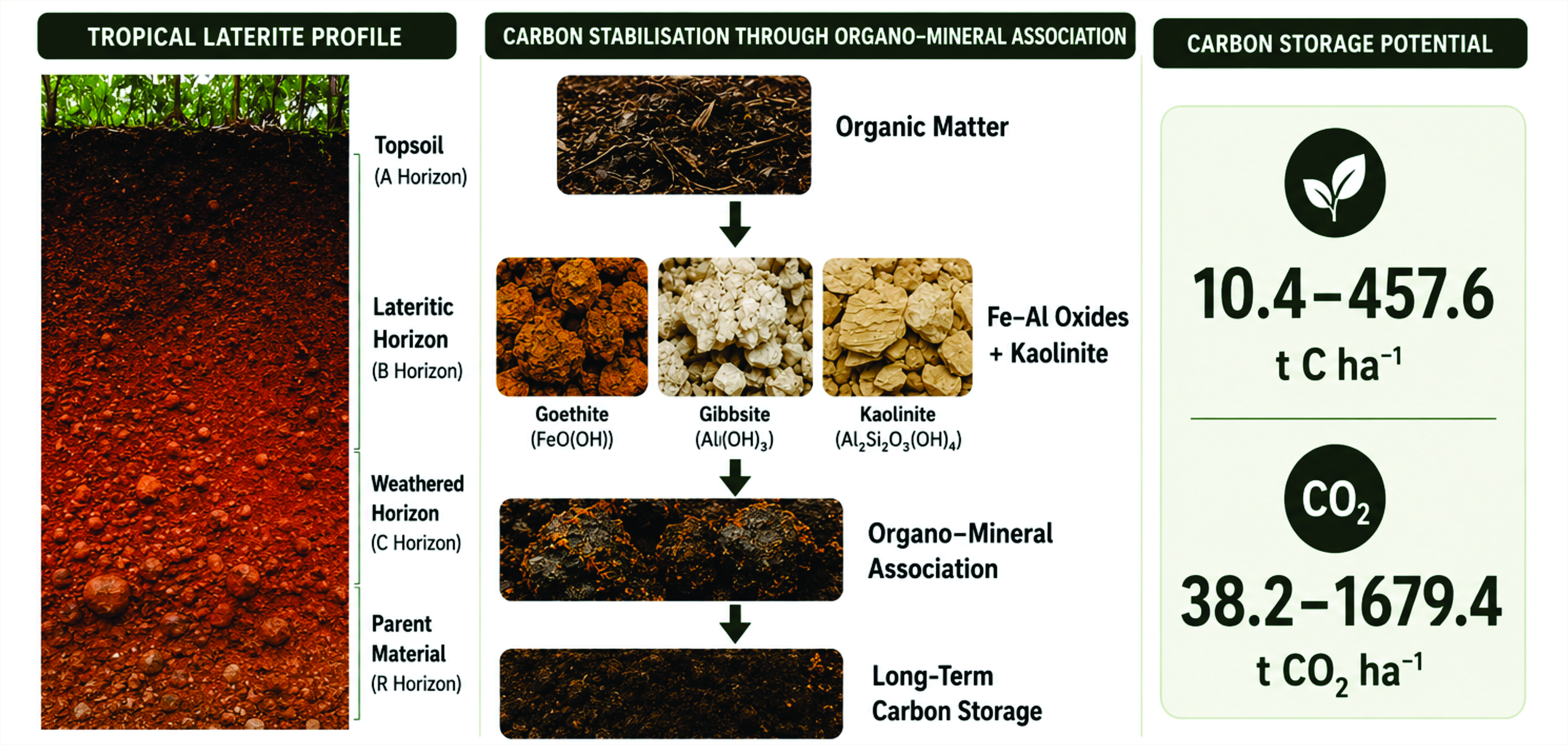
Lateritic soils are widespread in the tropics but their role in carbon storage has not been well studied. This study reports petrographic, grain-size distribution, XRD, XRF, and total organic carbon (TOC) analyses of selected laterite samples from four representative profiles in Kerala, India, to assess their carbon sequestration potential. Our results show that carbon stocks in these laterites are between 10.4 and 457.6 t ha−1, which is equivalent to 38.17 and 1679.39 t CO2 equivalent ha−1, with the highest values occurring in the Vilangara profile.The data reveal that iron- and aluminium-rich minerals such as goethite, gibbsite, and kaolinite play a central role in stabilising organic carbon through mineral-organic associations, enabling long-term carbon retention even under intense tropical weathering. Given their extensive distribution and demonstrated capacity for carbon storage, lateritic soils should be recognised as significant components of the global carbon cycle and integrated into future carbon accounting and climate mitigation strategies.
Graphical Abstract
Keywords
laterites | soil organic carbon | carbon stock | CO2 equivalent | mineral-associated organic matter | iron oxides | carbon sequestration
References
- 1.
Almendros, G.; Gonz´alez-P´ erez, J.A. Soil organic carbon sequestration mechanisms and the chemical nature of soil organic matter—A review. Sustainability 2025 17, 6689. https://doi.org/10.3390/su17156689
- 2.
Ramachandra, T.V.; Bharath, S. Carbon sequestration potential of the forest ecosystems in the western ghats, a global biodiversity hotspot. Nat. Resour. Res. 2020, 29, 2753–2771. https://doi.org/10.1007/s11053-019-09588-0
- 3.
Liddicoat, C.; Schapel, A.; Davenport, D.; et al. PIRSA Discussion 467 Paper—Soil Carbon and Climate Change; Primary Industries and Resources SA (PIRSA): URRBRAE, South Australia, 2010.
- 4.
Lal, R.; Negassa, W.; Lorenz, K. Carbon sequestration in soil. Curr. Opin. Environ. Sustain. 2015, 15, 79–86. https://doi.org/10.1016/j.cosust.2015.09.002
- 5.
Mazumder, S.Y.; Bania, J.K.; Sileshi, G.W.; et al. Variation in biomass and soil carbon storage and sequestration rates in different agroforestry systems with climatic zones and soil types. Environ. Sustain. Indic. 2025, 26, 100642. https://doi.org/10.1016/j.indic.2025.100642
- 6.
Adilakshmi, K.; Aparna, B.; Rani, B.; et al. “Organic carbon and biological properties of soils in various agro-ecological units of Kerala, India”. Int. J. Environ. Climate Chang. 2023, 13, 2939–2949. https://doi.org/10.9734/ijecc/2023/v13i113464
- 7.
Puget, P.; Chenu, C.; Balesdent, J. Dynamics of soil organic matter associated with particle-size fractions of water-stable aggregates. Eur. J. Soil Sci. 2000, 51, 595–605. https://doi.org/10.1111/j.1365-2389.2000.00353.x
- 8.
Jaya, P.; Rui, Y.; Navya, M.; et al. Soil organic carbon dynamics: Influences of land-use change in natural and plantation forests of the Western Ghats, India. PLOS ONE 2026 21, e0342399. https://doi.org/10.1371/journal.pone.0342399
- 9.
Widdowson, M.; Gunnell, Y. Lateritization, geomorphology and geodynamics of a passive continental margin: The Konkan and Kanara coastal lowlands of western peninsular India. In Palaeoweathering, Palaeosurfaces and Related Continental Deposits; Thiry, M., Simon Coinc¸on, C.R., Eds.; John Wiley & Sons Ltd.: Chichester, UK, 1995. https://doi.org/10.1002/9781444304190.ch10
- 10.
Widdowson, M. Laterite. In Encyclopedia of Paleoclimatology and Ancient Environments; Encyclopedia of Earth Sciences Series; Gornitz, V., Ed.; Springer: Dordrecht, The Netherlands. 2009. https://doi.org/10.1007/978-1-4020-4411-3_127
- 11.
Bonnet, N.J.; Beauvais, A.; Arnaud, N; et al. First 40Ar/39Ar dating of intense Late Palaeogene lateritic weathering in Peninsular India. Earth Planet. Sci. Lett. 2014, 386, 126–137, https://doi.org/10.1016/j.epsl.2013.11.002.
- 12.
Annie, P.K.; Lal, A.M.; John, A.J.; et al. Laterite formation under tropical weathering: A geochemical characterization. Habitable Planet 2025, 1, 271–285. https://doi.org/10.63335/j.hp.2025.0020
- 13.
Wang, C.; Li, R.; Liu, X.; et al. Iron-driven organic carbon sequestration in arid saline-alkali soils: Mechanisms of Fe-C coupling via reactive iron oxides and microaggregate stabilisation. Geoderma 2026, 465, 117655. https://doi.org/10.1016/j.geoderma.2025.117655
- 14.
Santosh, M. The Southern Granulite Terrane: A synopsis. Episodes 2020, 43, 109–123. https://doi.org/10.18814/epiiugs/2020/020006
- 15.
Tomson, J.K.; Dev, J.A. Tracing the crustal evolution of the Precambrian Southern Granulite terrane in East Gondwana: New insights from zircon U-Pb/Hf geochronology. Geol. Soc. Am. Bull. 2023, 136, 2075–2096.
- 16.
John, A.J.; Nandakumar, V. Reaction textures and metamorphic evolution of spinel-bearing metapelites of Kerala Khondalite Belt, Southern Granulite Terrain, India. J. Geointerface 2025, 4 68–82. https://doi.org/10.5281/zenodo.15569357
- 17.
Indu, G.K.; John, A.J.; Lal, A.M.; et al. Provenance and paleoenvironmental dynamics of the Cheruvathur Formation in Northern Kerala, India: Geological and geochemical perspectives. Arab. J. Geosci. 2025, 18, 168. https://doi.org/10.1007/s12517-025-12309-y
- 18.
Kumar, T.V.; Rao, Y.B.; Plavsa, D.; et al. Zircon U-Pb ages and Hf isotopic systematics of charnockite gneisses from the Ediacaran–Cambrian high-grade metamorphic terranes, southern India: Constraints on crust formation, recycling, and Gondwana correlations. GSA Bull. 2017, 129, 625–648. https://doi.org/10.1130/B31474.1
- 19.
Rajan, T.N.; Anil Kumar, P.S. Geology and Mineral Resources of the States of India: Part IX—Kerala; Miscellaneous Publication No. 30; Geological Survey of India: Kolkata, India, 2005.
- 20.
Folk, R.L.; Ward, W.C. Brazos River bar: A study in the significance of grain size parameters. J. Sediment. Petrol. 1957, 27, 3–26. https://doi.org/10.1306/74D70646-2B21-11D7-8648000102C1865D
- 21.
Walkley, A.; Black, I.A. An examination of the Degtjareff method for determining soil organic matter and a proposed modification of the chromic acid titration method. Soil Sci. 1934, 37, 29–38. https://doi.org/10.1097/00010694-193401000-00003
- 22.
Schellmann, W. A new definition of laterite. In Lateritisation Processes, IGCP-127; Banerji, P.K., Ed.; Memoirs of the Geological Survey of India Volume 20; Geological Survey of India: Calcutta, India, 1986; pp. 1–7.
- 23.
Bourman, R.P.; Ollier, C.D. A critique of the Schellmann definition and classification of ‘laterite’. Catena 2002, 47, 117–131. https://doi.org/10.1016/S0341-8162(01)00178-3
- 24.
Anand, R.R.; Paine, M. Regolith geology of the Yilgarn Craton,Western Australia: Implications for exploration. Aust. J. Earth Sci. 2002, 49, 3–162. https://doi.org/10.1046/j.1440-0952.2002.00912.x
- 25.
Nahon, D. Introduction to the Petrology of Soils and ChemicalWeathering; Basic Topics in Geology; John Wiley & Sons: New York, NY, USA, 1991; p. 313.
- 26.
Nelson, D.W.; Sommers, L.E. Total carbon, organic carbon, and organic matter. In Methods of Soil Analysis; Sparks, D.L., Page, A.L., Helmke, P.A., et al., Eds.; Soil Science Society of America (SSSA) and American Society of Agronomy (ASA): Madison, WI, USA, 1996. https://doi.org/10.2136/sssabookser5.3.c34
- 27.
Lal, R. Soil carbon sequestration to mitigate climate change. Geoderma 2004, 123, 1–22. https://doi.org/10.1016/j.geoderma.2004.01.032
- 28.
Iglesias-Mart´ınez, M.; Salama, W.; Anand, R.R.; et al. Exploration and mining of lateritic gold deposits (Part I): Ore formation, characterization, and sampling of ferruginous gravel and duricrust. Ore Geol. Rev. 2024, 170, 106146. https://doi.org/10.1016/j.oregeorev.2024.106146
- 29.
Batjes, N.H. Total carbon and nitrogen in the soils of the world. Eur. J. Soil Sci. 1996, 47, 151–163. https://doi.org/10.1111/j.1365-2389.1996.tb01386.x
- 30.
Basile-Doelsch, I.; Balesdent, J.; Pellerin, S. Reviews and syntheses: The mechanisms underlying carbon storage in soil. Biogeosciences 2020, 17, 5223–5242. https://doi.org/10.5194/bg-17-5223-2020.
- 31.
Kleber, M.; Bourg, I.C.; Coward, E.K.; et al. Dynamic interactions at the mineral–organic matter interface. Nat. Rev. Earth Environ. 2021, 2, 402–421. https://doi.org/10.1038/s43017-021-00162-y
- 32.
Ruiz, F.; Bernardino, A.F.; Queiroz, H.M.; et al. Iron’s role in soil organic carbon (de)stabilization in mangroves under land use change. Nat. Commun. 2024, 15, 10433. https://doi.org/10.1038/s41467-024-54447-z
- 33.
Jobbagy, E.G.; Jackson, R.B. The vertical distribution of soil organic carbon and its relation to climate and vegetation. Ecol. Appl. 2000, 10, 423–436. https://doi.org/10.1890/1051-0761(2000)010[0423:TVDOSO]2.0.CO;2
- 34.
Souza, I.F.; Archanjo, B.S.; Hurtarte, L.C.C.; et al. Al-/Fe-(hydr)oxides–organic carbon associations in Oxisols: From ecosystems to submicron scales. CATENA 2017, 154, 63–72. https://doi.org/10.1016/j.catena.2017.02.017
- 35.
Cotrufo, M.F.; Lavallee, J.M. Soil organic matter formation, persistence, and functioning: A synthesis of current understanding to inform its conservation and regeneration. Adv. Agron. 2022, 172, 1–66. https://doi.org/10.1016/bs.agron.2021.11.002
- 36.
Fritsch, E.; Balan, E.; Do Nascimento, N.R.; et al. Deciphering the weathering processes using environmental mineralogy and geochemistry: Towards an integrated model of laterite and podzol genesis in the Upper Amazon Basin. C. R. Geosci. 2011, 343, 188–198. https://doi.org/10.1016/j.crte.2010.11.002
- 37.
Georgiou, K.; Jackson, R.B.; Vindu˘skov´ a, O.; et al. Global stocks and capacity of mineral-associated soil organic carbon. Nat. Commun. 2022, 13, 3797. https://doi.org/10.1038/s41467-022-31540-9
- 38.
Jia, N.; Li, L.; Guo, H.; et al. Important role of Fe oxides in global soil carbon stabilization and stocks. Nat. Commun. 2024, 15, 10318. https://doi.org/10.1038/s41467-024-54832-8
- 39.
FAO. Global Soil Organic Carbon Sequestration Potential Map-SOCseq v.1.1; Technical Report; FAO: Rome, Italy, 2022. https://doi.org/10.4060/cb9002en
- 40.
Basile-Doelsch, I.; Amundson, R.; Stone, W.E.E.; et al. Mineralogical control of organic carbon dynamics in a volcanic ash soil on La R´eunion. Eur. J. Soil Sci. 2005, 56, 689–703. https://doi.org/10.1111/j.1365-2389.2005.00703.x
- 41.
Aide, M.T.; Aide, C.C.; Braden, I.S. Soil genesis of histosols and gelisols with an emphasis on soil processes supporting carbon sequestration. In Environmental Change and Sustainability; Sarvajayakesavalu, S., Chareonsudjai, P., Eds.; IntechOpen: London, UK, 2020; pp. 181–196. https://doi.org/10.5772/intechopen.94399
- 42.
Kochy, M.; Hiederer, R.; Freibauer, A.; et al. Global distribution of soil organic carbon – Part 1: Masses and frequency distributions of SOC stocks for the tropics, permafrost regions, wetlands, and the world. Soil 2015, 1, 351–365.
- 43.
Sharma, S.; Jain, P.K.; Soloman, P.E. Carbon storage potential of soil in diverse terrestrial ecosystems. Nat. Environ. Pollut. Technol. 2023, 22, 1809–1819. https://doi.org/10.46488/NEPT.2023.v22i04.009
- 44.
Kirsten, M.; Mikutta, R.; Vogel, C.; et al. Iron oxides and aluminous clays selectively control soil carbon storage and stability in the humid tropics. Sci. Rep. 2021, 11, 5076. https://doi.org/10.1038/s41598-021-84777-7
- 45.
Reichenbach, M.; Fiener, P.; Hoyt, A.; et al. Soil carbon stocks in stable tropical landforms are dominated by geochemical controls and not by land use. Glob. Chang. Biol. 2023, 29, 2591–2607. https://doi.org/10.1111/gcb.16622
- 46.
Marques, J.D.O.; Luizao, F.J.; Teixeira, W.G.; et al. Soil organic carbon, carbon stock and their relationships to physical attributes under forest soils in Central Amazonia. Rev. Arvore 2016, 40, 197–208. https://doi.org/10.1590/0100-67622016000200002
- 47.
Vaughan, N.E.; Eppes, M.C.; Vinson, D.S.; et al. Soil organic carbon in Ultisol landscapes: Influence of erosion rates, soil development, depth, and hillslope properties. CATENA 2026, 267, 109967. https://doi.org/10.1016/j.catena.2026.109967
- 48.
Łabaz, B.; Hartemink, A.E.; Zhang, Y.; et al. Organic carbon in Mollisols of the world—A review. Geoderma 2024, 447, 116937. https://doi.org/10.1016/j.geoderma.2024.116937
How to Cite
Deepthi, P.; Indu, G. K.; Lal, A. M.; John, A. J.; Krishna, A. A. A.; Biju, S. Carbon Storage in Tropical Laterites: Insights into Mineralogical Controls and Sequestration Potential. Earth Systems, Resources, and Sustainability 2026, 1 (4), 441–456. https://doi.org/10.53941/esrs.2026.100025.
RIS
BibTex
Copyright & License

Copyright (c) 2026 by the authors.
This work is licensed under a Creative Commons Attribution 4.0 International License.
Contents
References
