
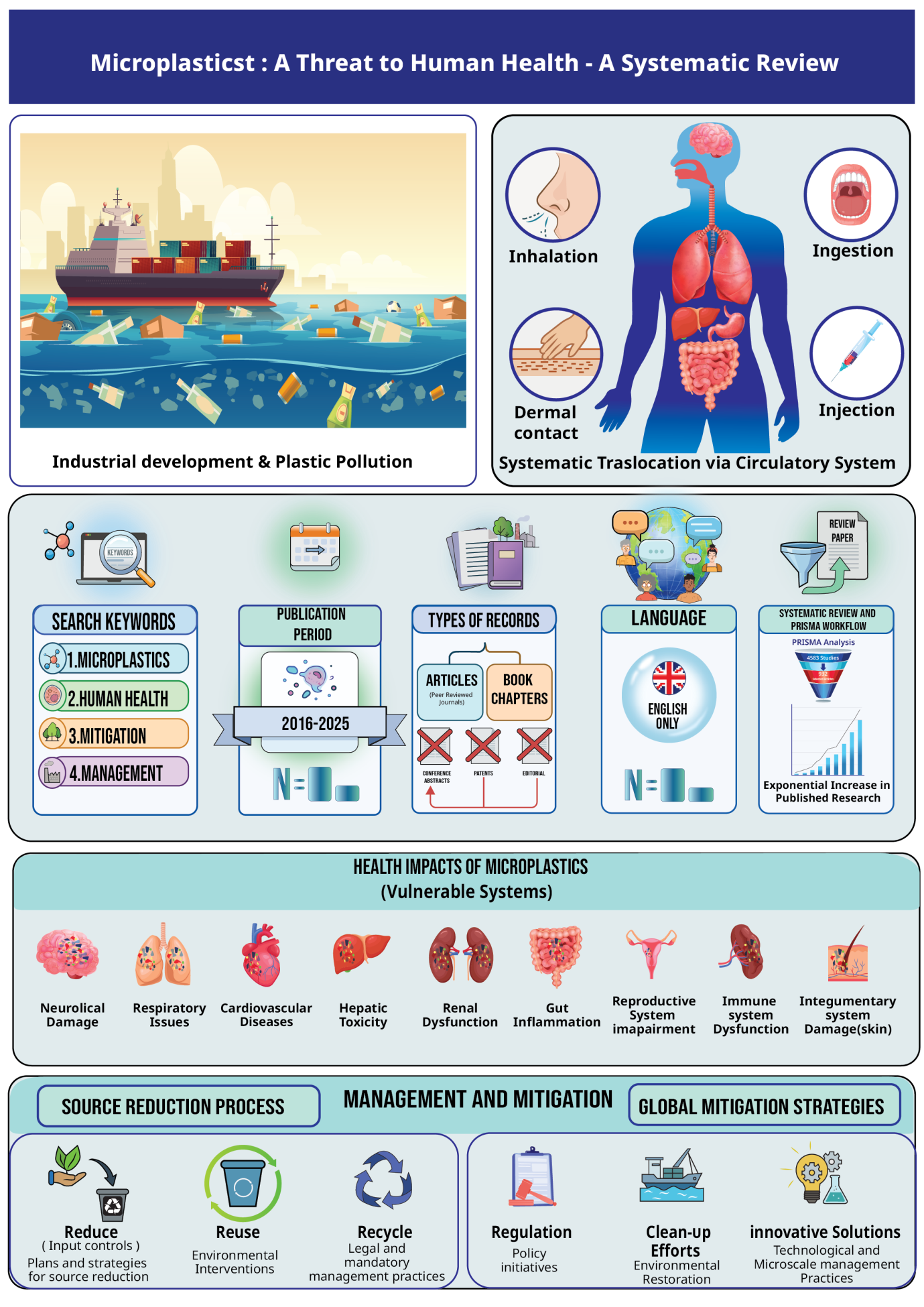
- Systematic Scoping review of 932 studies out of 4583 records from the Scopus database (2016–2025) on microplastics and human health.
- Microplastics enter human circulatory system through various pathways and threatens multiple organ systems.
- Source reduction, environmental intervention, policy initiatives, and microscale management strategies are recommended.
- Open Access
- Article
Microplastics and Human Health: Exposure Pathways, Contributive Roles, and Mitigation Strategies
- V. Anjali 1,†,
- K.A. Prasad 2,†,
- K. Balasubramani 2,
- M. Ramkumar 3,*
Author Information
Received: 27 Apr 2026 | Revised: 21 Sep 2026 | Accepted: 08 Oct 2026 | Published: 14 Oct 2026
Highlights
Abstract
The sophistication of human life with the inventions and infrastructure development that followed the industrial revolution has one unintended consequence—plastic pollution. Their exponential growth, accumulation in all the environmental systems, persistence and low rate of decay have made them unique polluters of this century, to which no wise management practices and mitigation strategies are known currently. The micro/nano sizes of plastic debris not only concerned in the natural environment; they also possess emergency risks to human health. Through an extensive literature search, we retrieved a total of 4583 records from the Scopus database appeared in last decade (2016–2025). By adopting PRISMA guidelines, we selected 932 literatures for extensive scoping review of the exposure pathways and mechanistic evidence linking microplastics to human health. The review has synthesized the evidences on microplastics contamination of external and internal human systems and traced the occurrence, types, abundance, distribution, and modes of transportation and bioaccumulation reported in the literature. The dominant mode of microplastics transport includes ingestion, followed by inhalation, dermal contact, and injection. Translocation of microplastics through circulatory systems within the human body endangers vital organs including brain and placental tissues, raising concern about potential systemic health risks. Review and examination of the microplastics exposure to humans with reference to the relative vulnerabilities of various organs revealed that, the gastrointestinal tract-digestive system, followed by liver-hepatic system, kidney-renal system, lungs-respiratory system, brain and nerves-the nervous system, reproductive system, cardiovascular and circulatory system, skin-integumentary system and lymphoid organs and tissues-immune system are all prone to microplastic-nanoplastic contaminants and are subjected to various levels of threats. Owing to their bioaccumulation capacity, slow rate of decay and persistence in almost all the media, effective mitigation/management strategies are yet to be devised and their effectiveness in tackling the menace is validated. With about 50 primary types of polymers, producing over 60,000 formulations, at an approximate rate of 8% increase every year, result in an alarming rate of plastic refuse in natural environments, often unmanaged is a looming threat to environmental systems and ecological niches. Addressing this situation requires urgent, policy initiatives, and microscale management practices, that include plans and strategies for source reduction, environmental intervention, legal and mandatory management/reuse/recycle practices at microscale.
Graphical Abstract
Keywords
exposure pathways | health impacts | microplastics | mitigation and management | pollution prevention
References
- 1.
Li, B.; Li, M.; Du, D.; et al. Characteristics and influencing factors of microplastics entering human blood through intravenous injection. Environment International 2025, 198, 109377. https://doi.org/10.1016/j.envint.2025.109377
- 2.
Liu, S.; He, Y.; Yin, J.; et al. Neurotoxicities induced by micro/nanoplastics: A review focusing on the risks of neurological diseases. Journal of Hazardous Materials 2024, 469, 134054. https://doi.org/10.1016/j.jhazmat.2024.134054
- 3.
Li, P.; Li, Q.; Lai, Y.; et al. Direct entry of micro(nano)plastics into human blood circulatory system by intravenous infusion. iScience 2023, 26, 108454. https://doi.org/10.1016/j.isci.2023.108454
- 4.
Leslie, H.A.; van Velzen, M.J.M.; Brandsma, S.H.; et al. Discovery and quantification of plastic particle pollution in human blood. Environment International 2022, 163, 107199. https://doi.org/10.1016/j.envint.2022.107199
- 5.
Ragusa, A.; Svelato, A.; Santacroce, C.; et al. Plasticenta: First evidence of microplastics in human placenta. Environment International 2021, 146, 106274. https://doi.org/10.1016/j.envint.2020.106274
- 6.
Zhu, Y.; Che, R.; Zong, X.; et al. Comprehensive review on the source, ingestion route, attachment and toxicity of microplastics/nanoplastics in human systems. Journal of Environmental Management 2024, 352, 120039. https://doi.org/10.1016/j.jenvman.2024.120039
- 7.
Wu, D.; Feng, Y.; Wang, R.; et al. Pigment microparticles and microplastics found in human thrombi based on raman spectral evidence. Journal of Advanced Research 2023, 49, 141–150. https://doi.org/10.1016/j.jare.2022.09.004
- 8.
Mamun, A.A.; Prasetya, T.A.E.; Dewi, I.R.; et al. Microplastics in human food chains: Food becoming a threat to health safety. Science of The Total Environment 2023, 858, 159834. https://doi.org/10.1016/j.scitotenv.2022.159834
- 9.
Feng, Y.; Tu, C.; Li, R.; et al. A systematic review of the impacts of exposure to micro- and nano-plastics on human tissue accumulation and health. Eco-Environment & Health 2023, 2, 195–207. https://doi.org/10.1016/j.eehl.2023.08.002
- 10.
Rahman, A.; Sarkar, A.; Yadav, O.P.; et al. Potential human health risks due to environmental exposure to nano- and microplastics and knowledge gaps: A scoping review. Science of The Total Environment 2021, 757, 143872. https://doi.org/10.1016/j.scitotenv.2020.143872
- 11.
Wright, S.L.; Kelly, F.J. Plastic and human health: A micro issue? Environmental Science & Technology 2017, 51, 6634–6647. https://doi.org/10.1021/acs.est.7b00423
- 12.
Liu, Z.; You, X.-Y. Recent progress of microplastic toxicity on human exposure base on in vitro and in vivo studies. Science of The Total Environment 2023, 903, 166766. https://doi.org/10.1016/j.scitotenv.2023.166766
- 13.
Dzierżyński, E.; Gawlik, P.J.; Puźniak, D.; et al. Microplastics in the human body: Exposure, detection, and risk of carcinogenesis: A State-of-the-Art review. Cancers 2024, 16, 3703. https://doi.org/10.3390/cancers16213703
- 14.
Horvatits, T.; Tamminga, M.; Liu, B.; et al. Microplastics detected in cirrhotic liver tissue. eBioMedicine 2022, 82, 104147. https://doi.org/10.1016/j.ebiom.2022.104147
- 15.
Yang, Z.; Wang, M.; Feng, Z.; et al. Human microplastics exposure and potential health risks to target organs by different routes: A review. Current Pollution Reports 2023, 9, 468–485. https://doi.org/10.1007/s40726-023-00273-8
- 16.
Shen, R.; Yang, K.; Cheng, X.; et al. Accumulation of polystyrene microplastics induces liver fibrosis by activating CGAS/STING pathway. Environmental Pollution 2022, 300, 118986. https://doi.org/10.1016/j.envpol.2022.118986
- 17.
Amato-Lourenço, L.F.; Carvalho-Oliveira, R.; Júnior, G.R.; et al. Presence of airborne microplastics in human lung tissue. Journal of Hazardous Materials 2021, 416, 126124. https://doi.org/10.1016/j.jhazmat.2021.126124
- 18.
Amato-Lourenço, L.F.; Dantas, K.C.; Júnior, G.R. Microplastics in the olfactory bulb of the human brain. JAMA Network Open 2024, 7(10), e2440018. https://doi.org/10.1001/jamanetworkopen.2024.40018
- 19.
Wang, T.; Yi, Z.; Tan, Y.; et al. Detection of micro- and nanoplastics in cerebrospinal fluid and blood: Implications for brain diseases. Ecotoxicology and Environmental Safety 2026, 309, 119614. https://doi.org/10.1016/j.ecoenv.2025.119614
- 20.
Ramsperger, A.F.R.M.; Bergamaschi, E.; Panizzolo, M.; et al. Nano and microplastics: A comprehensive review on their exposure routes, translocation, and fate in humans. NanoImpact 2023, 29, 100441. https://doi.org/10.1016/j.impact.2022.100441
- 21.
Nafea, T.H.; Chan, F.K.S.; Xu, H.; et al. Status of management and mitigation of microplastic pollution. Critical Reviews in Environmental Science and Technology 2024, 54, 1734–1756. https://doi.org/10.1080/10643389.2024.2361502
- 22.
Gaur, P.; Gupta, P.; Gaur, V.; et al. Microplastic pollution: Progress in remediation, policy challenges, and future directions. Current Microbiology 2026, 83, 146. https://doi.org/10.1007/s00284-025-02402-z
- 23.
Thacharodi, A.; Hassan, S.; Meenatchi, R.; et al. Mitigation of microplastic pollution: A review on remediation methods and future perspectives. Journal of Environmental Management 2024, 351, 119988. https://doi.org/10.1016/j.jenvman.2023.119988
- 24.
Fang, M.; Liao, Z.; Ji, X.; et al. Ingestion of microplastics during daily food consumption. Journal of Hazardous Materials 2022, 432, 128674. https://doi.org/10.1016/j.jhazmat.2022.128674
- 25.
Ghosh, S.; Sinha, J.K.; Ghosh, S.; et al. Microplastics as an emerging global environmental contaminant. Sustainability 2023, 15(14), 10821. https://doi.org/10.3390/su151410821
- 26.
Nikpay, M.; Toorchi Roodsari, S. Strategies to mitigate microplastic pollution in aquatic ecosystems. Microplastics 2024, 3(1), 165–183. https://doi.org/10.3390/microplastics3010010
- 27.
Jiao, H.; Ali, S.S.; Alsharbaty, M.H.M.; et al. A critical review on plastic waste lifecycle management: Challenges and future prospects. Ecotoxicology and Environmental Safety 2024, 271, 115942. https://doi.org/10.1016/j.ecoenv.2024.115942
- 28.
Borg, K.; Lennox, A.; Kaufman, S.; et al. Reducing microplastic release from single-use plastic products: A review of intervention strategies. Journal of Cleaner Production 2022, 344, 131077. https://doi.org/10.1016/j.jclepro.2022.131077
- 29.
Environmental Research & Education Foundation. Extended producer responsibility literature review and what we know about its effectiveness; Environmental Research & Education Foundation: Raleigh, NC, USA, 2025.
- 30.
Drohmann, D. Regulating microplastics: The global status on microbeads regulation in cosmetics & personal care products; Lexxion Verlagsgesellschaft mbH: Berlin, Germany, 2018; Vol. 1.
- 31.
Meyer, A.M.; Smith, C.F.; Meister, K.; et al. Microplastic pollution policy and one health: A critical case study of California legislation. Frontiers in Environmental Science 2026, 14, 1878679. https://doi.org/10.3389/fenvs.2026.1878679
- 32.
Mohsin, M.A.; Abd Zaid, A.H. Microplastic pollution in the environment: A chemical engineering perspective on sources, transport and remediation. Polymers 2025, 18(1), 29. https://doi.org/10.3390/polym18010029
- 33.
Ahmed, S.F.; Islam, N.; Tasnim, N.; et al. Microplastic removal technologies for wastewater treatment plants. Chemosphere 2024, 347, 140648. https://doi.org/10.1016/j.chemosphere.2023.140648
- 34.
Di Bella, G.; Corsino, S.F.; De Marines, F.; et al. Microplastics in sewage sludge: Comparison of MBR and conventional activated sludge processes. Membranes 2022, 12(4), 371. https://doi.org/10.3390/membranes12040371
- 35.
Bayo, J.; Olmos, S.; López-Castellanos, J. Evaluation of advanced tertiary treatments for microplastic removal in municipal wastewater. Water 2021, 13(10), 1339. https://doi.org/10.3390/w13101339
- 36.
Béalu, Z.; Walther, J.; Abusafia, A.; et al. Removal of organic micropollutants and microplastics via ozonation followed by granular activated carbon filtration. Environments 2024, 11, 241. https://doi.org/10.3390/environments11110241
- 37.
Doti, B.; Gray, A.; Strom, K.; et al. Potential release of micro- and nanoplastics from stormwater infrastructure. ACS ES&T Water 2026, 6, 3314–3327. https://doi.org/10.1021/acsestwater.6c00263
- 38.
Sharma, D.; Dhanker, R.; Bhawna; et al. Fishing gears and nets as a source of microplastic. In Microplastic Pollution; Shahnawaz, M., Adetunji, C.O., Dar, M.A., et al., Eds.; Springer Nature Singapore: Singapore, 2024; pp. 127–140. ISBN 978-981-99-8357-5.
- 39.
Pothiraj, C.; Amutha Gokul, T.; Ramesh Kumar, K.; et al. Vulnerability of microplastics on marine environment: A review. Ecological Indicators 2023, 155, 111058. https://doi.org/10.1016/j.ecolind.2023.111058
- 40.
Padervand, M.; Lichtfouse, E.; Robert, D.; et al. Removal of microplastics from the environment. A review. Environmental Chemistry Letters 2020, 18, 807–828. https://doi.org/10.1007/s10311-020-00983-1
- 41.
Nolte, T.M.; Hartmann, N.B.; Kleijn, J.M.; et al. The toxicity of plastic nanoparticles to green algae as influenced by surface modification, medium hardness and cellular adsorption. Aquatic Toxicology 2017, 183, 11–20. https://doi.org/10.1016/j.aquatox.2016.12.005
- 42.
Ramesh, K.; Chellam, P.V.; Sundaram, B. Transport of Layered and Spherical Microplastics in Aqueous Ecosystems: A Review; Springer International Publishing: Cham, Switzerland, 2024; Volume 22. ISBN 0123456789.
- 43.
Omoregie, I.P.; Osagie, A.D.; Ogochukwu Oritseweyinmi, O. Crustacean nanochitosan-based bioremediation of nanoplastic-polluted aquatic habitat: A review pursuant to SDG 6. Scientific African 2023, 21, e01881. https://doi.org/10.1016/j.sciaf.2023.e01881
- 44.
Mallek, M.; Barcelo, D. Assessment of removal technologies for microplastics in surface waters and wastewaters. Current Opinion in Chemical Engineering 2025, 49, 101170. https://doi.org/10.1016/j.coche.2025.101170
- 45.
Zoppas, F.M.; Sacco, N.; Soffietti, J.; et al. Catalytic approaches for the removal of microplastics from water: Recent advances and future opportunities. Chemical Engineering Journal Advances 2023, 16, 100529. https://doi.org/10.1016/j.ceja.2023.100529
- 46.
Surana, M.; Pattanayak, D.S.; Yadav, V.; et al. An insight decipher on photocatalytic degradation of microplastics: Mechanism, limitations, and future outlook. Environmental Research 2024, 247, 118268. https://doi.org/10.1016/j.envres.2024.118268
- 47.
Wiśniowska, E.; Moraczewska-Majkut, K.; Nocoń, W.; et al. Microplastics removal from natural surface water by coagulation process. Desalination and Water Treatment 2024, 319, 100462. https://doi.org/10.1016/j.dwt.2024.100462
- 48.
Tofa, T.S.; Kunjali, K.L.; Paul, S.; et al. Visible light photocatalytic degradation of microplastic residues with zinc oxide nanorods. Environmental Chemistry Letters 2019, 17, 1341–1346. https://doi.org/10.1007/s10311-019-00859-z
- 49.
Gembo, R.O.; Phiri, Z.; Madikizela, L.M.; et al. Global research trends in photocatalytic degradation of microplastics: A Bibliometric perspective. Microplastics 2025, 4, 35. https://doi.org/10.3390/microplastics4030035
- 50.
Bule Mozar, K.; Miloloza, M.; Martinjak, V.; et al. Evaluation of fenton, photo-fenton and fenton-like processes in degradation of PE, PP, and PVC microplastics. Water 2024, 16, 673. https://doi.org/10.3390/w16050673
- 51.
de Mello, R.; Kronka, M.S.; Rossini, E.L.; et al. Electrochemical oxidation of polyethylene microplastics: From efficient removal to sustainable valorization. Journal of Applied Electrochemistry 2026, 56, 70. https://doi.org/10.1007/s10800-025-02402-1
- 52.
Falco, G.; Fenti, A.; Galoppo, S.; et al. Promoting removal of polystyrene microplastics from wastewater by electrochemical treatment. Journal of Water Process Engineering 2024, 68, 106418. https://doi.org/10.1016/j.jwpe.2024.106418
- 53.
Ziembowicz, S.; Kida, M. The effect of water ozonation in the presence of microplastics on water quality and microplastics degradation. Science of The Total Environment 2024, 929, 172595. https://doi.org/10.1016/j.scitotenv.2024.172595
- 54.
Fazli, A.; Athanassiou, A.; Fragouli, D. Current approaches and challenges in advanced oxidation processes for nanoplastic degradation. Advanced Science 2025, 12, e04352. https://doi.org/10.1002/advs.202504352
- 55.
Sahu, S.; Kaur, A.; Khatri, M.; et al. A review on cutinases enzyme in degradation of microplastics. Journal of Environmental Management 2023, 347, 119193. https://doi.org/10.1016/j.jenvman.2023.119193
- 56.
Dey, S.; Rout, A.K.; Behera, B.K.; et al. Plastisphere community assemblage of aquatic environment: Plastic-microbe interaction, role in degradation and characterization technologies. Environmental Microbiomes 2022, 17, 32. https://doi.org/10.1186/s40793-022-00430-4
- 57.
Mohanan, N.; Montazer, Z.; Sharma, P.K.; et al. Microbial and enzymatic degradation of synthetic plastics. Frontiers in Microbiology 2020, 11, 580709. https://doi.org/10.3389/fmicb.2020.580709
- 58.
Yadav, P.; Kumar, A.; Ram, K.; et al. Microbial degradation of microplastics: Effectiveness, challenges, and sustainable solutions. Current Research in Microbial Sciences 2025, 9, 100495. https://doi.org/10.1016/j.crmicr.2025.100495
- 59.
Li, B.; Li, M.; Du, D.; et al. Removal of organic micropollutants and microplastics via ozonation followed by granular activated carbon filtration. Environments 2024, 11, 241. https://doi.org/10.3390/environments11110241
- 60.
Doti, B.; Gray, A.; Strom, K.; et al. Potential release of microand nanoplastics from stormwater infrastructure. ACS ES&T Water 2026, 6, 3314–3327. https://doi.org/10.1021/acsestwater.6c00263
- 61.
Sharma, D.; Dhanker, R.; Bhawna; et al. Fishing gears and nets as a source of microplastic. In Microplastic Pollution; Shahnawaz, M., Adetunji, C.O., Dar, M.A., et al., Eds.; Springer Nature Singapore: Singapore, 2024; pp. 127–140. ISBN 978-981-99-8357-5.
- 62.
Pothiraj, C.; Amutha Gokul, T.; Ramesh Kumar, K.; et al. Vulnerability of microplastics on marine environment: A review. Ecol. Indic. 2023, 155, 111058. https://doi.org/10.1016/j.ecolind.2023.111058
- 63.
Padervand, M.; Lichtfouse, E.; Robert, D.; et al. Removal of microplastics from the environment. A review. Environ. Chem. Lett. 2020, 18, 807–828. https://doi.org/10.1007/s10311-020-00983-1
- 64.
Nolte, T.M.; Hartmann, N.B.; Kleijn, J.M.; et al. The toxicity of plastic nanoparticles to green algae as influenced by surface modification, medium hardness and cellular adsorption. Aquat. Toxicol. 2017, 183, 11–20. https://doi.org/10.1016/j.aquatox.2016.12.005
- 65.
Béalu, Z.; Walther, J.; Abusafia, A.; et al. Removal of organic micropollutants and microplastics via ozonation followed by granular activated carbon filtration. Environments 2024, 11, 241. https://doi.org/10.3390/environments11110241
- 66.
Doti, B.; Gray, A.; Strom, K.; et al. Potential release of microand nanoplastics from stormwater infrastructure. ACS ES&T Water 2026, 6, 3314–3327. https://doi.org/10.1021/acsestwater.6c00263
- 67.
Sharma, D.; Dhanker, R.; Bhawna; et al. Fishing gears and nets as a source of microplastic. In Microplastic Pollution; Shahnawaz, M., Adetunji, C.O., Dar, M.A., et al., Eds.; Springer Nature Singapore: Singapore, 2024; pp. 127–140. ISBN 978-981-99-8357-5.
- 68.
Pothiraj, C.; Amutha Gokul, T.; Ramesh Kumar, K.; et al. Vulnerability of microplastics on marine environment: A review. Ecol. Indic. 2023, 155, 111058. https://doi.org/10.1016/j.ecolind.2023.111058
- 69.
Padervand, M.; Lichtfouse, E.; Robert, D.; et al. Removal of microplastics from the environment. A review. Environ. Chem. Lett. 2020, 18, 807–828. https://doi.org/10.1007/s10311-020-00983-1
- 70.
Nolte, T.M.; Hartmann, N.B.; Kleijn, J.M.; et al. The toxicity of plastic nanoparticles to green algae as influenced by surface modification, medium hardness and cellular adsorption. Aquat. Toxicol. 2017, 183, 11–20. https://doi.org/10.1016/j.aquatox.2016.12.005
- 71.
Ramesh, K.; Chellam, P.V.; Sundaram, B. Transport of Layered and Spherical Microplastics in Aqueous Ecosystems: A Review; Springer International Publishing: Cham, Switzerland, 2024; Volume 22. ISBN 0123456789.
- 72.
Omoregie, I.P.; Osagie, A.D.; Ogochukwu Oritseweyinmi, O. Crustacean nanochitosan-based bioremediation of nanoplastic-polluted aquatic habitat: A review pursuant to SDG 6. Sci. Afr. 2023, 21, e01881. https://doi.org/10.1016/j.sciaf.2023.e01881
- 73.
Mallek, M.; Barcelo, D. Assessment of removal technologies for microplastics in surface waters and wastewaters. Curr. Opin. Chem. Eng. 2025, 49, 101170. https://doi.org/10.1016/j.coche.2025.101170
- 74.
Zoppas, F.M.; Sacco, N.; Soffietti, J.; et al. Catalytic approaches for the removal of microplastics from water: Recent advances and future opportunities. Chem. Eng. J. Adv. 2023, 16, 100529. https://doi.org/10.1016/j.ceja.2023.100529
- 75.
Surana, M.; Pattanayak, D.S.; Yadav, V.; et al. An insight decipher on photocatalytic degradation of microplastics: Mechanism, limitations, and future outlook. Environ. Res. 2024, 247, 118268. https://doi.org/10.1016/j.envres.2024.118268
- 76.
Wi´sniowska, E.; Moraczewska-Majkut, K.; Noco´ n, W.; et al. Microplastics removal from natural surface water by coagulation process. Desalin. Water Treat. 2024, 319, 100462. https://doi.org/10.1016/j.dwt.2024.100462
- 77.
Tofa, T.S.; Kunjali, K.L.; Paul, S.; et al. Visible light photocatalytic degradation of microplastic residues with zinc oxide nanorods. Environ. Chem. Lett. 2019, 17, 1341–1346. https://doi.org/10.1007/s10311-019-00859-z
- 78.
Gembo, R.O.; Phiri, Z.; Madikizela, L.M.; et al. Global research trends in photocatalytic degradation of microplastics: A Bibliometric perspective. Microplastics 2025, 4, 35. https://doi.org/10.3390/microplastics4030035
- 79.
Bule Mozar, K.; Miloloza, M.; Martinjak, V.; et al. Evaluation of fenton, photo-fenton and fenton-like processes in degradation of PE, PP, and PVC microplastics. Water 2024, 16, 673. https://doi.org/10.3390/w16050673
- 80.
de Mello, R.; Kronka, M.S.; Rossini, E.L.; et al. Electrochemical oxidation of polyethylene microplastics: From efficient removal to sustainable valorization. J. Appl. Electrochem. 2026, 56, 70. https://doi.org/10.1007/s10800-025-02402-1
- 81.
Falco, G.; Fenti, A.; Galoppo, S.; et al. Promoting removal of polystyrene microplastics from wastewater by electrochemical treatment. J. Water Process Eng. 2024, 68, 106418. https://doi.org/10.1016/j.jwpe.2024.106418
- 82.
Ziembowicz, S.; Kida, M. The effect of water ozonation in the presence of microplastics on water quality and microplastics degradation. Sci. Total Environ. 2024, 929, 172595. https://doi.org/10.1016/j.scitotenv.2024.172595
- 83.
Fazli, A.; Athanassiou, A.; Fragouli, D. Current approaches and challenges in advanced oxidation processes for nanoplastic degradation. Adv. Sci. 2025, 12, e04352. https://doi.org/10.1002/advs.202504352
- 84.
Sahu, S.; Kaur, A.; Khatri, M.; et al. A review on cutinases enzyme in degradation of microplastics. J. Environ. Manage. 2023, 347, 119193. https://doi.org/10.1016/j.jenvman.2023.119193
- 85.
Dey, S.; Rout, A.K.; Behera, B.K.; et al. Plastisphere community assemblage of aquatic environment: Plastic-microbe interaction, role in degradation and characterization technologies. Environ. Microbiomes 2022, 17, 32. https://doi.org/10.1186/s40793-022-00430-4
- 86.
Mohanan, N.; Montazer, Z.; Sharma, P.K.; et al. Microbial and enzymatic degradation of synthetic plastics. Front. Microbiol. 2020, 11, 580709. https://doi.org/10.3389/fmicb.2020.580709
- 87.
Yadav, P.; Kumar, A.; Ram, K.; et al. Microbial degradation of microplastics: Effectiveness, challenges, and sustainable solutions. Curr. Res. Microb. Sci. 2025, 9, 100495. https://doi.org/10.1016/j.crmicr.2025.100495
- 88.
Li, B.; Li, M.; Du, D.; et al. Characteristics and influencing factors of microplastics entering human blood through intravenous injection. Environ. Int. 2025, 198, 109377. https://doi.org/10.1016/j.envint.2025.109377
- 89.
Liu, S.; He, Y.; Yin, J.; et al. Neurotoxicities induced by micro/nanoplastics: A review focusing on the risks of neurological diseases. J. Hazard. Mater. 2024, 469, 134054. https://doi.org/10.1016/j.jhazmat.2024.134054
- 90.
Li, P.; Li, Q.; Lai, Y.; et al. Direct entry of micro(nano)plastics into human blood circulatory system by intravenous infusion. iScience 2023, 26, 108454. https://doi.org/10.1016/j.isci.2023.108454
- 91.
Leslie, H.A.; van Velzen, M.J.M.; Brandsma, S.H.; et al. Discovery and quantification of plastic particle pollution in human blood. Environ. Int. 2022, 163, 107199. https://doi.org/10.1016/j.envint.2022.107199
- 92.
Ragusa, A.; Svelato, A.; Santacroce, C.; et al. Plasticenta: First evidence of microplastics in human placenta. Environ. Int. 2021, 146, 106274. https://doi.org/10.1016/j.envint.2020.106274
- 93.
Zhu, Y.; Che, R.; Zong, X.; et al. Comprehensive review on the source, ingestion route, attachment and toxicity of microplastics/nanoplastics in human systems. J. Environ. Manage. 2024, 352, 120039. https://doi.org/10.1016/j.jenvman.2024.120039
- 94.
Wu, D.; Feng, Y.; Wang, R.; et al. Pigment microparticles and microplastics found in human thrombi based on raman spectral evidence. J. Adv. Res. 2023, 49, 141–150. https://doi.org/10.1016/j.jare.2022.09.004
- 95.
Mamun, A.A.; Prasetya, T.A.E.; Dewi, I.R.; et al. Microplastics in human food chains: Food becoming a threat to health safety. Sci. Total Environ. 2023, 858, 159834. https://doi.org/10.1016/j.scitotenv.2022.159834
- 96.
Feng, Y.; Tu, C.; Li, R.; et al. A systematic review of the impacts of exposure to micro- and nano-plastics on human tissue accumulation and health. Eco-Environ. Health 2023, 2, 195–207. https://doi.org/10.1016/j.eehl.2023.08.002
- 97.
Rahman, A.; Sarkar, A.; Yadav, O.P.; et al. Potential human health risks due to environmental exposure to nano- and microplastics and knowledge gaps: A scoping review. Sci. Total Environ. 2021, 757, 143872. https://doi.org/10.1016/j.scitotenv.2020.143872
- 98.
Wright, S.L.; Kelly, F.J. Plastic and human health: A micro issue? Environ. Sci. Technol. 2017, 51, 6634–6647. https://doi.org/10.1021/acs.est.7b00423
- 99.
Liu, Z.; You, X.-Y. Recent progress of microplastic toxicity on human exposure base on in vitro and in vivo studies. Sci. Total Environ. 2023, 903, 166766. https://doi.org/10.1016/j.scitotenv.2023.166766
- 100.
Béalu, Z.; Walther, J.; Abusafia, A.; et al. Removal of organic micropollutants and microplastics via ozonation followed by granular activated carbon filtration. Environments 2024, 11, 241. https://doi.org/10.3390/environments11110241
- 101.
Doti, B.; Gray, A.; Strom, K.; et al. Potential release of microand nanoplastics from stormwater infrastructure. ACS ES&T Water 2026, 6, 3314–3327. https://doi.org/10.1021/acsestwater.6c00263
- 102.
Sharma, D.; Dhanker, R.; Bhawna; et al. Fishing gears and nets as a source of microplastic. In Microplastic Pollution; Shahnawaz, M., Adetunji, C.O., Dar, M.A., et al., Eds.; Springer Nature Singapore: Singapore, 2024; pp. 127–140. ISBN 978-981-99-8357-5.
- 103.
Pothiraj, C.; Amutha Gokul, T.; Ramesh Kumar, K.; et al. Vulnerability of microplastics on marine environment: A review. Ecol. Indic. 2023, 155, 111058. https://doi.org/10.1016/j.ecolind.2023.111058
- 104.
Padervand, M.; Lichtfouse, E.; Robert, D.; et al. Removal of microplastics from the environment. A review. Environ. Chem. Lett. 2020, 18, 807–828. https://doi.org/10.1007/s10311-020-00983-1
- 105.
Nolte, T.M.; Hartmann, N.B.; Kleijn, J.M.; et al. The toxicity of plastic nanoparticles to green algae as influenced by surface modification, medium hardness and cellular adsorption. Aquat. Toxicol. 2017, 183, 11–20. https://doi.org/10.1016/j.aquatox.2016.12.005
- 106.
Ramesh, K.; Chellam, P.V.; Sundaram, B. Transport of Layered and Spherical Microplastics in Aqueous Ecosystems: A Review; Springer International Publishing: Cham, Switzerland, 2024; Volume 22. ISBN 0123456789.
- 107.
Omoregie, I.P.; Osagie, A.D.; Ogochukwu Oritseweyinmi, O. Crustacean nanochitosan-based bioremediation of nanoplastic-polluted aquatic habitat: A review pursuant to SDG 6. Sci. Afr. 2023, 21, e01881. https://doi.org/10.1016/j.sciaf.2023.e01881
- 108.
Mallek, M.; Barcelo, D. Assessment of removal technologies for microplastics in surface waters and wastewaters. Curr. Opin. Chem. Eng. 2025, 49, 101170. https://doi.org/10.1016/j.coche.2025.101170
- 109.
Zoppas, F.M.; Sacco, N.; Soffietti, J.; et al. Catalytic approaches for the removal of microplastics from water: Recent advances and future opportunities. Chem. Eng. J. Adv. 2023, 16, 100529. https://doi.org/10.1016/j.ceja.2023.100529
- 110.
Surana, M.; Pattanayak, D.S.; Yadav, V.; et al. An insight decipher on photocatalytic degradation of microplastics: Mechanism, limitations, and future outlook. Environ. Res. 2024, 247, 118268. https://doi.org/10.1016/j.envres.2024.118268
- 111.
Wi´sniowska, E.; Moraczewska-Majkut, K.; Noco´ n, W.; et al. Microplastics removal from natural surface water by coagulation process. Desalin. Water Treat. 2024, 319, 100462. https://doi.org/10.1016/j.dwt.2024.100462
- 112.
Tofa, T.S.; Kunjali, K.L.; Paul, S.; et al. Visible light photocatalytic degradation of microplastic residues with zinc oxide nanorods. Environ. Chem. Lett. 2019, 17, 1341–1346. https://doi.org/10.1007/s10311-019-00859-z
- 113.
Gembo, R.O.; Phiri, Z.; Madikizela, L.M.; et al. Global research trends in photocatalytic degradation of microplastics: A Bibliometric perspective. Microplastics 2025, 4, 35. https://doi.org/10.3390/microplastics4030035
- 114.
Bule Mozar, K.; Miloloza, M.; Martinjak, V.; et al. Evaluation of fenton, photo-fenton and fenton-like processes in degradation of PE, PP, and PVC microplastics. Water 2024, 16, 673. https://doi.org/10.3390/w16050673
- 115.
de Mello, R.; Kronka, M.S.; Rossini, E.L.; et al. Electrochemical oxidation of polyethylene microplastics: From efficient removal to sustainable valorization. J. Appl. Electrochem. 2026, 56, 70. https://doi.org/10.1007/s10800-025-02402-1
- 116.
Falco, G.; Fenti, A.; Galoppo, S.; et al. Promoting removal of polystyrene microplastics from wastewater by electrochemical treatment. J. Water Process Eng. 2024, 68, 106418. https://doi.org/10.1016/j.jwpe.2024.106418
- 117.
Ziembowicz, S.; Kida, M. The effect of water ozonation in the presence of microplastics on water quality and microplastics degradation. Sci. Total Environ. 2024, 929, 172595. https://doi.org/10.1016/j.scitotenv.2024.172595
- 118.
Fazli, A.; Athanassiou, A.; Fragouli, D. Current approaches and challenges in advanced oxidation processes for nanoplastic degradation. Adv. Sci. 2025, 12, e04352. https://doi.org/10.1002/advs.202504352
- 119.
Sahu, S.; Kaur, A.; Khatri, M.; et al. A review on cutinases enzyme in degradation of microplastics. J. Environ. Manage. 2023, 347, 119193. https://doi.org/10.1016/j.jenvman.2023.119193
- 120.
Dey, S.; Rout, A.K.; Behera, B.K.; et al. Plastisphere community assemblage of aquatic environment: Plastic-microbe interaction, role in degradation and characterization technologies. Environ. Microbiomes 2022, 17, 32. https://doi.org/10.1186/s40793-022-00430-4
- 121.
Mohanan, N.; Montazer, Z.; Sharma, P.K.; et al. Microbial and enzymatic degradation of synthetic plastics. Front. Microbiol. 2020, 11, 580709. https://doi.org/10.3389/fmicb.2020.580709
- 122.
Yadav, P.; Kumar, A.; Ram, K.; et al. Microbial degradation of microplastics: Effectiveness, challenges, and sustainable solutions. Curr. Res. Microb. Sci. 2025, 9, 100495. https://doi.org/10.1016/j.crmicr.2025.100495
How to Cite
Anjali, V.; Prasad, K. A.; Balasubramani, K.; Ramkumar, M. Microplastics and Human Health: Exposure Pathways, Contributive Roles, and Mitigation Strategies. Earth Systems, Resources, and Sustainability 2026, 1 (4), 475–493. https://doi.org/10.53941/esrs.2026.100027.
RIS
BibTex
Copyright & License

Copyright (c) 2026 by the authors.
This work is licensed under a Creative Commons Attribution 4.0 International License.
Article Metrics
78
Article Views
0
Citations
Contents
References

 Suite 4002 Level 4, 447 Collins Street, Melbourne, Victoria 3000, Australia
 General Inquiries: info@sciltp.com