
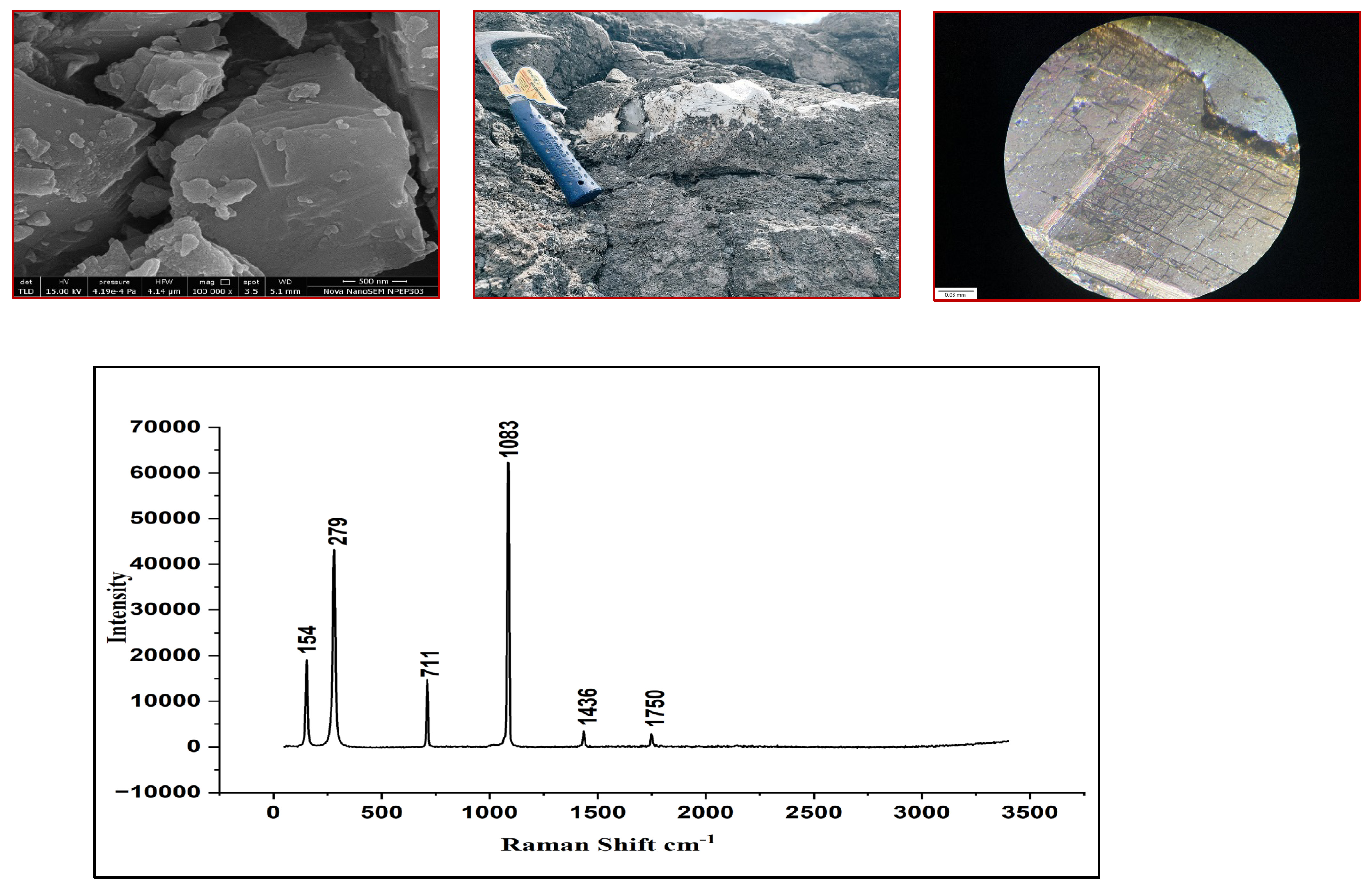
- Mechanical deformation of calcite and implications for engineered carbon storage, post growth deformation.
- Vibrational spectroscopy of calcite amygdules and relevance to carbon storage implication as a natural analogue.
- The twin morphology of calcite is consistent with low temperature deformation, broadly below ∼170–200 °C according to the Ferrill framework.
- Open Access
- Article
Cavity-Filling Calcite in the Deccan Traps as a Natural Analogue for Mineral Carbon Sequestration and Low-Temperature Deformation
Author Information
Received: 15 August 2026 | Revised: 03 October 2026 | Accepted: 21 October 2026 | Published: 26 October 2026
Highlights
Abstract
Cavity-filling calcite is among the most widespread secondary phases in the Deccan Traps, and its position late in the amygdale paragenesis, after zeolites and silica phases, is long established. Two questions that remain open are addressed here: whether this calcite retains a mechanical record of deformation imposed after the cavities were sealed, and what a naturally carbonated flood-basalt pile can tell us about the durability of engineered mineral carbon storage. Calcite from three closely spaced amygdaloidal basalt exposures in the district of Maharashtra, Ane Ghat in Junnar taluka, Pune, Shindewadi 1 and Shindewadi 2 in Parner taluka, Ahilyanagar was examined by transmitted-light petrography, scanning electron microscopy with energy-dispersive X-ray spectrometry (SEM–EDS) and micro-Raman spectroscopy, with growth features deliberately separated from post-growth strain features. All three occurrences comprise coarse, optically continuous calcite grown into open voids: rhombohedral cleavage is perfect, birefringence is extreme, planar crystal faces survive in secondary-electron images, and no replacement front is developed against the basalt wall. Superimposed on this growth fabric are closely spaced polysynthetic e-twin lamellae, undulose extinction, cleavage-controlled intracrystalline microfractures, and healed fractures carrying trails of secondary inclusions. Because these features truncate cleavage and crystal boundaries that are continuous elsewhere in the same individual, they post-date crystal growth. Twin morphology is dominated by thin, straight lamellae, which on the Ferrill classification indicates deformation below roughly 170–200 °C. EDS spectra confirm a Cacarbonate composition; because light-element quantification in a coated carbonate is not reliable, measured Ca/C atomic ratios of 1.31–1.61 depart substantially from the ideal value of unity and the analyses are treated as semi-quantitative throughout. Micro-Raman spectra are those of well-ordered calcite, with lattice modes near 156 and 279–281 cm−1 and internal modes at 711–712 cm−1 (ν4) and 1085–1087 cm−1 (ν1); differences between sites do not exceed instrument calibration uncertainty. The results are placed in the framework of in situ mineral carbon sequestration. Deccan amygdale calcite is a completed natural experiment in basalt carbonation: divalent cations liberated by fluid–rock interaction was fixed as a thermodynamically stable carbonate that has survived approximately 66 million years in the same pore volume now targeted for engineered CO2 injection. The microstructural record modifies that otherwise reassuring picture in a specific way. Mineralized amygdales were subsequently strained, brittle microfractures propagated through the carbonate cement, and those fractures were later healed by carbonate-bearing fluids. Permanence of mineral trapping in a tectonically quiescent plateau interior is therefore neither unconditional nor catastrophically compromised: it is a balance between fracture generation and carbonate self-sealing that can be read directly from the cement.
Graphical Abstract
Keywords
amygdale calcite | carbon sequestration | Deccan traps | low-temperature deformation | reservoir integrity
References
- 1.
Schoene, B.; Eddy, M.P.; Samperton, K.M.; et al. U-Pb constraints on pulsed eruption of the Deccan Traps across the end-cretaceous mass extinction. Science 2019, 363, 862–866. https://doi.org/10.1126/science.aau2422.
- 2.
Sprain, C.J.; Renne, P.R.; Vanderkluysen, L.; et al. The eruptive tempo of Deccan volcanism in relation to the cretaceous-paleogene boundary. Science 2019, 363, 866–870. https://doi.org/10.1126/science.aav1446.
- 3.
Courtillot, V.; Féraud, G.; Maluski, H.; et al. Deccan flood basalts and the cretaceous/tertiary boundary. Nature 1988, 333, 843–846. https://doi.org/10.1038/333843a0.
- 4.
Krishnamurthy, P. The Deccan Volcanic Province (DVP), India: A review. J. Geol. Soc. India 2020, 96, 9–35. https://doi.org/10.1007/s12594-020-1501-5.
- 5.
Rao, N.V.C.; Parthasarathy, G. Recent studies on volcanic materials and chemistry of the Earth’s interior—An Indian perspective. J. Geol. Soc. India 2024, 100, 159–167. https://doi.org/10.17491/jgsi/2024/173816.
- 6.
Walker, G.P.L. Some observations and interpretations on the Deccan traps. In Deccan Volcanic Province; Subbarao, K.V., Ed.; Memoir 43; Geological Society of India: Bangalore, India, 1999; pp. 367–395.
- 7.
Sukheswala, R.N.; Avasia, R.K.; Gangopadhyay, M. Zeolites and associated secondary minerals in the Deccan traps of Western India. Mineral. Mag. 1974, 39, 658–671. https://doi.org/10.1180/minmag.1974.039.306.04.
- 8.
Jeffery, K.L.; Henderson, P.; Subbarao, K.V.; et al. The zeolites of Deccan basalts—A study of their distribution. In Deccan Flood Basalts; Subbarao, K.V., Ed.; Geological Society of India: Bangalore, India, 1988; pp. 151–162.
- 9.
Ottens, B.; Götze, J.; Schuster, R.; et al. Exceptional multi stage mineralization of secondary minerals in cavities of flood basalts from the Deccan volcanic province, India. Minerals 2019, 9, 351. https://doi.org/10.3390/min9060351.
- 10.
Ottens, B.; Schuster, R.; Benkó, Z. The secondary minerals from the pillow basalt of Salsette-Mumbai, Deccan Volcanic Province, India. Minerals 2022, 12, 444. https://doi.org/10.3390/min12040444.
- 11.
Burkhard, M. Calcite twins, their geometry, appearance and significance as stress-strain markers and indicators of tectonic regime: A review. J. Struct. Geol. 1993, 15, 351–368. https://doi.org/10.1016/0191-8141(93)90132-T.
- 12.
Ferrill, D.A.; Morris, A.P.; Evans, M.A.; et al. Calcite twin morphology: A low-temperature deformation geothermometer. J. Struct. Geol. 2004, 26, 1521–1529. https://doi.org/10.1016/j.jsg.2003.11.028.
- 13.
Lacombe, O.; Parlangeau, C.; Beaudoin, N.E.; et al. Calcite twin formation, measurement and use as stress–strain indicators: A review of progress over the last decade. Geosciences 2021, 11, 445. https://doi.org/10.3390/geosciences11110445.
- 14.
Rutter, E.; Wallis, D.; Kosiorek, K. Application of electron backscatter diffraction to calcite-twinning paleopiezometry. Geosciences 2022, 12, 222. https://doi.org/10.3390/geosciences12060222.
- 15.
Rowe, K.J.; Rutter, E.H. Palaeostress estimation using calcite twinning: Experimental calibration and application to nature. J. Struct. Geol. 1990, 12, 1–17.
- 16.
Kale, V.S.; Shejwalkar, N. Uplift along the western margin of the Deccan Basalt Province: Is there any geomorphometric evidence? J. Earth Syst. Sci. 2008, 117, 959–971. https://doi.org/10.1007/s12040-008-0081-3.
- 17.
Santosh, M. Habitable planet earth: Secular evolution and sustainable future. Habitable Planet 2025, 1, 286–297. https://doi.org/10.63335/j.hp.2025.0021.
- 18.
Kartal, M.T.; Santosh, M.; Mukhtarov, S.; et al. The role of critical minerals’ price changes on the nexus between power sector CO2 emissions and disaggregated level renewable energy generation in China. J. Environ. Manag. 2026, 406, 129790. https://doi.org/10.1016/j.jenvman.2026.129790.
- 19.
Oelkers, E.H.; Gislason, S.R.; Matter, J. Mineral carbonation of CO2. Elements 2008, 4, 333–337.
- 20.
Gislason, S.R.; Oelkers, E.H. Carbon storage in basalt. Science 2014, 344, 373–374. https://doi.org/10.1126/science.1250828.
- 21.
Matter, J.M.; Stute, M.; Snæbjörnsdóttir, S.Ó.; et al. Rapid carbon mineralization for permanent disposal of anthropogenic carbon dioxide emissions. Science 2016, 352, 1312–1314. https://doi.org/10.1126/science.aad8132.
- 22.
Snæbjörnsdóttir, S.Ó.; Sigfússon, B.; Marieni, C.; et al. Carbon dioxide storage through mineral carbonation. Nat. Rev. Earth Environ. 2020, 1, 90–102.
- 23.
McGrail, B.P.; Schaef, H.T.; Ho, A.M.; et al. Potential for carbon dioxide sequestration in flood basalts. J. Geophys. Res. 2006, 111, B12201. https://doi.org/10.1029/2005JB004169.
- 24.
Jayaraman, K.S. India’s carbon dioxide trap. Nature 2007, 445, 350. https://doi.org/10.1038/445350a.
- 25.
Gorain, S.; Kumar, A.; Saha, D.; et al. Assessment of carbon dioxide storage potential in Deccan basalts using geophysical methods. Discov. Geosci. 2025, 3, 166.
- 26.
Niyogi, A.; Mallik, J.; Tiwari, B.; et al. Evaluation of the Deccan dykes as potential CO2 sink. J. Earth Syst. Sci. 2025, 134, 98.
- 27.
Punnam, P.R.; Krishnamurthy, B.; Surasani, V.K. Investigations of structural and residual trapping phenomena during CO2 sequestration in Deccan volcanic province of the Saurashtra Region, Gujarat. Int. J. Chem. Eng. 2021, 2021, 7762127. https://doi.org/10.1155/2021/7762127.
- 28.
Liu, D.; Agarwal, R.; Liu, F.; et al. Modeling and assessment of CO2 geological storage in the Eastern Deccan Basalt of India. Environ. Sci. Pollut. Res. 2022, 29, 85465–85481. https://doi.org/10.1007/s11356-022-21757-y.
- 29.
Pan, Y.; Liu, Y.; Hou, Z.; et al. Laboratory experiments of carbon mineralization potential of the main terrestrial basalt reservoirs in China. Geosci. Front. 2025, 16, 101961. https://doi.org/10.1016/j.gsf.2024.101961.
- 30.
Wang, M.; Dai, X.; Sang, S.; et al. CO2 Mineralization projects, techniques, mechanisms, potential and future outlook in basalt: A review. Renew. Sustain. Energy Rev. 2025, 221, 115920. https://doi.org/10.1016/j.rser.2025.115920.
- 31.
Prasad, P.S.R.; Sarma, D.S.; Charan, S.N. Mineral trapping and sequestration of carbon-dioxide in Deccan Basalts: SEM, FTIR and Raman spectroscopic studies on secondary carbonates. J. Geol. Soc. India 2012, 80, 546–552. https://doi.org/10.1007/s12594-012-0175-z.
- 32.
Kumar, A.; Shrivastava, J.P. Long-Term CO2 capture-induced calcite crystallographic changes in Deccan Basalt, India. Environ. Earth Sci. 2019, 78, 376. https://doi.org/10.1007/s12665-019-8378-x.
- 33.
Delerce, S.; Bénézeth, P.; Schott, J.; et al. The dissolution rates of naturally altered basalts at pH 3 and 120 °C: Implications for the in situ mineralization of CO2 injected into the subsurface. Chem. Geol. 2023, 621, 121353. https://doi.org/10.1016/j.chemgeo.2023.121353.
- 34.
Geological Survey of India (GSI). Geology and Mineral Resources of Maharashtra; Geological Survey of India Special Publication No. 64; Geological Survey of India: Kolkata, India, 2001; 113p.
- 35.
Vaddadi, S. Comment on “Emplacement History and Evolution of the Deccan Volcanic Province, India” by Kale et al. (2020). Episodes 2021, 44, 203–205. https://doi.org/10.18814/epiiugs/2020/020068.
- 36.
Godbole, S.M.; Rana, R.S.; Natu, S.R. Report lava stratigraphy of basalt flows of Western Maharashtra. Gondwana Geol. Mag. 1996, 2, 125–135.
- 37.
Subbarao, K.V.; Hooper, P.R. Reconnaissance NMORB signatures from the Western Deccan Traps. In Deccan Flood Basalts; Subbarao, K.V., Ed.; Memoir No. 10; Geological Society of India: Bangalore, India, 1988; pp. 182–188.
- 38.
Kale, V.S.; Bodas, M.; Chatterjee, P.; et al. Emplacement history and evolution of the Deccan volcanic Province, India. Episodes 2020, 43, 278–299. https://doi.org/10.18814/epiiugs/2020/020016.
- 39.
Srivastava, P.; Siva Siddaiah, N.; Sangode, S.J.; et al. Mineralogy and geochemistry of various colored boles from the Deccan Volcanic Province: Implications for paleoweathering and paleoenvironmental conditions. CATENA 2018, 167, 44–59. https://doi.org/10.1016/j.catena.2018.04.024.
- 40.
Parthasarathy, G. Zeolite zonation and amygdaloidal minerals from the Killari borehole of Deccan traps, Maharashtra, India. J. Appl. Geochem. 2006, 8, 546–557.
- 41.
Newbury, D.E.; Ritchie, N.W.M. Is scanning electron microscopy/energy dispersive X-ray spectrometry (SEM/EDS) quantitative? Scanning 2013, 35, 141–168. https://doi.org/10.1002/sca.21041.
- 42.
Urmos, J.; Sharma, S.K.; Mackenzie, F.T. Characterization of some biogenic carbonates with Raman spectroscopy. Am. Mineral. 1991, 76, 641–646.
- 43.
Mackenzie, F.; Bischoff, D.B.; Sharma, S. Carbonate ion disorder in synthetic and biogenic magnesium calcites: A Raman spectral study. Am. Mineral. 1985, 70, 581–589.
- 44.
Perrin, J.; Vielzeuf, D.; Laporte, D.; et al. Raman characterization of synthetic magnesian calcites. Am. Mineral. 2016, 101, 2525–2538. https://doi.org/10.2138/am-2016-5714.
- 45.
Borromeo, L.; Zimmermann, U.; Andò, S.; et al. Raman spectroscopy as a tool for magnesium estimation in Mg-calcite. J. Raman Spectrosc. 2017, 48, 983–992. https://doi.org/10.1002/jrs.5156.
- 46.
Dufresne, W.J.B.; Rufledt, C.J.; Marshall, C.P. Raman spectroscopy of the eight natural carbonate minerals of calcite structure. J. Raman Spectrosc. 2018, 49, 1999–2007. https://doi.org/10.1002/jrs.5481.
- 47.
Saikia, B.J.; Parthasarathy, G.; Saikia, B.K.; et al. Nanocrystalline cookeite from lithium mineral deposits of Jammu, India: A multianalytical characterization. Earth Syst. Resour. Sustain. 2026, 1, 97–109. https://doi.org/10.53941/esrs.2026.100006.
- 48.
White, W.B. The carbonate minerals. In The Infrared Spectra of Minerals; Farmer, V.C., Ed.; Mineralogical Society of Great Britain and Ireland: London, UK, 1974; pp. 227–284. https://doi.org/10.1180/mono-4.12.
- 49.
Gottardi, G.; Galli, E. Natural Zeolites; Minerals and Rocks, Volume 18; Springer: Berlin, Heidelberg, 1985; 409p. https://doi.org/10.1007/978-3-642-46518-5.
- 50.
Neuhoff, P.S. Porosity evolution and mineral paragenesis during low-grade metamorphism of basaltic lavas at teigarhorn, Eastern Iceland. Am. J. Sci. 1999, 299, 467–501.
- 51.
Parlangeau, C.; Dimanov, A.; Hallais, S. In situ evolution of calcite twinning during uniaxial compression of carrara marble at room temperature. Geosciences 2022, 12, 233. https://doi.org/10.3390/geosciences12060233.
- 52.
Sakaguchi, A.; Ando, K. Calcite twin stress and strain indicators for various polymineralic rocks and mortars. J. Struct. Geol. 2025, 194, 105369. https://doi.org/10.1016/j.jsg.2025.105369.
- 53.
Gomila, R.; Chiesurin, A.; Spagnuolo, E.; et al. Fault zone rocks associated with the reservoir-triggered seismicity of the Koyna-Warna Region (India). Geophys. Res. Lett. 2025, 52, e2025GL115072. https://doi.org/10.1029/2025GL115072.
- 54.
Reeder, R.J. Chapter 1. Crystal chemistry of the rhombohedral carbonates. In Carbonates; Reeder, R.J., Ed.; De Gruyter: Berlin, Germany, 1983; pp. 1–48. https://doi.org/10.1515/9781501508134-005.
- 55.
Elkholy, E.; Anandhi, A. Biological and geological carbon sequestration monitoring techniques: A review. Carbon Manage. 2026, 17, 2590609. https://doi.org/10.1080/17583004.2025.2590609.
- 56.
Goldberg, D.S.; Takahashi, T.; Slagle, A.L. Carbon dioxide sequestration in deep-sea basalt. Proc. Natl. Acad. Sci. USA 2008, 105, 9920–9925. https://doi.org/10.1073/pnas.0804397105.
- 57.
Tripathi, P.; Parthasarathy, G.; Ahmad, S.M.; et al. Mantle-derived fluids in the basement of the Deccan Trap: Evidence from stable carbon and oxygen isotopes of carbonates from the Killari Borehole Basement, Maharashtra, India. Int. J. Earth Sci. 2012, 101, 1385–1395. https://doi.org/10.1007/s00531-011-0723-6.
- 58.
Guha Roy, D.; Vishal, V.; Singh, T.N. Effect of carbon dioxide sequestration on the mechanical properties of Deccan Basalt. Environ. Earth Sci. 2016, 75, 771. https://doi.org/10.1007/s12665-016-5587-4.
- 59.
Hernandez-Mejia, J.L.; Imhof, M.; Pyrcz, M.J. Anomaly detection for geological carbon sequestration monitoring. Int. J. Greenhouse Gas Control 2024, 136, 104188. https://doi.org/10.1016/j.ijggc.2024.104188.
- 60.
Lyu, W.; Li, Y.; Wang, M.; et al. Application and prospects of spatial information technology in CO2 sequestration monitoring. Pet. Explor. Dev. 2024, 51, 727–740. https://doi.org/10.1016/S1876-3804(24)60501-X.
- 61.
Cai, J.; Wu, D.; Xu, X.; et al. Review of carbon dioxide sequestration by basalt mineral carbonation. Environ. Prog. Sustain. Energy 2026, 45, e70266. https://doi.org/10.1002/ep.70266.
- 62.
Kang, S.-S.; Jang, B.-A. Paleostress inferred from calcite twins in the pungchon limestone, joseon supergroup. J. Eng. Geol. 2022, 32, 13–26. https://doi.org/10.9720/KSEG.2022.1.013.
- 63.
Dorzadeh, H.; Shafieibafti, S.; Keshavarz, S.; et al. Calcite E-Twins as a tectonic indicator, paleo stress pattern and structural evolution of the zagros Hinterland, SE Iran. Front. Earth Sci. 2024, 12, 1445918. https://doi.org/10.3389/feart.2024.1445918.
- 64.
Bazargani-Guilani, K.; Rabbani, M.S. Amygdaloidal and other Cavity filling zeolites of Kuh-e-Aradeh, Central Iran. J. Sci. Islamic Repub. Iran 2004, 15, 149–157.
- 65.
Giret, A.; Verdier, O.; Nativel, P. The zeolitization model of Kerguelen Islands, southern Indian Ocean. In Recent Progress in Antarctic Earth Science; Yoshida, K.K., Shiraishi, K., Eds.; Terrapub: Tokyo, Japan, 1992; pp. 457–463.
- 66.
Apte, A.S. Thermal Analysis of Zeolites and Associated Cavity Minerals from the Deccan Volcanic Province. Ph.D. Thesis, University of Pune, Pune, India, 1994. (Unpublished)
- 67.
James, S.; Walsh, J.N. Zeolites from the Deccan Basalts: Chemistry and formation. Mem. Geol. Soc. India 1999, 43, 803–817.
- 68.
Randive, K.; Chaudhary, S.; Dandekar, S.; et al. Characterisation and genesis of the chalcedony occurring within the Deccan lava flows of the LIT Hill, Nagpur, India. J. Earth Syst. Sci. 2019, 128, 192. https://doi.org/10.1007/s12040-019-1208-4.
- 69.
Parthasarathy, G.; Kunwar, A.C.; Srinivasan, R. Occurrence of moganite-rich chalcedony in Deccan flood basalts, killari, Maharashtra, India. Eur. J. Mineral. 2001, 13, 127–134. https://doi.org/10.1127/0935-1221/01/0013-0127.
- 70.
Jørgensen, O. The regional distribution of zeolites in the basalts of the Faroe Islands and the significance of zeolites as palaeotemperature indicators. GEUS Bull. 2006, 9, 123–156. https://doi.org/10.34194/geusb.v9.4865.
- 71.
Kristmannsdottir, H. Alteration of basaltic rocks by hydrothermal activity at 100–300 °C. In Developments in Sedimentology; Elsevier: Amsterdam, The Netherlands, 1979; Volume 27, pp. 359–367. https://doi.org/10.1016/S0070-4571(08)70732-5.
How to Cite
Mookherjee, A.; Huma, S.; Parthasarathy, G. Cavity-Filling Calcite in the Deccan Traps as a Natural Analogue for Mineral Carbon Sequestration and Low-Temperature Deformation. Earth Systems, Resources, and Sustainability 2026, 1 (4), 494–512. https://doi.org/10.53941/esrs.2026.100028.
RIS
BibTex
Copyright & License

Copyright (c) 2026 by the authors.
This work is licensed under a Creative Commons Attribution 4.0 International License.
Contents
References
