
- A 35-year climate dataset was analysed using SPI and SPEI at 3, 6, 9 and 12 month scales to evaluate drought patterns.
- Spearman’s rank correlation and Sen’s Slope tests were used to recognize drought trends.
- Holt–Winters forecasting was used to forecast drought circumstances for the next 10 years.
- SPI and SPEI showed strong positive relationships across diverse timescales.
- Open Access
- Article
Longitudinal Drought Patterns and Predictive Analysis in Lalitpur, Uttar Pradesh, India: An Application of SPI and SPEI
- Sudipta Kundu 1,
- Biplab Banerjee 2 and
- Surtisha Ghosh 3,*
Author Information
Received: 28 June 2026 | Revised: 26 September 2026 | Accepted: 28 October 2026 | Published: 02 November 2026
Highlights
Abstract
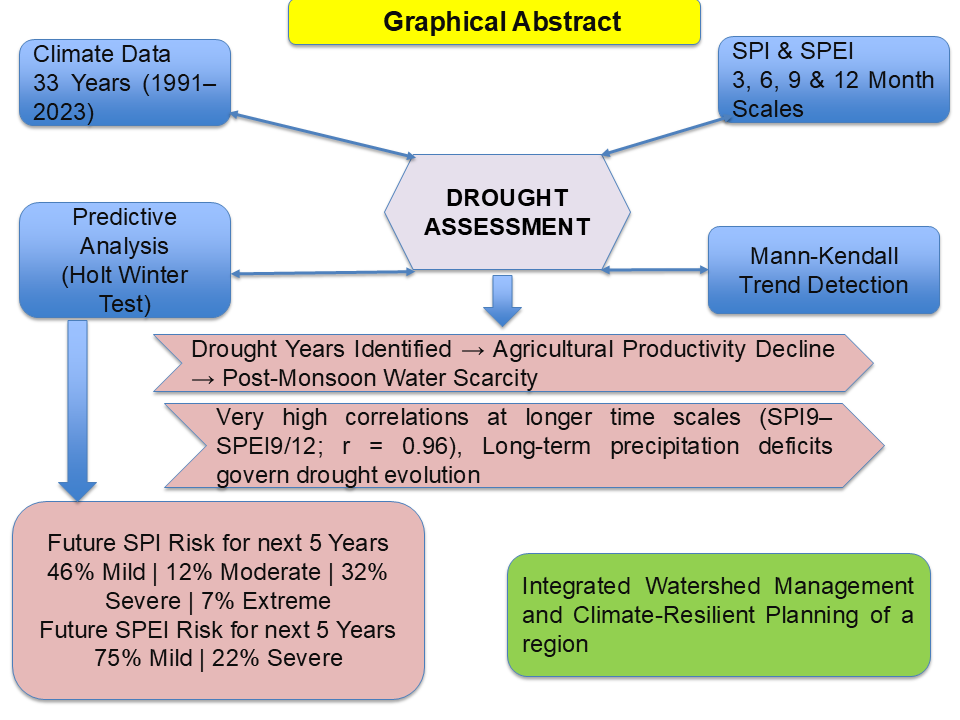
Drought is a significant hydrological hazard that leaves a serious footprint on the environment, society and human life. Water resources, agricultural productivity, ecosystems, livelihoods and socio-economic well-beings are negatively impacted by drought. This make a serious footprint on the environment, society and also human lives. Nowadays, many regions of the worlds are experiencing increasing frequent and a severe drought condition. Natural climatic variability and anthropogenic factors combinedly influence the drought patterns and trends. This study investigates the spatial and temporal characteristics and variation of drought patterns in Lalitpur District of Uttar Pradesh State, India. Thirty-five years metrological data collected from the NASA POWER Access Viewer were used to fulfil the research objectives. Two drought indices, Standardized Precipitation Index (SPI) and Standardized Precipitation Evapotranspiration Index (SPEI) were calculated 3, 6, 9 and 12 month timescales. For asses the direction and statistical significance of temporal trends, Spearman’s rank correlation method was used. Sen’s slope estimator was employed to quantifying magnitude of these trends. The result indicates the occurrence of drought over multiple years and reveals a tendency toward increasing drought severity. Variations in rainfall patterns, overuse of ground water, agricultural transformation and changes in land use pattern may be contribute to the observed of drought trends. As a result, agricultural productivity in this region is also significantly affected. Future projections for 2026–2035 indicated drought occurrence of 11.67%, 8.33%, 1.67%, and 9.17% for SPI-3, SPI-6, SPI-9, and SPI-12, respectively, while SPEI projected 5.83%, 3.33%, 1.67%, and 0.83% at the corresponding time scales. The findings highlight the importance of multi-timescale drought assessment and forecasting for effective drought monitoring, water-resource management, and agricultural planning in Lalitpur District.
Graphical Abstract
Keywords
Standardized Precipitation Evapotranspiration Index (SPEI) | Standardized Precipitation Index (SPI) | spearman’s rank correlation test | future projections
References
- 1.
Ndehedehe, C.E.; Ferreira, V.G.; Adeyeri, O.E.; et al. Global assessment of drought characteristics in the Anthropocene. Resour. Environ. Sustain. 2023, 12, 100105. https://doi.org/10.1016/j.resenv.2022.100105.
- 2.
Cutter, S.L. The Changing nature of hazard and disaster risk in the anthropocene. Ann. Am. Assoc. Geogr. 2021, 111, 819–827. https://doi.org/10.1080/24694452.2020.1744423.
- 3.
Fleming-Muñoz, D.A.; Whitten, S.; Bonnett, G.D. The economics of drought: A review of impacts and costs. Aust. J. Agric. Resour. Econ. 2023, 67, 501–523. https://doi.org/10.1111/1467-8489.12527.
- 4.
Entekhabi, D. Propagation in the drought cascade: Observational analysis over the continental US. Water Resour. Res. 2023, 59, e2022WR032608. https://doi.org/10.1029/2022WR032608.
- 5.
Vicente-Serrano, S.M.; McVicar, T.R.; Miralles, D.G.; et al. Unraveling the influence of atmospheric evaporative demand on drought and its response to climate change. WIREs Clim. Change 2020, 11, e632. https://doi.org/10.1002/wcc.632.
- 6.
Haile, G.G.; Tang, Q.; Li, W.; et al. Drought: Progress in broadening its understanding. WIREs Water 2020, 7, e1407. https://doi.org/10.1002/wat2.1407.
- 7.
Wilhite, D.A.; Glantz, M.H. Understanding: The drought phenomenon: The role of definitions. Water Int. 1985, 10, 111–120. https://doi.org/10.1080/02508068508686328.
- 8.
Mishra, V.; Cherkauer, K.A. Retrospective droughts in the crop growing season: Implications to corn and soybean yield in the Midwestern United States. Agric. For. Meteorol. 2010, 150, 1030–1045. https://doi.org/10.1016/j.agrformet.2010.04.002.
- 9.
Apurv, T.; Sivapalan, M.; Cai, X. Understanding the role of climate characteristics in drought propagation. Water Resour. Res. 2017, 53, 9304–9329. https://doi.org/10.1002/2017WR021445.
- 10.
Sternberg, T. Chinese drought, bread and the Arab Spring. Appl. Geogr. 2012, 34, 519–524. https://doi.org/10.1016/j.apgeog.2012.02.004.
- 11.
Narasimhan, B.; Srinivasan, R. Development and evaluation of Soil Moisture Deficit Index (SMDI) and Evapotranspiration Deficit Index (ETDI) for agricultural drought monitoring. Agric. For. Meteorol. 2005, 133, 69–88. https://doi.org/10.1016/j.agrformet.2005.07.012.
- 12.
Fuentes, I.; Padarian, J.; Vervoort, R.W. Spatial and temporal global patterns of drought propagation. Front. Environ. Sci. 2022, 10, 788248. https://doi.org/10.3389/fenvs.2022.788248.
- 13.
Pedro-Monzonís, M.; Solera, A.; Ferrer, J.; et al. A review of water scarcity and drought indexes in water resources planning and management. J. Hydrol. 2015, 527, 482–493. https://doi.org/10.1016/j.jhydrol.2015.05.003.
- 14.
Hernandez, E.A.; Uddameri, V. Standardized precipitation evaporation index (SPEI)-based drought assessment in semi-arid south Texas. Environ. Earth Sci. 2014, 71, 2491–2501. https://doi.org/10.1007/s12665-013-2897-7.
- 15.
Tomas-Burguera, M.; Vicente-Serrano, S.M.; Peña-Angulo, D.; et al. Global characterization of the varying responses of the standardized precipitation evapotranspiration index to atmospheric evaporative demand. J. Geophys. Res.: Atmos. 2020, 125, e2020JD033017. https://doi.org/10.1029/2020JD033017.
- 16.
Potop, V.; Možný, M.; Soukup, J. Drought evolution at various time scales in the lowland regions and their impact on vegetable crops in the Czech Republic. Agric. For. Meteorol. 2012, 156, 121–133. https://doi.org/10.1016/j.agrformet.2012.01.002.
- 17.
Nikoo, M.R.; Zarei, E.; Al-Wardy, M. Non-stationary drought patterns in hyper-arid regions: Spatiotemporal and multi-timescale drought analysis. Sci. Total Environ. 2025, 1000, 180401. https://doi.org/10.1016/j.scitotenv.2025.180401.
- 18.
Tilahun Alehegn, T.; Teka Tadesse, D.; Kassaw Beshaw, T.; et al. Spatio-temporal analysis of drought frequency and severity in the Bilate Watershed, Ethiopia: A multi-scalar SPI Approach. H2Open J. 2026, 9, 100078. https://doi.org/10.1016/j.htopen.2026.100078.
- 19.
Hao, Z.; Singh, V.P.; Xia, Y. Seasonal drought prediction: Advances, challenges, and future prospects. Rev. Geophys. 2018, 56, 108–141. https://doi.org/10.1002/2016RG000549.
- 20.
Ahmedbahaaaldin, I.; Nouar, A.; Chong, K.L.; et al. A review on machine learning models for drought monitoring and forecasting. Clim. Risk Manag. 2025, 50, 100758. https://doi.org/10.1016/j.crm.2025.100758.
- 21.
Hemalatha, K.; Kandula, B.; Thotli, L.R. Variability in Indian monsoon onset: Delays, advances, and regional disruptions. Evol. Earth 2026, 4, 100103. https://doi.org/10.1016/j.eve.2025.100103.
- 22.
Vaishnavi, T.; Resmi, M.R. Spatiotemporal dynamics of drought and wet extremes across Gujarat’s agro-climatic zones: Insights from multi-index analysis and return period modelling. Energy Clim. Change 2026, 7, 100257. https://doi.org/10.1016/j.egycc.2026.100257.
- 23.
Kumar, P.; Paul, M.; Dobriyal, M. Mapping ground water potential using machine learning models in semi-arid region of Bundelkhand, India: A comparative evaluation. Earth Syst. Environ. 2026, 10, 6341–6363. https://doi.org/10.1007/s41748-025-00957-9.
- 24.
District Lalitpur. District Lalitpur, Government of Uttar Pradesh. Available online: https://lalitpur.nic.in/en/ (accessed on 04 October 2026).
- 25.
Som, K.S.; Dey, M. Analysis and forecasting of rainfall trends in semiarid Bundelkhand region of Madhya Pradesh, India: Using statistical methods. Environ. Earth Sci. 2022, 81, 98. https://doi.org/10.1007/s12665-021-10159-x.
- 26.
Sharma, S.; Mukherjee, J.; Chatterjee, U.; et al. Looking back to look forward: Explorations on water scenario in Bundelkhand, Central India. Phys. Chem. Earth A/B/C 2025, 137, 103805. https://doi.org/10.1016/j.pce.2024.103805.
- 27.
District Administration Lalitpur. Geographical Status. Government of Uttar Pradesh. Available online: https://lalitpur.nic.in/en/geographical-status/ (accessed on 23 October 2026).
- 28.
Wakjira, M.T.; Peleg, N.; Anghileri, D.; et al. Rainfall seasonality and timing: Implications for cereal crop production in Ethiopia. Agric. For. Meteorol. 2021, 310, 108633. https://doi.org/10.1016/j.agrformet.2021.108633.
- 29.
Thomas, T.; Jaiswal, R.K.; Galkate, R.V.; et al. Reconnaissance drought index based evaluation of meteorological drought characteristics in Bundelkhand. Procedia Technol. 2016, 24, 23–30. https://doi.org/10.1016/j.protcy.2016.05.005.
- 30.
Pandey, V.; Srivastava, P.K.; Das, P.; et al. Hydrological modelling for post-monsoon agricultural drought assessment and implications for the agro-economy. Hydrol. Sci. J. 2024, 69, 923–938. https://doi.org/10.1080/02626667.2024.2347981.
- 31.
Dracup, J.A.; Lee, K.S.; Paulson, E.G., Jr. On the definition of droughts. Water Resour. Res. 1980, 16, 297–302. https://doi.org/10.1029/WR016i002p00297.
- 32.
Ojha, S.S.; Singh, V.; Roshni, T. Comparison of meteorological drought using SPI and SPEI. Civ. Eng. J. 2021, 7, 2130–2149. https://doi.org/10.28991/cej-2021-03091783.
- 33.
Wable, P.S.; Jha, M.K.; Shekhar, A. Comparison of drought indices in a semi-arid river basin of India. Water Resour. Manag. 2019, 33, 75–102. https://doi.org/10.1007/s11269-018-2089-z.
- 34.
Livada, I.; Assimakopoulos, V.D. Spatial and temporal analysis of drought in greece using the Standardized Precipitation Index (SPI). Theor. Appl. Climatol. 2007, 89, 143–153. https://doi.org/10.1007/s00704-005-0227-z.
- 35.
McKee, T.B.; Doesken, N.J.; Kleist, J. The relationship of drought frequency and duration to time scales. In 8th Conference on Applied Climatology; American Meteorological Society (AMS): Anaheim, CA, USA, 1993.
- 36.
Tirivarombo, S.; Osupile, D.; Eliasson, P. Drought monitoring and analysis: Standardised Precipitation Evapotranspiration Index (SPEI) and Standardised Precipitation Index (SPI). Phys. Chem. Earth A/B/C 2018, 106, 1–10. https://doi.org/10.1016/j.pce.2018.07.001.
- 37.
Mathbout, S.; Lopez-Bustins, J.A.; Martin-Vide, J.; et al. Spatial and temporal analysis of drought variability at several time scales in Syria during 1961–2012. Atmos. Res. 2018, 200, 153–168. https://doi.org/10.1016/j.atmosres.2017.09.016.
- 38.
Moccia, B.; Mineo, C.; Ridolfi, E.; et al. SPI-Based drought classification in Italy: Influence of different probability distribution functions. Water 2022, 14, 3668. https://doi.org/10.3390/w14223668.
- 39.
Angelidis, P.; Maris, F.; Kotsovinos, N.; et al. Computation of drought index SPI with alternative distribution functions. Water Resour. Manag. 2012, 26, 2453–2473. https://doi.org/10.1007/s11269-012-0026-0.
- 40.
Liang, L.; Zhao, L.; Gong, Y.; et al. Probability distribution of summer daily precipitation in the Huaihe basin of China based on Gamma distribution. Acta Meteorol. Sin. 2012, 26, 72–84. https://doi.org/10.1007/s13351-012-0107-2.
- 41.
Mwinjuma, M.; Wang, R.; Mtupili, M.; et al. Comparisons of SPI and SPEI in capturing drought dynamics: A Global assessment across arid and humid regions. Atmos. Res. 2026, 329, 108475. https://doi.org/10.1016/j.atmosres.2025.108475.
- 42.
Vicente-Serrano, S.M.; Beguería, S.; López-Moreno, J.I. A multiscalar drought index sensitive to global warming: The standardized precipitation evapotranspiration index. J. Clim. 2010, 23, 1696–1718. https://doi.org/10.1175/2009JCLI2909.1.
- 43.
Fung, K.F.; Huang, Y.F.; Koo, C.H. Assessing drought conditions through temporal pattern, spatial characteristic and operational accuracy indicated by SPI and SPEI: Case analysis for Peninsular Malaysia. Nat. Hazards 2020, 103, 2071–2101. https://doi.org/10.1007/s11069-020-04072-y.
- 44.
Zhao, Q.; Sun, T.; Guo, H.; et al. Two-step method of surface-based high-precision PET retrieval. Atmos. Res. 2024, 304, 107406. https://doi.org/10.1016/j.atmosres.2024.107406.
- 45.
McCabe, G.J.; Wolock, D.M. Temporal and spatial variability of the global water balance. Clim. Change 2013, 120, 375–387. https://doi.org/10.1007/s10584-013-0798-0.
- 46.
Rahman, N.M.F.; Asadullah, M.; Hossain, M.S.; et al. Spatiotemporal trends and machine learning-based prediction of temperature variability during the T. Aman rice-growing season in Bangladesh. Sci. Rep. 2025, 15, 44883. https://doi.org/10.1038/s41598-025-28804-x.
- 47.
Güner Bacanli, U. Trend analysis of precipitation and drought in the Aegean region, Turkey. Meteorol. Appl. 2017, 24, 239–249. https://doi.org/10.1002/met.1622.
- 48.
AlSubih, M.; Kumari, M.; Mallick, J.; et al. Time series trend analysis of rainfall in last five decades and its quantification in Aseer Region of Saudi Arabia. Arab. J. Geosci. 2021, 14, 519. https://doi.org/10.1007/s12517-021-06935-5.
- 49.
Badar, Z.; Ahmad, I.; Ahmad, T.; et al. A novel multivariate vine-copula–based drought index with application to high-elevation catchments. Environ. Sci. Pollut. Res. 2026, 33, 16359–16379. https://doi.org/10.1007/s11356-026-38256-z.
- 50.
Yildirim, G.; Rahman, A. Homogeneity and trend analysis of rainfall and droughts over Southeast Australia. Nat. Hazards 2022, 112, 1657–1683. https://doi.org/10.1007/s11069-022-05243-9.
- 51.
Batool, A.; Ali, Z.; Mohsin, M.; et al. Assessing the generalization of forecasting ability of machine learning and probabilistic models for complex climate characteristics. Stoch. Environ. Res. Risk Assess. 2024, 38, 2927–2947. https://doi.org/10.1007/s00477-024-02721-3.
- 52.
Lallawmzuali, M.; Muniyan, S. Rainfall prediction in Mizoram using the modified holt winters method. Theor. Appl. Climatol. 2025, 156, 125. https://doi.org/10.1007/s00704-025-05354-w.
- 53.
Soulsby, C.; Scheliga, B.; Neill, A.; et al. A longer-term perspective on soil moisture, groundwater and stream flow response to the 2018 drought in an experimental catchment in the Scottish Highlands. Hydrol. Process. 2021, 35, e14206. https://doi.org/10.1002/hyp.14206.
- 54.
Brleković, T.; Tadić, L. Hydrological drought assessment in a small lowland catchment in Croatia. Hydrology 2022, 9, 79. https://doi.org/10.3390/hydrology9050079.
- 55.
Beguería, S.; Vicente-Serrano, S.M.; Reig, F.; et al. Standardized precipitation evapotranspiration index (SPEI) revisited: parameter fitting, evapotranspiration models, tools, datasets and drought monitoring. Int. J. Climatol. 2014, 34, 3001–3023. https://doi.org/10.1002/joc.3887.
- 56.
Yang, A.; Guo, J.; Su, Y.; et al. Projected global changes in severe and extreme drought occurrence: A CMIP6 multi-model assessment using SPI, SPEI, and concurrent SPI-SPEI conditions. Hydrology 2026, 13, 187. https://doi.org/10.3390/hydrology13070187.
- 57.
Bodner, G.; Nakhforoosh, A.; Kaul, H.-P. Management of crop water under drought: a review. Agron. Sustain. Dev. 2015, 35, 401–442. https://doi.org/10.1007/s13593-015-0283-4.
- 58.
Kundu, S.; Shukla, S.; Banerjee, B. Assessment of thermal changes using land surface temperature (LST) in Raigarh District: Implications for Sustainable development. Asian J. Geogr. Res. 2026, 9, 519–538. https://doi.org/10.9734/ajgr/2026/v9i3446.
- 59.
Ogunrinde, A.T.; Adigun, P.; Xue, X.; et al. Evaporative demand drought index for monitoring and analyzing drought conditions in arid regions of Asia and Africa. Weather Clim. Extrem. 2026, 51, 100873. https://doi.org/10.1016/j.wace.2026.100873.
- 60.
Amrit, K.; Pandey, R.P.; Mishra, S.K. Assessment of meteorological drought characteristics over Central India. Sustain. Water Resour. Manag. 2018, 4, 999–1010. https://doi.org/10.1007/s40899-017-0205-5.
- 61.
Thomas, T.; Nayak, P.C.; Ghosh, N.C. Spatiotemporal analysis of drought characteristics in the Bundelkhand Region of Central India using the standardized precipitation index. J. Hydrol. Eng. 2015, 20, 05015004. https://doi.org/10.1061/(ASCE)HE.1943-5584.0001189.
- 62.
Thomas, T.; Jaiswal, R.K.; Galkate, R.; et al. Drought indicators-based integrated assessment of drought vulnerability: A case study of Bundelkhand droughts in central India. Nat. Hazards 2016, 81, 1627–1652. https://doi.org/10.1007/s11069-016-2149-8.
- 63.
Hamed, K.H.; Ramachandra Rao, A. A modified Mann-Kendall trend test for autocorrelated data. J. Hydrol. 1998, 204, 182–196. https://doi.org/10.1016/S0022-1694(97)00125-X.
- 64.
Zolfaghari, F.; Matinzadeh, M.M.; Eslamian, S.; et al. Tail weighted multi criteria probability distribution selection for drought frequency analysis. Sci. Rep. 2026, 16. https://doi.org/10.1038/s41598-026-73322-z.
- 65.
Aydemir, S.; Hocalar, Ç.; Şekerci, K.; et al. Integrating observational datasets and CMIP6 projections for multi-scale drought characterization: Evidence from Western Türkiye. Sustainability 2026, 18, 8543. https://doi.org/10.3390/su18168543.
- 66.
Hyndman, R.J.; Koehler, A.B. Another look at measures of forecast accuracy. Int. J. Forecast. 2006, 22, 679–688. https://doi.org/10.1016/j.ijforecast.2006.03.001.
- 67.
Sun, W.; Chang, L.-C.; Lin, J.J.; et al. Integrating deep learning and groundwater dynamics for drought vulnerability assessment under climate scenarios. Groundw. Sustain. Dev. 2026, 33, 101591. https://doi.org/10.1016/j.gsd.2026.101591.
- 68.
Niranjannaik, M.; Kumar, A.; Beg, Z.; et al. Groundwater variability in a semi‑arid river Basin, Central India. Hydrology 2022, 9, 222. https://doi.org/10.3390/hydrology9120222.
- 69.
Mallick, J.; Alqadhi, S.; Talukdar, S.; et al. Modeling GRACE‑based groundwater drought and its teleconnections with global climate drivers for water sustainability in arid regions. Water Resour. Manag. 2025, 39, 6907–6930. https://doi.org/10.1007/s11269-025-04271-x.
- 70.
Aeschbach‑Hertig, W.; Gleeson, T. Regional strategies for the accelerating global problem of groundwater depletion. Nat. Geosci. 2012, 5, 853–861. https://doi.org/10.1038/ngeo1617.
- 71.
Bloomfield, J.P.; Marchant, B.P. Analysis of groundwater drought building on the standardised precipitation index approach. Hydrol. Earth Syst. Sci. 2013, 17, 4769–4787. https://doi.org/10.5194/hess-17-4769-2013.
How to Cite
Kundu , S.; Banerjee, B.; Ghosh, S. Longitudinal Drought Patterns and Predictive Analysis in Lalitpur, Uttar Pradesh, India: An Application of SPI and SPEI. Earth Systems, Resources, and Sustainability 2026, 1 (4), 513–529. https://doi.org/10.53941/esrs.2026.100029.
RIS
BibTex
Copyright & License

Copyright (c) 2026 by the authors.
This work is licensed under a Creative Commons Attribution 4.0 International License.
Article Metrics
37
Article Views
0
Citations
Contents
References
