- Critically reviews CO2 trapping mechanisms across seven geological environments.
- Evaluates structural, residual, solubility, mineral, adsorptive and supporting trapping processes.
- Introduces a five-dimensional framework for comparing trapping effectiveness.
- Identifies formation-specific limitations, enhancement opportunities, and monitoring gaps.
- Open Access
- Review
Formation-Specific CO2 Trapping in Geological Storage: A Review of Classical Mechanisms and Supporting Retention Processes
- Muhammad Hammad Rasool 1,2,*,
- Numair Ahmed Siddiqui 2,
- Maqsood Ahmad 2,
- Nisar Ahmed 2,
- Muhammad Mubashir 2,
- Opeyemi Lawal 2,
- Muhammad Shakil 2 and
- Arnob Deb 2
Author Information
Received: 23 September 2026 | Revised: 16 November 2026 | Accepted: 23 November 2026 | Published: 27 November 2026
Highlights
Abstract
The long-term security of geological CO2 storage depends on trapping mechanisms and the geological and hydrodynamic controls governing their effectiveness. Although classical mechanisms are well established, their interactions with formation-specific controls remain insufficiently integrated into comparative assessments. This review examines structural, residual, solubility, mineral and adsorption trapping, and evaluates capillary entry pressure, regional groundwater flow, and geological heterogeneity as controls on CO2 migration and immobilization. Experimental, numerical, and field evidence published between 1979 and 2026 is synthesized across seven settings: onshore and offshore saline aquifers, depleted hydrocarbon reservoirs, basalts, ultramafic formations, organic-rich shales, and coal seams. Quantitative comparisons of residual saturation, capillary breakthrough pressure, adsorption parameters, and mineralization performance reveal how pore architecture, wettability, permeability contrasts, fluid transport, and mineral reactivity alter retention. Structural trapping depends on seal integrity and capillary thresholds, whereas residual trapping reflects pore-scale displacement and saturation hysteresis. Groundwater flow and reservoir heterogeneity influence plume migration, CO2–brine contact, and access to reactive minerals, thereby governing dissolution and carbonation. In coal and shale, adsorption retains CO2 directly, although swelling and restricted pore accessibility can limit injectivity. An evidence-informed five-dimensional framework compares mechanism clarity, time to effectiveness, permanence potential, enhancement potential, and monitoring transparency. It identifies formation-specific trade-offs and verification uncertainties, providing a basis for interpreting geological CO2 retention and monitoring priorities under representative geological conditions and available field evidence.
Graphical Abstract
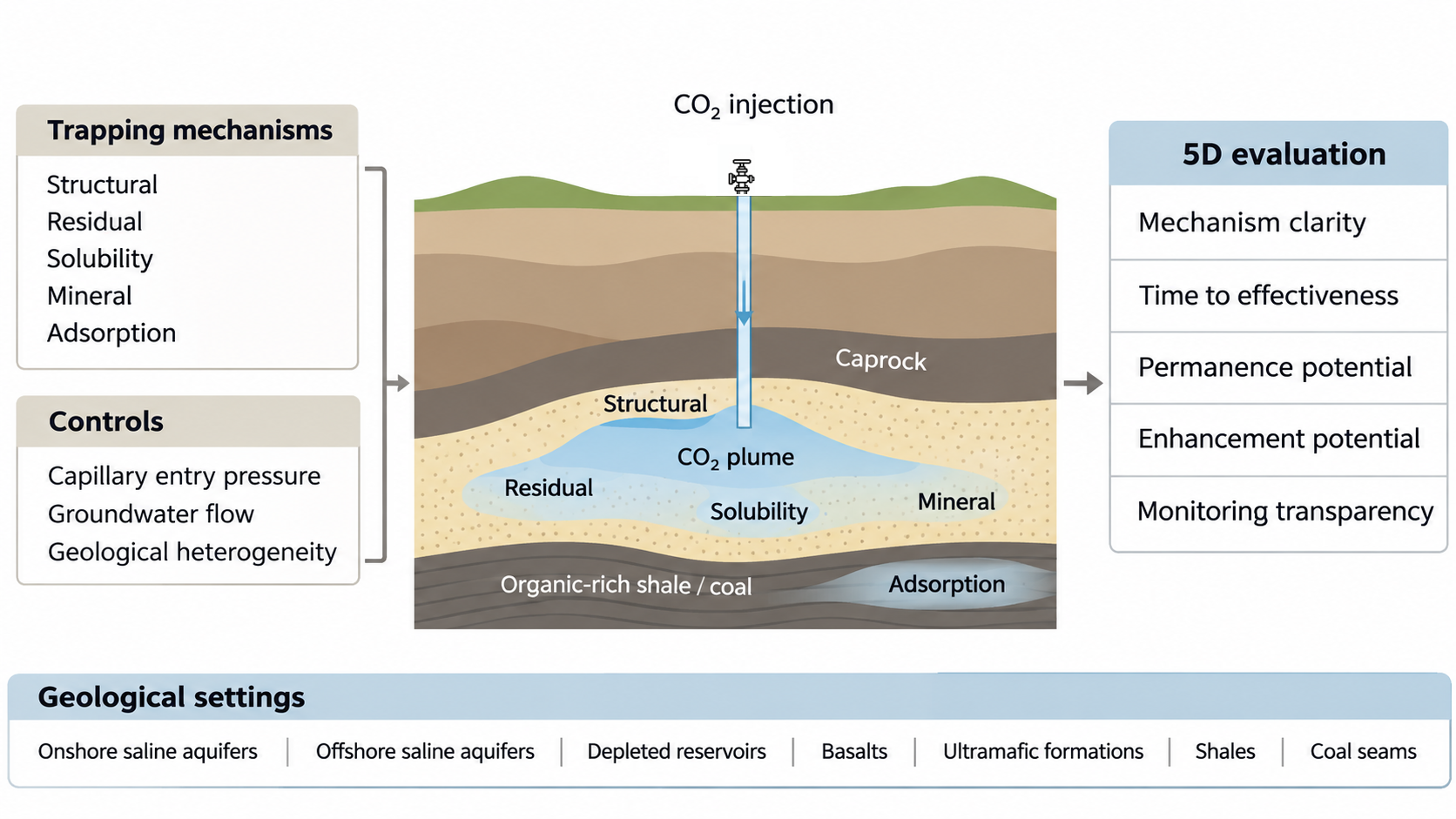
References
- 1.
Renné, D.S. Progress, opportunities and challenges of achieving net-zero emissions and 100% renewables. Sol. Compass 2022, 1, 100007.
- 2.
Morris, J.; Chen, Y.-H.H.; Gurgel, A.; et al. Net zero emissions of greenhouse gases by 2050: Achievable and at What Cost? Clim. Chang. Econ. 2023, 14, 2340002.
- 3.
Deutch, J. Is net zero carbon 2050 possible? Joule 2020, 4, 2237–2240.
- 4.
Greig, C.; Uden, S. The value of CCUS in transitions to net-zero emissions. Electr. J. 2021, 34, 107004.
- 5.
Nathanael, A.J.; Kannaiyan, K.; Kunhiraman, A.K.; et al. Global opportunities and challenges on net-zero CO₂ emissions towards a sustainable future. React. Chem. Eng. 2021, 6, 2226–2247.
- 6.
Suleman, H.; Nasir, R. CCUS: The road to net-zero. Energies 2023, 16, 4260.
- 7.
Shukla Potdar, R.; Vishal, V. Trapping mechanism of CO₂ storage in deep saline aquifers: Brief review. In Geologic Carbon Sequestration: Understanding Reservoir Behavior; Vishal, V., Singh, T.N., Eds.; Springer: Cham, Switzerland, 2016; pp. 47–58.
- 8.
Zhang, L.; Li, X.; Ren, B.; et al. CO₂ storage potential and trapping mechanisms in the H-59 block of Jilin oilfield China. Int. J. Greenh. Gas Control 2016, 49, 267–280.
- 9.
Abba, M.K.; Abbas, A.J.; Nasr, G.G.; et al. Solubility trapping as a potential secondary mechanism for CO₂ sequestration during enhanced gas recovery by CO₂ injection in conventional natural gas reservoirs: An experimental approach. J. Nat. Gas Sci. Eng. 2019, 71, 103002.
- 10.
Al Hameli, F.; Belhaj, H.; Al Dhuhoori, M. CO₂ sequestration overview in geological formations: Trapping mechanisms matrix assessment. Energies 2022, 15, 7805.
- 11.
Ajayi, T.; Gomes, J.S.; Bera, A. A review of CO₂ storage in geological formations emphasizing modeling, monitoring and capacity estimation approaches. Pet. Sci. 2019, 16, 1028–1063.
- 12.
Baines, S.J.; Worden, R.H. The long-term fate of CO₂ in the subsurface: Natural analogues for CO₂ storage. In Geological Storage of Carbon Dioxide; Baines, S.J., Worden, R.H., Eds.; Geological Society: London, UK, 2004; Volume 233, pp. 59–85.
- 13.
Ambrose, W.A.; Lakshminarasimhan, S.; Holtz, M.H.; et al. Geologic factors controlling CO₂ storage capacity and permanence: Case studies based on experience with heterogeneity in oil and gas reservoirs applied to CO₂ storage. Environ. Geol. 2008, 54, 1619–1633.
- 14.
Bourg, I.C.; Beckingham, L.E.; DePaolo, D.J. The nanoscale basis of CO₂ trapping for geologic storage. Environ. Sci. Technol. 2015, 49, 10265–10284.
- 15.
Sun, L.; Liu, Y.; Cheng, Z.; et al. Review on multiscale CO₂ mineralization and geological storage: Mechanisms, characterization, modeling, applications and perspectives. Energy Fuels 2023, 37, 14512–14537.
- 16.
Zhang, C.; Wang, Y.; Kou, Z.; et al. Recent research advances in enhanced CO₂ mineralization and geologic CO₂ storage. Adv. Geo-Energy Res. 2023, 10, 141–145.
- 17.
Iglauer, S. Optimum storage depths for structural CO₂ trapping. Int. J. Greenh. Gas Control 2018, 77, 82–87.
- 18.
Hameli, F.A.; Belhaj, H.; AlDhuhoori, M.; et al. Emerging advances in CO₂ storativity and trappability within shale reservoirs. Energy Sci. Eng. 2024, 12, 3950–3966.
- 19.
Bachu, S.; Gunter, W.D.; Perkins, E.H. Aquifer disposal of CO₂: Hydrodynamic and mineral trapping. Energy Convers. Manag. 1994, 35, 269–279.
- 20.
Rasool, M.H.; Ahmad, M.; Ayoub, M. Selecting geological formations for CO₂ storage: A comparative rating system. Sustainability 2023, 15, 6599.
- 21.
Rasool, M.H.; Ahmad, M. Reactivity of basaltic minerals for CO₂ sequestration via in situ mineralization: a review. Minerals 2023, 13, 1154.
- 22.
Kim, K.; Kim, D.; Na, Y.; et al. A review of carbon mineralization mechanism during geological CO₂ storage. Heliyon 2023, 9, e23135.
- 23.
Bashir, A.; Ali, M.; Patil, S.; et al. Comprehensive review of CO₂ geological storage: Exploring principles, mechanisms, and prospects. Earth-Sci. Rev. 2024, 249, 104672.
- 24.
Wei, B.; Wang, B.; Li, X.; et al. CO₂ storage in depleted oil and gas reservoirs: A review. Adv. Geo-Energy Res. 2023, 9, 76–93.
- 25.
White, C.M.; Smith, D.H.; Jones, K.L.; et al. Sequestration of carbon dioxide in coal with enhanced coalbed methane recovery: A review. Energy Fuels 2005, 19, 659–724.
- 26.
Gholami, R.; Raza, A. CO₂ sequestration in sandstone reservoirs: How does reactive flow alter trapping mechanisms? Fuel 2022, 324, 124781.
- 27.
Goldberg, D.S.; Takahashi, T.; Slagle, A.L. Carbon dioxide sequestration in deep-sea basalt. Proc. Natl. Acad. Sci. USA 2008, 105, 9920–9925.
- 28.
Nisbet, H.; Buscarnera, G.; Carey, J.W.; et al. Carbon mineralization in fractured mafic and ultramafic rocks: A review. Rev. Geophys. 2024, 62, e2023RG000815.
- 29.
Teng, Y.; Wang, P.; Xie, H.; et al. Capillary trapping characteristics of CO₂ sequestration in fractured carbonate rock and sandstone using MRI. J. Nat. Gas Sci. Eng. 2022, 108, 104809.
- 30.
Raza, A.; Rezaee, R.; Bing, C.H.; et al. Carbon dioxide storage in subsurface geologic medium: A review on capillary trapping mechanism. Egypt. J. Pet. 2016, 25, 367–373.
- 31.
Peter, A.; Yang, D.; Eshiet, K.I.-I.I.; et al. A review of the studies on CO₂–brine–rock interaction in geological storage process. Geosciences 2022, 12, 168.
- 32.
Zhang, D.; Song, J. Mechanisms for geological carbon sequestration. Procedia IUTAM 2014, 10, 319–327.
- 33.
Fentaw, J.W.; Emadi, H.; Hussain, A.; et al. Geochemistry in geological CO₂ sequestration: A comprehensive review. Energies 2024, 17, 5000.
- 34.
Wang, S.; Jin, K.; Zhao, W.; et al. Mechanism, modeling and challenges of geological storage of supercritical carbon dioxide. Energies 2025, 18, 4338.
- 35.
Rigby, S.P.; Alsayah, A.; Seely, R. Impact of exposure to supercritical carbon dioxide on reservoir caprocks and inter-layers during sequestration. Energies 2022, 15, 7538.
- 36.
Rutqvist, J. The Geomechanics of CO₂ storage in deep sedimentary formations. Geotech. Geol. Eng. 2012, 30, 525–551.
- 37.
Shukla, R.; Ranjith, P.; Haque, A.; et al. A review of studies on CO₂ sequestration and caprock integrity. Fuel 2010, 89, 2651–2664.
- 38.
Song, J.; Zhang, D. Comprehensive review of caprock-sealing mechanisms for geologic carbon sequestration. Environ. Sci. Technol. 2013, 47, 9–22.
- 39.
Osmond, J.L.; Mulrooney, M.J.; Holden, N.; et al. Structural traps and seals for expanding CO₂ storage in the northern Horda platform, North Sea. AAPG Bull. 2022, 106, 1711–1752.
- 40.
Zhang, Y.; Li, Q.; Li, X.; et al. Reactivation of rate-and-state faults induced by CO₂ injection: Effects of pore pressure diffusion and fluid pressurization. J. Rock Mech. Geotech. Eng. 2026, 18, 954–970.
- 41.
Nicol, A.; Seebeck, H.; Field, B.; et al. Fault permeability and CO₂ storage. Energy Procedia 2017, 114, 3229–3236.
- 42.
White, J.A.; Chiaramonte, L.; Ezzedine, S.; et al. Geomechanical behavior of the reservoir and caprock system at the In Salah CO₂ storage project. Proc. Natl. Acad. Sci. USA 2014, 111, 8747–8752.
- 43.
Shah, M.S.; Zendehboudi, S.; Duan, X.; et al. Geological and technical foundations of offshore CO₂ storage in depleted reservoirs. ACS Omega 2026, 11, 17013–17078.
- 44.
Freifeld, B.M.; Oldenburg, C.M.; Jordan, P.; et al. Well Integrity for Natural Gas Storage in Depleted Reservoirs and Aquifers. Technical Report LBNL-1006165; Lawrence Berkeley National Laboratory: Berkeley, CA, USA, 2016.
- 45.
Jammernegg, B. CO₂-Brine Primary Displacement Mechanisms: Salt Precipitation as a Result of Supercritical Gas Injection. Ph.D. Thesis, Montanuniversität Leoben, Leoben, Austria, 2025.
- 46.
Ngouangna, E.N.; Dzulkarnain, I.B.; Jaafar, M.Z.; et al. The effects of brine on CCUS-EOR and challenges faced during CO₂ projects: A review involving storage mechanisms with future prospects. ACS Omega 2026, 11, 111–142.
- 47.
Iglauer, S.; Pentland, C.; Busch, A. CO₂ wettability of seal and reservoir rocks and the implications for carbon geo-sequestration. Water Resour. Res. 2015, 51, 729–774.
- 48.
Akbarabadi, M.; Piri, M. Relative permeability hysteresis and capillary trapping characteristics of supercritical CO₂/brine systems: An experimental study at reservoir conditions. Adv. Water Resour. 2013, 52, 190–206.
- 49.
Pentland, C.H.; El-Maghraby, R.; Iglauer, S.; et al. Measurements of the capillary trapping of super-critical carbon dioxide in Berea sandstone. Geophys. Res. Lett. 2011, 38, L06401.
- 50.
Krevor, S.C.M.; Pini, R.; Zuo, L.; et al. Relative permeability and trapping of CO₂ and water in sandstone rocks at reservoir conditions. Water Resour. Res. 2012, 48, W02532.
- 51.
Niu, B.; Al-Menhali, A.; Krevor, S.C. The impact of reservoir conditions on the residual trapping of carbon dioxide in Berea sandstone. Water Resour. Res. 2015, 51, 2009–2029.
- 52.
Heinemann, N.; Stewart, R.J.; Wilkinson, M.; et al. Hydrodynamics in subsurface CO₂ storage: Tilted contacts and increased storage security. Int. J. Greenh. Gas Control 2016, 54, 322–329.
- 53.
Moghadasi, R.; Foroughi, S.; Goodarzi, S.; et al. Trapping and remobilization during geological CO₂ storage: A pore-scale imaging and modeling study. Adv. Water Resour. 2025, 205, 105092.
- 54.
Suekane, T.; Nobuso, T.; Hirai, S.; et al. Geological storage of carbon dioxide by residual gas and solubility trapping. Int. J. Greenh. Gas Control 2008, 2, 58–64.
- 55.
Soroush, M.; Wessel-Berg, D.; Torsaeter, O.; et al. Investigating residual trapping in CO₂ storage in saline aquifers–application of a 2D glass model, and image analysis. Energy Sci. Eng. 2014, 2, 149–163.
- 56.
Meng, Q.; Jiang, X. Numerical analyses of the solubility trapping of CO₂ storage in geological formations. Appl. Energy 2014, 130, 581–591.
- 57.
Duan, Z.; Sun, R.; Zhu, C.; et al. An improved model for the calculation of CO₂ solubility in aqueous solutions containing Na⁺, K⁺, Ca²⁺, Mg²⁺, Cl⁻, and SO₄²⁻. Mar. Chem. 2006, 98, 131–139.
- 58.
Spycher, N.; Pruess, K. A phase-partitioning model for CO₂–brine mixtures at elevated temperatures and pressures: Application to CO₂-enhanced geothermal systems. Transp. Porous Media 2010, 82, 173–196.
- 59.
Iding, M.; Blunt, M.J. Enhanced solubility trapping of CO₂ in fractured reservoirs. Energy Procedia 2011, 4, 4961–4968.
- 60.
Burnside, N.; Naylor, M. Review and implications of relative permeability of CO₂/brine systems and residual trapping of CO₂. Int. J. Greenh. Gas Control 2014, 23, 1–11.
- 61.
Nghiem, L.; Shrivastava, V.; Kohse, B.; et al. Simulation and optimization of trapping processes for CO₂ storage in saline aquifers. J. Can. Pet. Technol. 2010, 49, 15–22.
- 62.
Rochelle, C.A.; Czernichowski-Lauriol, I.; Milodowski, A.E. The impact of chemical reactions on CO₂ storage in geological formations: A brief review. In Geological Storage of Carbon Dioxide; Baines, S.J., Worden, R.H., Eds.; Geological Society: London, UK, 2004; Volume 233, pp. 87–106.
- 63.
Leslie, R.; Cavanagh, A.J.; Haszeldine, R.S.; et al. Quantification of solubility trapping in natural and engineered CO₂ reservoirs. Pet. Geosci. 2021, 27, petgeo2020-120.
- 64.
Chen, Z.; Zhou, Y.; Li, H. A review of phase behavior mechanisms of CO₂ EOR and storage in subsurface formations. Ind. Eng. Chem. Res. 2022, 61, 10298–10318.
- 65.
Golding, S.; Uysal, I.; Boreham, C.; et al. Adsorption and mineral trapping dominate CO₂ storage in coal systems. Energy Procedia 2011, 4, 3131–3138.
- 66.
Siqueira, T.A.; Iglesias, R.S.; Ketzer, J.M. Carbon dioxide injection in carbonate reservoirs–a review of CO₂-water-rock interaction studies. Greenh. Gases Sci. Technol. 2017, 7, 802–816.
- 67.
Hanshaw, B.B.; Back, W. Major geochemical processes in the evolution of carbonate—Aquifer systems. J. Hydrol. 1979, 43, 287–312.
- 68.
Pearce, J.; Raza, S.; Baublys, K.; et al. Unconventional CO₂ storage: CO₂ mineral trapping predicted in characterized shales, sandstones, and coal seam interburden. SPE J. 2022, 27, 3218–3239.
- 69.
Rasool, M.H.; Ahmad, M.; Siddiqui, N.A. Revisiting basalt reactivity for in situ CO₂ mineralization: A condition-dependent reactivity framework. Environ. Earth Sci. Proc. 2026, 43, 6.
- 70.
Kelemen, P.; Benson, S.M.; Pilorgé, H.; et al. An overview of the status and challenges of CO₂ storage in minerals and geological formations. Front. Clim. 2019, 1, 9.
- 71.
Matter, J.M.; Stute, M.; Snæbjörnsdóttir, S.Ó.; et al. Rapid carbon mineralization for permanent disposal of anthropogenic carbon dioxide emissions. Science 2016, 352, 1312–1314.
- 72.
Snæbjörnsdóttir, S.Ó.; Sigfússon, B.; Marieni, C.; et al. Carbfix: CO₂ mineral storage in basaltic rocks. In The Impacts of Volcanism on Sedimentary Basins and Their Energy Resources; Geological Society of London: London, UK, 2022; pp. 7–8.
- 73.
Snæbjörnsdóttir, S.Ó.; Sigfússon, B.; Marieni, C.; et al. Carbon dioxide storage through mineral carbonation. Nat. Rev. Earth Environ. 2020, 1, 90–102.
- 74.
Clark, D.E. Mineral Storage of Carbon in Basaltic Rocks at Elevated Temperatures: A Field and Experimental Study. Ph.D. Thesis, University of Iceland, Reykjavík, Iceland, 2019.
- 75.
Wang, K.; Wang, G.; Ren, T.; et al. Methane and CO₂ sorption hysteresis on coal: A critical review. Int. J. Coal Geol. 2014, 132, 60–80.
- 76.
Garnier, C.; Finqueneisel, G.; Zimny, T.; et al. Selection of coals of different maturities for CO₂ Storage by modelling of CH₄ and CO₂ adsorption isotherms. Int. J. Coal Geol. 2011, 87, 80–86.
- 77.
Busch, A.; Gensterblum, Y. CBM and CO₂-ECBM related sorption processes in coal: A review. Int. J. Coal Geol. 2011, 87, 49–71.
- 78.
Heller, R.; Zoback, M. Adsorption of methane and carbon dioxide on gas shale and pure mineral samples. J. Unconv. Oil Gas Resour. 2014, 8, 14–24.
- 79.
Wei, S.; Ji, X.; Zhang, T.; et al. Moisture dependence of binary CH₄ and CO₂ adsorption equilibrium on marine shales: Experimental and modelling study. Sep. Purif. Technol. 2026, 380, 135095.
- 80.
Lin, S.; Chang, X.; Wang, K.; et al. Swelling damage characteristics induced by CO₂ adsorption in shale: Experimental and modeling approaches. J. Rock Mech. Geotech. Eng. 2025, 17, 5526–5541.
- 81.
Romanov, V.N.; Ackman, T.E.; Soong, Y.; et al. CO₂ storage in shallow underground and surface coal mines: Challenges and opportunities. Environ. Sci. Technol. 2009, 43, 561–564.
- 82.
Liu, S.; Sun, B.; Xu, J.; et al. Study on competitive adsorption and displacing properties of CO₂ enhanced shale gas recovery: Advances and challenges. Geofluids 2020, 2020, 6657995.
- 83.
Mastalerz, M.; He, L.; Melnichenko, Y.B.; et al. Porosity of coal and shale: Insights from gas adsorption and SANS/USANS techniques. Energy Fuels 2012, 26, 5109–5120.
- 84.
Rasool, M.H.; Abdulkareem, F.A.; Meester, R.J.C.; et al. Enhancing shale oil recovery through CO₂ injection and sequestration techniques. In Reference Module in Earth Systems and Environmental Sciences; Elsevier: Amsterdam, The Netherlands, 2026.
- 85.
Larkin, R.G. Hydrodynamic trapping of CO₂ geosequestered in saline aquifers. In Proceedings of the SPE Improved Oil Recovery Symposium, Tulsa, OK, USA, 24–28 April 2010; Paper SPE-128205-MS; SPE: Tulsa, OK, USA, 2010.
- 86.
Pruess, K.; Müller, N. Formation dry-out from CO₂ injection into saline aquifers: 1. Effects of solids precipitation and their mitigation. Water Resour. Res. 2009, 45, W03402.
- 87.
Zhou, Y.; Hatzignatiou, D.G.; Helland, J.O. On the estimation of CO₂ capillary entry pressure: Implications on geological CO₂ storage. Int. J. Greenh. Gas Control 2017, 63, 26–36.
- 88.
Gershenzon, N.I.; Ritzi, R.W.; Dominic, D.F.; et al. Capillary trapping of CO₂ in heterogeneous reservoirs during the injection period. Int. J. Greenh. Gas Control 2017, 59, 13–23.
- 89.
Ide, S.T.; Jessen, K.; Orr, F.M. Jr. Storage of CO₂ in saline aquifers: Effects of gravity, viscous, and capillary forces on amount and timing of trapping. Int. J. Greenh. Gas Control 2007, 1, 481–491.
- 90.
Li, B.; Tchelepi, H.A.; Benson, S.M. The influence of capillary entry pressure representation on CO₂ solubility trapping. Energy Procedia 2013, 37, 3808–3815.
- 91.
Larson, R.C. The Effect of Microscale Heterogeneity on the Transport of Carbon Dioxide in Geologic Carbon Sequestration. Master’s Thesis, The University of Texas at Austin, Austin, TX, USA, 2024.
- 92.
Darraj, N.; Manoorkar, S.; Spurin, C.; et al. Pore-scale investigation of heterogeneity effects on saturation and trapping for geological CO₂ storage in dolomites. In Proceedings of the SPE Europe Energy Conference and Exhibition, Vienna, Austria, 10–12 June 2025; Paper SPE-225555-MS; SPE: Vienna, Austria, 2025.
- 93.
Illangasekare, T.H. Validation of models simulating capillary and dissolution trapping during injection and post-injection of CO₂ in heterogeneous geological formations using data from intermediate scale test systems. Presented at the Carbon Storage R&D Project Review Meeting, Pittsburgh, PA, USA, 20–22 August 2013; DOE Project DE-FE0004630.
- 94.
Harris, C.; Jackson, S.J.; Benham, G.P.; et al. The impact of heterogeneity on the capillary trapping of CO₂ in the Captain Sandstone. Int. J. Greenh. Gas Control 2021, 112, 103511.
- 95.
Krishnamurthy, P.G.; DiCarlo, D.; Meckel, T. Geologic heterogeneity controls on trapping and migration of CO₂. Geophys. Res. Lett. 2022, 49, e2022GL099104.
- 96.
Ringrose, P.S.; Furre, A.-K.; Gilfillan, S.M.V.; et al. Storage of carbon dioxide in saline aquifers: Physicochemical processes, key constraints, and scale-up potential. Annu. Rev. Chem. Biomol. Eng. 2021, 12, 471–494.
- 97.
El-Maghraby, R.M.; Blunt, M.J. Residual CO₂ trapping in Indiana limestone. Environ. Sci. Technol. 2013, 47, 227–233.
- 98.
Kim, H.; Vilarrasa, V.; Makhnenko, R.Y. Laboratory-scale assessment of CO₂ sealing potential of heterogeneous caprock. Water Resour. Res. 2025, 61, e2025WR040339.
- 99.
Li, M.; Long, Y.; Guo, L.; et al. An experimental study on CO₂ displacing CH₄ effects of different rank coals. Geofluids 2022, 2022, 6822908.
- 100.
Matter, J.M.; Speer, J.; Day, C.; et al. Rapid mineralisation of carbon dioxide in peridotites. Commun. Earth Environ. 2025, 6, 590.
- 101.
Eyitayo, S.; Arbad, N.; Okere, C.; et al. Advancing geological storage of carbon dioxide (CO₂) with emerging technologies for climate change mitigation. Int. J. Environ. Sci. Technol. 2025, 22, 5023–5056.
- 102.
Uliasz-Misiak, B.; Misiak, J. Underground gas storage in saline aquifers: Geological aspects. Energies 2024, 17, 1666.
- 103.
Cui, G.; Hu, Z.; Wang, Y.; et al. Migration characteristics and local capillary trapping mechanism after the CO₂ leakage out of saline aquifers. Fuel 2024, 356, 129347.
- 104.
Li, X.; Yue, G. CO₂ trapping mechanism in deep saline aquifers under the control of composite geological factors: A numerical case study in China. J. Supercrit. Fluids 2025, 221, 106547.
- 105.
Zhou, X.; Wu, Y.-S.; Chen, H.; et al. Review of Carbon dioxide utilization and sequestration in depleted oil reservoirs. Renew. Sustain. Energy Rev. 2024, 202, 114646.
- 106.
Amer, M.; Mabrouk, W.M.; Eid, A.M.; et al. 3D seismic modeling of the Amal oil field to evaluate CO₂ storage potential in depleted reservoirs, Southern Gulf of Suez. Sci. Rep. 2025, 15, 18334.
- 107.
Mouallem, J.; Raza, A.; Mahmoud, M.; et al. Impact of petrophysical properties on CO₂ residual trapping in limestone formations. Fuel 2025, 396, 135327.
- 108.
Lawal, U.-K.; Khan, H.J.; Alajmei, S.; et al. Evaluating CO₂ residuals in water aquifers and depleted oil reservoirs via X-ray coreflooding experiments. Energy Fuels 2024, 38, 17761–17769.
- 109.
AlRassas, A.M.; Al-Alimi, D.; Zosseder, K.; et al. AI-driven predictive framework for CO₂ sequestration and enhanced oil recovery: Insights from a depleted oil reservoir. J. Clean. Prod. 2025, 519, 146054.
- 110.
Zhao, R.; Zhong, Z.; Yu, Y.; et al. Numerical simulation of CO₂ storage by basalts in Xingouzui formation, Jianghan Basin, China. Int. J. Greenh. Gas Control 2024, 134, 104133.
- 111.
Boruah, A. Basalt: A viable host rock for CO₂ sequestration and mineralization. In CO₂ Geosequestration: Capturing Carbon for a Sustainable Future: Carbon Dioxide Storage in Geological Media; Springer: Cham, Switzerland, 2025; pp. 95–107.
- 112.
Otabir, P.N.; Khanal, A.; Nath, F. Geochemical impacts of CO₂ mineralization in carbonate and basalt formations: A critical review on challenges and future outlook. Energy Fuels 2025, 39, 1226–1251.
- 113.
Han, L.; Shi, X.; Ni, H.; et al. Review of CO₂ fracturing and carbon storage in shale reservoirs. Energy Fuels 2024, 38, 15913–15934.
- 114.
Zheng, S.; Sang, S.; Wang, M.; et al. Experimental investigations of CO₂ adsorption behavior in shales: Implication for CO₂ geological storage. Front. Earth Sci. 2023, 10, 1098035.
- 115.
Zhang, G.; Ranjith, P.; Fu, X.; et al. Pore-fracture alteration of different rank coals: Implications for CO₂ sequestration in coal. Fuel 2021, 289, 119801.
- 116.
Reeves, S.; Taillefert, A.; Pekot, L.; et al. The Allison Unit CO₂–ECBM Pilot: A Reservoir Modeling Study. Topical Report; Advanced Resources International: Houston, TX, USA, 2003.
- 117.
Niu, Q.; Cao, L.; Sang, S.; et al. Anisotropic adsorption swelling and permeability characteristics with injecting CO₂ in coal. Energy Fuels 2018, 32, 1979–1991.
- 118.
Viete, D.; Ranjith, P.G. The mechanical behaviour of coal with respect to CO₂ sequestration in deep coal seams. Fuel 2007, 86, 2667–2671.
- 119.
Qin, J.; Zhong, Q.; Tang, Y.; et al. CO₂ storage potential assessment of offshore saline aquifers in China. Fuel 2023, 341, 127681.
- 120.
Donda, F.; Volpi, V.; Persoglia, S.; et al. CO₂ storage potential of deep saline aquifers: The case of Italy. Int. J. Greenh. Gas Control 2011, 5, 327–335.
- 121.
Lee, H.; Seo, J.; Lee, Y.; et al. Regional CO₂ solubility trapping potential of a deep saline aquifer in Pohang basin, Korea. Geosci. J. 2016, 20, 561–568.
- 122.
Johnson, J.W.; Nitao, J.J.; Knauss, K.G. Reactive transport modelling of CO₂ storage in saline aquifers to elucidate fundamental processes, trapping mechanisms and sequestration partitioning. In Geological Storage of Carbon Dioxide; Baines, S.J., Worden, R.H., Eds.; Geological Society: London, UK, 2004; Volume 233, pp. 107–128.
- 123.
Power, I.M.; Wilson, S.; Dipple, G.M. Serpentinite carbonation for CO₂ sequestration. Elements 2013, 9, 115–121.
- 124.
Cutts, J.A.; Steinthorsdottir, K.; Turvey, C.; et al. Deducing mineralogy of serpentinized and carbonated ultramafic rocks using physical properties with implications for carbon sequestration and subduction zone dynamics. Geochem. Geophys. Geosyst. 2021, 22, e2021GC009989.
- 125.
Goff, F.; Lackner, K.S. Carbon dioxide sequestering using ultramafic rocks. Environ. Geosci. 1998, 5, 89–101.
- 126.
Martin, A.; Becattini, V.; Marieni, C.; et al. Potential and challenges of underground CO₂ storage via in-situ mineralization in Switzerland. Swiss J. Geosci. 2025, 118, 1.
- 127.
Rush, G.E.; O’Connor, W.K.; Dahlin, D.C.; et al. Laboratory tests of mafic, ultra-mafic, and sedimentary rock types for in-situ applications for carbon dioxide sequestration. In Proceedings of the 29th International Technical Conference on Coal Utilization & Fuel Systems, Clearwater, FL, USA, 18–22 April 2004; Report DOE/ARC-2004-038: Albany Research Center (ARC), U.S. Department of Energy (DOE): Albany, OR, USA, 2004.
- 128.
Ellison, E.T.; Templeton, A.S.; Zeigler, S.D.; et al. Low-temperature hydrogen formation during aqueous alteration of serpentinized peridotite in the samail ophiolite. J. Geophys. Res. Solid Earth 2021, 126, e2021JB021981.
- 129.
Schaef, H.T.; McGrail, B.P.; Owen, A.T. Carbonate mineralization of volcanic province basalts. Int. J. Greenh. Gas Control 2010, 4, 249–261.
- 130.
Bauer, R.A.; Will, R.; Greenberg, S.E.; et al. Illinois basin–decatur project. In Geophysics and Geosequestration; Davis, T.L., Landrø, M., Wilson, M., Eds.; Cambridge University Press: Cambridge, UK, 2019; pp. 339–370.
- 131.
Vandeweijer, V.; van der Meer, B.; Hofstee, C.; et al. Monitoring the CO₂ injection site: K12-B. Energy Procedia 2011, 4, 5471–5478.
- 132.
Louk, K.; Ripepi, N.; Luxbacher, K.; et al. Monitoring CO₂ storage and enhanced gas recovery in unconventional shale reservoirs: Results from the Morgan County, Tennessee injection test. J. Nat. Gas Sci. Eng. 2017, 45, 11–25.
- 133.
Boait, F.C.; White, N.J.; Bickle, M.J.; et al. Spatial and temporal evolution of injected CO₂ at the Sleipner Field, North Sea. J. Geophys. Res. Solid Earth 2012, 117, B03309.
- 134.
Jenkins, C.R.; Cook, P.J.; Ennis-King, J.; et al. Safe storage and effective monitoring of CO₂ in depleted gas fields. Proc. Natl. Acad. Sci. USA 2012, 109, E35–E41.
- 135.
McGrail, B.P.; Schaef, H.T.; Spane, F.A.; et al. Field validation of supercritical CO₂ reactivity with basalts. Environ. Sci. Technol. Lett. 2017, 4, 6–10.
- 136.
Chang, X.; Lin, S.; Yang, C.; et al. A critical review of ScCO₂-enhanced gas recovery and geologic storage in shale reservoirs. Gas Sci. Eng. 2024, 125, 205317.
- 137.
Bachu, S. CO₂ storage in geological media: Role, means, status and barriers to deployment. Prog. Energy Combust. Sci. 2008, 34, 254–273.
- 138.
Aradóttir, E.S.P.; Sonnenthal, E.L.; Björnsson, G.; et al. Multidimensional reactive transport modeling of CO₂ mineral sequestration in basalts at the Hellisheidi geothermal field, Iceland. Int. J. Greenh. Gas Control 2012, 9, 24–40.
- 139.
IEAGHG. Criteria for Depleted Reservoirs to be Developed for CO₂ Storage. Technical Report 2022-01; IEA Greenhouse Gas R&D Programme: Cheltenham, UK, 2022.
- 140.
Buscheck, T.A.; Sun, Y.; Chen, M.; et al. Active CO₂ reservoir management for carbon storage: Analysis of operational strategies to relieve pressure buildup and improve injectivity. Int. J. Greenh. Gas Control 2012, 6, 230–245.
- 141.
Tillero, E. Machine learning-based modelling for geologic CO₂ storage in deep saline aquifers. Case study of bunter sandstone in Southern North Sea. Int. J. Greenh. Gas Control 2024, 133, 104077.
- 142.
An, Y.; Kwon, S. Evaluation of CO₂ injectivity and geological storage scenarios using nodal analysis and tubing injectivity index in a depleted gas field in Malaysia. Energies 2025, 18, 5983.
- 143.
Gunnarsson, I.; Aradóttir, E.S.; Oelkers, E.H.; et al. The rapid and cost-effective capture and subsurface mineral storage of carbon and sulfur at the CarbFix2 site. Int. J. Greenh. Gas Control 2018, 79, 117–126.
- 144.
Smith, N.; Boone, P.; Oguntimehin, A.; et al. Quest CCS facility: Halite damage and injectivity remediation in CO₂ injection wells. Int. J. Greenh. Gas Control 2022, 119, 103718.
- 145.
Ivanova, A.; Kashubin, A.; Juhojuntti, N.; et al. Monitoring and volumetric estimation of injected CO₂ using 4D seismic, petrophysical data, core measurements and well logging: A case study at Ketzin, Germany. Geophys. Prospect. 2012, 60, 957–973.
- 146.
Jenkins, C.; Barraclough, P.; Correa, J.; et al. Field tests of geological storage of CO₂ at the Otway International Test Centre, Australia: Trapping and monitoring the migrating plumes. Geoenergy 2024, 2, geoenergy2023-035.
- 147.
Chadwick, R.A.; Marchant, B.P.; Williams, G.A. CO₂ storage monitoring: Leakage detection and measurement in subsurface volumes from 3D seismic data at Sleipner. Energy Procedia 2014, 63, 4224–4239.
- 148.
Bukar, I.; Bell, R.; Muggeridge, A.H.; et al. Carbon dioxide migration along faults at the illinois basin—decatur project revealed using time shift analysis of seismic monitoring data. Geophys. Res. Lett. 2025, 52, e2024GL110049.

How to Cite
Rasool, M. H.; Siddiqui, N. A.; Ahmad, M.; Ahmed, N.; Mubashir, M.; Lawal, O.; Shakil, M.; Deb, A. Formation-Specific CO2 Trapping in Geological Storage: A Review of Classical Mechanisms and Supporting Retention Processes. Earth Systems, Resources, and Sustainability 2026. https://doi.org/10.53941/esrs.2027.100001.
RIS
BibTex
Copyright & License

Copyright (c) 2026 by the authors.
This work is licensed under a Creative Commons Attribution 4.0 International License.
Article Metrics
24
Article Views
0
Citations
Contents
References