
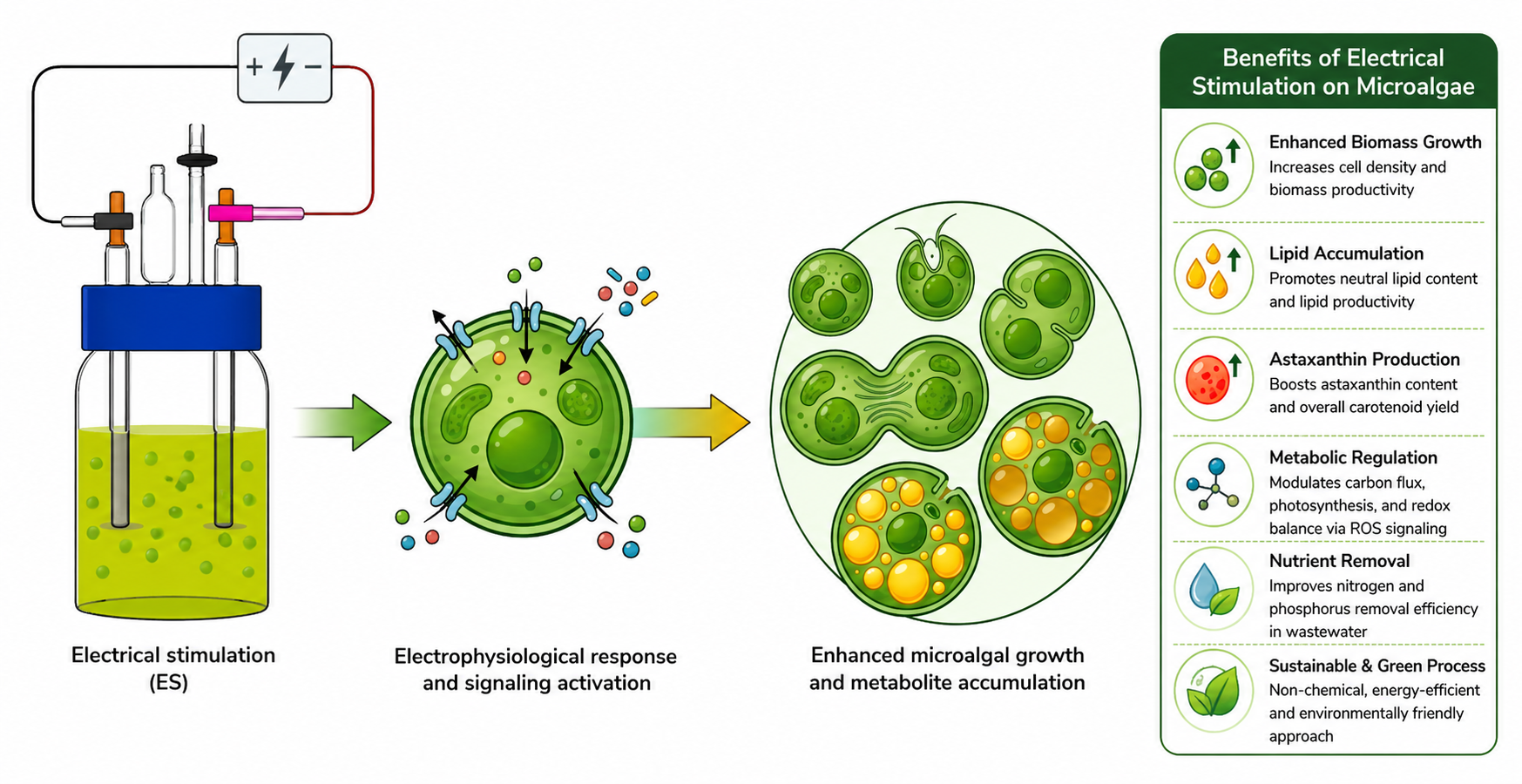
The increasing severity of climate change and global energy insecurity has intensified the demand for sustainable and carbon-neutral biofuel production technologies. Microalgae are considered promising bioresources due to their rapid growth, high photosynthetic efficiency, and exceptional CO2 fixation capability. However, large-scale commercialization remains limited by the metabolic trade-off between biomass growth and metabolite accumulation. Electrical stimulation (ES) has gained wide attention as an emerging strategy for regulating microalgal metabolism through modulation of membrane permeability, electron transport, intracellular redox balance, and reactive oxygen species (ROS)-mediated signaling pathways. This narrative review systematically summarizes recent advances in ES-assisted microalgal systems, focusing on biomass enhancement, lipid accumulation, and astaxanthin biosynthesis. Particular attention is given to the mechanisms by which electrical inputs affect photosynthetic activity, calcium-mediated signaling, intracellular carbon partitioning, and stress-responsive metabolic mechanisms. Overall, ES offers a versatile and environmentally friendly platform to stimulate microalgal growth and metabolite accumulation, supporting the advancement of sustainable microalgae-based biorefineries.
- Open Access
- Review
Electrical Stimulation for Microalgal Growth and High-Value Bioproduct Production: Mechanistic Insights and Emerging Opportunities
- Chi-Kai Wang 1,
- Yun-Jui Tai 1,
- Tzu-Wei Chen 1,
- Po-Yu Chiu 1,
- Adi Kusmayadi 2,
- Yoong Kit Leong 1,3,*
Author Information
Received: 01 May 2026 | Revised: 22 Jun 2026 | Accepted: 26 Jun 2026 | Published: 30 Jun 2026
Abstract
Graphical Abstract
Keywords
sustainable biorefinery | lipid accumulation | astaxanthin biosynthesis | electrophysiology | nanosecond pulsed electric field | reactive oxygen species (ROS)
References
- 1.
Energy Institute. Statistical Review of World Energy. 2025. Available online: https://www.energyinst.org/statistical-review (accessed on 20 March 2026).
- 2.
U.S. Energy Information Administration (EIA). Amid Regional Conflict, the Strait of Hormuz Remains Critical Oil Chokepoint. 2025. Available online: https://www.eia.gov/todayinenergy/detail.php?id=65504 (accessed on 25 April 2026).
- 3.
IPCC (Intergovernmental Panel on Climate Change). Climate Change 2023: Synthesis Report. Available online: https://www.ipcc.ch/report/ar6/syr/ (accessed on 25 April 2026).
- 4.
Kiseleva, S.V.; Chernova, N.I.; Vlaskin, M.S.; et al., Carbon dioxide absorption by microalgae: Analysis of technologies and energy costs. Therm. Eng. 2024, 71, 1038–1048.
- 5.
Kupriyanova, E.V.; Pronina, N.A.; Los, D.A. Adapting from low to high: An update to CO2-concentrating mechanisms of cyanobacteria and microalgae. Plants 2023, 12, 1569.
- 6.
Zhu, T.; Ning, P.; Liu, Y.; et al. Knowledge of microalgal Rubiscos helps to improve photosynthetic efficiency of crops. Planta 2025, 261, 78.
- 7.
Occhipinti, P.S.; Russo, N.; Foti, P.; et al. Current challenges of microalgae applications: Exploiting the potential of non-conventional microalgae species. J. Sci. Food Agric. 2024, 104, 3823–3833.
- 8.
Tahir, F.; Ashfaq, H.; Khan, A.Z.; et al., Emerging trends in algae farming on non-arable lands for resource reclamation, recycling, and mitigation of climate change-driven food security challenges. Rev. Environ. Sci. Biotechnol. 2024, 23, 869–896.
- 9.
Gaurav, K.; Neeti, K.; Singh, R. Microalgae-based biodiesel production and its challenges and future opportunities: A review. Green. Technol. Sustain. 2024, 2, 100060.
- 10.
He, Z.; Jin, W.; Zhou, X.; et al. Enhancing biomass and lipid yield of microalga Scenedesmus obliquus by periodic direct current. J. Water Process Eng. 2022, 48, 102872.
- 11.
Li, H.; Sun, X.; Sun, Y.; et al. Enhancing lipid production in Chlorella under successive stresses of periodic micro-current and salinity: Performance and contribution. Chem. Eng. J. 2024, 486, 150409.
- 12.
Mulgund, A. Increasing lipid accumulation in microalgae through environmental manipulation, metabolic and genetic engineering: A review in the energy NEXUS framework. Energy Nexus 2022, 5, 100054.
- 13.
Kayani, S.-I.; Jin, N.; Cui, Y.; et al. Enhancing biomass productivity towards carbohydrates and fatty acids biosynthesis under the effects of magneto-electric composite fields on filamentous algae. Biomass Bioenergy 2023, 174, 106841.
- 14.
Chuang, C.-E.; Chien, Y.-H.; Lin, S.-Y.; et al. Harnessing stress: Conventional and unconventional strategies for enhancing microalgal productivity in sustainable biorefineries. Green Energy Fuel Res. 2025, 2, 77–92.
- 15.
He, Z.; Jin, W.; Zhou, X.; et al. Improving microalgal growth and nitrogen, and phosphorus removal by electric field in municipal wastewater. Process Saf. Environ. Prot. 2024, 188, 549–558.
- 16.
Chi, Y.; Zhong, Y.; Hu, W.; et al. Influence of continuous and short-term direct current stimulation on the growth and nutrient composition of Nitzschia closterium f. minutissima with prospects for large-scale production. Appl. Sci. 2024, 14, 11127.
- 17.
da Silva, C.S.; Santos, G.M.P.; Conceição, G.R.; et al. Role of low-level alternating current and impedance for enhancing microalgae biomass and lipid production. J. Biosci. Bioeng. 2025, 139, 369–376.
- 18.
Pereira, R.N.; Jaeschke, D.P.; Mercali, G.D. Impact of ultrasound and electric fields on microalgae growth: A comprehensive review. Braz. J. Chem. Eng. 2023, 40, 607–622.
- 19.
Rusyn, I. Innovative strategies to enhance lipid accumulation for algal biodiesel production: Ultrasound treatment, external electrostimulation, and integration of bioelectrochemical systems. Biotechnol. Adv. 2026, 86, 108740.
- 20.
Zhou, Z.; Huang, X.; Sun, D.; et al. A low-voltage alternating electric field strategy against Phaeodactylum tricornutum: Anti-biofouling mechanism under electrical stimulation. Bioelectrochemistry 2026, 169, 109180.
- 21.
Cheng, J.; Xin, K.; Wang, Z.; et al. Improving biomass growth of Nannochloropsis oceanica with electrical treatment. J. CO2 Util. 2022, 58, 101923.
- 22.
Barreiros, M.; Maciel, F.; Pereira, R.S.; et al. Electric fields to support microalgae growth with a differentiated biochemical composition. Innov. Food Sci. Emerg. Technol. 2024, 97, 103829.
- 23.
da Silva, C.S.; Santos, G.M.P.; Conceição, G.R.; et al. Low-current electrostimulation boosts Dunaliella salina growth on hypersaline produced water. Algal Res. 2025, 91, 104315.
- 24.
Nezammahalleh, H.; Ghanati, F.; Adams, T.A.I.I.; et al. Effect of moderate static electric field on the growth and metabolism of Chlorella vulgaris. Bioresour. Technol. 2016, 218, 700–711.
- 25.
Bai, F.; Gusbeth, C.; Frey, W.; et al. Nanosecond pulsed electric fields trigger cell differentiation in Chlamydomonas reinhardtii. Biochim. Biophys. Acta 2017, 1859, 651–661.
- 26.
Buchmann, L.; Frey, W.; Gusbeth, C.; et al. Effect of nanosecond pulsed electric field treatment on cell proliferation of microalgae. Bioresour. Technol. 2017, 244, 402–409.
- 27.
Haberkorn, I.; Buchmann, L.; Hiestand, M.; et al. Continuous nanosecond pulsed electric field treatments foster the upstream performance of Chlorella vulgaris-based biorefinery concepts. Bioresour. Technol. 2019, 293, 122029.
- 28.
La, H.-J.; Choi, G.-G.; Cho, C.; et al. Increased lipid productivity of Acutodesmus dimorphus using optimized pulsed electric field. J. Appl. Phycol. 2015, 28, 1067–1076.
- 29.
Choi, S.-A.; Lee, S.Y.; Lee, J.; et al. Rapid induction of edible lipids in Chlorella by mild electric stimulation. Bioresour. Technol. 2019, 292, 121950.
- 30.
Liu, X.; Xing, D.; Wang, H.; et al. Response mechanisms of bacteria and microalgae to electrical stimulation in electro-assisted bacterial–algal systems for mariculture wastewater treatment. Process Saf. Environ. Prot. 2026, 210, 108735.
- 31.
Kim, J.Y.; Lee, C.; Jeon, M.S.; et al. Enhancement of microalga Haematococcus pluvialis growth and astaxanthin production by electrical treatment. Bioresour. Technol. 2018, 268, 815–819.
- 32.
Fitriana, H.N.; Lee, S.Y.; Choi, S.-A.; et al. Electric stimulation of astaxanthin biosynthesis in Haematococcus pluvialis. Appl. Sci. 2021, 11, 3348.
- 33.
Sathiyavahisan, L.P.; Lakshmi Narasimhan, A.; Mahadi, R.; et al. Rapid induction of astaxanthin in Haematococcus lacustris by mild electric stimulation. Appl. Sci. 2023, 13, 12959.
- 34.
Bai, F.; Gusbeth, C.; Frey, W.; et al. Nanosecond pulsed electric fields modulate the expression of the astaxanthin biosynthesis genes psy, crtR-b and bkt1 in Haematococcus pluvialis. Sci. Rep. 2020, 10, 15508.
- 35.
Lakshmi Narasimhan, A.; Lee, N.; Kim, S.; et al. Enhanced astaxanthin production in Haematococcus lacustris by electrochemical stimulation of cyst germination. Bioresour. Technol. 2024, 411, 131301.

This work is licensed under a Creative Commons Attribution 4.0 International License.

 Suite 4002 Level 4, 447 Collins Street, Melbourne, Victoria 3000, Australia
 General Inquiries: info@sciltp.com