
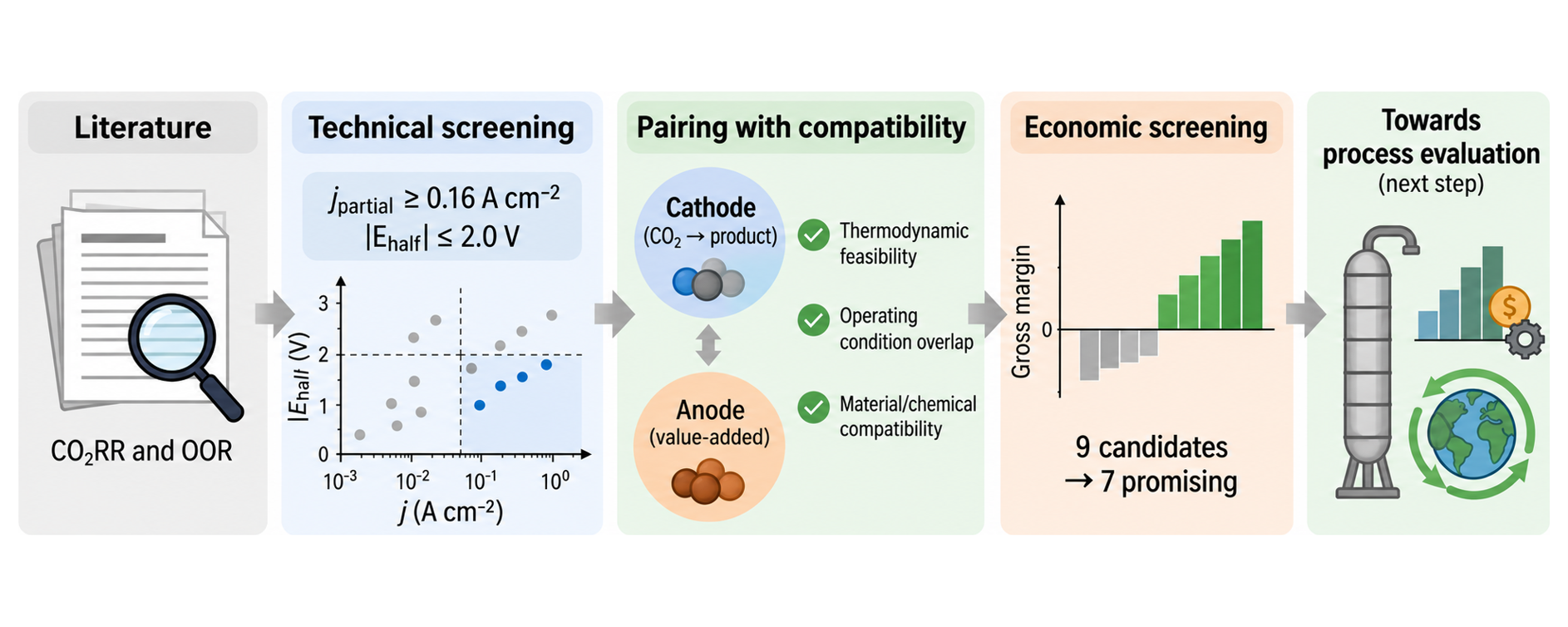
Electrochemical CO2 reduction (ECO2RR) provides a promising route for its conversion into fuels and value-added chemicals using renewable electricity. Recent advancements have explored the integration of cathodic ECO2RR with various anodic organic oxidation reactions (OOR) to enhance economic feasibility and lower operating potentials. However, process-level insights into these integrated systems remain largely unexplored. The numerous potential combinations of ECO2RR and OOR make it impractical to conduct detailed process designs for every pairing. In this paper, we review existing half-reaction experiments and establish a framework to screen for potential integrations of OOR and ECO2RR based on reported technical feasibility and economic margins. From our framework, we have identified seven candidate pairing systems, predominantly demonstrating economic margins ranging from $0.1 to $0.4 per kg of product. In addition, we highlight the practical challenges encountered in downstream processing, particularly the recovery of ionic products from dilute reaction media. Overall, we conclude that co-electrolysis is economically viable when the added value from the anodic reaction provides sufficient margins to offset downstream separation and purification costs (e.g., pairing methanol and glycolic acid production), or when both half-reactions yield identical products (e.g., formate), which significantly simplifies downstream processing.
- Open Access
- Article
Current Potentials and Challenges in Designing Co-Electrolysis Systems for CO2 Conversion
- Kuan-Wen Chen †,
- Ching-Han Lu †,
- Bor-Yih Yu *
Author Information
Received: 02 Jun 2026 | Revised: 04 Aug 2026 | Accepted: 06 Aug 2026 | Published: 12 Aug 2026
Abstract
Graphical Abstract
Keywords
CCUS | electrochemical reduction | coelectrolysis | organic oxidative reaction | process design
References
- 1.
Chiu, H.H.; Yu, B.Y. Synthesis of green light olefins from direct hydrogenation of CO2. Part I: Techno-economic, decarbonization, and sustainability analyses based on rigorous simulation. J. Taiwan. Inst. Chem. E 2024, 156, 105340.
- 2.
Chiu, H.H.; Yu, B.Y. Synthesis of green light olefins from direct hydrogenation of CO2. Part II: Detailed process design and optimization. J. Taiwan Inst. Chem. E 2024, 155, 105287.
- 3.
Lee, M.T.; Chiu, H.H.; Yu, B.Y. Exploration of environmentally friendly processes for converting CO2 into propanol through direct hydrogenation. J. Ind. Eng. Chem. 2025, 143, 271–282.
- 4.
Wu, P.J.; Hsu, C.C.; Yu, B.Y.; et al. Rigorous simulation and comprehensive analysis for the novel glycerol carbonate (GC) production process via indirect conversion of CO2. Fuel 2024, 357, 129831.
- 5.
Huang, T.H.; Chen, Y.S.; Yu, B.Y. Techno-economic, environmental, and exergetic evaluation of a novel isopropyl n-phenylcarbamate production process through non-reductive conversion of CO2. Process Saf. Environ. 2023, 179, 124–136.
- 6.
Su, T.-E.; Chen, Y.-X.; Huang, T.-W.; et al. Current progress, potentials, and challenges for developing photo-assisted CO2 conversion processes. Camb. Prism. Carbon. Technol. 2025, 1, e7.
- 7.
Yin, Z.; Sun, H.; Li, W.; et al. Rational design of photocatalysts for CO2 reduction to multi-carbon products. Nano-Electrochem. Nano-Photochem. 2025, 1, 6.
- 8.
De Luna, P.; Hahn, C.; Higgins, D.; et al. What would it take for renewably powered electrosynthesis to displace petrochemical processes? Science 2019, 364, eaav3506.
- 9.
Zhu, N.; Zhang, X.; Chen, N.; et al. Integration of MnO2 nanosheets with Pd nanoparticles for efficient CO2 electroreduction to methanol in membrane electrode assembly electrolyzers. J. Am. Chem. Soc. 2023, 145, 24852–24861.
- 10.
Hong, J.; Park, K.T.; Kim, Y.E.; et al. Ag/C composite catalysts derived from spray pyrolysis for efficient electrochemical CO2 reduction. Chem. Eng. J. 2022, 431, 133384.
- 11.
Shen, H.; Jin, H.; Li, H.; et al. Acidic CO2-to-HCOOH electrolysis with industrial-level current on phase engineered tin sulfide. Nat. Commun. 2023, 14, 2843.
- 12.
Ding, J.; Yang, H.B.; Ma, X.-L.; et al. A tin-based tandem electrocatalyst for CO2 reduction to ethanol with 80% selectivity. Nat. Energy 2023, 8, 1386–1394.
- 13.
Hauch, A.; Küngas, R.; Blennow, P.; et al. Recent advances in solid oxide cell technology for electrolysis. Science 2020, 370, eaba6118.
- 14.
Wakerley, D.; Lamaison, S.; Wicks, J.; et al. Gas diffusion electrodes, reactor designs and key metrics of low-temperature CO2 electrolysers. Nat. Energy 2022, 7, 130–143.
- 15.
Masel, R.I.; Liu, Z.; Yang, H.; et al. An industrial perspective on catalysts for low-temperature CO2 electrolysis. Nat. Nanotechnol. 2021, 16, 118–128.
- 16.
Shin, H.; Hansen, K.U.; Jiao, F. Techno-economic assessment of low-temperature carbon dioxide electrolysis. Nat. Sustain. 2021, 4, 911–919.
- 17.
Li, X.; Chen, Y.; Zhan, X.; et al. Strategies for enhancing electrochemical CO2 reduction to multi-carbon fuels on copper. Innov. Mater. 2023, 1, 100014.
- 18.
Duanmu, J.-W.; Yang, X.-P.; Gao, F.-Y.; et al. Progress of mechanistic pathways involved in electrochemical CO2 reduction. J. Energy Chem. 2025, 102, 745–767.
- 19.
Xie, L.; Liu, Y.; Li, S.; et al. Phase and facet engineering for nanoscale catalyst discovery in electrochemical CO2 reduction. Nat. Synth. 2026, 5, 489–505.
- 20.
Verma, S.; Lu, S.; Kenis, P.J. Co-electrolysis of CO2 and glycerol as a pathway to carbon chemicals with improved technoeconomics due to low electricity consumption. Nat. Energy 2019, 4, 466–474.
- 21.
Liu, W.-J.; Dang, L.; Xu, Z.; et al. Electrochemical oxidation of 5-hydroxymethylfurfural with NiFe layered double hydroxide (LDH) nanosheet catalysts. ACS Catal. 2018, 8, 5533–5541.
- 22.
Ma, D.; Jin, T.; Xie, K.; et al. An overview of flow cell architecture design and optimization for electrochemical CO2 reduction. J. Mater. Chem. A 2021, 9, 20897–20918.
- 23.
Chen, H.; Ding, C.; Kang, C.; et al. The design of alternative anodic reactions paired with electrochemical CO2 reduction. Green. Chem. 2023, 25, 5320–5337.
- 24.
Li, D.; Yang, J.; Lian, J.; et al. Recent advances in paired electrolysis coupling CO2 reduction with alternative oxidation reactions. J. Energy Chem. 2023, 77, 406–419.
- 25.
Xu, Z.; Peng, C.; Zheng, G. Coupling value-added anodic reactions with electrocatalytic CO2 reduction. Chem. –A Eur. J. 2023, 29, e202203147.
- 26.
Li, Y.; Lu, T.-B. Coupling electrochemical CO2 reduction with value-added anodic oxidation reactions: Progress and challenges. Mater. Chem. Front. 2024, 8, 341–353.
- 27.
Zhai, Y.; Wang, C.; Chen, Z. System design in CO2 electrolysis: Integrating value-added anode reactions with cathodic reduction. Molecules 2025, 30, 4485.
- 28.
Jiang, C.; Zhang, Z.; Deuss, P.J.; et al. CO2 electroreduction coupled with the electrooxidation of alcohols and sugars to formate: Review and evaluation. ChemSusChem 2025, 18, e202500478.
- 29.
Na, J.; Seo, B.; Kim, J.; et al. General technoeconomic analysis for electrochemical coproduction coupling carbon dioxide reduction with organic oxidation. Nat. Commun. 2019, 10, 5193.
- 30.
Sun, X.; Wang, L.; Lan, X.; et al. Positively charged nickel-sulfur dual sites for efficient CO2 electroreduction reaction. Appl. Catal. B Environ. 2024, 342, 123389.
- 31.
Guo, J.; Zhang, W.; Zhang, L.-H.; et al. Control over electrochemical CO2 reduction selectivity by coordination engineering of tin single-atom catalysts. Adv. Sci. 2021, 8, 2102884.
- 32.
Li, H.; Cao, S.; Sun, H.; et al. CuNCN derived Cu-based/CxNᵧ catalysts for highly selective CO2 electroreduction to hydrocarbons. Appl. Catal. B Environ. 2023, 320, 121948.
- 33.
Han, L.; Song, S.; Liu, M.; et al. Stable and Efficient Single-Atom Zn Catalyst for CO2 Reduction to CH4. J. Am. Chem. Soc. 2020, 142, 12563–12567.
- 34.
De Gregorio, G.L.; Burdyny, T.; Loiudice, A.; et al. Facet-dependent selectivity of Cu catalysts in electrochemical CO2 reduction at commercially viable current densities. ACS Catal. 2020, 10, 4854–4862.
- 35.
Zhang, G.; Wang, T.; Zhang, M.; et al. Selective CO2 electroreduction to methanol via enhanced oxygen bonding. Nat. Commun. 2022, 13, 7768.
- 36.
Wang, T.; Chen, J.; Ren, X.; et al. Halogen-incorporated Sn catalysts for selective electrochemical CO2 reduction to formate. Angew. Chem. Int. Ed. 2023, 62, e202211174.
- 37.
Chen, M.; Wan, S.; Zhong, L.; et al. Dynamic restructuring of Cu-Doped SnS2 Nanoflowers for highly selective electrochemical CO2 reduction to formate. Angew. Chem. Int. Ed. Engl. 2021, 60, 26233–26237.
- 38.
Zheng, X.; De Luna, P.; García de Arquer, F.P.; et al. Sulfur-modulated tin sites enable highly selective electrochemical reduction of CO2 to formate. Joule 2017, 1, 794–805.
- 39.
Liang, C.; Kim, B.; Yang, S.; et al. High efficiency electrochemical reduction of CO2 beyond the two-electron transfer pathway on grain boundary rich ultra-small SnO2 nanoparticles. J. Mater. Chem. A 2018, 6, 10313–10319.
- 40.
Luo, W.; Xie, W.; Li, M.; et al. 3D hierarchical porous indium catalyst for highly efficient electroreduction of CO2. J. Mater. Chem. A 2019, 7, 4505–4515.
- 41.
Gong, Q.; Ding, P.; Xu, M.; et al. Structural defects on converted bismuth oxide nanotubes enable highly active electrocatalysis of carbon dioxide reduction. Nat. Commun. 2019, 10, 2807.
- 42.
Chen, C.; Shen, S.; Wang, J.; et al. Construction of a self-supporting bifunctional Sn–SnSₓ electrocatalyst via one-step electrodeposition for formate production from coupled CO2 reduction and glucose oxidation. Green. Chem. 2024, 26, 9888–9898.
- 43.
He, S.; Ni, F.; Ji, Y.; et al. The p-orbital delocalization of main-group metals to boost CO2 electroreduction. Angew. Chem. Int. Ed. 2018, 57, 16114–16119.
- 44.
Wang, H.; Matios, E.; Wang, C.; et al. Rapid and scalable synthesis of cuprous halide-derived copper nano-architectures for selective electrochemical reduction of carbon dioxide. Nano Lett. 2019, 19, 3925–3932.
- 45.
Li, M.; Song, N.; Luo, W.; et al. Engineering surface oxophilicity of copper for electrochemical CO2 reduction to ethanol. Adv. Sci. 2023, 10, e2204579.
- 46.
Wang, X.; Jiang, Z.; Wang, P.; et al. Ag⁺-Doped InSe nanosheets for membrane electrode assembly electrolyzer toward large-current electroreduction of CO2 to ethanol. Angew. Chem. 2023, 135, e202313646.
- 47.
Gao, J.; Bahmanpour, A.; Kröcher, O.; et al. Electrochemical synthesis of propylene from carbon dioxide on copper nanocrystals. Nat. Chem. 2023, 15, 705–713.
- 48.
Fuku, K.; Miyase, Y.; Miseki, Y.; et al. Enhanced oxidative hydrogen peroxide production on conducting glass anodes modified with metal oxides. ChemistrySelect 2016, 1, 5721–5726.
- 49.
Liu, Y.; Zhao, S.-F.; Guo, S.-X.; et al. Electrooxidation of ethanol and methanol using the molecular catalyst [{Ru4O4 (OH)2 (H2O)4}(γ-SiW10O36)2]10⁻. J. Am. Chem. Soc. 2016, 138, 2617–2628.
- 50.
Li, M.; Deng, X.; Xiang, K.; et al. Value-added formate production from selective methanol oxidation as anodic reaction to enhance electrochemical hydrogen cogeneration. ChemSusChem 2020, 13, 914–921.
- 51.
Hao, Y.; Yu, D.; Zhu, S.; et al. Methanol upgrading coupled with hydrogen product at large current density promoted by strong interfacial interactions. Energy Environ. Sci. 2023, 16, 1100–1110.
- 52.
Zhang, Y.; Han, Z.; Dong, B.; et al. A novel and effective strategy for electro-oxidation of ethanol to acetaldehyde. Catal. Commun. 2016, 86, 119–123.
- 53.
Chen, G.-F.; Luo, Y.; Ding, L.-X.; et al. Low-voltage electrolytic hydrogen production derived from efficient water and ethanol oxidation on fluorine-modified FeOOH anode. ACS Catal. 2018, 8, 526–530.
- 54.
Dai, L.; Qin, Q.; Zhao, X.; et al. Electrochemical partial reforming of ethanol into ethyl acetate using ultrathin Co3O4 nanosheets as a highly selective anode catalyst. ACS Cent. Sci. 2016, 2, 538–544.
- 55.
Liu, Y.; Wang, L.; Zhang, Y.; et al. From ethylene glycol to glycolic acid: Electrocatalytic conversion on Pt-group metal surfaces. Inorg. Chem. 2024, 63, 14794–14803.
- 56.
Matsumoto, T.; Sadakiyo, M.; Ooi, M.L.; et al. CO2-free power generation on an iron group nanoalloy catalyst via selective oxidation of ethylene glycol in alkaline media. Sci. Rep. 2014, 4, 5620.
- 57.
Yan, Y.; Fu, Y.; Yang, J.; et al. Electrocatalytic upcycling of polyethylene terephthalate waste to biodegradable polymer coupled with hydrogen production at ampere-level current density. CCS Chem. 2026, 8, 974–988.
- 58.
Wu, T.; Zhu, X.; Wang, G.; et al. Vapor-phase hydrothermal growth of single crystalline NiS2 nanostructure film on carbon fiber cloth for electrocatalytic oxidation of alcohols to ketones and simultaneous H2 evolution. Nano Res. 2018, 11, 1004–1017.
- 59.
Dai, C.; Sun, L.; Liao, H.; et al. Electrochemical production of lactic acid from glycerol oxidation catalyzed by AuPt nanoparticles. J. Catal. 2017, 356, 14–21.
- 60.
Mahmoudian, J.; Bellini, M.; Pagliaro, M.V.; et al. Electrochemical coproduction of acrylate and hydrogen from 1,3-propandiol. ACS Sustain. Chem. Eng. 2017, 5, 6090–6098.
- 61.
Chadderdon, D.J.; Xin, L.; Qi, J.; et al. Selective oxidation of 1,2-propanediol in alkaline anion-exchange membrane electrocatalytic flow reactors: Experimental and DFT investigations. ACS Catal. 2015, 5, 6926–6936.
- 62.
Zheng, J.; Chen, X.; Zhong, X.; et al. Hierarchical porous NC@ CuCo nitride nanosheet networks: Highly efficient bifunctional electrocatalyst for overall water splitting and selective electrooxidation of benzyl alcohol. Adv. Funct. Mater. 2017, 27, 1704169.
- 63.
You, B.; Liu, X.; Liu, X.; et al. Efficient H2 evolution coupled with oxidative refining of alcohols via a hierarchically porous nickel bifunctional electrocatalyst. Acs Catal. 2017, 7, 4564–4570.
- 64.
Jiang, N.; Liu, X.; Dong, J.; et al. Electrocatalysis of furfural oxidation coupled with H2 evolution via nickel-based electrocatalysts in water. ChemNanoMat 2017, 3, 491–495.
- 65.
Xia, H.; Xiang, D.; Liu, F.; et al. Boosting cathodic hydrogen evolution with furfuryl alcohol oxidation as the anodic half-reaction for hybrid water splitting. Electrochim. Acta 2023, 441, 141736.
- 66.
Chen, D.; Yang, S.; Gao, J.; et al. Electrochemical co-upgrading CO2 and glycerol for selective formate production with 190% overall Faradaic efficiency. Nano Res. 2025, 18, 94907399.
- 67.
Li, X.; Gao, K.; Qu, M.; et al. Membrane-free CO2 electrolyzer design for economically efficient formic acid electro-synthesis. Nat. Commun. 2025, 16, 9237.
- 68.
Le, T.H.H.; Zuo, Y.; Chatti, M.; et al. Coupling of CuO@ NiBiOₓ catalyzed glycerol oxidation to carbon dioxide reduction reaction for enhanced energy efficiency. Angew. Chem. 2025, 64, e202502617.
- 69.
Lu, C.; Yang, S.; Shi, P.; et al. Integrated electrochemical biomass oxidation and CO2 reduction over ultra-wide potential window. Angew. Chem. 2025, 137, e202502846.
- 70.
Liu, S.-Q.; Gao, M.-R.; Wu, S.; et al. A coupled electrocatalytic system with reduced energy input for CO2 reduction and biomass valorization. Energy Environ. Sci. 2023, 16, 5305–5314.
- 71.
Zhang, Z.; Liu, S.; Wu, Z.; et al. High efficiency coupled electrocatalytic CO2 reduction to C2H4 with 5-hydroxymethylfurfural oxidation over Cu-based nanoflower electrocatalysts. Green. Chem. 2023, 25, 5404–5415.
- 72.
Zhou, Y.; Wang, Z.; Fang, W.; et al. Modulating O–H activation of methanol oxidation on nickel-organic frameworks for overall CO2 electrolysis. ACS Catal. 2023, 13, 2039–2046.
- 73.
Kang, C.; Li, Y.; Xu, Y.; et al. Coupling CO2-to-ethylene reduction with the chlor-alkaline process in seawater through in situ-formed Cu catalysts. J. Phys. Chem. Lett. 2023, 14, 2983–2989.
- 74.
Yu, X.; Rabiee, H.; Dutta, A.; et al. Upcycling CO2 and PET waste: Ampere-level formate electrosynthesis in an integrated electrolyzer. J. Am. Chem. Soc. 2025, 147, 41481–41491.
- 75.
Pei, Y.; Pi, Z.; Zhong, H.; et al. Glycerol oxidation-assisted electrochemical CO2 reduction for the dual production of formate. J. Mater. Chem. A 2022, 10, 1309–1319.
- 76.
Wang, X.; Li, P.; Tam, J.; et al. Efficient CO and acrolein coproduction via paired electrolysis. ECS Meet. Abstr. 2024, 7, 931–937.
- 77.
Zhang, M.; Liao, J.-P.; Li, R.-H.; et al. Green synthesis of bifunctional phthalocyanine-porphyrin COFs in water for efficient electrocatalytic CO2 reduction coupled with methanol oxidation. Natl. Sci. Rev. 2023, 10, nwad226.
- 78.
Vehrenberg, J.; Baessler, J.; Decker, A.; et al. Paired electrochemical synthesis of formate via oxidation of glycerol and reduction of CO2 in a flow cell reactor. Electrochem. Commun. 2023, 151, 107497.
- 79.
Segets, D.; Andronescu, C.; Apfel, U.-P. Accelerating CO2 electrochemical conversion towards industrial implementation. Nat. Commun. 2023, 14, 7950.
- 80.
Ozden, A.; Li, J.; Kandambeth, S.; et al. Energy-and carbon-efficient CO2/CO electrolysis to multicarbon products via asymmetric ion migration–adsorption. Nat. Energy 2023, 8, 179–190.
- 81.
Siegmund, D.; Metz, S.; Peinecke, V.; et al. Crossing the valley of death: From fundamental to applied research in electrolysis. Jacs Au 2021, 1, 527–535.
- 82.
Ko, B.H.; Hasa, B.; Shin, H.; et al. The impact of nitrogen oxides on electrochemical carbon dioxide reduction. Nat. Commun. 2020, 11, 5856.
- 83.
Xu, Y.; Edwards, J.P.; Zhong, J.; et al. Oxygen-tolerant electroproduction of C2 products from simulated flue gas. Energy Environ. Sci. 2020, 13, 554–561.
- 84.
Lu, C.-H.; Chen, T.-L.; Chen, K.-W.; et al. From electrons to formic acid: rigorous process synthesis and sustainability assessment of a fully integrated electrochemical CO2 valorization system. ACS Sustain. Chem. Eng. 2026, 14, 13457–13471.
- 85.
Li, Y.C.; Yan, Z.; Hitt, J.; et al. Bipolar membranes inhibit product crossover in CO2 electrolysis cells. Adv. Sustain. Syst. 2018, 2, 1700187.
- 86.
Wang, Z.; Yan, J.; Wang, H.; et al. Separation and conversion of CO2 reduction products into high-concentration formic acid using bipolar membrane electrodialysis. J. Membr. Sci. 2024, 708, 123016.
- 87.
Chien, I.L.; Yu, B.-Y.; Ai, Z.J. Chapter 15—Design of Azeotropic Distillation Systems. In Chemical Engineering Process Simulation; Elsevier: Amsterdam, The Netherlands, 2017; pp. 355–385.
- 88.
Yu, B.-Y.; Huang, R.; Zhong, X.-Y.; et al. Energy-efficient extraction–distillation process for separating diluted acetonitrile–water mixture: Rigorous design with experimental verification from ternary liquid–liquid equilibrium Data. Ind. Eng. Chem. Res. 2017, 56, 15112–15121.
- 89.
Yu, B.-Y.; Chien, I.L. Novel temperature-control strategy for single column side-stream extractive distillation process with intermediate-boiling entrainer. Sep. Purif. Technol. 2023, 310, 123163.
- 90.
Hori, Y.; Kikuchi, K.; Suzuki, S. Production of CO and CH4 in electrochemical reduction of CO2 at metal electrodes in aqueous hydrogencarbonate solution. Chem. Lett. 1985, 14, 1695–1698.
- 91.
Royer, M. Réduction de l’acide carbonique en acide formique. Compt. Rend. 1870, 1870, 731–732.
- 92.
Bevilacqua, M.; Filippi, J.; Lavacchi, A.; et al. Energy savings in the conversion of CO2 to fuels using an electrolytic device. Energy Technol. 2014, 2, 522–525.
- 93.
Li, T.; Cao, Y.; He, J.; et al. Electrolytic CO2 reduction in tandem with oxidative organic chemistry. ACS Cent. Sci. 2017, 3, 778–783.
- 94.
Wang, G.; Chen, J.; Li, K.; et al. Cost-effective and durable electrocatalysts for Co-electrolysis of CO2 conversion and glycerol upgrading. Nano Energy 2022, 92, 106751.
- 95.
Xie, K.; Ozden, A.; Miao, R.K.; et al. Eliminating the need for anodic gas separation in CO2 electroreduction systems via liquid-to-liquid anodic upgrading. Nat. Commun. 2022, 13, 3070.
- 96.
Liu, S.; Tian, B.; Xu, X.; et al. Ampere-level electrolytic coproduction of formate with coupled carbon dioxide reduction and selective methanol oxidation. ACS Catal. 2024, 14, 9476–9486.
- 97.
Lin, J.; Chi, H.; Liu, H.; et al. Concentrated formate produced through co-electrolysis of CO2 and methanol in a zero-gap electrolyzer. AIChE J. 2024, 70, e18382.
- 98.
Zhang, H.; Bo, Z.; Wang, M.; et al. Copper-stabilized bismuth subcarbonate electrocatalysts for durable large-scale formate production at kilowatt power. Nat. Commun. 2025, 17, 577.


This work is licensed under a Creative Commons Attribution 4.0 International License.

 Suite 4002 Level 4, 447 Collins Street, Melbourne, Victoria 3000, Australia
 General Inquiries: info@sciltp.com