
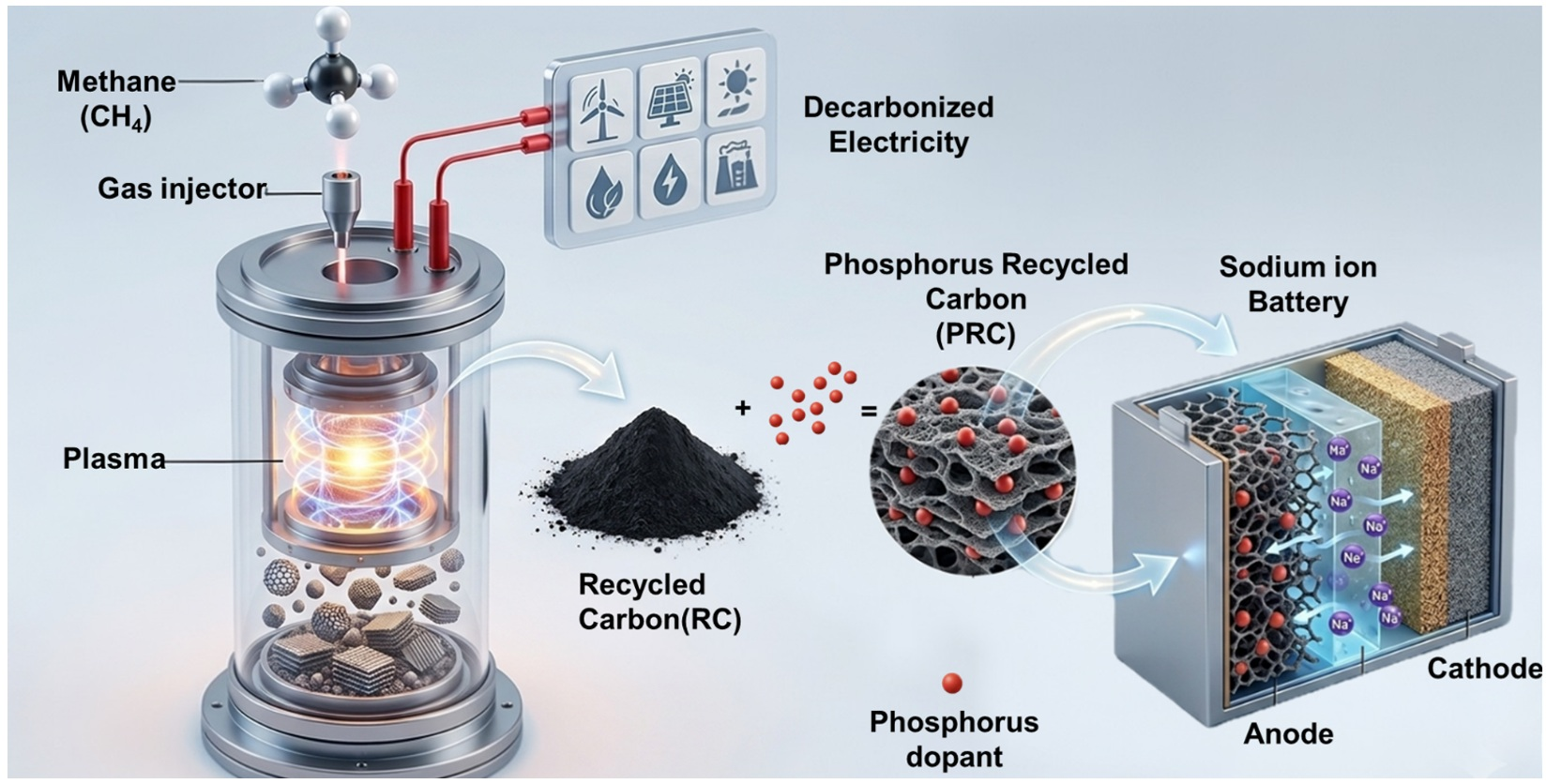
High-capacity and sustainable anode materials are critical for the commercial advancement of sodium-ion batteries (SIBs). In this study, red phosphorus was integrated into a carbon framework using high-energy ball milling to create a phosphorus-doped recovered carbon (PRC) composite. Structural characterization through HRTEM and XRD confirms that phosphorus incorporation induces a significant lattice expansion (d002 = 0.358 nm), providing widened pathways for sodium-ion (Na+) transport. Electrochemical evaluations reveal that the PRC anode has an outstanding reversible capacity of 250 mAh/g at 0.1 A/g and sustains around 100 mAh/g at a high current density of 5.0 A/g, significantly outperforming the pristine recovered carbon (55 mAh/g). Kinetic analysis using the Randles-Sevcik equation indicates an order-of-magnitude boost in the diffusion coefficient 3.5 × 10⁻¹³ cm2/s compared to the undoped precursor. Furthermore, b-value analysis demonstrates that the superior rate capability is driven by dominant pseudocapacitive charge storage and enhanced structural stability over 200 cycles. These findings underscore the potential of heteroatom-doped recovered carbon as a robust, low-cost platform for high-power density SIBs.
- Open Access
- Article
Electrochemical Modification of Methane Plasma-Derived Recovered Carbon by Phosphorus Doping as an Anode Material for Sodium-Ion Batteries
- Sanjay Babu 1,
- Yu-Hsuan Li 1,
- Wei-Ren Liu 1,2,3,*
Author Information
Received: 04 Jul 2026 | Revised: 09 Sep 2026 | Accepted: 18 Sep 2026 | Published: 28 Sep 2026
Abstract
Graphical Abstract
Keywords
Na-ion batteries | anode | phosphorus doping | plasma | recovered carbon
References
- 1.
Mashfy, M.M.; Alvy, T.A.; Hossain, N.; et al. Sodium ion batteries: A sustainable alternative to lithium-ion batteries with an overview of market trends, recycling, and battery chemistry. Next Energy 2026, 10, 100478. https://doi.org/10.1016/j.nxener.2025.100478.
- 2.
Staples, M.D.; Malina, R.; Barrett, S.R.H. The limits of bioenergy for mitigating global life-cycle greenhouse gas emissions from fossil fuels. Nat. Energy 2017, 2, 16202. https://doi.org/10.1038/nenergy.2016.202.
- 3.
Yang, Y.; Bremner, S.; Menictas, C.; et al. Battery energy storage system size determination in renewable energy systems: A review. Renew. Sustain. Energy Rev. 2018, 91, 109–125. https://doi.org/10.1016/j.rser.2018.03.047.
- 4.
Goodenough, J.B. Electrochemical energy storage in a sustainable modern society. Energy Environ. Sci. 2014, 7, 14–18. https://doi.org/10.1039/c3ee42613k.
- 5.
Zhang, D.; Zhang, H.; Gao, F.; et al. Dual activation for tuning N, S Co‐doping in porous carbon sheets toward superior sodium ion storage. Small 2024, 20, e2308684. https://doi.org/10.1002/smll.202308684.
- 6.
Darwiche, A.; Marino, C.; Sougrati, M.T.; et al. Better cycling performances of bulk Sb in Na-ion batteries compared to Li-ion systems: An unexpected electrochemical mechanism. J. Am. Chem. Soc. 2012, 134, 20805–20811. https://doi.org/10.1021/ja310347x.
- 7.
Jeon, I.; Yang, D.; Yadav, D.; et al. Sodium storage behavior and long cycle stability of boron-doped carbon nanofibers for sodium-ion battery anodes. Electrochim. Acta 2023, 439, 141730. https://doi.org/10.1016/j.electacta.2022.141730.
- 8.
Guo, H.Y.; Li, Y.Y.; Wang, C.L.; et al. Effect of the air oxidation stabilization of pitch on the microstructure and sodium storage of hard carbons. New Carbon Mater. 2021, 36, 1073–1078. https://doi.org/10.1016/s1872-5805(21)60075-6.
- 9.
Eren, E.O.; Senokos, E.; Scoppola, E.; et al. An enhanced three-stage model for sodium storage in hard carbons. Energy Environ. Sci. 2025, 18, 7859–7868. https://doi.org/10.1039/d4ee06029f.
- 10.
Shao, W.; Shi, H.; Jian, X.; et al. Hard‐carbon anodes for sodium‐ion batteries: Recent status and challenging perspectives. Adv. Energy Sustain. Res. 2022, 3, 2200009. https://doi.org/10.1002/aesr.202200009.
- 11.
Qian, J.; Wu, X.; Cao, Y.; et al. High capacity and rate capability of amorphous phosphorus for sodium ion batteries. Angew. Chem. Int. Ed. 2013, 52, 4633–4636. https://doi.org/10.1002/anie.201209689.
- 12.
Kim, Y.; Park, Y.; Choi, A.; et al. An amorphous red phosphorus/carbon composite as a promising anode material for sodium ion batteries. Adv. Mater. 2013, 25, 3045–3049. https://doi.org/10.1002/adma.201204877.
- 13.
Fang, L.; Bahlawane, N.; Sun, W.; et al. Conversion‐alloying anode materials for sodium ion batteries. Small 2021, 17, 2101137. https://doi.org/10.1002/smll.202101137.
- 14.
Hashmi, S.A. Hard carbon anode derived from pre-treated bio-waste sugarcane bagasse for high capacity sodium-ion battery fabricated with bio-deFgradable porous polymer electrolyte. J. Energy Storage 2024, 83, 110694. https://doi.org/10.1016/j.est.2024.110694.
- 15.
Chen, Y.; Li, F.; Guo, Z.; et al. Sustainable and scalable fabrication of high-performance hard carbon anode for Na-ion battery. J. Power Sources 2023, 557, 232534. https://doi.org/10.1016/j.jpowsour.2022.232534.
- 16.
Moon, H.; Innocenti, A.; Liu, H.; et al. Bio‐waste‐derived hard carbon anodes through a sustainable and cost‐effective synthesis process for sodium‐ion batteries. ChemSusChem 2023, 16, e202201713. https://doi.org/10.1002/cssc.202201713.
- 17.
Babu, S.; Chi, H.W.; Babu, S.K.; et al. Temperature effects on hard carbon derived from bio-frass as anode materials for Sodium ion batteries. Mater. Res. Bull. 2026, 199, 114069. https://doi.org/10.1016/j.materresbull.2026.114069.
- 18.
Stevens, D.A.; Dahn, J.R. High capacity anode materials for rechargeable sodium‐ion batteries. J. Electrochem. Soc. 2000, 147, 1271. https://doi.org/10.1149/1.1393348.
- 19.
Samanta, R.; Roy, S.; Barman, S. Sulfur and nitrogen codoped hard carbon with expanded interlayer distance as an effective anode material for sodium-ion batteries. Energy Fuels 2024, 38, 19867–19877. https://doi.org/10.1021/acs.energyfuels.4c03258.
- 20.
Ramireddy, T.; Xing, T.; Rahman, M.M.; et al. Phosphorus–carbon nanocomposite anodes for lithium-ion and sodium-ion batteries. J. Mater. Chem. A 2015, 3, 5572–5584. https://doi.org/10.1039/c4ta06186a.
- 21.
Liang, P.; Huo, Z.; Liu, Y.; et al. Biomass‐Derived Phosphorus‐Doped Porous Hard Carbon Anode for Stable and High‐Rate Sodium Ion Batteries. Batter. Supercaps 2025, 8, e202400694. https://doi.org/10.1002/batt.202400694.
- 22.
Liu, B.; Song, T.; Chen, L.; et al. Sustainable Recovery and Reuse of Hard Carbon From Scrap and End‐of‐Life Sodium‐Ion Batteries. Adv. Energy Mater. 2025, 15, 2405894. https://doi.org/10.1002/aenm.202405894.
- 23.
Fulcheri, L.; Dames, E.; Rohani, V. Plasma-based conversion of methane into hydrogen and carbon black. Curr. Opin. Green Sustain. Chem. 2024, 50, 100973. https://doi.org/10.1016/j.cogsc.2024.100973.
- 24.
Wu, F.; Dong, R.; Bai, Y.; et al. Phosphorus-doped hard carbon nanofibers prepared by electrospinning as an anode in sodium-ion batteries. ACS Appl. Mater. Interfaces 2018, 10, 21335–21342.
- 25.
Katsuyama, Y.; Nakayasu, Y.; Kobayashi, H.; et al. Rational Route for Increasing Intercalation Capacity of Hard Carbons as Sodium‐Ion Battery Anodes. ChemSusChem 2020, 13, 5762–5768. https://doi.org/10.1002/cssc.202001837.
- 26.
Li, K.; Rimmer, S.M.; Liu, Q.; et al. Micro-Raman spectroscopy of microscopically distinguishable components of naturally graphitized coals from central Hunan Province, China. Energy Fuels 2019, 33, 1037–1048. https://doi.org/10.1021/acs.energyfuels.8b04065.
- 27.
He, Q.; Ding, L.; Raheem, A.; et al. Kinetics comparison and insight into structure-performance correlation for leached biochar gasification. Chem. Eng. J. 2021, 417, 129331. https://doi.org/10.1016/j.cej.2021.129331.
- 28.
Zhang, Y.; Huang, Y.; Wang, X.; et al. Improved electrochemical performance of lithium iron phosphate in situ coated with hierarchical porous nitrogen-doped graphene-like membrane. J. Power Sources 2016, 305, 122–127. https://doi.org/10.1016/j.jpowsour.2015.11.092.
- 29.
Singh, A.S.; Advani, J.H.; Biradar, A.V. Phosphonate functionalized carbon spheres as Brønsted acid catalysts for the valorization of bio-renewable α-pinene oxide to trans-carveol. Dalton Trans. 2020, 49, 7210–7217. https://doi.org/10.1039/d0dt00921k.
- 30.
Wang, H.; Liu, S.; Lei, C.; et al. P-doped hard carbon material for anode of sodium ion battery was prepared by using polyphosphoric acid modified petroleum asphalt as precursor. Electrochim. Acta 2024, 477, 143812. https://doi.org/10.1016/j.electacta.2024.143812.
- 31.
Wang, X.; Hou, M.; Shi, Z.; et al. Regulate phosphorus configuration in high P-doped hard carbon as a superanode for sodium storage. ACS Appl. Mater. Interfaces 2021, 13, 12059–12068. https://doi.org/10.1021/acsami.0c23165.
- 32.
Augustyn, V.; Come, J.; Lowe, M.A.; et al. High-rate electrochemical energy storage through Li+ intercalation pseudocapacitance. Nat. Mater. 2013, 12, 518–522. https://doi.org/10.1038/nmat3601.
- 33.
Sun, W.; Sun, Q.; Lu, R.; et al. Sodium hypophosphite-assist pyrolysis of coal pitch to synthesis P-doped carbon nanosheet anode for ultrafast and long-term cycling sodium-ion batteries. J. Alloys Compd. 2021, 889, 161678. https://doi.org/10.1016/j.jallcom.2021.161678.
- 34.
Yan, J.; Li, H.; Wang, K.; et al. Ultrahigh phosphorus doping of carbon for high‐rate sodium ion batteries anode. Adv. Energy Mater. 2021, 11, 2003911. https://doi.org/10.1002/aenm.202003911.
- 35.
Li, N.; Yang, Q.; Wei, Y.; et al. Phosphorus-doped hard carbon with controlled active groups and microstructure for high-performance sodium-ion batteries. J. Mater. Chem. A 2020, 8, 20486–20492. https://doi.org/10.1039/d0ta06910h.
- 36.
Li, Y.; Yuan, Y.; Bai, Y.; et al. Insights into the Na+Storage Mechanism of Phosphorus‐Functionalized Hard Carbon as Ultrahigh Capacity Anodes. Adv. Energy Mater. 2018, 8, 1702781. https://doi.org/10.1002/aenm.201702781.
- 37.
Shim, J.W.; Park, S.J.; Ryu, S.K. Effect of modification with HNO3 and NaOH on metal adsorption by pitch-based activated carbon fibers. Carbon 2001, 39, 1635–1642. https://doi.org/10.1016/s0008-6223(00)00290-6.
- 38.
Wang, Z.; Qie, L.; Yuan, L.; et al. Functionalized N-doped interconnected carbon nanofibers as an anode material for sodium-ion storage with excellent performance. Carbon 2013, 55, 328–334. https://doi.org/10.1016/j.carbon.2012.12.072.
- 39.
Fu, L.; Tang, K.; Song, K.; et al. Nitrogen doped porous carbon fibres as anode materials for sodium ion batteries with excellent rate performance. Nanoscale 2014, 6, 1384–1389. https://doi.org/10.1039/c3nr05374a.
- 40.
Hulicova‐Jurcakova, D.; Seredych, M.; Lu, G.Q.; et al. Combined Effect of Nitrogen‐ and Oxygen‐Containing Functional Groups of Microporous Activated Carbon on its Electrochemical Performance in Supercapacitors. Adv. Funct. Mater. 2009, 19, 438–447. https://doi.org/10.1002/adfm.200801236.
- 41.
Wang, Z.; Li, Y.; Lv, X.J. N-doped ordered mesoporous carbon as a high performance anode material in sodium ion batteries at room temperature. RSC Adv. 2014, 4, 62673–62677. https://doi.org/10.1039/c4ra09084e.
- 42.
Hou, H.; Shao, L.; Zhang, Y.; et al. Large‐area carbon nanosheets doped with phosphorus: A high‐performance anode material for sodium‐ion batteries. Adv. Sci. 2017, 4, 1600243. https://doi.org/10.1002/advs.201600243.


This work is licensed under a Creative Commons Attribution 4.0 International License.

 Suite 4002 Level 4, 447 Collins Street, Melbourne, Victoria 3000, Australia
 General Inquiries: info@sciltp.com