
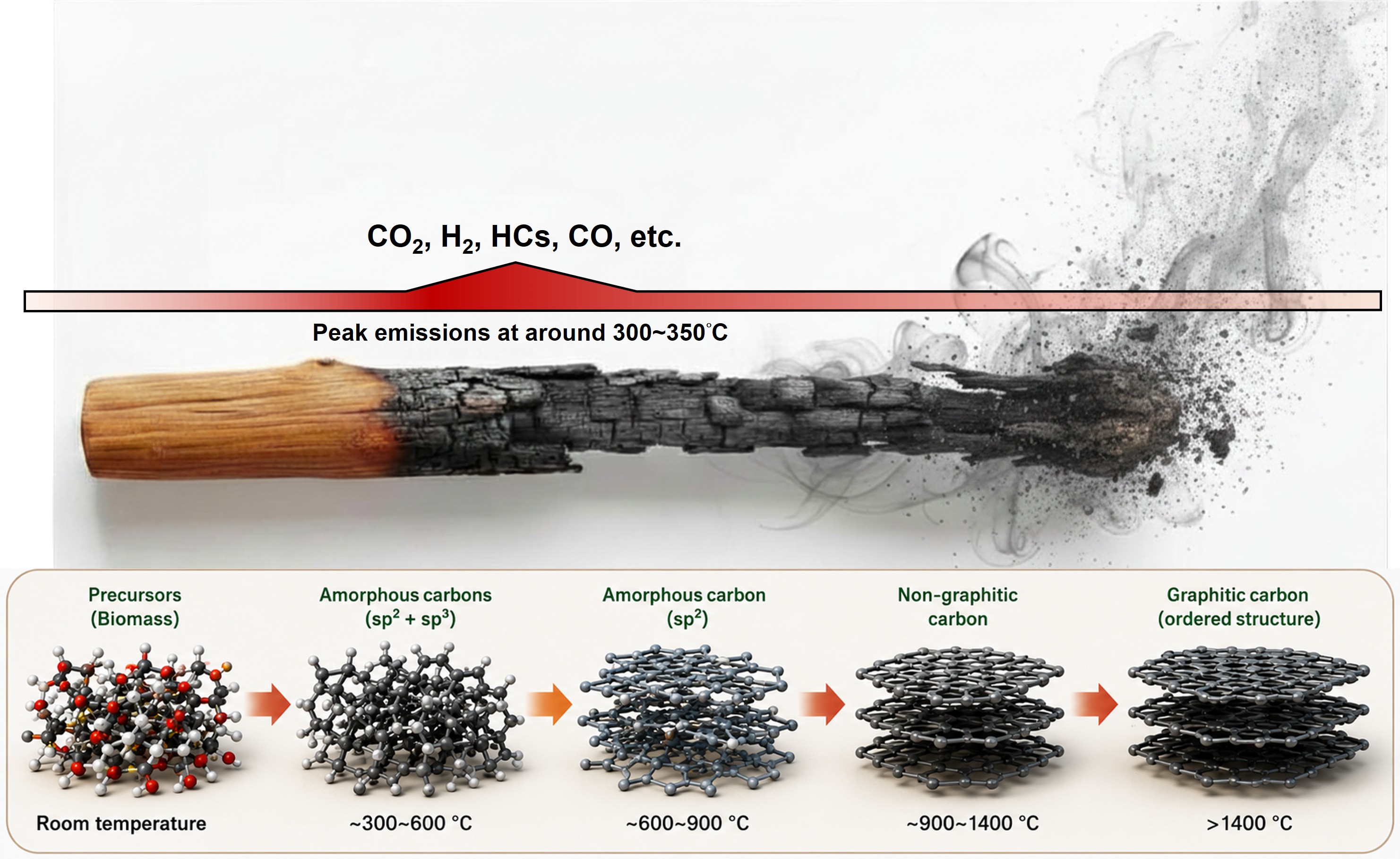
Biomass pyrolysis has attracted increasing attention as a sustainable technology for simultaneous biochar production, renewable energy recovery, and carbon sequestration. This mini review discusses the carbon-negative characteristics of biochar, gas emissions during biomass pyrolysis, and the influence of pyrolysis conditions on syngas composition and carbon structural evolution. During pyrolysis, biomass undergoes devolatilization, deoxygenation, aromatization, and graphitization, producing gaseous products such as H2, CO, CO2, CH4, and light hydrocarbons together with stable carbonaceous residues. Elevated pyrolysis temperatures generally enhance the formation of combustible gases, particularly H2 and CO, while reducing oxygenated gases such as CO2 due to intensified secondary cracking and deoxygenation reactions. Simultaneously, carbon structures progressively transform from disordered precursor molecules into aromatic and graphitic domains with improved physicochemical stability. Biomass species, reactor configuration, carrier gas atmosphere, and thermal conditions significantly affect gas evolution behavior and carbon conversion efficiency. Overall, biomass pyrolysis demonstrates strong potential for carbon-neutral energy production, greenhouse gas mitigation, and development of sustainable carbon materials within circular bioeconomy systems.
- Open Access
- Review
Carbon-Negative Characteristics of Biochar and Gas Emissions during Biomass Pyrolysis: A Mini Review
Author Information
Received: 29 May 2026 | Revised: 29 Aug 2026 | Accepted: 21 Sep 2026 | Published: 29 Sep 2026
Abstract
Graphical Abstract
Keywords
biochar | pyrolysis | greenhouse gases | air pollution | carbon neutrality | carbon sequestration
References
- 1.
Antal, M.J.; Grønli, M. The art, science, and technology of charcoal production. Ind. Eng. Chem. Res. 2003, 42, 1619–1640. https://doi.org/10.1021/ie0207919.
- 2.
Gui, X.; Xu, X.; Zhang, Z.; et al. Biochar-amended soil can further sorb atmospheric CO2 for more carbon sequestration. Commun. Earth Environ. 2025, 6, 5. https://doi.org/10.1038/s43247-024-01985-5.
- 3.
Shyam, S.; Ahmed, S.; Joshi, S.J.; et al. Biochar as a Soil amendment: Implications for soil health, carbon sequestration, and climate resilience. Discov. Soil 2025, 2, 18. https://doi.org/10.1007/s44378-025-00041-8.
- 4.
Hsu, C.J.; Cheng, Y.H.; Chung, A.; et al. Using recoverable sulfurized magnetic biochar for active capping to remediate multiple heavy metal contaminated sediment. Environ. Pollut. 2023, 316, 120555. https://doi.org/10.1016/j.envpol.2022.120555.
- 5.
Yan, K.; Yang, X.; Yuan, Q. Biochar for carbon-negative hydrogen production from fossil fuel reservoirs. J. Clean. Prod. 2025, 505, 145463. https://doi.org/10.1016/j.jclepro.2025.145463.
- 6.
Gaurav, S.; Diptanu, B.; Mehta, C.M.; et al. Effects of biochar amendment at various soil depths on maize roots and growth indices. Sci. Rep. 2025, 15, 26310. https://doi.org/10.1038/s41598-025-09218-1.
- 7.
Yang, Y.; Bu, J.; Tiong, Y.W.; et al. Enhanced thermophilic dark fermentation of hydrogen production from food waste by Fe-modified biochar. Environ. Res. 2024, 244, 117946. https://doi.org/10.1016/j.envres.2023.117946.
- 8.
Woolf, D.; Amonette, J.E.; Street-Perrott, F.A.; et al. Sustainable biochar to mitigate global climate change. Nat. Commun. 2010, 1, 56. https://doi.org/10.1038/ncomms1053.
- 9.
Shen, Y.; Ma, D.; Ge, X. CO2-looping in biomass pyrolysis or gasification. Sustain. Energy Fuels 2017, 1, 1700–1729. https://doi.org/10.1039/c7se00279c.
- 10.
Devi, M.; Rawat, S.; Sharma, S. A comprehensive review of the pyrolysis process: From carbon nanomaterial synthesis to waste treatment. Oxf. Open Mater. Sci. 2021, 1, itab014. https://doi.org/10.1093/oxfmat/itab014.
- 11.
Biswal, B.K.; Balasubramanian, R. Use of biomass-derived biochar as a sustainable material for carbon sequestration in soil: Recent advancements and future perspectives. Npj Mater. Sustain. 2025, 3, 26. https://doi.org/10.1038/s44296-025-00066-8.
- 12.
Zhang, S.; Wang, S.; Zhang, J.; et al. Research on the application of biochar in carbon sequestration: A bibliometric analysis. Energies 2025, 18, 2745. https://doi.org/10.3390/en18112745.
- 13.
Lehmann, J.; Joseph, S. Biochar for Environmental Management: Science, Technology and Implementation, 3nd ed. Routledge, Oxfordshire, UK, 2015.
- 14.
Joseph, S.; Cowie, A.L.; Van Zwieten, L.; et al. How biochar works, and when it doesn’t: A review of mechanisms controlling soil and plant responses to biochar. GCB Bioenergy 2021, 13, 1731–1764. https://doi.org/10.1111/gcbb.12885.
- 15.
Li, H.; Azzi, E.S.; Sundberg, C.; et al. Can inert pool models improve predictions of biochar long-term persistence in soils? Geoderma 2024, 452, 117093. https://doi.org/10.1016/j.geoderma.2024.117093.
- 16.
Ntonta, S.; Mathew, I.; Zengeni, R.; et al. Crop residues differ in their decomposition dynamics: Review of available data from world literature. Geoderma 2022, 419, 115855. https://doi.org/10.1016/j.geoderma.2022.115855.
- 17.
Divyangkumar, N.; Panwar, N.L.; Agrawal, C.; et al. Cradle-to-gate analyses of biochar produced from agricultural crop residues by vacuum pyrolysis. Clean Energy 2024, 8, 1–15. https://doi.org/10.1093/ce/zkae069.
- 18.
Kavindi, G.A.G.; Tang, L.; Sasaki, Y. Assessing GHG Emission Reduction in Biomass-Derived Biochar Production via Slow Pyrolysis: A Cradle-to-gate LCA Approach. Resour. Conserv. Recycl. 2025, 212, 107900. https://doi.org/10.1016/j.resconrec.2024.107900.
- 19.
Raj, R.S.; Jain, S.; Sharma, A.K.; et al. Biochar production from rice husk: A comparative life cycle assessment of grid, biomass, and solar-powered pyrolysis. Energies 2026, 19, 1344. https://doi.org/10.3390/en19051344.
- 20.
Arena, N.; Lee, J.; Clift, R. Life Cycle Assessment of activated carbon production from coconut shells. J. Clean. Prod. 2016, 125, 68–77. https://doi.org/10.1016/j.jclepro.2016.03.073.
- 21.
Hjaila, K.; Baccar, R.; Sarrà, M.; et al. Environmental impact associated with activated carbon preparation from olive-waste cake via life cycle assessment. J. Environ. Manag. 2013, 130, 242–247. https://doi.org/10.1016/j.jenvman.2013.08.061.
- 22.
Liao, M.; Kelley, S.; Yao, Y. Generating energy and greenhouse gas inventory data of activated carbon production using machine learning and kinetic based process simulation. ACS Sustain. Chem. Eng. 2019, 8, 1252–1261. https://doi.org/10.1021/acssuschemeng.9b06522.
- 23.
Saleem, J.; Khalid Baig Moghal, Z.; Tahir, F.; et al. Life cycle assessment of high value activated carbon production based on mass and functional performance metrics. Sci. Rep. 2025, 15, 32797. https://doi.org/10.1038/s41598-025-16300-1.
- 24.
Sepúlveda-Cervantes, C.V.; Soto-Regalado, E.; Rivas-García, P.; et al. Technical-environmental optimisation of the activated carbon production of an agroindustrial waste by means response surface and life cycle assessment. Waste Manag. Res. J. a Sustain. Circ. Econ. 2018, 36, 121–130. https://doi.org/10.1177/0734242x17741680.
- 25.
Tobarameekul, P.; Worathanakul, P. Heat management options to reduce carbon footprint of green zeolite faujasite synthesis from rice husk ash. Thai Environ. Eng. J. 2021, 35, 59–68.
- 26.
Bahmei, F.; Bahramifar, N.; Ghasemi, S.; et al. Comparison of environmental impacts in the production of graphene from biomass waste and the Hummers’ method. J. Clean. Prod. 2025, 497, 145145. https://doi.org/10.1016/j.jclepro.2025.145145.
- 27.
Escobar-Hernandez, H.U.; Quan, Y.; Papadaki, M.I.; et al. Life cycle assessment of metal–organic frameworks: Sustainability study of zeolitic imidazolate framework-67. ACS Sustain. Chem. Eng. 2023, 11, 4219–4225. https://doi.org/10.1021/acssuschemeng.2c07276.
- 28.
Grande, C.A.; Blom, R.; Spjelkavik, A.; et al. Life-cycle assessment as a tool for eco-design of metal-organic frameworks (MOFs). Sustain. Mater. Technol. 2017, 14, 11–18. https://doi.org/10.1016/j.susmat.2017.10.002.
- 29.
Luo, H.; Cheng, F.; Huelsenbeck, L.; et al. Comparison between conventional solvothermal and aqueous solution-based production of UiO-66-NH2: Life cycle assessment, techno-economic assessment, and implications for CO2 capture and storage. J. Environ. Chem. Eng. 2021, 9, 105159. https://doi.org/10.1016/j.jece.2021.105159.
- 30.
Espada, J.J.; Rodríguez, R.; de la Peña, A.; et al. Environmental impact analysis of surface printing and 3D inkjet printing applications using an imine based covalent organic framework: A life cycle assessment study. J. Clean. Prod. 2023, 395, 136381. https://doi.org/10.1016/j.jclepro.2023.136381.
- 31.
Enebe, M.C.; Ray, R.L.; Griffin, R.W. The impacts of biochar on carbon sequestration, soil processes, and microbial communities: A review. Biochar 2025, 7, 107. https://doi.org/10.1007/s42773-025-00499-3.
- 32.
Islam, M.U.; Jiang, F.; Guo, Z.; et al. Does biochar application improve soil aggregation? A meta-analysis. Soil Tillage Res. 2021, 209, 104926. https://doi.org/10.1016/j.still.2020.104926.
- 33.
Sun, F.; Lu, S. Biochars improve aggregate stability, water retention, and pore-space properties of clayey soil. J. Plant Nutr. Soil Sci. 2014, 177, 26–33. https://doi.org/10.1002/jpln.201200639.
- 34.
Lv, P.; Huan, Q.; Song, M. A review of biochar toward carbon neutrality: Production optimization and carbon sequestration potential assessment. Carbon Neutral Technol. 2026, 2, 100019. https://doi.org/10.1016/j.cnt.2026.100019.
- 35.
Steiner, C. Biochar: Mitigation of Climate Change and Soil Restoration; Deutsche Gesellschaft für Internationale Zusammenarbeit (GIZ): Eschborn, Germany, 2010. https://d-nb.info/1097402185/34.
- 36.
Radojević, M.; Janković, B.; Stojiljković, D.; et al. Improved TGA-MS measurements for evolved gas analysis (EGA) during pyrolysis process of various biomass feedstocks. Syngas energy balance determination. Thermochim. Acta 2021, 699, 178912. https://doi.org/10.1016/j.tca.2021.178912.
- 37.
Zhang, S.; Dong, Y.; Qi, G. TG-GC-MS study of pyrolysis characteristics and kinetic analysis during different kinds of biomass. Int. J. Hydrogen Energy 2023, 48, 11171–11179. https://doi.org/10.1016/j.ijhydene.2022.11.333.
- 38.
Schuepfer, D.B.; Badaczewski, F.; Guerra-Castro, J.M.; et al. Assessing the structural properties of graphitic and non-graphitic carbons by Raman spectroscopy. Carbon 2020, 161, 359–372. https://doi.org/10.1016/j.carbon.2019.12.094.
- 39.
MP, D.; Misra, M.; Mohanty, A.K. Recent advances on value-added biocarbon preparation by the pyrolysis of renewable and waste biomass, their structure and properties: A move toward an ecofriendly alternative to carbon black. Environ. Sci. Adv. 2023, 2, 1282–1301. https://doi.org/10.1039/d3va00107e.
- 40.
Dey, S.C.; Lower, L.; Vook, T.; et al. Catalytic graphitization of pyrolysis oil for anode application in lithium-ion batteries. Green Chem. 2024, 26, 8840–8853. https://doi.org/10.1039/d4gc01647e.
- 41.
Ye, J.; Peng, Q.; Li, D.; et al. Multimodal optimization of synergistic aluminum/nickel catalytic pyrolysis for enhanced hydrogen production from tobacco straw. Ind. Crops Prod. 2025, 237, 122258. https://doi.org/10.1016/j.indcrop.2025.122258.
- 42.
Gao, N.; Liu, B.; Li, A.; et al. Continuous pyrolysis of pine sawdust at different pyrolysis temperatures and solid residence times. J. Anal. Appl. Pyrolysis 2015, 114, 155–162. https://doi.org/10.1016/j.jaap.2015.05.011.
- 43.
Desai, H.; Dutta, R.; Panicker, T.F.; et al. Catalytic co-pyrolysis of waste pistachio nutshells and polystyrene: Optimisation of parameters, and catalyst loading on the products yield and composition. RSC Adv. 2025, 15, 44691–44710. https://doi.org/10.1039/d5ra06092c.
- 44.
Amrullah, A.; Alfiannur, M.; Kusuma, R.B.; et al. Synergistic production of fuel-grade hydrocarbons and carbon-rich biochar from peat soil–plastic waste co-pyrolysis. Results Eng. 2026, 29, 109154. https://doi.org/10.1016/j.rineng.2026.109154.
- 45.
Yang, Z.; Kumar, A.; Huhnke, R.L.; et al. Pyrolysis of eastern redcedar: Distribution and characteristics of fast and slow pyrolysis products. Fuel 2016, 166, 157–165. https://doi.org/10.1016/j.fuel.2015.10.101.
- 46.
Wang, M.; Tafti, N.D.; Wang, J.J.; et al. Effect of pyrolysis temperature on Si release of alkali-enhanced Si-rich biochar and plant response. Biochar 2021, 3, 469–484. https://doi.org/10.1007/s42773-021-00112-3.
- 47.
Zhang, C.; Zhang, Z.; Zhang, L.; et al. Evolution of the functionalities and structures of biochar in pyrolysis of poplar in a wide temperature range. Bioresour. Technol. 2020, 304, 123002. https://doi.org/10.1016/j.biortech.2020.123002.
- 48.
Zou, X.; Debiagi, P.; Amjed, M.A.; et al. Impact of high-temperature biomass pyrolysis on biochar formation and composition. J. Anal. Appl. Pyrolysis 2024, 179, 106463. https://doi.org/10.1016/j.jaap.2024.106463.
- 49.
Kabir, G.; Hameed, B.H. Recent progress on catalytic pyrolysis of lignocellulosic biomass to high-grade bio-oil and bio-chemicals. Renew. Sustain. Energy Rev. 2017, 70, 945–967. https://doi.org/10.1016/j.rser.2016.12.001.
- 50.
Kan, T.; Strezov, V.; Evans, T.; et al. Catalytic pyrolysis of lignocellulosic biomass: A review of variations in process factors and system structure. Renew. Sustain. Energy Rev. 2020, 134, 110305. https://doi.org/10.1016/j.rser.2020.110305.
- 51.
Dunnigan, L.; Morton, B.J.; Ashman, P.J.; et al. Emission characteristics of a pyrolysis-combustion system for the co-production of biochar and bioenergy from agricultural wastes. Waste Manag. 2018, 77, 59–66. https://doi.org/10.1016/j.wasman.2018.05.004.
- 52.
Hamidu, I.; Afotey, B.; Kwakye-Awuah, B.; et al. Synthesis of silica and silicon from rice husk feedstock: A review. Heliyon 2025, 11, e42491. https://doi.org/10.1016/j.heliyon.2025.e42491.
- 53.
Wibowo, W.; Pranolo, S.; Cahyono, R.; et al. Catalytic slow pyrolysis of rice husk pellets with rice husk ash catalyst using macro-TGA: Apparent kinetics and product characterization. J. Renew. Energy Environ. 2025, 12, 19–32. https://doi.org/10.30501/jree.2025.447645.1870.
- 54.
Chambers, E.; Hassall, M.; Johnson, D.; et al. From bamboo to biochar: A critical review of bamboo pyrolysis conditions and products with a focus on relevance to the developing world. RSC Sustain. 2025, 3, 2712–2732. https://doi.org/10.1039/d4su00800f.
- 55.
Sarkar, J.K.; Wang, Q. Different pyrolysis process conditions of South Asian waste coconut shell and characterization of gas, bio-char, and bio-oil. Energies 2020, 13, 1970. https://doi.org/10.3390/en13081970.
- 56.
El-Sayed, S.A. Chemical products yielded from different pyrolysis processes of rice waste residues: A comprehensive review. Biomass Convers. Biorefinery 2025, 15, 20615–20655. https://doi.org/10.1007/s13399-025-06624-3.
- 57.
Fouladi, S.; Mahmoud, K.A.; Al-Ansari, T.; et al. Techno-economic feasibility of biochar production from local biomass resources in Qatar: A review. Resour. Conserv. Recycl. Adv. 2026, 31, 200370. https://doi.org/10.1016/j.rcradv.2026.200370.
- 58.
Tang, Y.; Ford, J.; Cockerill, T.T. Environmental and economic assessment of biochar production systems from agricultural residues. Biochar 2026, 8, 24. https://doi.org/10.1007/s42773-025-00527-2.


This work is licensed under a Creative Commons Attribution 4.0 International License.

 Suite 4002 Level 4, 447 Collins Street, Melbourne, Victoria 3000, Australia
 General Inquiries: info@sciltp.com